Frank Ricard

1K posts

Frank Ricard banner
Frank Ricard

Frank Ricard

@NovusOrderM

Katılım Mayıs 2011
697 Takip Edilen480 Takipçiler
M
M@011235813H·
@MoonlitMonkey69 @NovusOrderM @Teknium Yep, quite a pickle! This embarrassing usg reaction will be swept under rug. I don’t even see this exiting our AI bubble to the mainstream; but let’s see if Big AI PR/lobbyists spin it up again. I am guessing not.
English
1
0
1
9
Frank Ricard
Frank Ricard@NovusOrderM·
@CtrlAltDwayne Why? This happens with every new company ushering in a new technology. Legit copy paste.
English
0
0
0
147
Avi
Avi@AvrosPentos·
@NovusOrderM @LukeGromen @SOBX305 Your folly here is comparing the lifespan of a human to the resilience of nations. One is measured in decades, and the other in centuries. Delve beneath the superficial, and time reveals the rhythm.
English
1
0
0
13
Frank Ricard
Frank Ricard@NovusOrderM·
To ban/block frontier Chinese open sourced models, you need to stop distillation. The only way to stop distillation, that I can think of, is lock the frontier models down. Security clearance to gain access. Period. We’re already seeing this via recent USG actions against fable. It’s only going to get more intense. If someone else has a better, more comprehensive, solution please lmk
Chubby♨️@kimmonismus

„sanctions and Entity List designations will be on the table.“ Yeah, bans on Chinese open source are coming. Pretty sure at this point. If Scott Bessent, who pushed through similar measures against Anthropic, raises this as a possibility, we know where things are headed.

English
0
0
1
90
Frank Ricard retweetledi
Trade Whisperer
Trade Whisperer@TradexWhisperer·
$GOOGL Google Cloud’s unfulfilled backlog hit $514 billion this quarter, a massive increase from the $106 billion backlog in Q2 2025. Nearly 5x in a year. That is revenue under contract, not a pipeline forecast. $MU $SKHY $DRAM $NVDA
English
33
12
222
26.8K
Frank Ricard
Frank Ricard@NovusOrderM·
Remember, Progress = discovery + invention + innovation. Progress is gated by intelligence. Solve intelligence, and you solve everything else. This is most likely not a once-in-a-lifetime technological revolution. Rather, it's most likely one of the big ones. Think Agriculture or the Industrial Revolution. And to be quite frank, given that this technology will solve progress itself, it may be the largest tech revolution in human history. In fact, debatably, it may be the largest tech revolution humans will EVER go through. If the above is true, ask yourself what future tech change could be larger than the one that opened the door to it. Think big picture. Yes, you are probably alive during the most important technological shift ever in human history. Yes, that is statistically improbable. Yes, you are lucky enough (or maybe unlucky enough, we'll see) to be alive for it. The world is about to get really, really, extremely weird. Buckle up.
The Kobeissi Letter@KobeissiLetter

We are in the midst of the biggest technological revolution in modern history. Alphabet, $GOOGL, just raised their full-year 2026 CapEx guidance to up to $205 billion. This annual CapEx budget alone is larger than the market cap of all but 85 companies in the world. The Magnificent 7 will soon spend over $1 trillion in combined annual CapEx. This is a once-in-a-lifetime technological revolution.

English
0
0
0
105
Frank Ricard
Frank Ricard@NovusOrderM·
@011235813H @Teknium Had a great back and forth on this earlier today. He outlined the hypocrisy re: IP theft using examples from the 19th century. Good stuff. He then clarified in a subsequent post his overall position. It was an insightful exchange. x.com/NovusOrderM/st… x.com/LukeGromen/sta…
Luke Gromen@LukeGromen

What China is doing/has done is exactly what Alexander Hamilton & the US' state-sponsored theft did vis a vis British trade secrets 👇 Not saying it's right, just saying "Stop being naive, start paying attention to history, end post-71 USD reserve status to stop this, & compete"

English
0
0
3
54
Frank Ricard
Frank Ricard@NovusOrderM·
@Teknium @011235813H Eh, I disagree that US policymakers and industry leaders should just roll over and let it happen. That would be a severe disservice to my children and future generations, even if our complaints and ultimate actions would be considered hypocritical.
English
2
0
0
42
Frank Ricard
Frank Ricard@NovusOrderM·
And for my children's and future generations' sake - and all the benefits living in the US has provided all of us - I would hope that US policymakers and industry leaders would put up a defense and fight against this behavior, rather than accepting it because prior generations did it 200 years ago. The logic is seemingly similar to the idea that we should pay reparations because prior generations owned slaves - logic I do not agree with. But I get your overall point - we shouldn't be surprised that a competing power is using similar techniques that we employed early on in our nation's history. At least, I assume that's the point you're making here?
English
2
0
1
61
Luke Gromen
Luke Gromen@LukeGromen·
@NovusOrderM @SOBX305 2/ Agree it was a US domestic policy choice, but this is the final part of that domestic policy choice.
English
2
0
18
6.9K
Frank Ricard
Frank Ricard@NovusOrderM·
Going back 200 years to draw a comparison is quite something. That said, tough to compare the various examples from the 1800s to China's state-orchestrated, whole-of-society Thousand Talents Program, espionage, and forced JV tech transfers backed by the CCP. Maybe I'm missing something here, but I can't find anything about a whole-of-society level, centrally coordinated IP theft apparatus in the 1800s comparable to modern China. Please share if you have stuff on that for me to read up on! As for your second point, I would say that investor and policy failure shouldn't excuse or justify current Chinese behavior. Short-term profit motives and offshoring hurt US workers for sure, but that was a domestic policy choice. Again, I don't see how that legitimizes the CCP's state-directed theft.
English
2
0
1
410
Luke Gromen
Luke Gromen@LukeGromen·
@NovusOrderM @SOBX305 How's this different than what US did to the UK in the 1800s? And why didn't investors stand up for US working and middle classes when China was doing this to the US working and middle class? (B/c it was good for short term profits.) Now the devil's here to take the hindmost
English
1
0
19
802
Frank Ricard
Frank Ricard@NovusOrderM·
@LukeGromen @SOBX305 I wouldn't call these cases pro-American. x.com/NovusOrderM/st…
Frank Ricard@NovusOrderM

Well, as it relates to distillation. 1. Anthropic releases Mythos Preview in April 2026 2. Anthropic sends a letter in June 2026 to US officials accusing Alibaba of approximately 30 million exchanges with its model, using thousands of fraudulent accounts. 3. Kimi K-3 is released in July 2026 with similar frontier capabilities. Alibaba holds an approximate 36% stake in Moonshot AI. Quite the coincidence. As it relates to historic patterns of the same strategy, it's not a coincidence that China's industrial system has repeatedly combined 1) acquisition of foreign technology, coercively or illegally, 2) compression of the time and cost required for independent research and development, 3) state-supported financing, procurement, and industrial policy and capacity expansion, and 4) aggressive price competition in domestic and international markets. 2024 USTR concluded that China's tech-transfer practices persisted, that state-supported cyber theft continued, and that these practices cost American companies and consumers billions of dollars. Case examples: 1. Sinovel and American Superconductor case. A federal jury convicted China-based Sinovel of stealing American Superconductor’s wind-turbine control software. 2. Dupont titanium-dioxide technology case. Federal prosecutors proved a conspiracy to transfer DuPont’s proprietary chloride-route titanium-dioxide process to Chinese state-owned companies. 3. DuPont Pioneer and Monsanto seed lines case. A defendant connected to the Chinese agricultural company Dabeinong pleaded guilty in a conspiracy involving the theft of proprietary inbred corn seeds from DuPont Pioneer and Monsanto fields 4. Chinese intelligence targeting GE Aviation. A Chinese Ministry of State Security officer was convicted of attempting to obtain proprietary aviation information from U.S. companies, including GE Aviation. 5. Google. In January 2026, a former Google engineer was convicted of stealing thousands of pages of confidential material concerning AI supercomputing and chip infrastructure while affiliating himself with two Chinese technology ventures. Prosecutors presented evidence that he intended to reproduce or modify Google’s technology for Chinese entities. 6. Motorola Solutions / Hytera Communications. Beginning in 2006, China-based Hytera recruited Motorola engineers and directed them to take Motorola source code and other trade secrets covering digital mobile radio technology. Motorola had developed the technology through years of research and engineering. Hytera pleaded guilty to conspiracy to steal trade secrets. In March 2026, it was fined $50 million and placed on probation. 7. Coca-Cola / Weihai Jinhong Group. Chemist Xiaorong “Shannon” You obtained proprietary formulations for bisphenol-A-free—or BPA-free—coatings used inside beverage and food cans while working at Coca-Cola and Eastman Chemical. You was convicted of economic espionage, possession of stolen trade secrets and related offenses and was sentenced to 14 years in prison. 8. GlaxoSmithKline / Renopharma. Several individuals associated with GlaxoSmithKline transferred confidential pharmaceutical and biotechnology information to Renopharma, a company created to develop drugs in China. The economic value was potentially enormous: the Department of Justice noted that these kinds of products typically cost more than $1 billion each to research and develop. At least four defendants pleaded guilty, while another defendant was convicted 9. GE turbine tech / Chinese firms, universities, and government-linked industrial programs. Xiaoqing Zheng, a longtime GE Power engineer, was convicted of conspiring to steal GE trade secrets involving turbine-sealing technology and other ground-based and aviation turbine technologies. Trial evidence showed that Zheng and collaborators in China intended the information to benefit the People’s Republic of China and Chinese organizations researching, manufacturing and developing turbine components. Zheng was also identified as a participant in China’s Thousand Talents Program. Following a jury conviction, he was sentenced in 2023 to two years in prison. 10. Edwards Lifesciences / Medtronic / Chinese Medical-device company. Engineer Wenfeng Lu stole confidential information and trade secrets from two American medical-device companies that developed products used to treat cardiac and vascular conditions. While still working for the U.S. companies, Lu traveled repeatedly to China, obtained financing and prepared to open a Chinese company that would manufacture vascular-treatment devices using the stolen American technology. He applied for and was selected to receive approximately $328,000 in Chinese government funding, along with three years of free laboratory space in a Chinese technology park. Prosecutors described the program as one designed to attract overseas scientists and intellectual property to develop Chinese biomedical technology. Lu pleaded guilty to six trade-secret offenses and was sentenced to 27 months in prison. He was arrested before departing for China, preventing the proposed venture from being fully implemented. Just to name a few... Appreciate the comment, honestly. A few of these cases I was not familiar with until having AI dig into it and reading up on them. It's broader than I originally anticipated.


English
1
0
0
662
Luke Gromen
Luke Gromen@LukeGromen·
@SOBX305 Isn’t China doing what America does pro American?
English
4
0
28
1.5K
Frank Ricard retweetledi
Director Michael Kratsios
Director Michael Kratsios@mkratsios47·
We have information that Moonshot AI distilled Anthropic’s Fable for the development of its K3 model. To do this they developed a sophisticated internal platform to conduct large scale distillation against U.S. models, allowing them to quickly switch between multiple methods of access to avoid detection. Moonshot AI has also acquired GB300-equipped servers and has accessed GB300s in Thailand, likely to train its AI models.   The United States strongly supports the free and fair development of AI, including a thriving competitive ecosystem that spans frontier models, specialized systems, open-source frameworks, and open-weight models. Legitimate AI distillation used to create smaller, more efficient models plays a vital role in this open innovation ecosystem. However, large-scale, covert industrial distillation aimed at stealing proprietary U.S. technology and undermining American research is unacceptable.
English
3.6K
1.2K
13.6K
6.6M
Frank Ricard retweetledi
Andrew Curran
Andrew Curran@AndrewCurran_·
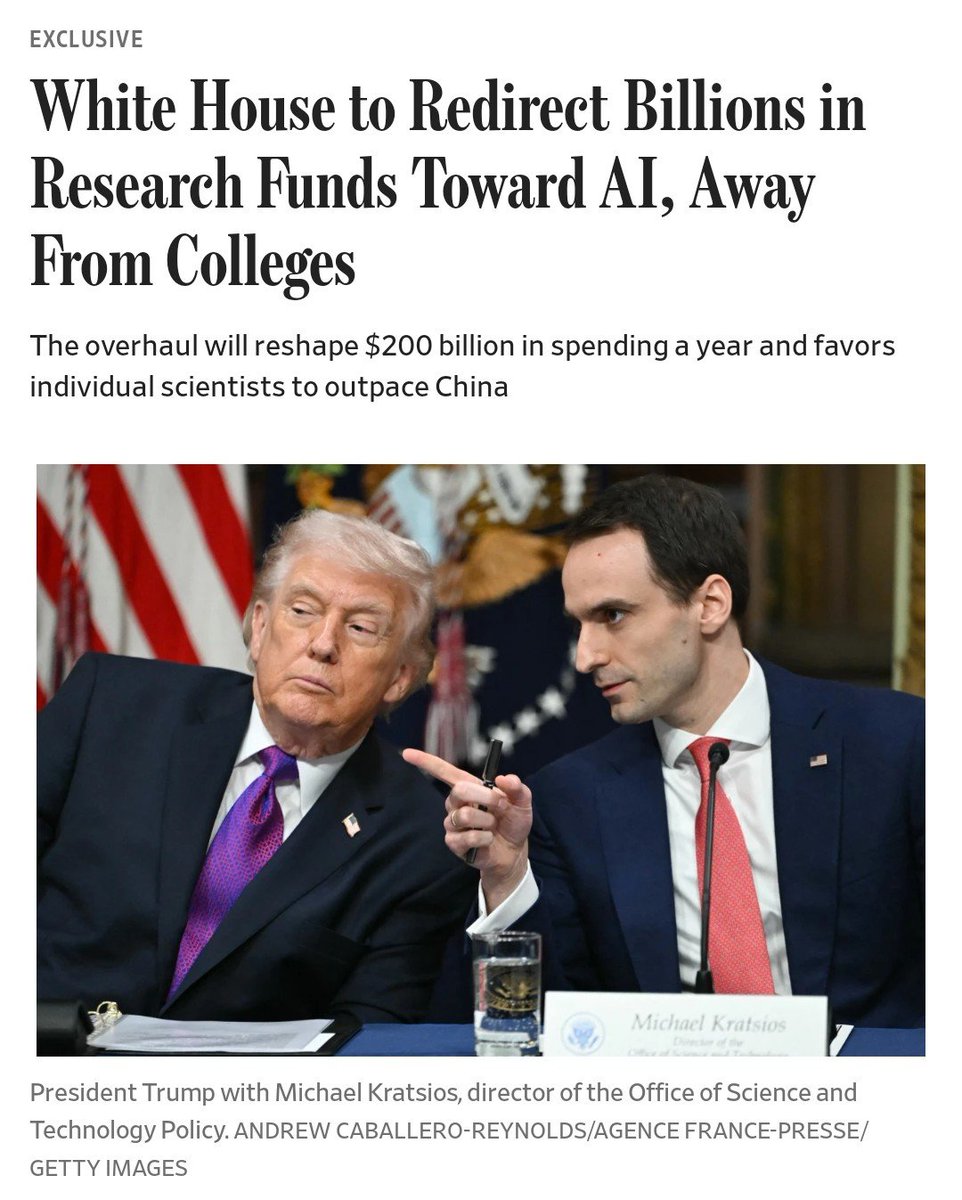
In an new report expected to be released later today the Trump administration will argue that directing federal funding towards individual researchers, and research that uses AI, will accelerate scientific progress faster than funding collages and universites.
Andrew Curran tweet media
English
149
176
2.1K
297.8K
Frank Ricard
Frank Ricard@NovusOrderM·
The US courts just ruled that it is not "ok if our companies steal IP wholesale from artists and writes..." in the Anthropic case. "Bad people from other countries". The CCP, yes. Who has a decades-long history of IP and trade-secret theft. Attached are 10 specific cases, with dozens more you can find with just a little bit of research. x.com/NovusOrderM/st…
Frank Ricard@NovusOrderM

Well, as it relates to distillation. 1. Anthropic releases Mythos Preview in April 2026 2. Anthropic sends a letter in June 2026 to US officials accusing Alibaba of approximately 30 million exchanges with its model, using thousands of fraudulent accounts. 3. Kimi K-3 is released in July 2026 with similar frontier capabilities. Alibaba holds an approximate 36% stake in Moonshot AI. Quite the coincidence. As it relates to historic patterns of the same strategy, it's not a coincidence that China's industrial system has repeatedly combined 1) acquisition of foreign technology, coercively or illegally, 2) compression of the time and cost required for independent research and development, 3) state-supported financing, procurement, and industrial policy and capacity expansion, and 4) aggressive price competition in domestic and international markets. 2024 USTR concluded that China's tech-transfer practices persisted, that state-supported cyber theft continued, and that these practices cost American companies and consumers billions of dollars. Case examples: 1. Sinovel and American Superconductor case. A federal jury convicted China-based Sinovel of stealing American Superconductor’s wind-turbine control software. 2. Dupont titanium-dioxide technology case. Federal prosecutors proved a conspiracy to transfer DuPont’s proprietary chloride-route titanium-dioxide process to Chinese state-owned companies. 3. DuPont Pioneer and Monsanto seed lines case. A defendant connected to the Chinese agricultural company Dabeinong pleaded guilty in a conspiracy involving the theft of proprietary inbred corn seeds from DuPont Pioneer and Monsanto fields 4. Chinese intelligence targeting GE Aviation. A Chinese Ministry of State Security officer was convicted of attempting to obtain proprietary aviation information from U.S. companies, including GE Aviation. 5. Google. In January 2026, a former Google engineer was convicted of stealing thousands of pages of confidential material concerning AI supercomputing and chip infrastructure while affiliating himself with two Chinese technology ventures. Prosecutors presented evidence that he intended to reproduce or modify Google’s technology for Chinese entities. 6. Motorola Solutions / Hytera Communications. Beginning in 2006, China-based Hytera recruited Motorola engineers and directed them to take Motorola source code and other trade secrets covering digital mobile radio technology. Motorola had developed the technology through years of research and engineering. Hytera pleaded guilty to conspiracy to steal trade secrets. In March 2026, it was fined $50 million and placed on probation. 7. Coca-Cola / Weihai Jinhong Group. Chemist Xiaorong “Shannon” You obtained proprietary formulations for bisphenol-A-free—or BPA-free—coatings used inside beverage and food cans while working at Coca-Cola and Eastman Chemical. You was convicted of economic espionage, possession of stolen trade secrets and related offenses and was sentenced to 14 years in prison. 8. GlaxoSmithKline / Renopharma. Several individuals associated with GlaxoSmithKline transferred confidential pharmaceutical and biotechnology information to Renopharma, a company created to develop drugs in China. The economic value was potentially enormous: the Department of Justice noted that these kinds of products typically cost more than $1 billion each to research and develop. At least four defendants pleaded guilty, while another defendant was convicted 9. GE turbine tech / Chinese firms, universities, and government-linked industrial programs. Xiaoqing Zheng, a longtime GE Power engineer, was convicted of conspiring to steal GE trade secrets involving turbine-sealing technology and other ground-based and aviation turbine technologies. Trial evidence showed that Zheng and collaborators in China intended the information to benefit the People’s Republic of China and Chinese organizations researching, manufacturing and developing turbine components. Zheng was also identified as a participant in China’s Thousand Talents Program. Following a jury conviction, he was sentenced in 2023 to two years in prison. 10. Edwards Lifesciences / Medtronic / Chinese Medical-device company. Engineer Wenfeng Lu stole confidential information and trade secrets from two American medical-device companies that developed products used to treat cardiac and vascular conditions. While still working for the U.S. companies, Lu traveled repeatedly to China, obtained financing and prepared to open a Chinese company that would manufacture vascular-treatment devices using the stolen American technology. He applied for and was selected to receive approximately $328,000 in Chinese government funding, along with three years of free laboratory space in a Chinese technology park. Prosecutors described the program as one designed to attract overseas scientists and intellectual property to develop Chinese biomedical technology. Lu pleaded guilty to six trade-secret offenses and was sentenced to 27 months in prison. He was arrested before departing for China, preventing the proposed venture from being fully implemented. Just to name a few... Appreciate the comment, honestly. A few of these cases I was not familiar with until having AI dig into it and reading up on them. It's broader than I originally anticipated.

English
1
1
1
131
Frank Ricard
Frank Ricard@NovusOrderM·
@ramez US contract law says that distillation to create a competing model is theft. Or are you saying US contract law doesn't apply here?
English
4
0
0
675
Ramez Naam
Ramez Naam@ramez·
Bessent lays out the playbook: 1. Declare distillation to be theft. 2. Find that every foreign model has distilled a US model. 3. Sanction those companies and make it harder to use their models. This is a playbook for giving people outside the US, including malicious actors, more powerful AI capabilities than Americans. It does nothing to reduce the capabilities of a cyber attacker or terrorist outside of the US. It does attempt to make life harder for American defenders.
Ed Ludlow@EdLudlow

Treasury Sec. Bessent on Fox: “This administration supports open source models, but what we do not support is IP theft. If we see, especially, that overseas models are stealing from our great companies, we have the ability to sanction them because of this theft.”

English
25
30
210
16.7K