

Nut Boult
298 posts


66+ days since the UGC Equity Regulations 2026 were notified on 13 Jan, and the Modi government is still sleeping peacefully!
General category students are committing suicide daily, yet these rules protect only one side. No committee for us, no punishment for false complaints.
As per NCRB data, 92% of SC/ST cases are never proven in court.
Even in IITs and central universities, from 2014 to 2023, General Category student suicides are equal to or higher than reserved category suicides.
Why are merit students being villainised?
Savarna Sena mahapanchayats across Rajasthan, from Gangapur to Jaipur, are rising.
English
64 दिन बीत चुके हैं, सामान्य वर्ग आत्महत्या कर रहा है, 92% केस साबित नहीं होते, मोदी सरकार क्षीरसागर में शयन कर रही है! उदाहरण देखिए 👇🏻 और शेयर कीजिए!
हिन्दी
@abhisar_sharma You absolute hypocritical presst!tute troll! Calling Paresh Rawal an “abusive pathetic troll” for Modi bhakti? Your brain turned to gobar by Congress bootlicking & anti-Modi derangement years ago. You loved him in Naam, Arjun, Hera Pheri as a kid, now jealous of a real patriot? Keep Swaroop Sampat ji out of your garbage.
GET WELL SOON from Modi Derangement Syndrome, fake tears hypocrite! Shame on you 😂
English
What an absolute idiot. These are guys who were part of our growing up. I liked this guy so much in Naam ,Arjun,Here pheri. Look what he has turned himself into ...an abusive pathetic troll. Forget him, Swaroop sampatji was a part of times when we were growing up. Modi bhakti me inka dimaag GOBAR ho gaya hai. GET WELL SOON @SirPareshRawal shame on you.
Paresh Rawal@SirPareshRawal
Your job as a stupid reporter is secured . Nobody wants it.
English
Today's stock market crash should disturb every Indian who cares about our economic future. The Sensex plummeted over 2,500 points, Nifty dropped sharply, and more than Rs 11 lakh crore in investor wealth was erased in hours. All because of rising crude oil prices amid West Asia tensions and the US Federal Reserve's stance.
What hurts most is that ordinary retail investors and the middle class take the biggest hit, while the system that promised growth leaves them exposed. We keep celebrating 'India's growth story,' but events like this reveal the cracks – over-dependence on imports, insufficient buffers, and policies that fail to shield us from global headwinds.
If even half the energy spent on optics was directed towards real self-reliance in energy and manufacturing, we wouldn't be here again. This isn't just a bad day on Dalal Street. It's a symptom of deeper issues we refuse to fix.
India's builders and savers deserve stability, not repeated shocks.
English
As a proud Hindu, I have no problem saying this openly: VVIP culture in temples is a disgrace to dharma.
A temple is the house of God, not a private lounge for the rich, powerful, connected, or politically important. The moment one devotee gets comfort, time, access, and respect because of status, while ordinary bhakts are pushed, rushed, shouted at, and treated without dignity, the spirit of worship is already damaged.
What hurts most is not just the special treatment for VVIPs, but the inhuman treatment of common devotees. People stand for hours with faith in their hearts, only to be handled like a burden. This is unacceptable. In front of Bhagwan, there should be no VIP and no ordinary person. Only devotees.
If crowd management is difficult, then fix the system properly with tokens, time slots, disciplined queues, and equal rules for everyone. But do not insult the common Hindu while pampering the influential.
For too long, we have normalized this discrimination in the name of tradition, management, and protocol. It is wrong. It has always been wrong. And it must end.
English
Both videos are from Baba Baidyanath Dhaam, Deoghar. The first shows how common devotees are treated, and the second shows how VIPs are treated.
This is same in most of the famous temples. This difference must end. You can’t expect unity and brotherhood in a religion if the rich and powerful receive pampered treatment at temples while ordinary devotees are treated like an inconvenience.
I understand that the sheer number of devotees makes it difficult to give everyone ample time, but things can still be managed with dignity, through better crowd management, token or time-slot systems, clearly marked queues, and strict enforcement of the same rules for everyone. Whatever is decided for the common people, the same rules should apply to the rich and powerful as well.
English
Read this before you ask why India’s brightest minds lose faith in India.
Anant Mittal, known as OnRoad Indian, was not just another content creator with a camera and big words.
Public reporting in 2023 showed he had already built a bio-refinery pilot in Roorkee to process e-waste, with capacity of about 150 kg a day, using a green extraction approach for precious metals from discarded electronics.
This was not theory. This was real innovation with national value.
According to Mittal’s public account, he approached IIT Roorkee in 2021 for lab access on a pay-per-use basis, got support tied to a government-backed project, waited through funding delays, and meanwhile poured roughly ₹50 to ₹60 lakh of his own savings into building the work forward.
Then comes the part that should disturb every young innovator in this country:
Mittal alleges that once results started coming, pressure began over patent credit, the project was later cancelled, his setup was dismantled, and the promise of institutional support turned into silence and destruction.
Whether every allegation is proven in full through a formal inquiry or not, one truth already feels painfully familiar to millions of Indians:
in this country, talent often has to fight the system before it can fight the market.
We keep asking why founders, researchers, and builders leave India.
Maybe because too often the biggest threat is not failure, competition, or lack of ideas.
Maybe the biggest threat is a system where access depends on power, ownership feels fragile, and the person who builds something can still end up the most unprotected person in the room.
If even half of this story is true, then the real scandal is not just what happened to one innovator.
The real scandal is what India keeps doing to its own builders.
English
@grok Generate a short video, not an image, by animating the two people or characters from the original image attached in this thread.
Make them dance naturally, smoothly, and gracefully, inspired by the vibe of “Afghan Jalebi (Ya Baba) – Mashook Farebi.” The movements should be realistic, fluid, and well synchronized with the beat. Avoid any exaggerated or unnatural dancing.
Use image-to-video mode so their appearance, outfits, and facial expressions remain consistent with the original photo.
The video should be 8 to 10 seconds long, with natural motion and proper audio synchronization if possible.
If video generation is not available or there are any limitations, clearly confirm that instead of generating a still image.
English
@AtriNeeraj Hi @grok, make the two dance on the song ‘Afghan jalebi, Mashook farebi’. Don’t make it wild, keep it natural.
English


@grok Generate a short video (not an image) of the two people or characters from the original image dancing naturally and smoothly to the full song “Afghan Jalebi (Ya Baba)” – Mashook Farebi.
Keep every movement realistic, graceful, fluid, and perfectly on the beat. No wild, exaggerated, or crazy dancing at all, just elegant and natural rhythm.
English
Nora Fatehi's new song "Sarke" from KD The Devil has sparked major controversy with its lyrics, which many are calling out for being overly suggestive and crossing lines of decency. Lines like "Pahle Uthale, Ander Wo Dale / Neeche Ek Boond Na Girae / Khali Kar Ke Nikale / Mujh Pe Na Girana Mujhe Lagta Hai Dar / Bhed Khul Jaae Na Sambhal Ke Jaana Ghar / Choosega ya chatega, jo karega kar" seem to rely on double meanings that feel inappropriate for mainstream audiences.
As someone who enjoys Bollywood music, I'm disappointed. This feels like a step back from empowering content. We don't expect anything from them but only vulgarity and agendas.
English
While this hike in honorariums for purohits and muezzins to ₹2,000/month sounds noble, it's just another cynical freebie from Mamata Banerjee's TMC to buy votes ahead of polls, adding to West Bengal's fiscal mess. TMC's Lakshmir Bhandar doles out ₹1,000-1,200/month to women, now hiked by ₹500, costing an extra ₹1,500 crore, while Banglar Yuba Sathi gives ₹1,500 unemployment aid to youth. Yet WB's economy is "destroyed," with no funds for university staff and 6,688 companies fleeing due to misrule.
But TMC isn't alone. All parties are corrupt vote-buyers wasting public money. BJP, despite Modi slamming "revdi culture" as "dangerous for development," runs Ladli Behna in MP, ₹1,500/month to 1.32 crore women, part of massive freebies, free gas connections nationwide, and matched rivals with ₹2,500/month for women in recent polls. It is hypocrisy at its finest, as their own schemes cost billions while criticizing others.
Congress is no better. Their Karnataka guarantees, 200 free electricity units per household, ₹2,000/month to women, and free buses, total around ₹60,000 crore/year, pushing states into debt spirals. Nyay promised ₹72,000 per household in 2019, and now Mahalaxmi's ₹1 lakh/year cash transfer could cost ₹10-12 lakh crore. Pure populism.
These freebies cost up to 2.2% of state GDPs, distort markets, kill private investment, and threaten bankruptcy in Punjab, WB, and AP. Supreme Court calls them "irresponsible," hampering growth. Experts warn of fiscal disaster and a dependency culture. Politicians develop themselves, not India. Courts do nothing, public gets lured. Time to end this corruption!
English

I am pleased to announce an increase of ₹500 in the monthly honorariums extended to our purohits and muezzins, whose service sustains the spiritual and social life of our communities. With this revision, they will now receive ₹2,000 per month.
At the same time, all fresh applications that have been duly submitted by purohits and muezzins have also been approved by the State Government.
We take pride in nurturing an environment where every community and every tradition is valued and strengthened. Our endeavour remains to ensure that the custodians of our rich spiritual heritage receive the recognition and support they deserve.
English
@NHAI_Official Built with public money, funded through fuel cess, charged again through tolls, monetised again as assets, and hiked again through annual passes. That is why people see these roads as a corruption pipeline, not public service.
English

Attention National Highway Users!
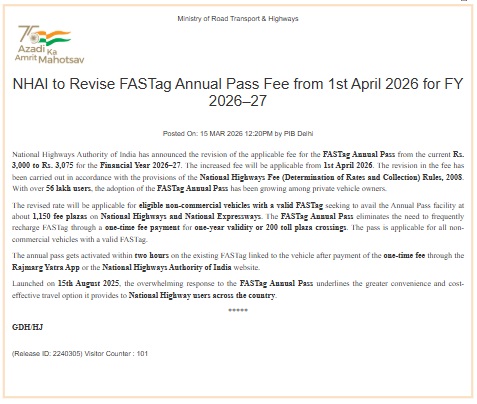
Effective 1st April 2026, the applicable fee for the #FASTagAnnualPass will be revised from ₹3,000 to ₹3,075 for FY 2026–27 in accordance with the National Highways Fee (Determination of Rates and Collection) Rules, 2008.
The Annual Pass offers convenient travel for eligible non-commercial vehicles with a valid #FASTag across around 1,150 fee plazas on National Highways and Expressways, through a one-time payment valid for one year or 200 toll crossings. With over 56 lakh users, the FASTag Annual Pass continues to provide a seamless and cost-effective travel option on National Highways and Expressways.
Read the press release: pib.gov.in/PressReleasePa…
@PMOIndia @MORTHIndia @PIBMoRTH @fastagofficial #NHAI #PragatiKaHighway #BuildingANation
English
Indian road users face multiple overlapping charges across the life of owning and using a vehicle: purchase-linked taxes, fuel cess/taxes, GST on related services, toll payments, and now recurring pass revisions. Even if every rupee is not literally “tax on tax,” the burden is layered, continuous, and very real.
English
Pay tax to buy the car. Pay GST on insurance, service and parts. Pay fuel taxes every time you drive. Pay toll on highways built in the name of public infrastructure. Then pay higher annual pass fees and listen to lectures about “convenience.”
This road model is not public service. It is organised extraction.
FASTag Annual Pass: ₹3,000 to ₹3,075 from 1 April 2026.
English
Another hike, another lesson in how Indian road users are treated like an endless revenue source. Fuel tax, toll tax, registration tax, GST on vehicles, GST on insurance, GST on repairs, and then yearly “revisions” on passes like this. They call it convenience. Citizens experience it as extraction. And the worst part? We are told to celebrate roads that are built with public money, paid for again through tolls, and then monetised like private cash machines. This is not governance for people. This is a layered revenue model built on compulsion. The FASTag Annual Pass is being raised from ₹3,000 to ₹3,075 from 1 April 2026. Call it what it is: one more squeeze.
English
You may disagree, but the harsh reality is that BJP has been implementing policies that disadvantage general castes (Swarn). Here's why:
1. SC/ST Act Amendment (2018): After SC diluted safeguards like anticipatory bail, BJP govt rushed amendments to restore strict provisions, no bail, no preliminary inquiry, leading to fears of misuse against upper castes. Protests erupted, but BJP prioritized it.
2. UGC Equity Rules (2026): New regs define caste discrimination ONLY against SC/ST/OBC, excluding general category protections. Committees must exclude general members, sparking massive backlash, upper-caste BJP leaders resigned in UP, calling it "reverse discrimination" and "anti-Savarna."
3. Caste Census U-Turn (2025): BJP long opposed it, fearing it empowers OBCs to demand proportional reservations, shrinking upper-caste space in jobs/education. Now approved under pressure, Savarnas feel betrayed, anti-reservation voices call it a "setback to Hindu unity," with no other parties to turn to.
4. Arrests of Anti-UGC Protesters (2026): General caste youth protesting UGC rules at Delhi's Ramlila Maidan and Jantar Mantar faced mass arrests in UP, Haryana, Rajasthan, echoing Emergency tactics. BJP accused of suppressing Savarna voices while favoring reserved categories.
Without Savarna support, BJP shrinks to nothing, yet they've stabbed us in the back since 2014. Time to wake up!
English


If all is well, why are families spending the whole day waiting for LPG? Why did the 14.2 kg cylinder price in Delhi rise to ₹913 this month? Why are airlines like IndiGo passing fuel costs to passengers again?
The government itself says India imports about 60% of its LPG and that most of those imports are exposed to the Hormuz route. So where was the planning? Stop telling citizens not to panic. Deliver supply, control black marketing, and fix the price burden.
A serious government prepares for shocks. It does not wake up late and ask the public to carry the cost of its failure.
@HardeepSPuri
English
@IndianTechGuide The real criticism is this: even floating an idea like this shows a tax-first mindset. For a government that already benefits from a telecom sector generating ₹215,078 crore in wireless data revenue, the instinct still seems to be finding new ways to squeeze basic digital access
English
@IndianTechGuide But there is no approved mobile data tax. What has been reported is that DoT has been asked to examine such a model by 30 September 2026. That is a study, not a decision.
English

🚨 India consumed 229 billion GB of mobile data in FY25.
The government is now exploring the possibility of a tax on mobile data.
A levy of ₹1 per GB could generate around ₹22,900 crore in revenue, based on FY25 usage.
A proposal may be examined by September 2026.
English
This is a good example of smuggling opinion in as fact.
The cancellation is real.
The reason you gave is not.
British Airways says the issue is regional uncertainty and airspace instability. It suspended multiple Middle East routes together, with Abu Dhabi paused longer than the others. That is an airline risk/operations call, not evidence that Abu Dhabi suddenly has no traffic.
English
BREAKING: British Airways cancels all flights to Abu Dhabi until later this year. Not because there isn't traffic. After all, 5,000 UK-registered companies operate across the United Arab Emirates, many of them active in Abu Dhabi’s financial and energy sectors. Instead the decision has been taken because there may not be any traffic. BA's decision is a manifestation of negative sentiment. And their is no insurance against it.
English