

Ola Virtech
6.3K posts
Ola Virtech
@Olavirtech
Executive Virtual Assistant| Project Manager| Digital Marketer| Helping Executives, Entrepreneurs & Startups Stay Organized, Save time and Grow faster.
Nigeria Katılım Ekim 2022
1.7K Takip Edilen225 Takipçiler

Why is it not a national emergency that students and teachers were kidnapped from their schools have been in the bush for over a week now ⁉️‼️
One of the teachers was beheaded on camera. There is a 2-year old child there ⁉️
Why is there no outcry ⁉️‼️
Have we gotten so used to bad news⁉️
English
Ola Virtech retweetledi

A lot of Yorubas have low ethnic consciousness. High IQ vs low EC in a country like Nigeria where literally EVERYONE ELSE is hyperaware of their ethnicity is a losing game. You are busy clamouring for “balance” while others are prioritising their group. Wake up!
English
Ola Virtech retweetledi
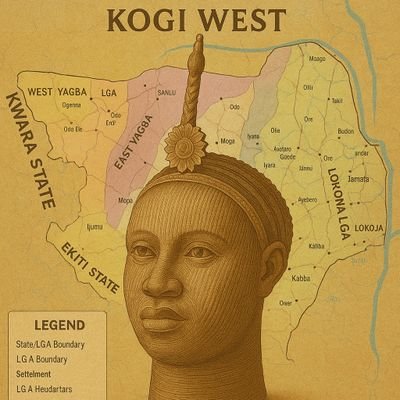
On Yoruba as a New Identity
I have always held the opinion that Yoruba identity is a relatively new construct, particularly in the context of Nigeria. That view is not entirely false, but I now recognize that it was incomplete. I was wrong because I reduced Yoruba identity to only its political dimension.
I did not initially object to this framing, because I assumed it was a fair interpretation and because it contains some elements of truth. However, the more I read perspectives that support this view and listened to arguments advancing it, the more I began to notice a pattern. Even though I was not fully in disagreement, I now see that this interpretation needs correction—not because it is entirely wrong, but because it is misleading and reductive.
I came to this realization after observing that such narratives are often not grounded in a careful reading of history or in the nuances of identity formation. Instead, they sometimes emerge from external intellectual frameworks that attempt to justify or reinforce certain disparaging claims about Yoruba origins, history, and even the etymology of the name and now a useful tool for bad faith actors hoping to cause division. This reflection deepened further after reading a many people go to book here, The Era of Forgotten (one day I'll finally say my mind on the book and the author).
To understand identity, we must first define it properly. Identity refers to the various ways people understand and describe who they are, where they belong, and how they relate to others.
By its very nature, identity is fluid and can evolve over time, even while still referring to the same people. Identities exist in many forms... religious, cultural, political, ethnic, national, tribal, linguistic, and more. Each of these can shift and develop, even when the same label continues to be used.
Now, regarding Yoruba identity: to properly understand it, it is useful to compare it with a broad identity such as “Jewish.” Yoruba identity, like Jewish identity, can be linguistic, ethnic, cultural, religious, and political. Modern Jewish identity, though more strongly shaped by religion, has also evolved over time. It was not always universally or uniformly expressed, and at different periods, people may have preferred more specific subgroup identities. However, this does not invalidate the broader identity.
The same applies to the Yoruba case. The linguistic identity has always existed, even when it was not always explicitly labeled in the modern sense. There is also a shared cultural identity that is historically recognizable across groups—reflected in customs, greetings, social organization, and worldviews.
Religious identity also played a role, as communities with shared language and culture often developed overlapping spiritual systems and mutual recognition of belonging within a broader cultural sphere.
Political identity, however, was more fragmented in the pre-colonial period for Yorubas. It was not always unified across the entire group, as different polities often pursued their own interests and competed for resources. This internal diversity does not negate the existence of broader shared identities, but it does explain why political identity was more fluid and situational.
Before the formation of Nigeria, political identity among Yorubas was often localized and shaped by immediate competition and alliances. However, in external contexts—such as the transatlantic world or in diaspora situations—there was often a stronger tendency toward broader self-identification under shared ethnolinguistic and cultural markers.
In contemporary times, especially within the Nigerian state, political realities and inter-ethnic competition have contributed to a more consolidated political consciousness among Yoruba people. This has led some to argue that Yoruba identity is purely a modern political creation or something finalized in recent history. That view is overly reductionist.
It ignores the fact that Yoruba identity already existed in multiple layers—linguistic, cultural, ethnic, and partly religious—long before modern political consolidation. The fact that the political dimension has become more unified in recent times does not mean the other dimensions were absent or artificially created.
A useful analogy is Jewish identity. The term “Jew” originates from the tribe of Judah, but over time it came to represent a broader collective identity encompassing multiple tribes and historical experiences. Similarly, Yoruba identity is often traced culturally and historically to Ile-Ife as a symbolic center of origin or special reverence to it civilization and Odùduwà dynasty, even though internal diversity has always existed.
Like the Jews in medieval periods—who often identified through tribe, covenantal community, or locality rather than a single unified national identity—Yoruba groups also expressed identity in multiple, overlapping ways. The evolution of a more unified political identity in later periods does not invalidate earlier forms of belonging.
The problem arises when Yoruba identity is reduced solely to modern political consciousness, while ignoring its deeper linguistic, cultural, and historical foundations. That reduction is often used to support certain arguments that are less about historical accuracy and more about intellectual framing or political positioning.
Identity can also be recognized externally. A group may be identified as a unit by outsiders based on shared language, customs, or cultural practices, and this external recognition can, in turn, reinforce internal identity. This has long been the case among Yoruba-speaking peoples in various contexts, where they were historically recognized as sharing related languages and cultural patterns.
For example, in parts of the diaspora, the use of greetings such as “aku” or “ẹku”—as seen in expressions like “aku ọdún,” “aku ojo” and “ẹku iṣẹ́”—became one of the linguistic markers associated with Yoruba speakers. In Sierra Leone and The Gambia, Yoruba-descended freed slaves are now referred to as “Aku,” Okun people a term derived from these greeting patterns.
Similarly, in Cuba and other parts of the Americas, Yoruba-descended communities came to be known as “Lucumí,” a designation often linked to the phrase “olúkúmi” (interpreted as “my friend” or “my companion”) in Yoruba oral tradition. These naming practices reflect how linguistic features were used as identifiers in diaspora settings.
In that sense, Yoruba identity is not a recent invention, but a layered and evolving historical reality shaped by language, culture, religion, and the ethnicity itself.
Unlike Jewish identity (ethnic component), which in academic discourse is often discussed in terms of its complex interplay between religion, ethnicity, and historical nationhood, Yoruba identity is grounded more directly in shared linguistic, cultural, and territorial continuities. Yoruba-speaking populations share closely related languages within a dialect continuum, broadly similar cultural and social institutions, and a largely contiguous geographical region in southwestern Nigeria and parts of neighboring countries.
Jewish identity, like Yoruba identity, has not always been expressed in a single, uniform way across all historical periods. In different contexts, it has been understood through religious practice, community belonging, lineage, and later, modern national and ethnic categories. Its contemporary form reflects a long process of historical development and consolidation rather than a single fixed origin point.
In a similar way, Yoruba identity should not be reduced to its modern political consolidation or treated as a purely recent invention. While it is true that political identity among Yoruba-speaking peoples became more explicitly unified in the modern Nigerian context, this does not negate the deeper historical foundations of linguistic, cultural, and social continuity that long predate the colonial and postcolonial state.
The key point, therefore, is not that Yoruba and Jewish identities are identical in structure or history, but that both illustrate a broader principle: modern political or national consolidation should not be mistaken for the origin of identity itself. Identity is layered, historically cumulative, and shaped by both internal developments and external classifications over time.
English
@Sensicut07 Are you joking??
Members are raised as Bible study teachers, building their public speaking skills.
That day that other departments will also be working in the media, technical ushering to capture, record and organize things. These are trainings done for free.
English

Not only ile kewu,even bible studying.
Proud Kuffar@weirdlyseen
What’s the economics importance of Kids going to Ile-Kewu
English
@Mansaah_Musa Una no get mosque to do that??
What's the essence of IRS??
If Bible studies done in church every week, will you agree that Bible study should also be done in schools nationwide?? What then is the purpose of CRS?
English

Nigeria should also make Quran studies a core subject in schools nationwide.
Cool_Ustaaz ☪@Cool_Ustaz
Senegal makes quran studies a core subject in schools nationwide. Alhamdulillah ❤️
English
Ola Virtech retweetledi

“In the annals of history, no people or kingdom has ever conquered its enemies by embracing weakness in the name of peace.”
By Lord_of_Warri on 𝕏.
Itsekiri Activist and Historian.
English
Ola Virtech retweetledi

The difference between Yoruba and other Groups in Nigeria is that we know how to call out our leaders, when the shit hits the fan. We have been calling out our Governors, Senators, HoR members, LGA Chairmen to do their job, but you see that president, we will protect him dearly.
English
Ola Virtech retweetledi

The more you understand geopolitics as a Yorùbá person in Nigeria. The more worried you get seeing Yorùbá people misbehaving all over the place in the name of One Nigeria or Religious Brotherhood 😔🥲
God abeg ó 🙏
English
Ola Virtech retweetledi
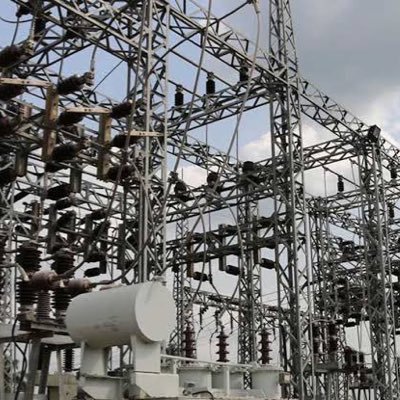
Patriotism is not pretending all is well. It is loving your country enough to demand better while refusing to give up on it. 🇳🇬
MrBanks💰@Mrbankstips
Soon, Nigeria will be the only African country without 24 hours electricity.
English
Ola Virtech retweetledi
This is a secret document from the year 2005, signed by Sheikh Gumi; he was appointed as an assistant warlord.
Why will a religious group create an office of warlord? Do you now understand why I am screaming? This is a war against our people.
Southern Muslims, please open your eyes; these jihadists are after our lives and land.
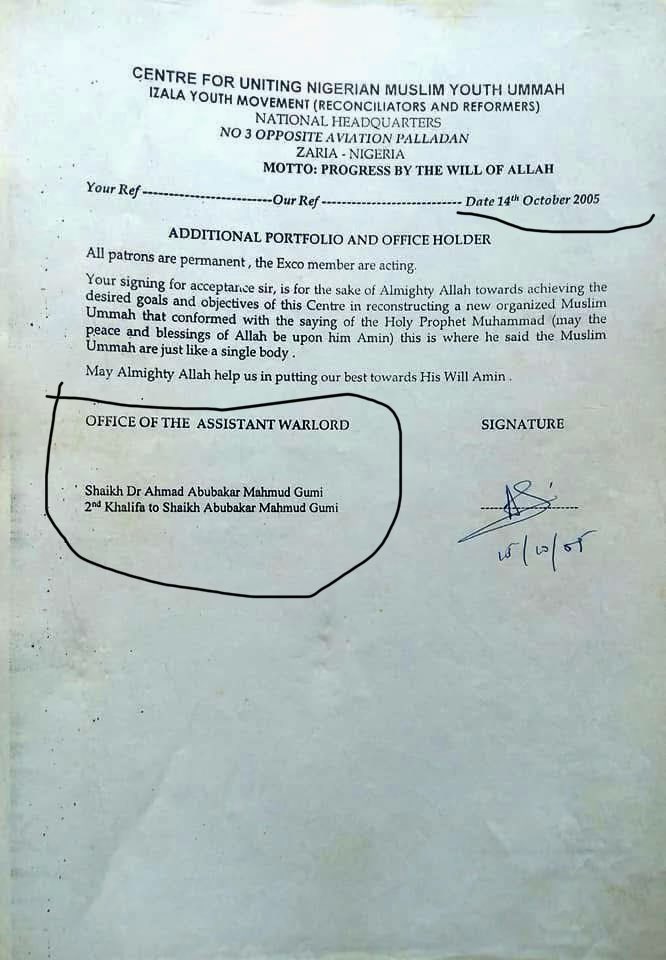
MADE IN LAGOS 🧊💎⚡️🔥@papichulo4224
Gumi should be declared an enemy of the state. Gumi is a terrorist!! @realDonaldTrump @POTUS Nigeria government keeps protecting him!!!
English
Ola Virtech retweetledi
Dear Yoruba leaders, in office and out of office and all Itsekiri leaders too, do you all understand that we are watching you? Do you all realize that we are the reason you hold such positions as leaders? One day you all will account for your stewardship to the 10th generation.
English
Ola Virtech retweetledi

With $700m Apapa Ports Upgrade?
Or the multi billion dollar Mordern Railway lines, infrastructure and Super Highway projects springing up in Lagos, Ogun, Oyo etc?
Or the new Port projects and industries springing up in Ogun and Lagos
Or Their sons and daughtets atop key MDAs
Yorubas have never had it so good oooo...they are lucky with him for real.
Infact after Tinubu, SW will end up the most developed REGION...and by then...it will be resource control FISCAL FEDERALISM
So i dont know what you are saying shaa
Cos me sef from SE dey envy them.
Abu Amir@SadiqMaunde
Yoruba will not recover after Tinubu. They won’t know the damage Tinubu has done to them until after he leaves office.
English
Ola Virtech retweetledi
I detest people that share fake news.
Emotions are already heightened, you then decide to circulate an old or untrue video to increase tension.
Is a knot not loose in your head like this????
English
Pls Yoruba's let's prove this people right in 2027. Let them know by our vote that we're tribalistic. All South Western states must be won by Tinubu
Ázibásamam📈@OGSamam_
One reason many Yorubas hated GEJ was because they felt that a Southern Nigerian president should come from the Southwest. Same reason they dislike Peter Obi. They will never speak up against a Northern President like Buhari. A warped sense of superiority and inferiority.
English
@Victor_Akanz Who be "this people" he's talking about? What was the context when he wrote that
English
Pls what does it mean when they say Yorùbá is tribalistic?
Are we intolerant?
Have we attacked and kill other tribes?
FS YUSUF@FSYusuff
The tribalism wey dey this people blood ehnn. Nigeria can’t progress like this!
English
@simply_abimbola Before I go know what kind of measurement I go give him and his household
English
@Olavirtech They wanted a push over Yoruba where they use to denigrate Yoruba people and Yoruba women.
English
@Olavirtech This one wey una daughter talk say una no dey educated 😂😂
English
People of Ejigan quarters, Efon Alaaye, Ekiti State.
One of your daughters said you people are unintelligent and uneducated oo.
Omo osan ti ko ponpo ba eyin iya ee oo
'Denike Danjuma@DeNiike_
I was in Efon Alaaye (Ekiti state) for three days and i kept wondering if the state even had a Local government, not to talk of state or representative in the federal level. I used to think Ekiti was filled with intelligent and educated people but nahhh, it's a lie!!!!
English
@Asakemijimi Ondo especially the Owo people bears the name Okoro. So he might not be Igbo
English

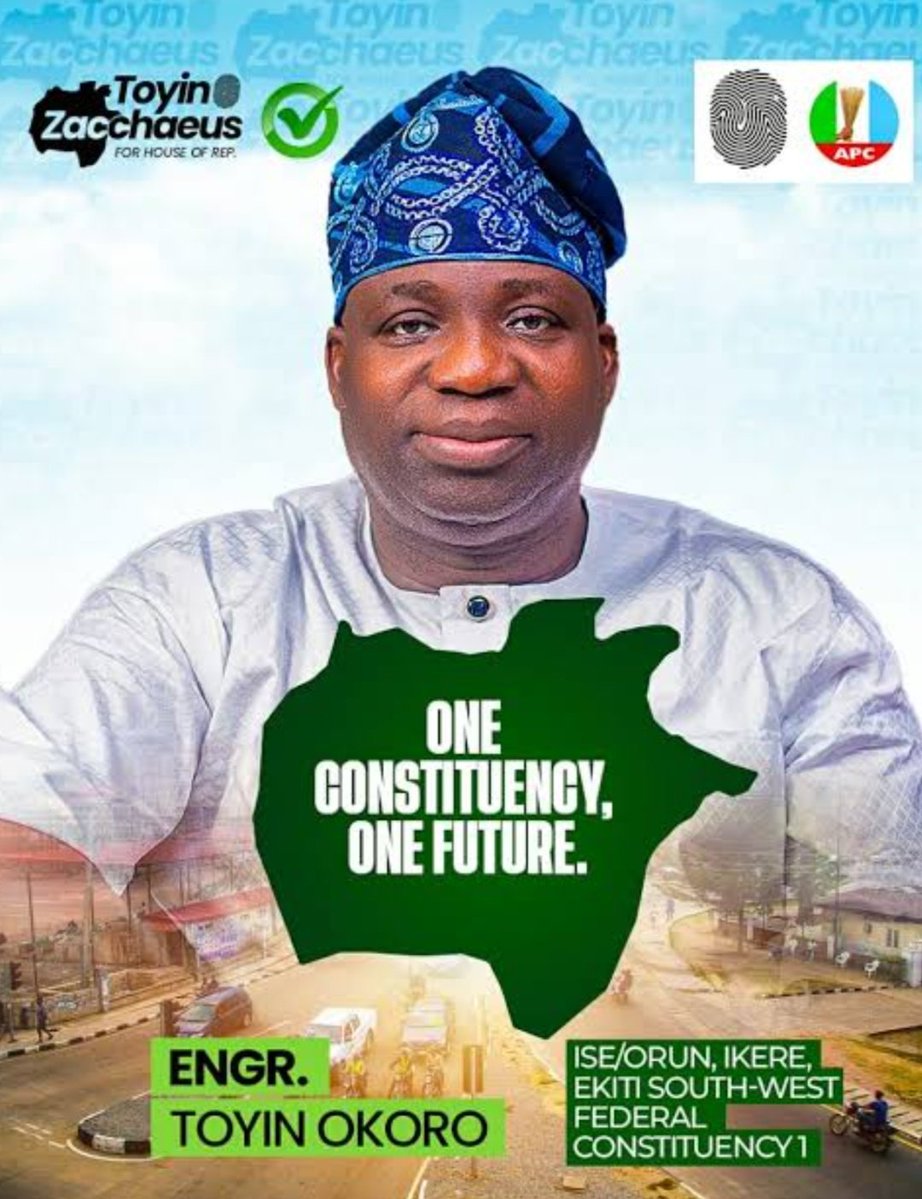
An ibo man, Okoro, is representing Ekiti people in the House of Reps. He will do the same thing, Okey Onuakalusi did in Oshodi -Isolo to Ekiti state people.
And I used to think Ekiti people qwee Conservatives.
P.s. His name is not Toyin. He added Toyin to his name.
English