Sabitlenmiş Tweet
Omniflow Founder
332 posts

Omniflow Founder
@OmniflowFounder
Founder @OmniflowFi I removed the bridge step from DeFi. 🌐 https://t.co/qE1bhSDdyx
Katılım Mayıs 2025
160 Takip Edilen26 Takipçiler
Omniflow Founder retweetledi

@RaveDAO @bitget @binance @Gate @heyibinance @GracyBitget Update: Binance & Gate both initially commented as well.
In the coming days / weeks I hope we can receive a bit of clarity about the entity responsible for targeting retail extraction and their connection to the RAVE team.


English

Harsh framing, but the core point is right:
most general-purpose L1s don’t have a token problem first.
They have a demand problem.
If the chain is not where liquidity lives, where apps matter, and where capital is actually used, the token becomes a distribution vehicle, not an asset.
Throughput is not a moat.
Economic gravity is.
English

@_clemens__ Building the layer that lets capital move across chains and execute where it needs to, without making users bridge first.
For protocols that want cross-chain UX to feel native.
English

@Param_eth Then the UI thesis is obvious:
chain fragmentation should be handled by infrastructure, not pushed onto the user.
“Choose chain, bridge, switch, deposit again” is not the end state.
English

Exactly.
Omniflow lets protocols accept liquidity from any chain in one transaction, without forcing users to bridge first.
Problem:
Cross-chain liquidity is still fragmented and users have to bridge before they can use capital.
Who has it:
Multi-chain DeFi protocols and their users.
Why it’s big:
Every new chain makes fragmentation worse.
Why this could be 50x:
If Omniflow becomes the settlement rail, protocols stop building chain by chain.
Compressed enough ?
English

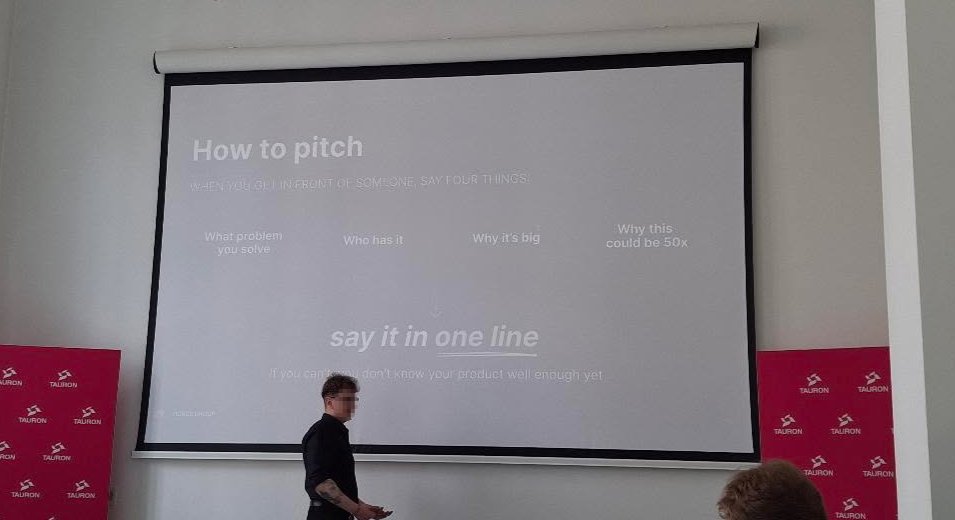
AI made it so any good dev can ship a product in weeks. the bottleneck isn't building anymore.
it's explaining what you built in one sentence. getting it in front of the right people. and getting someone to write a check.
talked about this today. the slide that got the most reactions was the simplest one: say it in one line. if you can't, you don't know your market well enough yet.

English

@MartinGTobias True.
At the earliest stage, the real edge is not famous capital.
It is finding the investor who can understand an unfinished but important thesis before it becomes legible to everyone else.
English

@OmniflowFounder Hello @OmniflowFounder I will love to join your team as a community manager
I manage Web3 communities with a 24/7 engagement across Discord, X, and Telegram.
I can help you turn attention into sustained community activity.
English

@StephNass Good framework for vanilla software.
Weak framework for blockchain infra.
If every early bet has to look like a clean $30k/month story, you mostly fund what is already legible inside the current stack.
Not the primitives that change the stack itself.
English

VC: "Come back at $30k monthly." Founder: "Why would I need you then?"
Wrong question. 6 things founders get wrong about raising:
1️⃣ You're confused about funding stages
A team and a buggy MVP is not enough to raise seed.
You need $250k+ monthly GMV or $30k+ MRR for that.
2️⃣ You fall for VC marketing
"We invest super early" is just PR so VCs can look cool and fill up their CRM with deals.
3️⃣ Your team doesn't have enough track record
Yes VCs invest at the idea stage… but in proven founders, not first-timers.
4️⃣ You're being given a polite pass
Some founders get aggressive when rejected.
That's why VCs say "come back at $30k" instead of just "no".
5️⃣ The others are building more
It's never been easier to build a SaaS with 0 users.
Therefore, the bar to raise is getting higher.
6️⃣ You don't understand how VC math works
If you raise with VCs, you're expected to raise multiple rounds after that.
Saying "I won't need money after $30k" signals you don't understand that.
Bottom line:
VCs don't "bet on the team" and "fund innovation."
They just invest in the strongest deal they see out of 500 or more.
And that deal will likely be doing $30k a month - or much more!
Want to know who actually qualifies for early-stage funding? Full breakdown → linked below

English

@daniilkozin Exactly.
Bridges became the tax users pay for a fragmented architecture.
If chain abstraction does not remove that cost from the user flow, we are not scaling.
We are just normalizing inefficiency.
English

@OmniflowFounder bridges are the tolls no one agreed to pay. chain abstraction fixes this or we're just cosplaying scale
English

“Multichain” became one of the biggest lies in DeFi.
If users still have to:
switch chain
bridge
wait
switch again
then use the app,
that is not multichain.
That is workflow debt disguised as UX.
More chains.
More assets.
More tokenization.
Same broken flow.
Issuance is not the bottleneck.
Coordination is the missing layer.
If your product still makes users think in chain steps, your design is already aging.
The next winner in DeFi will not be the loudest app.
It will be the infra layer that makes chain boundaries operationally irrelevant.
That is the bet behind @omniflowfi.
English

@brettcalhounn True.
Good founders do not want “an investor.”
They want alignment, speed, and conviction.
Everything else is just expensive noise.
English

@dlawant @Anchorage Building Omniflow.
We’re tackling one of the most structurally ignored problems in DeFi:
cross-chain liquidity coordination.
The industry kept normalizing bridge-first workflows.
We’re building toward making them obsolete.
English

If you're building in the space, check it out!
Hard to think of a better early strategic partner to have than @Anchorage
Anchorage Digital Ventures@AD_VenturesX
Building a crypto startup and need funding? We're actively writing checks and want to talk to teams building: • BTCFi, RWAs, DePIN, Derivatives, AI Infra • Protocols removing barriers to institutional adoption • Core infra with engineering or systems breakthroughs Submit ↓ anchorage.com/ventures

English

Omniflow.
DeFi keeps funding things that look legible inside the current stack.
But primitives that challenge the stack itself, especially around cross-chain coordination, are harder to finance because they don’t fit a familiar box fast enough.
A lot of missing infra is not unfunded because it is unimportant.
It is unfunded because it is harder to categorize.
English

🇨🇭 One country quietly built the entire foundation of crypto. Here's how.
In 2013 there was no crypto infrastructure anywhere in the world with no regulated brokers, no custody, no legal framework, almost nothing.
A Danish software engineer named Niklas Nikolajsen moved to Switzerland, got obsessed with Bitcoin, and founded @BitcoinSuisseAG in a small town called Zug
He built the first crypto brokerage. The first custody service. The first crypto company to ever work directly with a government entity in the town of Zug itself
By 2017 his company had processed over $1.1 billion in ICO raises including Tezos, Zilliqa, and Bancor
Today Bitcoin Suisse manages billions in client assets and runs Bitcoin ATMs across Switzerland
The man built the entire crypto banking layer before most people had even heard of Ethereum
Then in 2014 a 20-year-old kid named @VitalikButerin had a problem
He wanted to sell tokens to fund Ethereum but no country in the world could tell him if that was legal. The US couldn't answer and Europe couldn't answer. Lawyers everywhere said it was too risky
Switzerland said come here
Buterin set up the Ethereum Foundation in a small house in Zug that the team nicknamed "Das Raumschiff" or The Spaceship in English.
They raised $18.3 million in 42 days through a public crowdsale
It became the first blockchain foundation in history. The legal template that every single major crypto project copied after
- Cardano went to Switzerland.
- Polkadot went to Switzerland.
- Cosmos went to Switzerland.
- Solana went to Switzerland.
- NEAR went to Switzerland
All because one canton of 30,000 people gave Ethereum a legal home when nobody else would
Then in 2017 another team in Zug asked a question nobody had thought of before
What if a hardware wallet looked like a bank card?
@Tangem built a wallet with no screen, no cable, no USB port. You tap it to your phone and sign transactions. The private key generates inside a Samsung EAL6+ military-grade chip during setup and never leaves it. Same security technology used in biometric passports
Then they built the Tangem Ring. Same chip, same security, but it's a ring on your finger. A full hardware wallet you wear on your hand
Then they launched Tangem Pay. A non-custodial Visa card built directly into the app. You spend USDC through Apple Pay and Google Pay but your funds stay onchain at all times. Only the exact amount needed for each purchase leaves your wallet at the moment you tap. No custodian holding your money with no pooled accounts.
2025 revenue: $61.3 million. That's a 102% increase from the year before. For a hardware wallet company most of crypto Twitter has never even mentioned
One country of 9 million people gave Bitcoin its first regulated broker, gave Ethereum its legal home when the rest of the world wouldn't touch it, and built the most innovative hardware wallet ecosystem that exists today
Switzerland didn't just adopt crypto but it literally the infrastructure the industry runs on.
And this is only part one 👀


English

LI.FI Earn removes the need for wallet, neobank and fintech users to bridge and deposit manually, making the programmable economy more accessible.
The Arbitrum Platform gives products like @lifiprotocol deep liquidity, active markets and predictable execution to bring yield products to users seamlessly.
Excited to see LI.FI shape the programmable economy.
LI.FI@lifiprotocol
LI.FI Earn is now live on @arbitrum. With this integration, any app, wallet or fintech can plug into vault protocols on Arbitrum - out of the box. Expanding access to the programmable economy, one vault at a time.
English