
Open Medicine Insights
3.5K posts

@OpenMedInsights
Open access and free for everyone.


When can we say a cancer is curable? We want to cure all cancers. Some cancers are curable. Some are not. As oncologists, we all have individual patients with cancer who are cured. Even those considered incurable! Anecdotes abound. But when can we say a cancer is curable compared to saying an individual patient is cured. There is a critical difference. Let’s take myeloma, a form of blood cancer. With recent advances, some patients with myeloma are likely cured. But can we call myeloma a curable cancer? I am still reluctant. I still cannot look a young newly diagnosed patient in the eye and say that we are dealing with a curable cancer. I still cannot assure them like I do with diffuse large cell lymphoma or Hodgkins. Cure is a straightforward concept: -You need to be able to eradicate the disease. -You need to be able to stop all therapy. -You need to have a high probability that after a period of time of being disease free after stopping all therapy that patients have a very low risk (usually less than 5%) of recurrence. Some cancers are clearly curable, eg. many localized solid organ tumors. Some cancers are curable even in advanced stages. Eg., Hodgkins, acute leukemias, testicular cancer, diffuse large cell lymphoma. No one doubts that these cancers are curable. We confidently tell patients that. For some cancers, like myeloma we are now at the threshold of cure. We are debating whether it’s curable or not. (The fact we are wondering whether we can cure myeloma is in and of itself a monumental advance and reflects the fact that many patients can live 10-15 years or longer after diagnosis.) At present I am still not confident that we can call myeloma a curable disease because: 1) Most studies that show excellent disease free survival are in the context of continuous suppressive anti-myeloma therapy. Unlike curable cancers like diffuse large cell lymphoma, we don’t have studies that show a clear plateau in the disease free survival curve after stopping all therapy: the gold standard visual of a curable cancer. 2) The long overall survival we now see in myeloma reflects outcomes not just with frontline therapy but successful therapy of relapse with with sequential therapy of multiple relapses. The disease course of myeloma is still one of multiple remissions and relapses. 3) We don’t have sufficient follow up in patients with highly effective modern therapy. I’m hoping for example with ciltacel CART we can finally get there. Time will tell if we can fulfill requirement #1 above. But we are very hopeful. We want to cure both newly diagnosed and relapsed myeloma. We may already be achieving this, and all we need is time to demonstrate it.


Two practice-informing trials at #ESMOBreast26 carry a broader lesson for oncology: sequencing #ADCs with the same payload class — here, a TOPO1 inhibitor — may not work simply by changing the target, linker, or PK. BRE-354 from @ErikaHamilton9 @SarahCannonDocs and SATEEN from @PTarantinoMD @adawaksmd @DFCI_BreastOnc both speak to this important question. This echoes what we have seen with PD-1 after PD-1 strategies: changing the partner drug does not necessarily overcome resistance to the same core mechanism. In RCC, two randomized phase III trials showed that this approach does not generally work: TiNivo-2: shorturl.at/hP8AI CONTACT-03: shorturl.at/litTw with @montypal @motzermd @AlbigesL @BradMcG04 in @TheLancet The biology of resistance matters. Mechanism matters. Payload matters. @myESMO @ASCO @AACR @OncoAlert

🚨Testosterone replacement therapy after surgery for #prostatecancer🚨 @JAMAInternalMed ⭐️SPIRIT trial 📊 RCT, n=136, low/int-grade PCa, post-RP, hypogonadal men ⏱️ TRT started ≥2 yrs post-RP w/ undetectable PSA 💉 12 wks testosterone vs placebo ✅ ↑ sexual activity (+0.9 events/day), desire, lean mass, VO₂ peak 🛡️ ZERO biochemical recurrences ⚠️ Short-term, proof-of-concept. 👉Bigger/longer trials including patients with higher-risk disease needed @PCFnews @PCF_Science @urotoday @renalandurology @UrologyTimes 🔗shorturl.at/IzRyw


➡️Check out our paper evaluating the prognostic impact of ASXL1 mut 🧬 in ND AML treated with Low Int Therapy 💊 @UTMDAnderson @JournalCancer Great work by @JenMarvinPeek acsjournals.onlinelibrary.wiley.com/doi/10.1002/cn…

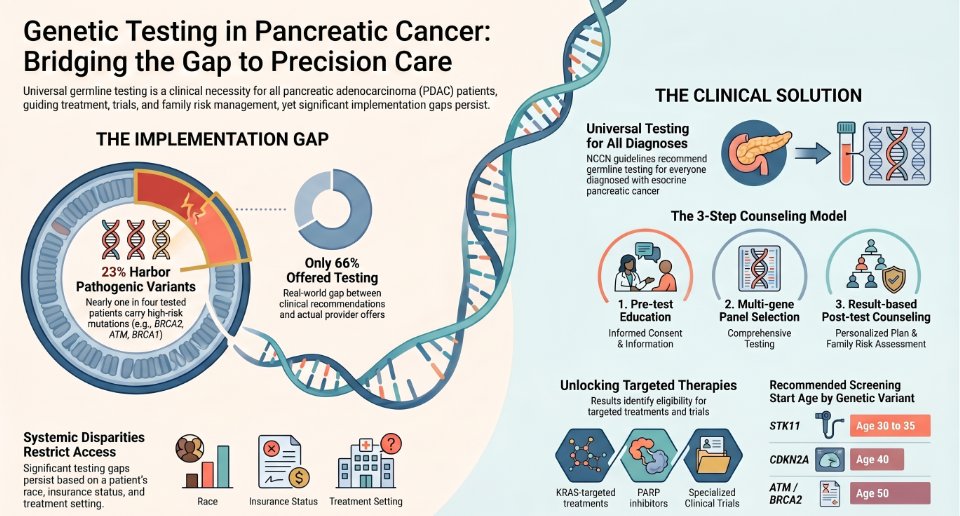
🧬 Universal germline testing in #PancreaticCancer is still failing too many patients. acsjournals.onlinelibrary.wiley.com/doi/epdf/10.10… A national PanCAN survey (n=1046) reveals major implementation gaps despite NCCN/ASCO recommendations. 🔹 Only 66.2% were offered germline testing 🔹 Only 69.2% completed testing 🔹 Black patients: ↓ odds of offer (OR 0.53) & completion (OR 0.42) 🔹 Hispanic patients: ↓ completion (OR 0.48) 🔹 Community settings: significantly lower testing rates 🔹 Main barrier? 👉 Testing was simply NEVER discussed/offered (66.8%) ⚠️ 🧬 Among tested patients: • 23.2% harbored pathogenic germline variants • Most common: BRCA2, ATM, BRCA1 • Only 61.7% reported cascade testing in relatives 💡 Genetic counseling mattered: Cascade testing was significantly higher after counseling (67.7% vs 38.2%). 🧠 Medical Watch take: Precision oncology is not only about discovering biomarkers… 👉 it’s about ensuring EVERY patient has access to them. @ASCO @myESMO @theNCI #PrecisionOncology #GeneticTesting #BRCA #PancreaticCancer #OncoTwitter #MedicalWatch


Episode 5 of The Breast Friends Podcast is out now, featuring special guest Dr. Hope Rugo. 🎙️ @JAMouabbi & @PTarantinoMD ▶️ Watch now on YouTube - youtu.be/IGbXzLpE-LY 🎧 Listen on Spotify, Apple Podcasts, iHeartRadio, CastBox & Amazon Music #BreastCancer #OncologyPodcast

🚨Telisotuzumab adizutecan (Temab-A), a c-MET ADC, shows encouraging activity in heavily pretreated metastatic CRC (phase I, n=57) ascopubs.org/doi/abs/10.120… 💥ORR 15.6% overall 🎯mPFS 4.6 months | mOS 10.4 months ▪️All pts had ≥1 TEAE; GI/Heme AEs most frequent (78%/71%); TR discontinuation/death rates were low (10%/3%) c-MET may be ready to MET the ADC era in CRC 😉 @OncoAlert @OncoReporte @myESMO @_SEOM @GrupoTTD @DraMartinezLago @Erman_Akkus

KRAS G12-mutant NSCLC: a practical guide for clinicians We review current evidence on treatment strategies to provide an up-to-date about this topic to clinicians and discussing challenges. @HendriksLizza @stephanieplsaw @BRicciutiMD La Cava M Borgeaud doi.org/10.1016/j.ctrv…