Operation🅰️TM

10.2K posts

Operation🅰️TM banner
Operation🅰️TM

Operation🅰️TM

@OperationATM

Canada Katılım Eylül 2009
1.6K Takip Edilen491 Takipçiler
Sabitlenmiş Tweet
Operation🅰️TM
Operation🅰️TM@OperationATM·
$ASTS Impulse Leg 4 Targets 🚀 Base: $49.31 (Nov 21, 2025)​ Impulse legs 1–3: $37 → $42 (+$5) → $62 (+$20) Ratios: 2/1 = 1.14x, 3/2 = 1.48x Accel ratio: (1.48 / 1.14) = 1.30x​ 🎯 Accel 1.92x: $119 gain → $168 🎯 Linear (+$35): $97 gain → $146 🎯 Recent 1.48x: $92 gain → $141 🎯 Avg 1.31x: $81 gain → $130​ ⚖️ Avg: $97 → $146 📈 Range: $130–168 💥 Curiosity triggered by : x.com/tuff_4r/status…
English
4
1
8
1.4K
AskLivermore
AskLivermore@asklivermore·
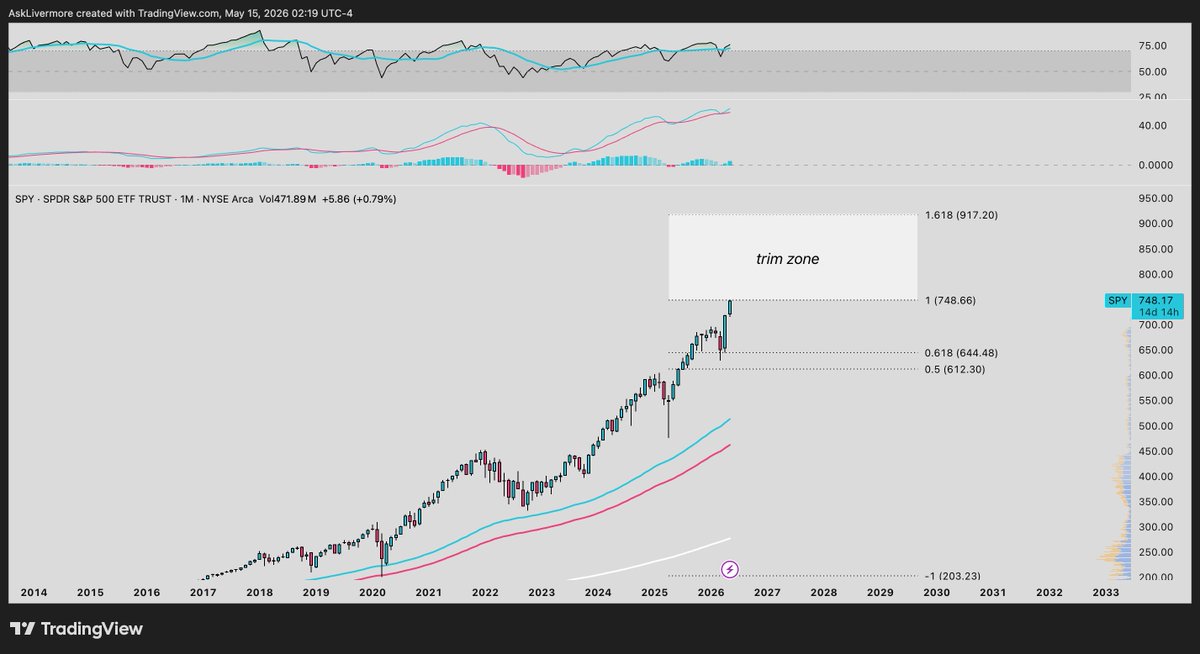
Listen to me. This is your FINAL warning. This is what will happen. The next cycle is May 25th - June 5th. 1. Trim your winners. Don't sell fully. Take minimum ~20% of your profits and rotate into defense. Or hedge with oil stocks, gold, cash, or puts. 2. AI will keep going up in the future, we're still very early. But $SPY will START its dip of -5% to -10%. 3. This will turn into -20% - 50% dip on high volatility stocks. Why will this happen? 1. It's a natural "breather" before we go up again (3 months of rest). We're too HOT. 2. No more earnings catalyst - we will have a period of LIMBO from June to August. 3. S&P 500 is stretched 15% away from its moving average. This is historically the time to trim. Future forecast? 1. Buy the BIG dip. Markets are still bullish and will continue to go up. What to do? 1. Balanced with AI, international exposure (Japan, Brazil, etc.), precious metals/miners (gold and silver miners), stable compounder companies, cash, and puts. Follow my every move or else you'll lose everything. I've already started to rotate, and I will more.
AskLivermore tweet media
English
195
180
2.6K
382.6K
M🅰️M
M🅰️M@MWM76·
Let me put it very simply, You want to buy all the F---ing $ASTS you can here...
English
9
8
154
10.3K
Trade Whisperer
Trade Whisperer@TradexWhisperer·
$NVDA hit $3 Trillion doing $30B/qtr at 75% gross margins. $MU just guided $33.5B next quarter at 81% gross margins. More revenue. Better margins. 70% lower market cap. 🤯 $DRAM
English
69
91
1.9K
243.4K
TheValueist
TheValueist@TheValueist·
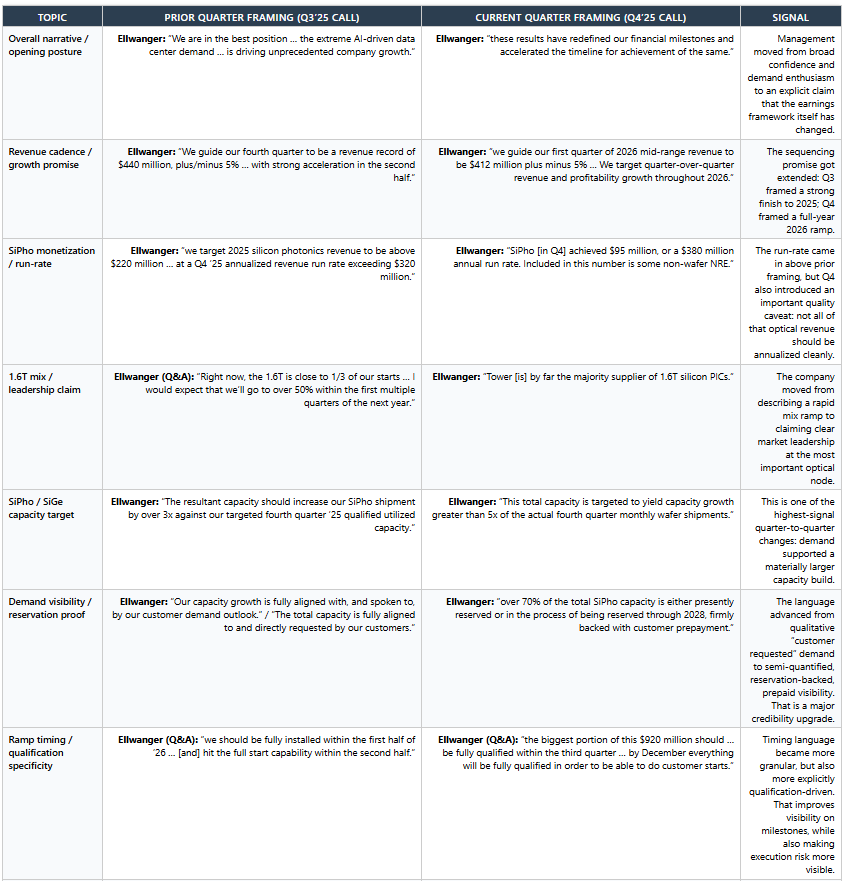
$TSEM Tower Semiconductor (TSEM) Q4 2025 Post-Earnings Debrief atlaspeakresearch.com/report/7405aa Core conclusion: This print mattered much more for the long-term earnings power framework than for the quarter itself. Q4 validated the mix thesis — RF infrastructure / SiPho / SiGe drove stronger gross margin and operating leverage — but the real change versus prior framing was management’s move from an accelerated path to the prior $2.7bn / $500m net-profit model to a new 2028 model of $2.84bn revenue and $750m net profit, explicitly excluding Fab11X. The investment debate is no longer “is photonics demand real?” and more “how much of this capacity-backed, prepaid demand converts on time, and how much of the margin structure is durable?”
TheValueist tweet media
English
1
4
35
10.6K
Sina 🗝️⚡ BI Report
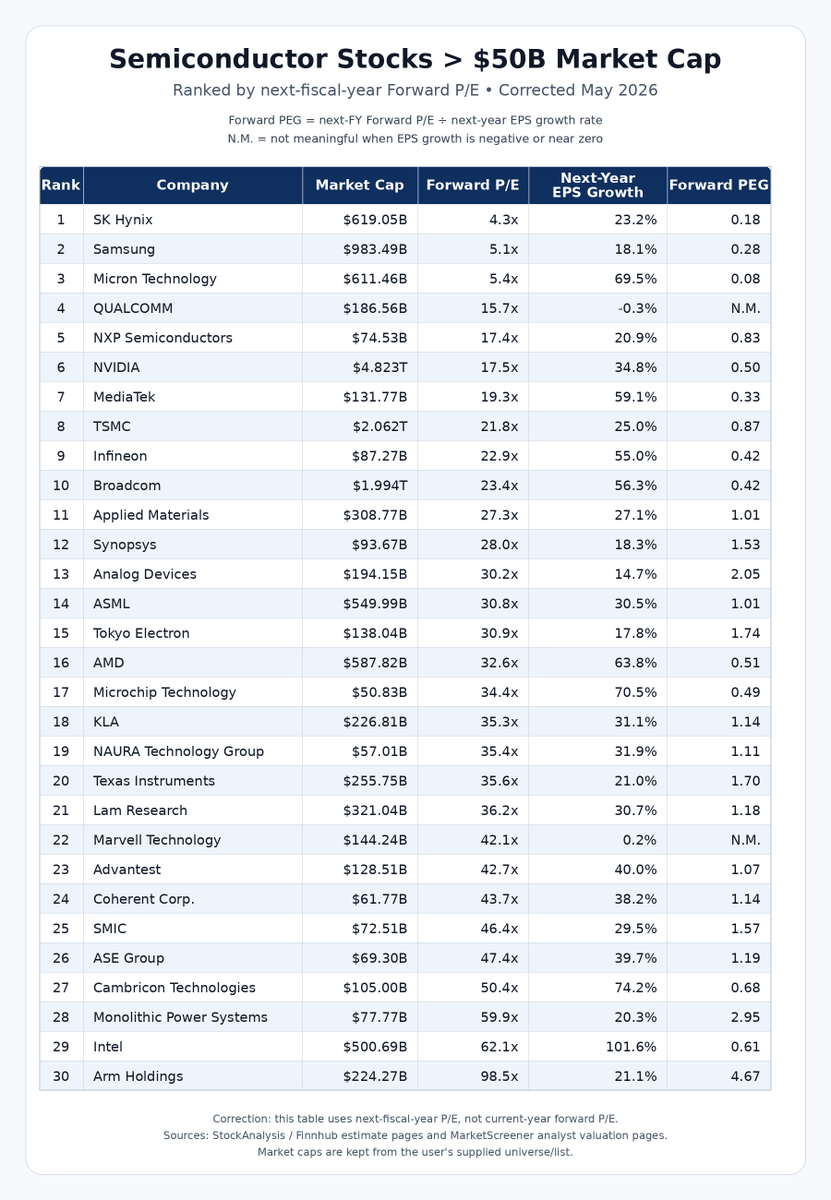
AI Semiconductor stocks ranked by forward PE / forward PEG It is crazy to see $MU trading at 5x forward PE after a 600%+ rip.
Sina 🗝️⚡ BI Report tweet media
English
4
4
22
3.5K
Johan N.
Johan N.@rk8215·
BREAKING NEWS: KEN GRIFFIN & CITADEL BUY TOTAL 4.9% OF $DGXX Citadel just filed 13G and as per it they added 2 million shares to position! Ken Griffin owns now 3,550,691 shares of $DGXX
Johan N. tweet media
English
24
57
349
75.2K
Gaetano
Gaetano@crux_capital_·
$P is one of my newest positions What they do: > turns NAND into enterprise-grade data infrastructure > helps companies store, move, protect, and govern data > gives GPU clusters faster access to AI/HPC data > gives hyperscalers a dense flash architecture layer > targets the enterprise inference data bottleneck Financially: > first $1B revenue quarter > nearly $2B subscription ARR > 40% RPO growth > $600M+ FCF guiding to high-teens growth NFA
English
25
25
384
180K
DadHustleHQ
DadHustleHQ@udubtrades·
Anthropic gonna be insane demand $SKM Also love the strength today
Aakash Gupta@aakashgupta

Anthropic just hit an implied $1.4 trillion. Not in a funding round. On Jupiter's tokenized pre-IPO market. The chart is a weekly candlestick of a private company's price. Each candle is the bid/ask on PreStocks, the synthetic tokens that give 1:1 SPV-backed exposure to actual Anthropic shares. October: $122 per token. Today: $1,408. Tenfold in seven months. 40% in the last 24 days. The wild part is what this number means. Anthropic's last primary round closed in February at $380 billion. Series G, $30 billion in, led by GIC and Coatue. The next round being negotiated right now is reportedly $850 to $900 billion. Forge Global, the regulated US secondary marketplace, has shares changing hands at roughly $1 trillion. Hiive sits at $851 billion. Jupiter is at $1.4 trillion. Four different prices for one private company, running 3-4x apart. The Jupiter pricing matters because PreStocks tokens are backed 1:1 by SPV exposure to actual shares. This isn't a meme coin. It's leverage and live bid/ask from people who can read a cap table. Now look at what this kills. Pre-IPO price discovery used to be a quarterly tender pegged to a 409A. Founders and employees lived with stale marks until the next auditor cycle. Secondary windows were rare and thin. Nobody knew what their equity was actually worth between rounds. A Solana DEX and a regulated US secondary marketplace are now pricing the same private company within 18% of each other. Both update every block. Both feed back into the next primary round Anthropic raises. Kalshi has Anthropic's 2026 IPO at 59%. Polymarket has it at 68% to list before OpenAI. The listing event itself is now a tradable instrument. In February, Anthropic was a $380 billion private company. In May, the market is pricing it as a quasi-mega-cap before it files an S-1. The 409A is dead. The order book is the valuation.

English
1
0
1
208
Lin
Lin@Speculator_io·
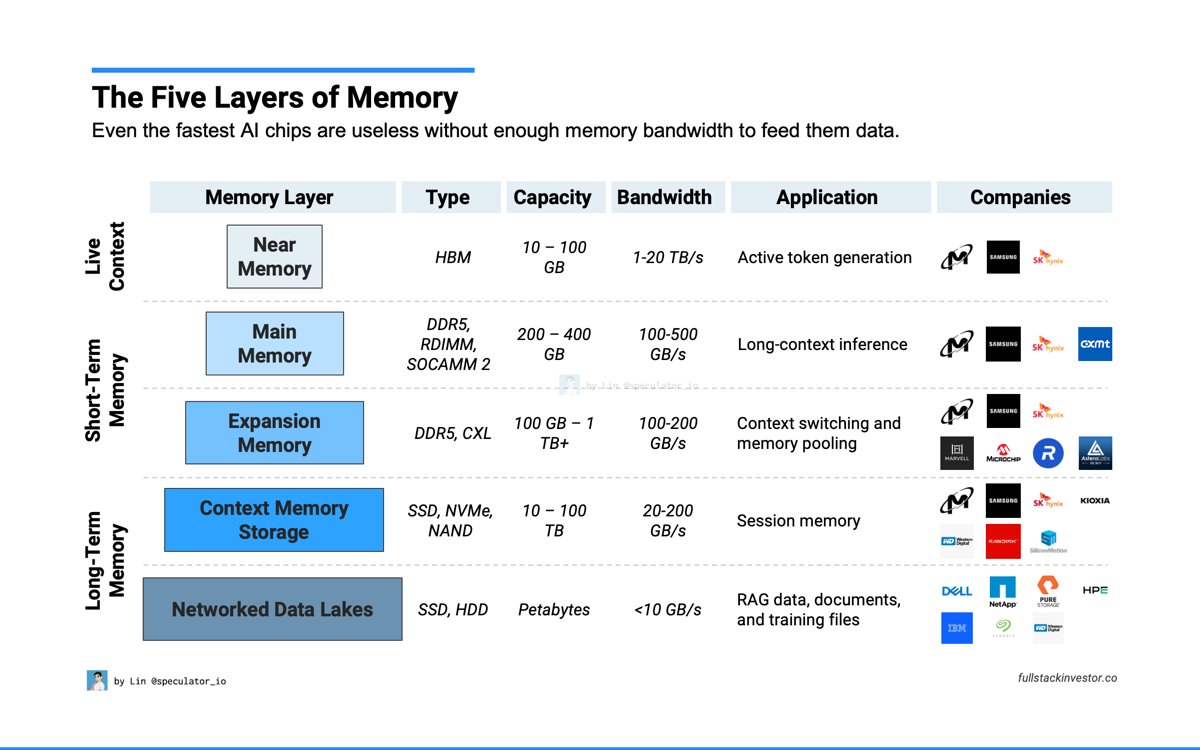
The Five Layers of Memory 1. Near Memory: Sk hynix, Samsung $MU 2. Main Memory: Sk hynix, Samsung, CMXT $MU 3. Expansion Memory: SK hynix, Samsung $MU $ALAB $MRVL $MCHP $RMBS 4. Contexted Memory: SK hynix, Samsung, Kioxia $MU $WDC $SNDK $SIMO 5. Data Lakes: $STX $WDC $DELL $NTAP $P $HPE $IBM
Lin tweet media
English
48
182
890
75.5K
Tut C🅰️pital
Tut C🅰️pital@kingtutcap·
$ASTS: Wen launch? Wen satellites? Wen moon? Those who just focus on that are missing the bigger picture by miles. AST’s tech has worked as promised on every single satellite they’ve launched. They have partnerships with over 50 MNOs worldwide. Those MNOs have installed gateways specifically for AST SpaceMobile service. The satellites are being used by the government across various defense applications with six satellites just launched. This is all proof that AST’s tech is far and away better than everything out there based on pure facts. Nothing more, just pure facts. When you look at competitors like Starlink, their current service is subpar at best. It’s not providing broadband or 5G speeds. If you think about it Starlink, they promised broadband too from day 1 and the best they could for now is texting and SOS. The next generation satellites they’re planning to launch are contingent on Starship being successful, which is still TBD, maybe six months to a year or more. Elon timelines so who knows. And even when they do launch, it’s still going to take time to build the full constellation and make sure the service is tested and works. So basically, let’s say 2-3 years out. And btw, no one is talking about how Elon basically gutted their entire direct-to-cell team last year. The two co-founders of Swarm who were put in charge of the D2C division were let go last year. This is equivalent of Abel or Scott leaving. If Starlink D2C was making any real advancement, you would have seen way more MNOs sign with them and way more defections from AST. If they were as good as AST, they would have signed up most of the market already because everyone in the industry would want to work with them if they believed it was the best or only option. Competitors like Amazon and others are not even in the picture for four or five years. So people are talking about a six-month or even a year delay for AST’s constellation when every competitor is years away from achieving what AST has already achieved. As long as the technology works as promised, the only issue is getting the satellites up. They will get there sooner or later. Is it going to take six months? A year? A year and a half? It really doesn’t matter, because AST has the lead for a first-of-its-kind technology. Funny enough, if AST was a private company it would be easily be valued triple its current market cap. It’s just a matter of getting production right, and things seem to be getting better. The company clearly is going through production hell which is no surprise. AST went from a lean startup to 10x their operations in 2 years from staff to footprint. Many innovative companies failed because they couldn’t scale and went bankrupt. The company has $3.5B in cash. Three point five billion. Cash is king and buys you time, people, satellites, spectrum, etc. And every single exec is busting their ass and working night and day. Abel is literally sleeping on the factory floor. If you go check the Glassdoor reviews, people who left complain about long and insane working hours. In the cheesiest way possible, they are giving it their all and have been fully aligned with shareholders in the process in terms of insider selling. Any company that ran that much would have seen nonstop insider selling (See PLTR or many other names out there). All things said, the company is on the right track. Every satellite comes closer to the next one. BB7 came a couple weeks after BB6, and now three months later we’re getting three satellites. The production cadence is catching up. Whether we hit 25 or 45 this year doesn’t really matter in the bigger picture. It’s coming (albeit slowly) but it’s coming. A bet on AST is a bet on the direct-to-cell market, because at this point in time, and based on all the facts and all the technological milestones achieved so far, they are the market leader.
English
17
41
371
28.8K
Serenity
Serenity@aleabitoreddit·
Random CPO related names I like: - $SIVE - Foci (3363) - $TSEM - Browave (3163) - PCL (4977) - $AXTI - Msscorps (6830) - $IQE - Shunsin (6451) - Furukawa Electric (5801) - $MTSI - Nextronics (8417) - $LITE - $COHR - FitTech (6706) - $GFS - $ASX - LandMark (3081) - $SOI Disclosure: I own most, not all though.
English
123
160
1.9K
279.2K
Paradis Labs
Paradis Labs@ParadisLabs·
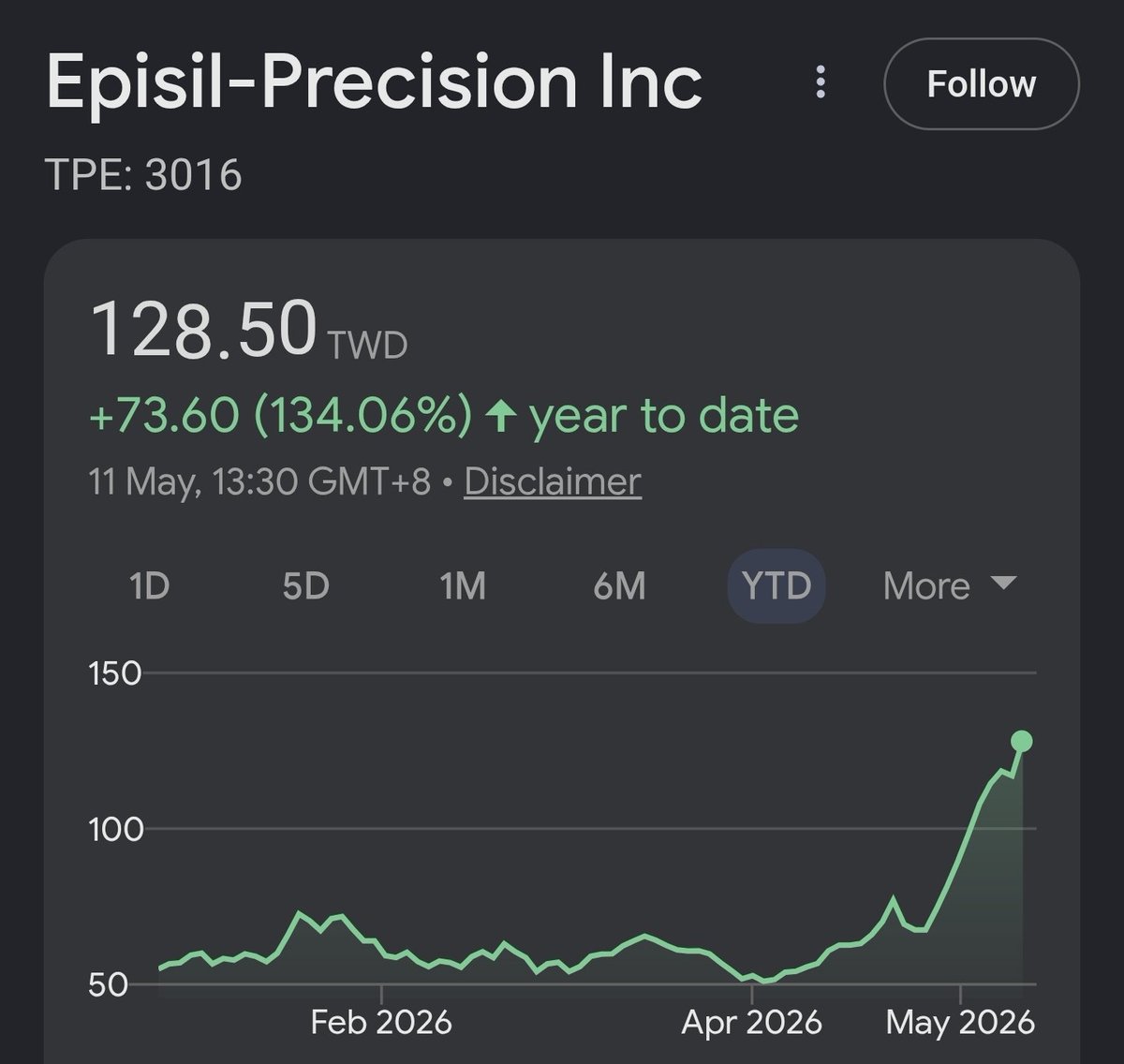
Oh, Episil-Precision just casually up 152% since my thesis. Impressive since literally nobody talked about the company before me. Might've outdone myself with this one?
Paradis Labs tweet media
Paradis Labs@ParadisLabs

Episil-Precision. A Taiwanese pure-play supplier of epitaxial processes inside the global power bottleneck. At less than $500M market cap?! $TSM rely on them for high yields... Even NASA engineers rely on them for GaN devices... Episil-Precision are recognized as the only player in Taiwan able to mass-produce both SiC & GaN epitaxial wafers simultaneously. Acting as a highly convenient one-stop-shop for foundries. The AI power constraint ----- Data centers need gigawatt-scale loads. But modern compute clusters throw up power swings that destabilize traditional grids. EVs demand semis that handle high voltages and temps without performance loss. Traditional silicon has hit its physical threshold. The solution lies in wide-bandgap (WBG) materials: > Silicon Carbide (SiC) > Gallium Nitride (GaN) These operate at 600V-1,200V+ with minimal energy loss. However, their adoption is restricted by manufacturing complexities in the initial growth phase, known as epitaxy. This is where Episil-Precision operates as a mission-critical asset. Episil’s position in the supply chain ----- Episil-Precision is a pure-play supplier of epitaxial processes. It acts as the bridge between raw material substrate vendors and device fabricators. Instead of logic design or volume foundries, Episil handles the front-end material engineering that transforms raw wafers into active electronic platforms. By depositing a crystal layer on a substrate, Episil defines a chip's thickness, resistivity, and dopant profiles. Companies like $NVDA and even NASA engineers rely on Episil to de-risk their operations since this layer determines the final yield of subsequent fab steps. Filling the epitaxial bottleneck ----- The transition to WBG materials has created a huge supply chain bottleneck. Growing GaN or SiC on supporting substrates produces intense mechanical stress due to lattice mismatches. At temperatures >1,000°C, this stress causes the wafer to warp, creating cracks or current collapse. Episil-Precision fills this bottleneck via patented nitride structures that grow alternating buffer layers to absorb mechanical stress. Engineers track structural stress second-by-second in real-time. This ensures that after cooling, the wafer returns to a flat state free from bowing. Without these material capabilities, downstream foundries like $TSM would face sh!t yields, stalling global electrification. Their technological moat ----- Episil's competitive moat is built on 25+ years of institutional process knowledge. Epitaxy is not a commodity; recipes for gas flows and temperature gradients require years of trial and error to perfect. The relationship with clients features high switching costs. In sectors like automotive, qualification cycles take over a year. Once Episil achieves IATF 16949 certification, clients are locked into the supply chain to avoid liability risks. Episil is also the only player in Taiwan capable of mass-producing SiC and GaN epitaxial wafers simultaneously. Competitive dynamics ----- The market features a tier of conglomerates focused on high-volume 300mm bulk silicon for logic (e.g. SUMCO, Shin-Etsu Handotai, GlobalWafers). However, power electronics require a high-mix, lower-volume batch profile on 150mm/200mm lines. The massive capital structures of mega-suppliers are not geared toward mastering the localized stress bottlenecks of WBG processing. Also vertically integrated leaders like $WOLF and STMicroelectronics are overwhelmed by AI demand. To meet backlogs without waiting for new fab construction, these IDMs are outsourcing to independent foundries like Episil. There are some Chinese competitors, but they have consistent defects. Not ideal when some end-clients are EVs. Vanguard alliance is a scaling catalyst ----- Historically, Episil’s growth was capped by capital constraints. This changed when Vanguard International Semiconductor acquired a 13% stake in Episil for approximately $77.1M. Vanguard provides the manufacturing scale for power management chips. Episil provides the WBG expertise. This alliance ultimately grants Episil the gravity to secure volume contracts from Japanese giants like Renesas Electronics and Denso. ----- Episil-Precision is a critical solution provider inside the global power bottleneck. Power systems simply cannot rely on legacy silicon platforms. The transition to WBG materials is non-negotiable. Because the growth of GaN and SiC on supporting substrates produces severe mechanical stress that ruins processing yields, third-party foundries and IDMs are forced to rely heavily on advanced epitaxy specialists. Episil-Precision directly fills this bottleneck by applying its process knowledge,designs, and real-time curvature tracking systems to produce ultra-high-yield starting materials.


English
17
14
201
39.6K
Ren
Ren@Ren_aramb·
Anders Storm. Former CEO of $SIVE for almost 10 years, gives us an informed opinion on what is going on with Sivers. The EFN piece framed 8B SEK in new US holders as retail speculation. Anders asks the right question instead: who actually sits behind that 8B SEK and what are they trading? We’ve been saying this for a couple of months. The InP laser shortage is bigger than most think. The CPO external light source market is real. The Jabil partnership, the Ayar Labs ecosystem, the O-Net collaboration – none of that is hype. That’s a confirmed commercial pipeline building toward a 2027-2028 volume production window. So when a Swedish expert quoted by EFN as a “former Sivers consultant” – the one saying the company is overhyped – can’t be recalled by anyone who worked there, including Anders and former board members, you have to ask yourself: who benefits from that kind of analysis??? Most retail investors still haven’t connected the dots between photonics and the AI buildout. That gap is where the opportunity lives. 8B SEK doesn’t flow through Schwab, IBKR, and Clearstream on pure speculation. Someone always knows. The question is whether you did it before or after they did. Long $SIVE
Anders Storm@StormDirac

EFN reports that ~50% of Sivers Semiconductors is now held by "new investors", primarily through CBNY, Charles Schwab, Interactive Brokers, and Clearstream. Combined value: ~8 billion SEK. efn.se/investerarna-s… It is framed as these investors are driving this on speculation. Yes maybe, that is of course possible. Or is there another angle? My take, SEK8B..what? Hence my reaction would probably be the opposite, this could be worth investigating: What thesis are these allocators actually trading? Is it pure speculation with SEK 8B in play? Who sits on these SEK8B? EFN however have asked "Richard Schatz, senior researcher in photonics at RISE Research Institutes of Sweden and former consultant for Sivers", for his opinion about Sivers. So what did Mr. Richard Schatz say: "There are several companies that manufacture these kinds of lasers, and Sivers is far from alone. I don't understand why the company has become so hyped. There are many players, not just in Europe and the US, but also in China," says Schatz. Honestly I have been COO and CEO at Sivers for almost 10 years 2015-2024 (2015 we had 18 headcount I known everyone in the Company until 2024) and also ask Board members that was in the board many years before me, both for Sivers and former CST Global (Sivers Photonics today) and none of them can recollect Mr. Schatz. I also sent an email, asking the reporter that interviewed Mr S and asked when he claims to have been a consultant at Sivers. Without reply. This doesn't really matter, it is just shows where the digging stops. Sivers Semiconductors is one of a handful of merchant InP laser suppliers globally. They have disclosed partnerships with POET Technologies, Jabil (1.6T LRO), O-Net, Ayar Labs and operate in the External Light Source category that scale-up CPO architectures depend on. Either are all these US investors dramatically wrong about the photonics layer of AI infrastructure, or the institutional allocators routing through US brokerages have identified what most Swedish investors haven't yet. Maybe this is worth investigating which? To be 100% clear no one knows (not even me), who has the right hypothesis, that we might know in 2028-2030 time frame. To help anyone intressted, I made this free and open substack to explain how the money flows. As they said in Washington follow the money... This article also gives insight to how Swedish retail trades in the stack via Avanza. andersstorm.substack.com/p/the-ai-inter…

English
6
17
272
49.9K
Negligible Capital
Negligible Capital@negligible_cap·
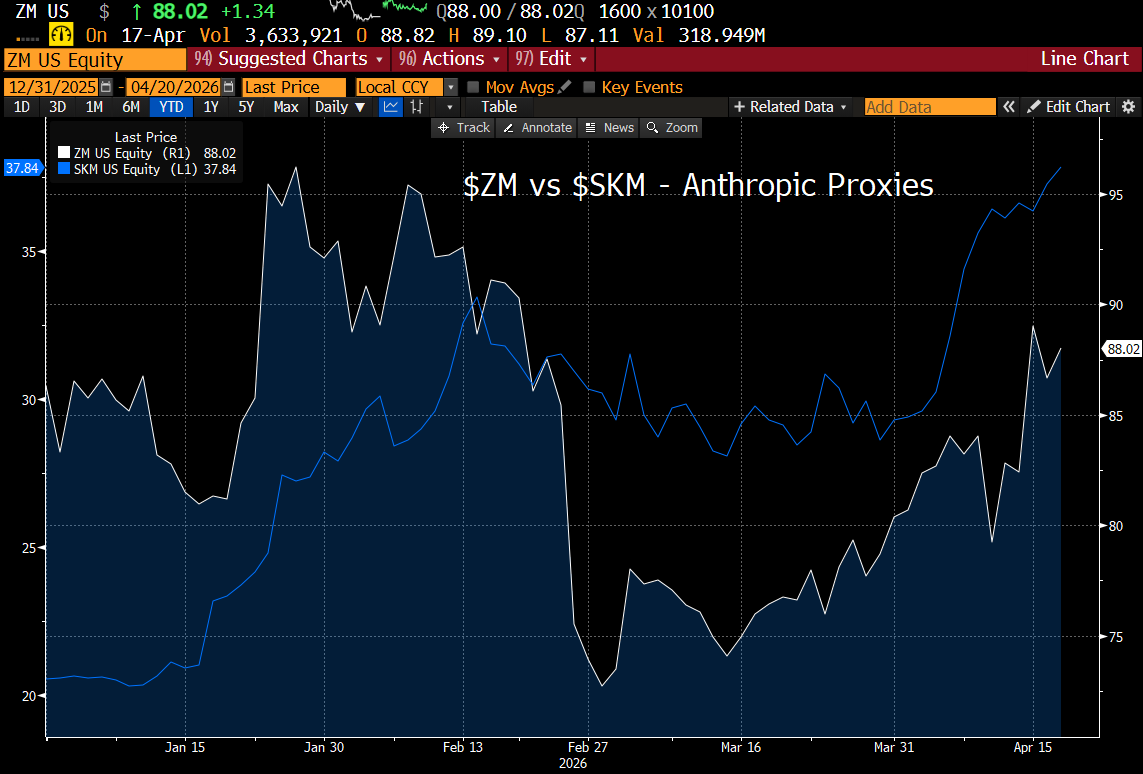
$SKM is a significantly better Anthropic proxy than $ZM. Both companies do have significant stakes in Anthropic, but SK Telecom's is much larger on both an absolute basis and relative basis. $ZM invested $51M at a $4.5B post-money valuation in Anthropic's series C round in May of 2023. $SKM invested nearly 2x the amount Anthropic did - they invested $100m at a $5B post-money valuation in a series C extension round in August of 2023 Since Series C, Anthropic has raised several other rounds - most recently they raised Series G in February of 2026 at a $380B valuation. Without getting too into the weeds on each round, accounting for dilution from each subsequent funding raise I estimate the effective percentage ownership of Anthropic for $ZM to be 0.6% and for $SKM to be about 1.07%. Since the Feb funding round at a $380B valuation, Anthropic's value has soared in the secondary markets. A few days ago the WSJ reported secondary platforms were valuing Anthropic at over $600B, rising over 60% in Q1. Business Insider also reported last week that Anthropic is actively receiving venture cap offers at an $800B valuation. Meanwhile I am told perp markets like Hyperliquid may be valuing Anthropic as high as $1T (though I haven't personally verified). So, using $800B as the valuation point for Anthropic, Zoom's 0.6% stake is worth just under $4.8B, or around a 90x return on their investment (not bad) At that same $800B valuation though, SK Telecom's 1.07% stake is worth around $8.6B, or about 85x their initial $100m investment (also not bad) Now, again without getting into the weeds, looking at $ZM and $SKM at a high level: $ZM: Market Cap: $27.1B (17.7% Anthropic) EV: $19.4B (24.7% Anthropic) $SKM: Market Cap: 14.6B (59% Anthropic) EV: $23.4B (36.8% Anthropic) So to summarize, when you buy 1 share of $ZM at $88 today, you get about $15.6 in Anthropic. When you buy one share of $SKM today at around $38 (despite shares running up over 80% YTD) you are getting $22.4 in Anthropic. Without opining on the value of the legacy businesses of Zoom and SK Telecom, one can see that SKM is a significantly better vessel to buy Anthropic exposure today than Zoom. Also if you back out the Anthropic stake of SKM in particular, the legacy business is being valued at ridiculously cheap levels (around 0.4x P/S) which is probably due to the value of the Anthropic stake not being fully realized yet rather than the value of the legacy biz dropping off a cliff. While $SKM is already up 80% YTD as the market has begun pricing the true value of their Anthropic stake, I believe it still has more room to run, especially leading up to Anthropic's IPO coming later this year, and is undoubtedly a better proxy for pure-play exposure relative to Zoom. For disclosure, I've held $SKM since mid-January and will continue to hold - not investment advice.
Negligible Capital tweet media
English
38
34
342
89.6K
Johan N.
Johan N.@rk8215·
I love $DGXX out of those three. $1.1B + $1.4B additional option with $CBRS is nuts for such small company. They also signed SubQ couple weeks earlier. Two senior Oracle directors joined to $DGXX recently together with ex-Verizon CEO who sits also in Blackrocks board of directors.
English
7
14
56
4.2K
Michael Sikand 🦑
Michael Sikand 🦑@michaelsikand·
I'm hearing retail is being denied the $CBRS IPO happening Thursday. People are reporting no allocation requests on their brokers like $HOOD? Here are 3 $CBRS proxy revenge trades for retail investors worth deeper research. Polymarket shows a 74% chance $CBRS closes above $50B on day 1. On $510M of 2025 revenue, $50B is a 98x P/S multiple. $VICR ($11.7B MC, 15x P/S, $767M LTM rev) The vertical power delivery monopoly inside Cerebras' wafer scale engine. CEO confirmed Cerebras is the lead customer and orders are filling the entire new Andover ChiP fab. That could be an $800M annual run rate that could basically double VICR's entire revenue base? $WYFI ($815M MC, 10x P/S, $79M LTM rev) WhiteFiber signed a 5 year, 5MW colocation deal to be Cerebras' first Canadian data center. AI grade colo runs $2.5-$3M per MW per year, so call it $12 to $15M recurring from Cerebras alone, around 15 to 20% of current revenue, with right of first refusal on additional capacity at the site. $DGXX ($411M MC, 8.8x P/S, $34M LTM rev) Just locked a 10 year $1.1B colocation contract with Cerebras (up to $2.5B with expansion options) for a 40MW Alabama site. That's $110M of base annual revenue from one customer, 3x DGXX's entire current top line. Up to $250M annually with full expansion, over 7x current revenue. This one feels the most asymmetrical on raw math as a pure play on CBRS success. 98x P/S for the chip but 8 to 15x for the infra around it. I haven't had time this weekend to develop a super strong opinion on which of these plays I might like the most, but curious what some other traders think? I saw @BULLOFBRITAIN is talking about $DGXX today, and he's always a great source.
Michael Sikand 🦑@michaelsikand

The biggest IPO so far in 2026 launches in 4 days. $25B $CBRS brands itself an $NVDA killer. It claims its huge, ultra fast AI chips are 21x faster than B200s. But it's a parlay trade. $CBRS depends on a $20B OpenAI contract. For $CBRS to win, OpenAI must win as well.

English
35
40
396
100.6K
Serenity
Serenity@aleabitoreddit·
Did you remember my $AXTI InP substrate bottleneck call last year anon? IntelliEPI CEO (Q1 2026 ER): "The InP substrate shortage is a bottleneck for the entire AI infrastructure" Digitimes: "Taiwan's IntelliEPI warns of severe indium phosphide supply shortage" I said as photonics ramps: There was going to be a major InP bottleneck as all the next-gen AI architectures go optical. This was most goated call with AXT as the upstream chokepoint. I'm usually a few months ahead of time, but they play out directionally. While I'm sitting in existing bottlenecks up 1800%+, I'm long CPO as the next major supercycle.
Serenity tweet media
Serenity@aleabitoreddit

Thanks, we might not see a InP substrate bottleneck yet, but we’ll likely see it when hyperscaler ASICs (TPU, Trainium, Maia, etc.) ramp up -> supply strains like memory mid-2026. That doesn’t quite mean material providers should be valued like $LITE, but the fact that the entire future AI buildout has a single point of failure that comes from a small $600m company like $AXTI is amusing.

English
104
70
1.2K
376.3K
Operation🅰️TM
Operation🅰️TM@OperationATM·
@Ren_aramb so much option flow into SNDK it's ridciulos in to 2000s from 1000->1500 in a week after earnings algo reaction and now it's heading to 2k and beyond
English
0
0
1
231
Ren
Ren@Ren_aramb·
Maybe we’re all just overthinking it… After hundreds if not thousands of trades. My YTD is barely more than half of that of $SNDK, which hasn’t stopped going up. Going forward, if anyone asks me for investing advice, I’m going to irresponsibly tell you to full port $SNDK and call it a day. Just kidding… or maybe not…
Ren tweet media
English
33
7
237
43.6K