Orceum

16 posts

Orceum banner
Orceum

Orceum

@Orceum_ai

The Operating System for our personal agents

San Francisco Katılım Eylül 2025
1 Takip Edilen17 Takipçiler
Orceum retweetledi
Peter Akande
Peter Akande@_PeterAkande·
Interesting to see the hype @openclaw is getting, everyone is finally getting to see the future I am trying to build with @Orceum_ai
English
0
1
2
106
Orceum
Orceum@Orceum_ai·
Happy New Year from us at Orceum ✨✨
Orceum tweet media
English
1
3
8
229
Orceum
Orceum@Orceum_ai·
Merry Christmas 🎄
Wishing you peace, joy, and a well-deserved break.
Orceum tweet media
English
0
2
5
526
Orceum retweetledi
Techparley Africa
Techparley Africa@Techparleynews·
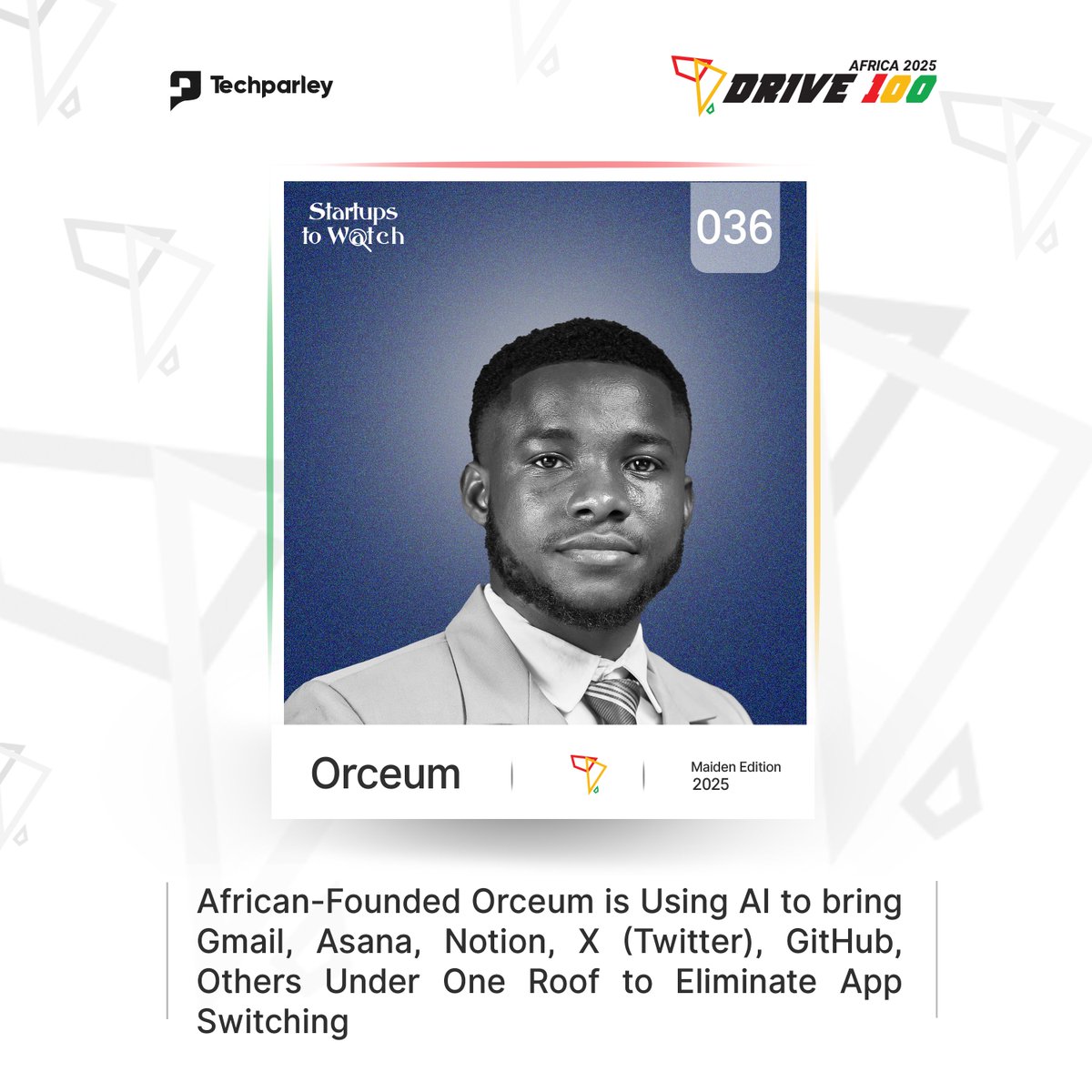
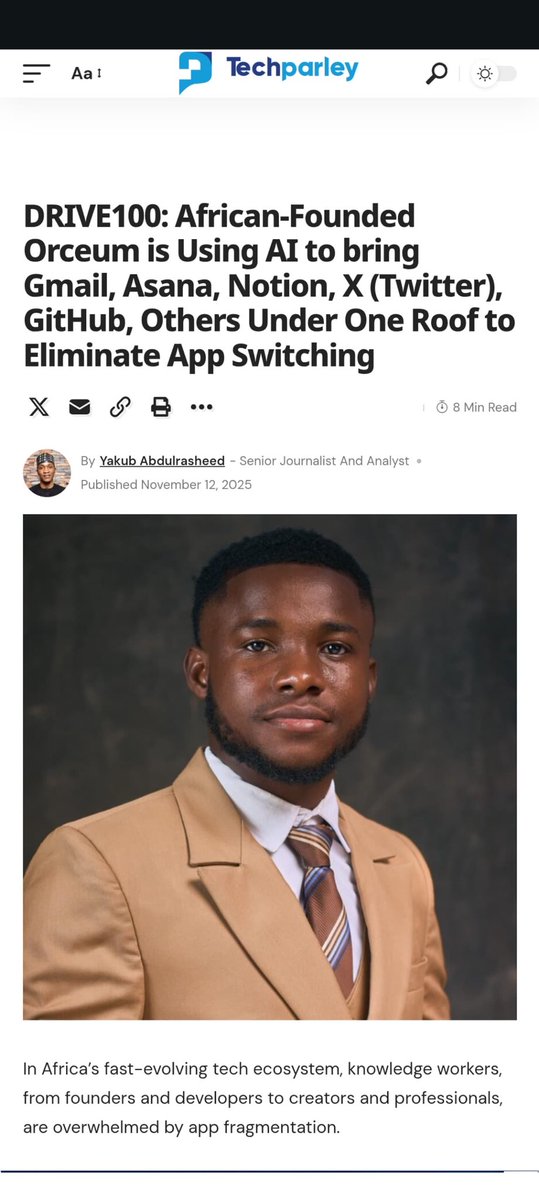
Many use over 10 different tools daily, Gmail, Slack, Notion, Twitter, GitHub, constantly switching contexts, copying and pasting, and manually coordinating tasks. This not only consumes hours each week but also interrupts focus and slows productivity. In this edition of Techparley’s Drive100, we spotlight @Orceum_ai, a conversation-driven productivity platform designed to unify fragmented workflows into a single, AI-powered workspace. Co-founded by Peter Akande, Orceum allows users to execute complex tasks across multiple apps directly from a single interface. “Teams today are stretched thin between too many apps. Orceum isn’t just another platform, it’s a movement to unify how modern work happens,” Akande says. Key features include integration with Gmail, Calendar, Slack, Notion, Twitter, GitHub, Linear, and Spotify, plus AI-powered task execution and workflow automation. As reported by Techparley's Yakub Abdulrasheed, Orceum is designing philosophy that prioritizes simplicity, adaptability, and cultural relevance for African teams, allowing it to fit naturally into existing work patterns. Read now: techparley.com/drive100-afric… #Drive100 #Stories #Startup #Africa2025 #futuretech #techtrends #technewsafrica #instagood #fyi #trending #techparley
Techparley Africa tweet media
English
0
7
14
187
Orceum
Orceum@Orceum_ai·
Work isn’t harder — it’s noisier.
Too many apps, too many tabs, too many tiny steps draining your focus. A beta user told us:
“I’m not tired from the work… I’m tired from preparing to work.” December is the month we fix that.
English
0
1
5
176
Orceum retweetledi
Engr Gudbee || Craftiaxops
Engr Gudbee || Craftiaxops@0xEngr_gudbee·
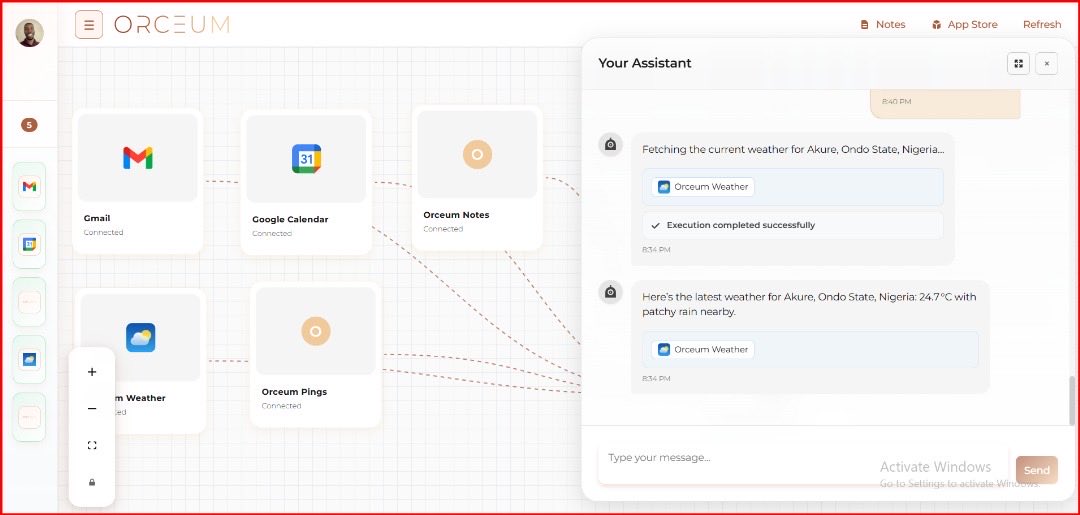
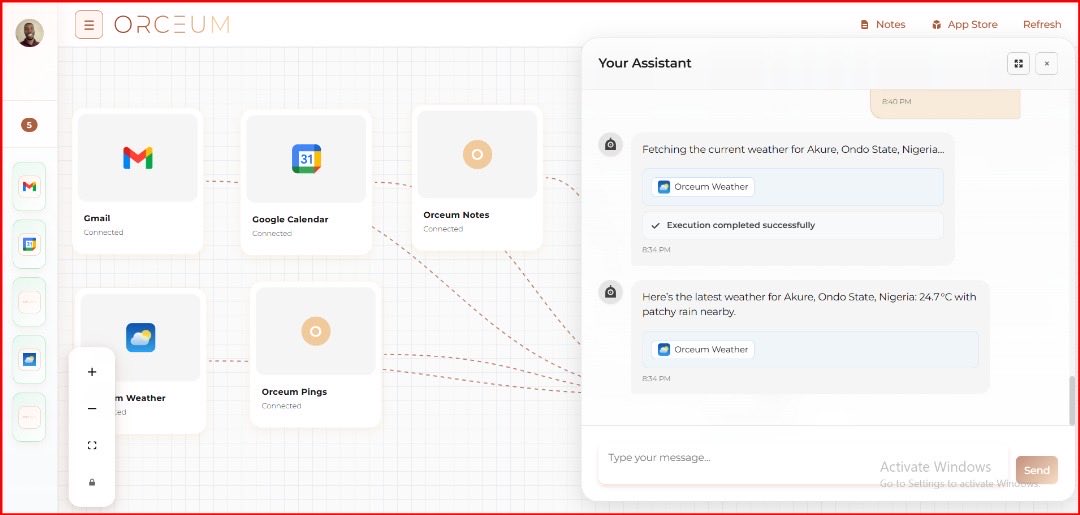
Been playing with my @Orceum_ai dashboard today. One canvas where the assistant talks to Gmail, Calendar, Notes, Weather and even socials like X, WhatsApp and Telegram. Draft once, publish everywhere, and get reminders where you are. One command center for my digital life! Gm people
Engr Gudbee || Craftiaxops tweet media
English
2
2
12
183
Orceum
Orceum@Orceum_ai·
Execution is the missing layer of AI. Everyone built chat interfaces. Nobody built the system that actually touches your tools. We’re changing that.
English
0
2
5
193
Orceum retweetledi
Daniel Akande
Daniel Akande@_danielakande·
Why does AI stop at the draft? What if you just texted "send this to Sarah" and it happened? Would you still open Gmail?
English
0
2
3
136
Orceum
Orceum@Orceum_ai·
What if you could post to X, update Notion, play Spotify...manage your digital life, All from one conversation? 👀
Orceum tweet media
English
0
2
6
137
Orceum
Orceum@Orceum_ai·
AI can think — but it still can’t do. Orceum makes it act.
English
0
0
4
94
Orceum retweetledi
Peter Akande
Peter Akande@_PeterAkande·
The Rise of the Horizontal Operating System In 2023, Andreessen Horowitz (@a16z ) published a defining piece on vertical operating systems — software that becomes the central nervous system for entire industries. Toast for restaurants. Procore for construction. Salesforce for CRMs. These companies didn’t just build better tools; they built the foundational layer that stitched together every other system their customers used. The thesis was simple but powerful, the most valuable software isn’t just a system of record, it’s the operating system — the common interface, the source of truth, the place where work actually happens. These vertical operating systems owned what a16z called the “foundational customer unit”, the core data object that every other application in the ecosystem revolves around. And with the rise of AI and AI agents, something else is quietly emerging. A new category that follows the same playbook but operates on a completely different axis. The horizontal operating system for individuals. Everyone agrees personal AI agents are inevitable. Every tech company is racing to build them. But there’s a massive infrastructure problem hiding in plain sight: AI agents have nowhere to live. Your digital life is fragmented across dozens of apps — Gmail, Slack, Notion, Calendar, Twitter, Spotify, Linear, Figma. Each app has its own interface, its own data model, its own way of doing things. An AI agent that wants to help you needs to somehow orchestrate across all of them. We’ve been solving this with APIs and integrations for decades. Zapier has 7,000+ app connections. Make, IFTTT, Pipedream — the integration layer is mature and massive. But here’s the thing: that infrastructure was built for developers, not for AI. When you tell your AI “schedule a meeting with Sarah next week and send her the deck we’ve been working on,” that’s not a webhook trigger. That’s not a pre-configured automation. That’s intent → reasoning → multi-app coordination → execution. It requires an entirely different kind of infrastructure. The AI Assistant needs: 1. Context about who Sarah is and your history with her 2. Access to your calendar to find availability 3. Understanding of which deck you mean 4. Ability to create the event, send the invite, attach the file 5. Memory that this happened so it can reference it later No single app has all of this. And stringing together APIs on the fly isn’t enough. What’s missing is an operating system. What Makes Something an Operating System? Let’s borrow from the a16z playbook. A vertical operating system has three defining characteristics: 1. It owns the foundational unit — the core data object everything else revolves around. 2. It becomes the common interface, where users spend their time and other apps integrate. 3. It abstracts away other systems, you work through the OS, not directly with underlying apps For Salesforce, it’s the customer object (SFID). For a horizontal personal OS, the foundational unit is your intent graph — the running history of what you want done, across every app, with all the context of how you work. Think about what this contains: > Every action you’ve asked your AI to take > Your communication patterns and relationships > How you use different tools and when > Your preferences, workflows, and habits across your entire digital life > The outcomes and feedback from everything that’s been done Each app sees a fragment of you. The OS sees the whole. That cross-app behavioral graph is the foundational unit of personal AI. The Interface Vertical operating systems won by becoming where the work happens. Restaurant staff live in Toast all day. Construction teams live in Procore. The operating system becomes the interface layer that makes the underlying systems feel like implementation details. For individuals, that interface is already here: conversation. You’re already in WhatsApp. You’re already in Slack. You’re already in iMessage. The horizontal OS doesn’t need to create a new place for you to be — it meets you where you already are and turns conversation into the universal interface for your entire digital life. This is the insight that changes everything. You don’t need to open Gmail to send an email. You don’t need to open Twitter to post. You don’t need to open Calendar to schedule. You just say what you want done, and the OS handles the orchestration. The apps become infrastructure. The conversation becomes the interface. Uhmm Isn’t this Zapier? Here’s where people get confused. “Isn’t this just automation? Don’t we already have tools for this?” No. The difference is fundamental. Zapier, Make, IFTTT — these are automation tools you configure. You set up triggers and actions. If this, then that. They’re deterministic, pre-programmed, and you’re the one doing the thinking. A horizontal operating system is an intelligent system you converse with. It reasons about what you want. It makes decisions. It handles ambiguity. It learns your patterns over time. It takes autonomous action on your behalf. It’s the difference between writing a bash script and hiring an employee. When you tell your OS “I need to follow up on that conversation from last week,” it knows which conversation, who it was with, what was discussed, and what follow-up makes sense. It doesn’t need you to configure that logic. It reasons through it. This is only possible now because LLMs can do something automation tools never could: understand intent and plan across contexts. The Technical Enablers Three things had to converge to make horizontal operating systems possible: 1. LLMs that can reason and plan GPT-5, Claude, and their successors aren’t just text predictors. They can break down complex requests, reason about multi-step workflows, and make contextual decisions. They’re the “brain” that can actually operate an OS. 2. Standardized protocols for app connections Anthropic’s Model Context Protocol (MCP) is doing for AI-app integration what USB did for hardware. It creates a standard way for AI to connect to any service. Thousands of tools can become instantly pluggable. 3. Conversational interfaces we already use. Unlike vertical operating systems that had to train users on new software, horizontal OS plugs into interfaces people already live in. You don’t learn a new tool — you just start talking to your AI differently. What Success Looks Like Imagine your day in five years. Morning: “Push today’s standup to 2pm and block focus time for the Q4 doc.” Your OS checks everyone’s availability, sends the Slack update, moves the meeting, and blocks your calendar — done before you finish your coffee. Midday: “Book me a flight to New York for that conference next month.” Your OS knows which conference from the email thread, searches flights matching your preferences, books it, and syncs everything to your calendar with venue details. Evening: “What needs handling before I’m out tomorrow?” Your OS scans email, Slack, and Linear, surfaces the three critical threads, drafts responses for your approval, and sends them when you confirm. You never opened an app. You described what you needed. It happened. The apps became implementation details. The OS became your operating environment. The Race Is Already On Multiple players are positioning for this: Consumer AI companies building agent infrastructure from the ground up. I am building this at @Orceum_ai  — users connect their apps once, then control everything through conversation from WhatsApp, Slack, or anywhere they already are, another notable player is Poke (by the @interaction company of California) Productivity platforms trying to expand horizontally. Notion wants to be your workspace OS. Linear wants to be your engineering OS. But they’re app-centric, not AI-centric. The interface is still clicking, not conversing. Big tech trying to own the assistant layer. Apple has Siri. Google has Assistant. Microsoft has Copilot. They have distribution but lack the foundational unit — they don’t own your cross-app behavioral data. And the newest which doesn’t fit in the “lack the foundational unit” category, @OpenAI ChatGPT, the addition of ChatGPT Apps looks very promising. The Best Time to Build is Now Here’s the thing about operating systems: they’re incredibly hard to displace once established. Windows dominated for decades. iOS and Android own mobile. When an OS gets entrenched, it’s nearly impossible to unseat. We’re in the brief window where the horizontal OS layer is still undefined. The technology is ready. The user behavior is shifting. The infrastructure is being built. In five years, this race might be over. Someone will own the conversational interface to your digital life. They’ll have your intent graph, your app ecosystem, your behavioral data. They’ll be the layer every other app builds for. The vertical operating system thesis taught us that the most valuable software becomes infrastructure, the common layer everything else plugs into. The horizontal operating system thesis says the same dynamic is about to play out for personal AI. The race is on. Hi, I am Peter, building @Orceum_ai , the operating system for your Personal AI. Connect your apps once, control everything through conversation. If you’re interested in shaping the future of personal AI, reach out.
English
2
2
5
938