Crystal Heath DVM@drcrystalheath
Tucked away on pages 744-746 of the Farm Bill is language that will allow corporations to continue confining mother pigs to gestation crates.
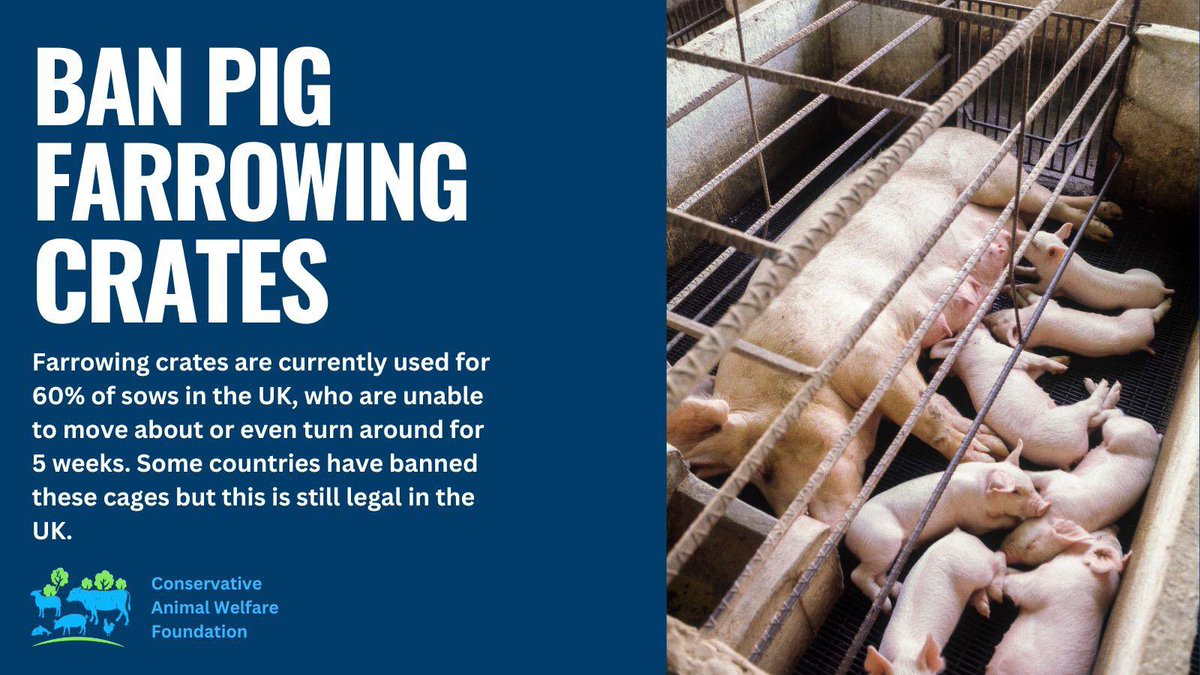
These 2.5' x 7' stalls restrain sows for 114 days of their pregnancy. They can only walk a few steps forward and a few steps backward.
It's called the 'Save Our Bacon Act' even though the legislation it would overturn does not address bacon. It would overturn legislation that prevents the sale of whole-pig meat that comes from pigs whose mothers were confined to gestation crates in jurisdictions that voted to ban such products.
This is not just an animal welfare issue. It's a public health threat.
Research shows that 92.6% of crated sows exhibit abnormal, repetitive behaviors—known as stereotypies—within just one hour of observation. This is a coping mechanisms triggered by stress.
Crated sows have markedly higher levels of stress hormones like adrenaline and noradrenaline compared to group-housed sows. This stress response weakens their immune systems and promotes the growth and virulence of foodborne pathogens such as Salmonella, Campylobacter, and Staphylococcus aureus. These pathogens often infect their piglets—who are born immunosuppressed and frequently remain infected until slaughter.
These infections frequently go undetected during inspections. When infected pigs are slaughtered, the resulting pork can transmit disease to consumers. This isn’t hypothetical—it’s happening now.
Piglets of group-housed sows show better resistance and resilience and are exposed to fewer pathogens.
Pork is a leading source of foodborne illness in the U.S., responsible for an estimated 787,000 illnesses annually.
Salmonella alone is responsible for $1.9 billion in annual public health costs, and 60% of sows test positive for it. Ten percent of these strains are multidrug-resistant.
Campylobacter from pork causes 37,000 infections in the U.S. annually, and 83% of Campylobacter found on commercial pork chops is resistant to at least one medically important antibiotic.
The overuse of antibiotics in pork production worsens this crisis. According to 2022 data from the FDA:
-89% of pork producers administer antibiotics through feed or water.
-27.1% of all medically important antibiotics sold in the U.S. are used in pork production.
-This contributes directly to the rise of antimicrobial resistance—a threat the World Health Organization estimates is responsible for 700,000 deaths each year.
The language in the Farm Bill says:
SEC. 12006. Ensuring the Free Movement of Livestock-Derived Products in Interstate Commerce.
(a) Purpose.— The purpose of this section is to—
(1) protect the free movement in interstate commerce of products derived from covered livestock;
(2) encourage a national market of such products;
(3) ensure that producers of covered livestock are not subject to a patchwork of State laws restricting access to a national market; and
(4) ensure that the United States continues to uphold its international trade obligations.
(b) In General.— Producers of covered livestock have a Federal right to raise and market their covered livestock in interstate commerce and therefore no State or subdivision thereof may enact or enforce, directly or indirectly, a condition or standard on the production of covered livestock other than for covered livestock physically raised in such State or subdivision.
(c) Protecting Interstate Commerce.— Producers of covered livestock have a Federal right to raise and market their covered livestock in interstate commerce and therefore no State or subdivision thereof may enact or enforce, directly or indirectly, as a condition for sale or consumption, any condition or standard of production on products derived from covered livestock not physically raised in such State or subdivision that is in addition to, or different from, the conditions or standards of production in the State in which the production occurs.
(d) Definitions.— In this section:
(1) Covered Livestock.— The term “covered livestock”
(A) means any domestic animal raised for the purpose of—
(i) slaughter for human consumption; or
(ii) producing products manufactured for human consumption which are derived from the processing of milk, including fluid milk products; and
(B) does not include domestic animals raised for the primary purpose of egg production.
(2) Production.— The term “production”—
(A) means the raising (including breeding) of covered livestock; and
(B) does not include the movement, harvesting, or further processing of covered livestock.
Photo courtesy of @WeAnimals.