_Suraya_

3.1K posts

_Suraya_ banner
_Suraya_

_Suraya_

@PGi_2001

Suraya

USA Katılım Haziran 2009
1.6K Takip Edilen707 Takipçiler
_Suraya_
_Suraya_@PGi_2001·
Despite only being attested in Standard Babylonian the Akkadian word for spider has apparently survived in vernacular forms of NENA to this day. “Standard Babylonian is the primary literary dialect of the Akkadian language, used from 1500 BCE to the Hellenistic period. It served as a prestige lingua franca across the ancient Near East, written in cuneiform to record epic poetry, royal inscriptions, and myths like the Standard Babylonian Epic of Gilgamesh.”
_Suraya_ tweet media
_Suraya_@PGi_2001

The original word for spider in Northeastern Neo-Aramaic comes from Akkadian. It survives today in Jewish Zakho qota/qo’ta and as a compound noun in Assyrian Urmi jardaquti (cobweb) and Assyrian Zakho zaqraqoda (spider) and other Jewish dialects as qennaqota (spider) 1/3

English
0
1
8
272
_Suraya_ retweetledi
Ancestral Whispers
Ancestral Whispers@Sulkalmakh·
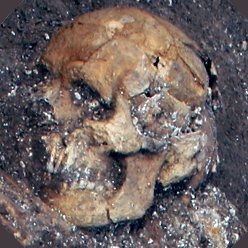
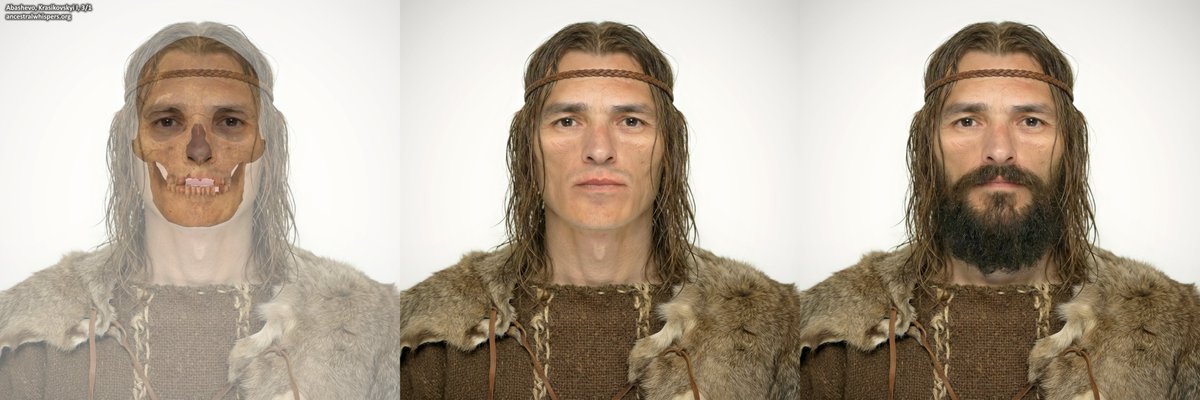
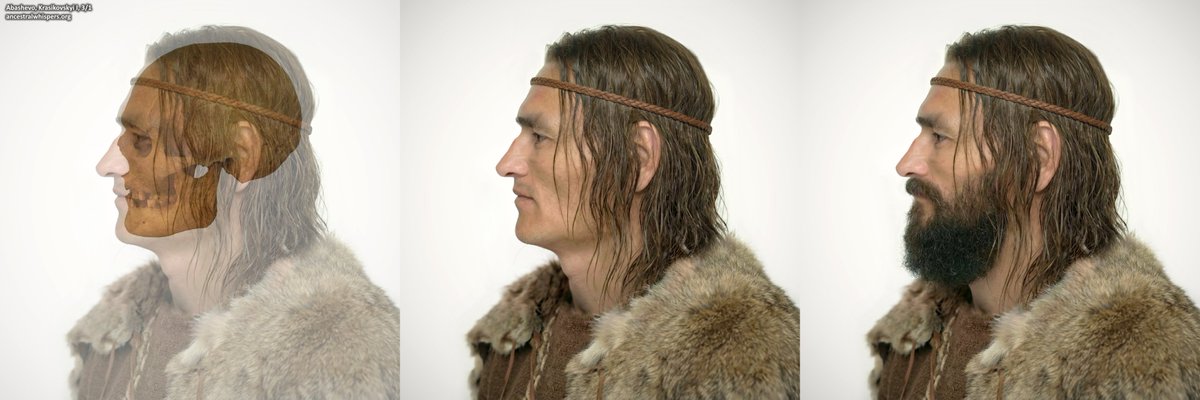
Facial reconstruction of a 4,000-year-old Proto-Aryan He belonged to the Volga–Ural group of the Proto-Indo-Iranic Abashevo culture, which included previously known materials from the Samara Trans-Volga region and the forest-steppe Cis-Urals (the cemeteries of Syezzhee I, Churakaevsky, and the more recently discovered Malo-Yuldashevo I, Krasikovo I, and Imangulovo-2e II). Ground burials at Mount Berezovaya (Bulanovo I) in the Orenburg Cis-Urals have also been tentatively attributed to this group, where rituals and artifacts characteristic simultaneously of the Abashevo, Sintashta, and Seima-Turbino populations were recorded (A.A. Khokhlov, A.P. Grigoriev). Excavations of Kurgan Cemetery I near the village of Krasikovo in the Krasnogvardeysky District of Orenburg Oblast were carried out by the Orenburg Archaeological Expedition of Orenburg State Pedagogical University. The site was discovered in 1977 by N. L. Gabelko (Morgunova). The cemetery is located north of Krasikovo, on the steep left bank of the Tok River (a right tributary of the Samara River), and consists of six earthen kurgans measuring 13–40 m in diameter and 0.25–2 m in height. In 2015, two kurgans (Nos. 1 and 3), situated in the southern and central parts of the cemetery, were investigated. Kurgan 3 was excavated manually; its diameter was 18 m and its height 0.25–0.3 m. The mound was constructed on a level platform; no surrounding ditch was identified. Stratigraphy: turf layer; mound fill (dark-gray humified sandy loam, 10–50 cm thick); buried soil (brown humified sandy loam, 30–50 cm thick); subsoil (brown loam). Within the mound fill and at the level of the buried soil, human bones (from the destroyed Burial 2), animal bones, a rounded stone artifact, and fragments of a single pot-jar–shaped vessel were found. The ornamentation of the vessel consisted of fingernail impressions beneath the rim and cord impressions forming a “herringbone” pattern. Four burials were identified in the kurgan: two intrusive burials (Nos. 1 and 2) at the level of the buried soil, one of which (Burial 2) was completely destroyed, and a complex consisting of Burials 3 and 4, over which the mound was constructed. In intrusive Burial 1, the skeleton lay extended on its back, head oriented to the southeast, and was accompanied by small fragments of resin. To the right of the skull stood a handmade pot-shaped vessel with a carination in the upper third of its height, an everted rim, and a pronounced internal ridge. The rim was decorated with zigzag lines; the body from the rim to the ridge was ornamented with horizontal fluting; below the ridge, a band of slanted lines was applied, underlined at the bottom by a double zigzag. The ornament was made with a toothed stamp, whose comb impressions covered the lower part of the vessel. In the upper part beneath the rim, the vessel had been repaired with two bronze clamps. Based on the vessel, Burial 1 of Kurgan 3 dates to the Sintashta period (Evgenyev A.A., Morgunova N.L., Kryukova E.A., Kharlamov P.V.). The individual (Krasikovo I, 3/1) had a large cranial length of 194 mm, a medium-large cranial breadth of 146 mm, and a large cheekbone breadth of 145 mm.
Ancestral Whispers tweet mediaAncestral Whispers tweet media
English
22
63
468
37.8K
_Suraya_
_Suraya_@PGi_2001·
Interestingly, the "akilu-pest", also attested in the Sefire Inscription, may have also influenced Syriac. cal.huc.edu/oneentry.php?l…
_Suraya_ tweet media
_Suraya_@PGi_2001

The word for caterpillar from Akkadian, "munu," is apparently attested in the Aramaic/Akkadian bilingual Sefire Inscription from ~750 BCE. There is a word in Syriac, "mnina," with the meaning of "weevil," that may be related. The Akkadian word is attested in Standard Babylonian and Neo-Assyrian. mn: cal.huc.edu/oneentry.php?l… mnīnā: cal.huc.edu/oneentry.php?l… "Weevils are a family of beetles (Curculionidae) identifiable by their distinct elongated snouts (rostrum) and elbowed antennae. They are major agricultural and field pests whose larvae (white, legless grubs) feed on roots, stems, and seeds, while adults chew notches into foliage and flowers. [1, 2, 3, 4]" The image is from the Chicago Assyrian Dictionary. Weevil description from Google.

English
0
1
3
162
_Suraya_
_Suraya_@PGi_2001·
The word for caterpillar from Akkadian, "munu," is apparently attested in the Aramaic/Akkadian bilingual Sefire Inscription from ~750 BCE. There is a word in Syriac, "mnina," with the meaning of "weevil," that may be related. The Akkadian word is attested in Standard Babylonian and Neo-Assyrian. mn: cal.huc.edu/oneentry.php?l… mnīnā: cal.huc.edu/oneentry.php?l… "Weevils are a family of beetles (Curculionidae) identifiable by their distinct elongated snouts (rostrum) and elbowed antennae. They are major agricultural and field pests whose larvae (white, legless grubs) feed on roots, stems, and seeds, while adults chew notches into foliage and flowers. [1, 2, 3, 4]" The image is from the Chicago Assyrian Dictionary. Weevil description from Google.
_Suraya_ tweet media
English
0
1
4
279
_Suraya_
_Suraya_@PGi_2001·
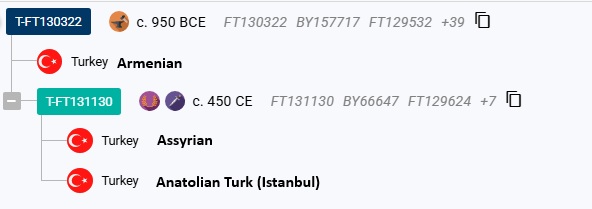
The Assyrian has been further defined as T-FT131130 and now has an estimated TMRCA with an Anatolian Turk from Istanbul dating to 450 CE. The Armenian remains far removed from the two men, with an estimated TMRCA between the three dating to 950 BCE. Interestingly, I have not come across a TMRCA between an Assyrian from the Church of the East and an Armenian dating to less than ~3000 years ago. However, I have come across a TMRCA between Kurds and an Assyrian under Q-YP1228 dating to ~1700 years ago and now with an Anatolian Turk under a YDNA T clade dating to ~1550 years ago. Image (edited) from FTDNA.
_Suraya_ tweet media
_Suraya_@PGi_2001

The final result for the tests I had sponsored were reported today. The Assyrian YDNA T Malik line shares a lineage with an Armenian and Anatolian Turk with an estimated TMRCA at FTDNA of 1000 BCE.

English
0
1
20
2K
_Suraya_
_Suraya_@PGi_2001·
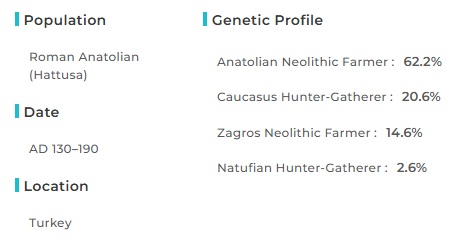
In addition to ancient/modern Iranian and Armenian sources, perhaps the modeling of modern Assyrians would improve by the inclusion of an ancient Anatolian/Greek source, such as samples BOG020 and BOG024 from Koptekin et al. 2023. It is possible that there were significant population movements eastward of "Syriac" Christians during the early centuries of the Common Era. Image is from Illustrative DNA.
_Suraya_ tweet media
English
0
0
8
769
_Suraya_ retweetledi
Silenced 🐴🐭 Ms. Information
Silenced 🐴🐭 Ms. Information@C19VaxInjured·
One of the greatest missionary movements in Christian history is almost unknown in the West. The Church of the East began in ancient Mesopotamia, modern day Iraq and parts of Iran, and carried Christianity across the Silk Road from Persia to Central Asia, India, and even China centuries before many Western missions existed. Their churches, monasteries, and missionaries stretched from the Mediterranean to the Pacific. They translated Scripture into numerous languages and spread Christianity throughout Asia for nearly 800 years. Even parts of the Mongol ruling elite had deep Nestorian Christian connections. Today, the descendants of the Church of the East are found mainly among Assyrian Christian communities in Iraq, Syria, Iran, and the diaspora around the world. ✝️🌍
English
3
11
48
940
_Suraya_
_Suraya_@PGi_2001·
youtu.be/w8tfBLvlN98?si… This is the Hurrian Hymn No. 6, a composition dedicated to the goddess Nikkal. The Syriac text, the Doctrine of Addai. refers to Nikkal.
YouTube video
YouTube
English
1
1
4
414
_Suraya_
_Suraya_@PGi_2001·
oracc.museum.upenn.edu/saao/aebp/Esse… “While little else is known about Šubria's gods and temples, it is clear that the "Tigris Source" must have ranked high as a sanctuary not just in local but also in international esteem. Shalmaneser III of Assyria (858-824 BC) deemed a visit to the "Tigris Source" so important that in 852 BC he had his army take a detour on its march back from inner Anatolia to Assyria; he and his predecessor Tiglath-pileser I (1114-1076 BC) performed sacrifices at the "Tigris Source" and both left inscriptions and reliefs at the site. Based on this, but also on the fact that the Tigris was considered a major deity in the Hurrian world, we should rank the "Tigris Source" among such famous and important sanctuaries as the temples of Haldi at Muṣaṣir PGP  and of the storm god at Kumme PGP . Moreover, as a holy precinct in open nature, with unlimited water and shelter from the powers of nature offered by three caves in addition to the river grotto itself, the "Tigris Source" would seem uniquely qualified to serve as a refuge sanctuary.” “But while the kingdom was lost, Šubrian culture continued. The local language was Hurrian and while no texts have survived as far as we know, a few words at least are documented in a letter from Sargon's correspondence (SAA 5 35: 31, r. 11). The names of the inhabitants of Šubria, including its kings, were Hurrian, and the names of a number of women listed in an Assyrian administrative document (ZTT 30) excavated in 2009 in the nearby provincial capital of Tušhan on the Upper Tigris (modern Ziyaret Tepe), dated to the 7th century BC, illustrate that the use of Hurrian names continued in the region.”
English
0
2
8
279
_Suraya_
_Suraya_@PGi_2001·
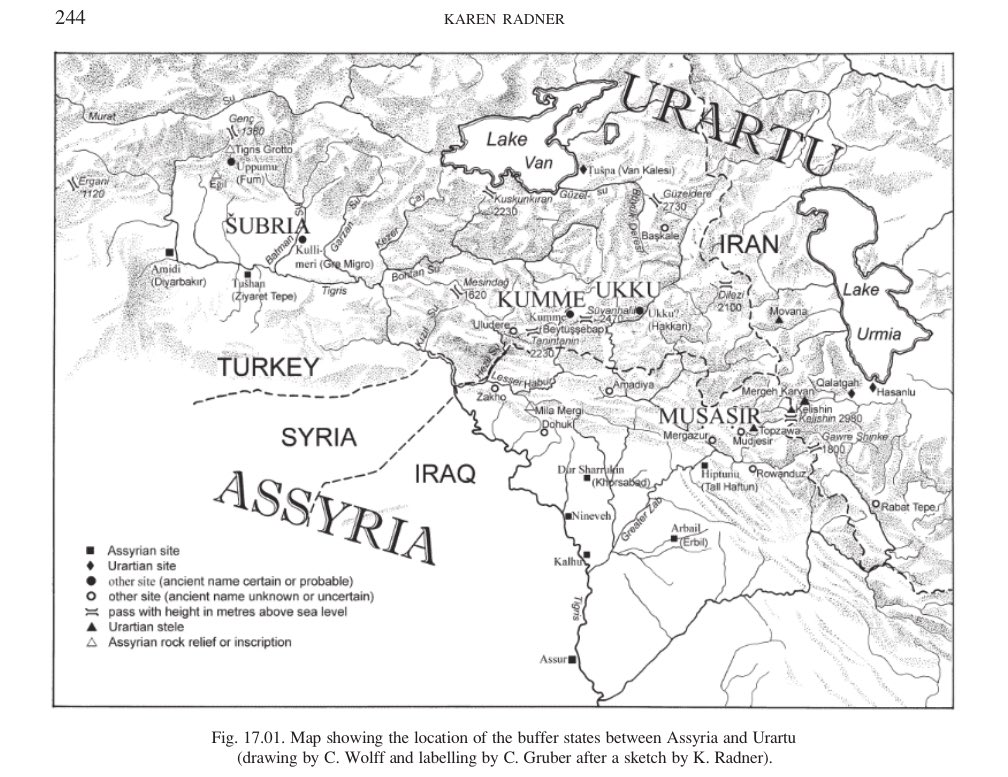
I believe Iron Age samples from some of the “buffer” states between Urartu and Assyria may help with the modeling. I think these are all believed to be remnants of Hurrian kingdoms. Musasir was of course the spiritual center of Urartu as it was the home of the shrine to the god Haldi as well as the location where Urartian kings were consecrated. Radner, Karen. 2012 Between a Rock and a Hard Place: Musasir, Kumme, Ukku and Šubria – the Buffer States between Assyria and Urartu. In S. Kroll Et Al. (Ed.), Urartu-Bianili. Acta Iranica 51 (Leuven 2012) 243-264. .
_Suraya_ tweet media
English
2
0
16
778
Ari
Ari@KurdiCompendium·
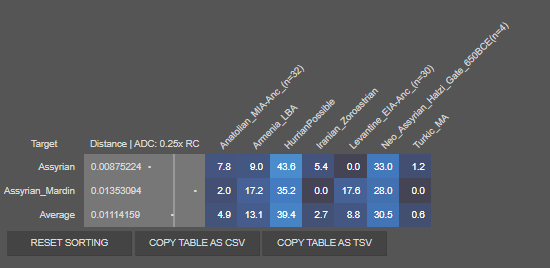
Assyrians are in some ways the inheritors of the Neo-Assyrians, but the direct Neo-Assyrian admixture in modern Assyrians is realistically less than half. Modern Assyrians are quite evidently Hurrian-shifted compared to Neo-Assyrians, which most people assume reflects Armenian admixture. While modern Assyrians do have some Armenian admixture, this is greatly exaggerated, because people are not using Hurrian samples to contextualise the excess Bronze Age Armenia-type ancestry flowing on top of the Hurrian baseline. Adding a modern Armenian sample here seems to interfere too much with the sources I have added, so it should be extrapolated, rather than calculated directly. What constitutes a Hurrian sample is difficult to determine with certainty, but I am personally quite confident that the samples from the Neo-Assyrian and Achaemenid era in Batman are a good reflection of this. These are what I have grouped as "HurrianPossible." The Neo-Assyrian samples themselves show some Hurrian-type shifts, but this should not significantly affect the model. In fact, the R1b Neo-Assyrian elite archer sample is probably distantly paternally Hurrian. G25 has some issues capturing Caucasus-type admixture, so these numbers should not be taken too literally. It is also difficult to properly calculate admixture proportions, as we are missing many relevant samples. Alternative or similar models can be run, but in theory the objective of the model should remain the same.
Ari tweet media
QardaghOfArbela@Arbelite1

Using qpAdm, Modern Assyrians can be modeled as having 100% ancestry from the Iron Age Assyrian samples from Nineveh.

English
19
8
65
13.8K
_Suraya_ retweetledi
Ancestral Whispers
Ancestral Whispers@Sulkalmakh·
Facial reconstruction of a 2,600-year-old man from Samtavro, Mtskheta, Georgia During the Late Iron Age, Mtskheta and the region of Shida Kartli were already largely under the control of expanding Kartvelian groups, who had spread from Samtskhe and Imereti and were additionally associated with the Koban culture, whose core area was the basin of the Great Liakhvi River. The preceding population of the Shida Kartli region, linked to the Trialeti culture cultural horizon - a syncretism of the preceding Kura-Araxes culture and incoming Indo-European invaders from the Steppes, who likely left the increasingly arid steppes following the cataclysmic 4.2-kiloyear event and were likely associated with Proto-Armenic tribes - had been conquered and gradually assimilated by the expanding Kartvelians. This process contributed to the formation of a proto-East Georgian genetic profile. Within a few centuries, these populations would give rise to the historical Kingdom of Iberia, with Mtskheta as its capital city. The remains of this man were described by the anthropologist Malkhaz Abdushelishvili as follows: "Ground burial No. 246. Northern sector. 1946 (Kaladandze). Male skull, fragmented, but restored fairly satisfactorily. Dolichocranial, egg-shaped in form, with well-developed parietal eminences. In lateral view, the skull is rounded, with pronounced brow ridges and a projecting occiput. The relief is well expressed. The skull is massive and large.” He had a massive cranial length of 202 mm, a very large cranial width of 149 mm, and a medium-large cheekbone width of 133 mm. His cranial capacity was very large ~1670cm³.
Ancestral Whispers tweet mediaAncestral Whispers tweet media
English
6
18
187
10.9K
_Suraya_ retweetledi
_Suraya_
_Suraya_@PGi_2001·
Great post! LEXICAL INVENTORY FOR “DATE” AND RELATED TERMS IN ARAMAIC OF CONFIRMED OR PROBABLE AKKADIAN ORIGIN Note the instances of Jewish Babylonian! Mandaic texts have not survived through the years to the extent of Jewish Babylonian. However, given the close relationship between Jewish Babylonian and Mandaic, it is not unreasonable to expect that many of the below items of Akkadian origin were once also part of the lexical inventory of Mandaic, in my opinion. 1.Unripe date: Galilean, Syriac, Jewish Babylonian cal.huc.edu/oneentry.php?l… 2.Dilmun date: Official Aramaic, Jewish Babylonian cal.huc.edu/oneentry.php?l… 3. Date palm spadix: Jewish Babylonian, Syriac cal.huc.edu/oneentry.php?l… 4.Dried date: Jewish Babylonian, Syriac (Reborrowed through Arabic?) cal.huc.edu/oneentry.php?l… 5.Woven basket for dates: Jewish Babylonian, Mandaic (Sumerian->Akkadian) cal.huc.edu/oneentry.php?l… 6.Inferior date: Jewish Babylonian cal.huc.edu/oneentry.php?l… 7.Unripe dates: Jewish Babylonian (Sumerian->Akkadian) cal.huc.edu/oneentry.php?l… 8.Basket for dates: Syriac Lexicon, Jewish Babylonian Geonic Unripe dates: Jewish Babylonian cal.huc.edu/oneentry.php?l… cal.huc.edu/oneentry.php?l… 9.Young date palm: Jewish Babylonian, Jewish Babylonian Geonic, Mandaic cal.huc.edu/oneentry.php?l… 10.Palm branch stump: Syriac Lexicon, Jewish Babylonian cal.huc.edu/oneentry.php?l… 11.Detached palm frond: Jewish Babylonian cal.huc.edu/oneentry.php?l… 12.Palm branch: Galilean, Syriac, Jewish Babylonian, Mandaic cal.huc.edu/oneentry.php?l… 13.Palm spadix or spathe: Qumran, Jewish Babylonian cal.huc.edu/oneentry.php?l… 14.Palm branch: Jewish Literary, Jewish Babylonian, Late Jewish Literary cal.huc.edu/oneentry.php?l… 15.Web of palm fibers: Syriac (Specifically Assyrian-Akkadian) cal.huc.edu/oneentry.php?l… 16.Palm band or the like: Jewish Babylonian cal.huc.edu/oneentry.php?l… 17.Basket of palm leaves: Jewish Literary, Jewish Babylonian, Late Jewish Literary cal.huc.edu/oneentry.php?l… 18.Heart of the palm: Galilean, Syriac, Jewish Babylonian cal.huc.edu/oneentry.php?l… 19.Rope device for climbing palm trees: Jewish Babylonian cal.huc.edu/oneentry.php?l… 20.Type of palm thorn: Jewish Babylonian cal.huc.edu/oneentry.php?l… Regarding the date palm in southern Mesopotamia. “On the Natural History of the Date Palm Phoenix dactylifera page, Geoff Sanderson writes that the date palm needs “its feet in running water and its head in the fire of the sky.” Such criteria made Lower Mesopotamia in the Tigris and Euphrates delta—where summers are dry, winters are mild, and irrigation was already a thing—the perfect location for the date palm to thrive and become a symbol of fecundity and success, as well as a vital part of the economy. Even with the perfect conditions Lower Mesopotamia provided a date palm, however, it still took the plant four to six years from planting time to bear fruit, along with some 15 to 20 years to reach full productivity. To give some perspective, full productivity for a date palm is an annual output of about 45 pounds (20kg) of fruit per tree. For a plant that played such a vital economic role to so many people, it’s hard to imagine that such yields were enough to, one, support such thriving civilizations, and two, reach quintessence status.” Source: allmesopotamia.wordpress.com/2018/01/28/dat… @Agamemnonuwa
English
1
4
14
2.6K