PLR.99

24 posts

PLR.99 banner
PLR.99

PLR.99

@PLR99Uni

Explore the world. Everything is speed up.

Earth Katılım Mayıs 2022
55 Takip Edilen2 Takipçiler
Claude
Claude@claudeai·
Computer use is now in Claude Code. Claude can open your apps, click through your UI, and test what it built, right from the CLI. Now in research preview on Pro and Max plans.
English
2.5K
4.8K
59.2K
16.1M
Cheng Lou
Cheng Lou@_chenglou·
My dear front-end developers (and anyone who’s interested in the future of interfaces): I have crawled through depths of hell to bring you, for the foreseeable years, one of the more important foundational pieces of UI engineering (if not in implementation then certainly at least in concept): Fast, accurate and comprehensive userland text measurement algorithm in pure TypeScript, usable for laying out entire web pages without CSS, bypassing DOM measurements and reflow

English
1.3K
8.2K
65.1K
24M
PLR.99 retweetledi
宝玉
宝玉@dotey·
发布一个新的 Skill:baoyu-youtube-transcript 输入 YouTube URL,直接抓取视频字幕,生成带章节、发言人和封面图的文档,不需要任何 API Key。 【怎么用】 选择这个 Skill,把 YouTube 链接丢进去就行。支持完整链接、短链接、嵌入链接、Shorts 链接,甚至直接输入视频 ID 都可以。 默认输出带时间戳的 Markdown 格式,也可以导出 SRT 字幕文件。支持多语言,可以指定优先语言,也可以翻译成其他语言。 第一次抓取后会自动缓存原始数据,之后换格式、换参数都不用重新请求,秒出结果。 【工作原理】 底层调用的是 YouTube 的 InnerTube API,这是 YouTube 内部用来获取字幕数据的接口,公开可用但没有官方文档。好处是不需要 Google API Key,不需要 OAuth 认证,脚本直接发请求就能拿到字幕数据。 拿到原始字幕后,脚本会做一次智能断句处理:按句末标点(句号、问号、感叹号等)切分,跨字幕片段合并成完整句子,时间戳按字符长度等比分配,对中日韩文字做了专门适配。这样输出的文本是自然的句子,不是 YouTube 那种碎片化的逐行字幕。 【章节分割】 如果视频描述里有章节时间戳(比如 "0:00 Introduction"),脚本会自动解析,按章节把字幕分段,生成带目录的 Markdown。没有章节信息的视频,就按段落分组输出。 【说话人识别】 这是最有意思的部分。YouTube 字幕本身不带说话人信息,所以识别说话人需要 AI 后处理。 流程是这样的:先用 --speakers 参数抓取原始字幕,脚本会把视频元数据(标题、频道名、简介)和 SRT 格式的原始字幕一起输出到一个 Markdown 文件里。然后启动一个 AI 子代理(用 Claude Sonnet,够用且省成本),按预设的 Prompt 模板处理这个文件。 AI 识别说话人的逻辑分三层优先级:首先从元数据推断,视频标题通常包含嘉宾名字,频道名就是主持人;其次从对话内容判断,比如自我介绍、互相称呼;都不行就用通用标签(Speaker 1、Host 之类),保持全文一致。如果后面对话中才出现名字,会回溯更新前面所有标签。 处理完的输出是带说话人标签的分段对话,长独白会被切成 2-4 句一段,每段末尾带时间范围。 【缓存机制】 第一次运行会缓存四样东西:视频元数据(meta.json)、原始字幕片段(transcript-raw.json)、断句后的字幕(transcript-sentences.json)、视频封面图(cover.jpg)。之后不管切换格式还是重新生成,都直接用缓存,不再请求网络。加 --refresh 参数可以强制刷新。 安装命令: $ npx skills add jimliu/baoyu-skills --skill baoyu-youtube-transcript 项目地址:github.com/jimliu/baoyu-s…
宝玉@dotey

New Agent skill: baoyu-youtube-transcript 🎬 Extract YouTube transcripts directly — no API key needed. ✦ Multi-language support ✦ Chapter segmentation ✦ AI speaker identification ✦ SRT & Markdown output ✦ Smart caching for instant re-formatting Just select the skill and paste a YouTube URL and go. Install: $ npx skills add github.com/jimliu/baoyu-s… --skill baoyu-youtube-transcript
中文
85
464
2K
393.1K
PLR.99
PLR.99@PLR99Uni·
"认知会奖励每一个懂ta的人"
GIF
中文
0
0
0
4
PLR.99
PLR.99@PLR99Uni·
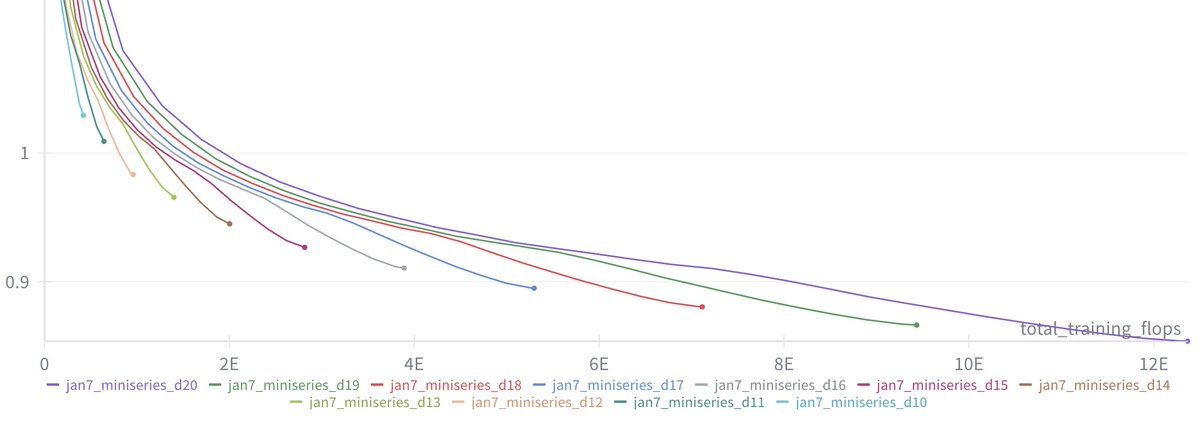
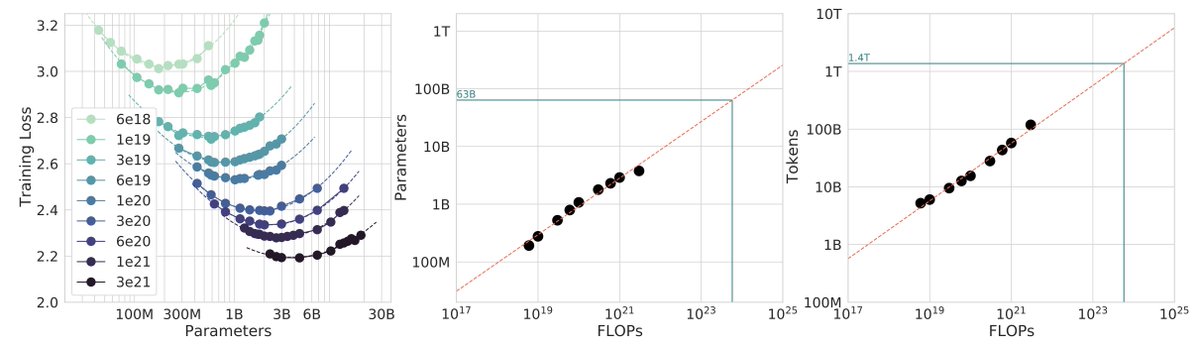
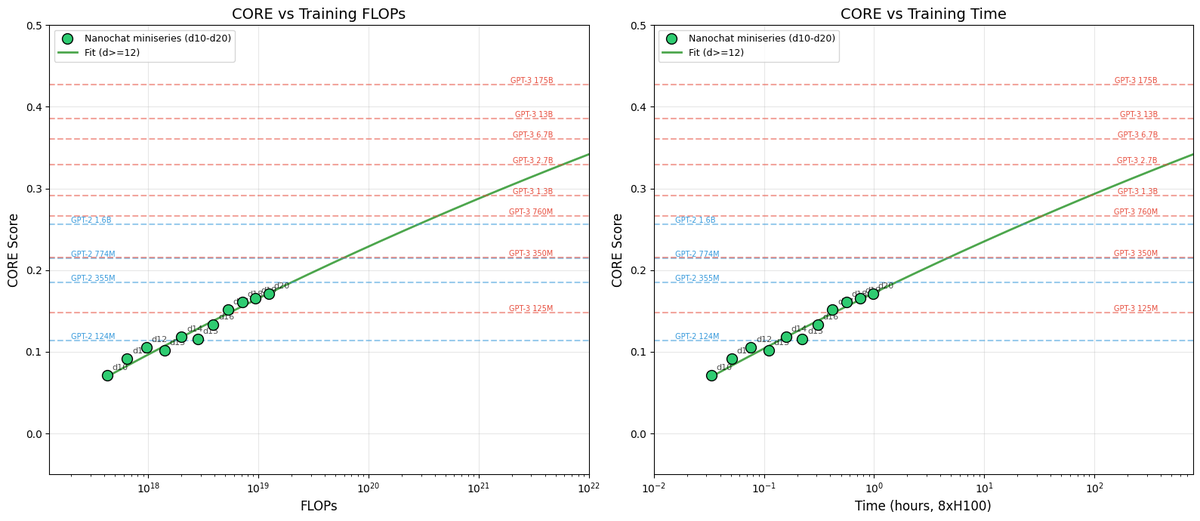
Karpathy 宣布推出 nanochat miniseries v1,這是一系列非常小的、計算最優(compute-optimal)的語言模型,命名為 d10 ~ d20(參數量從 91M 到 477M 不等)。 关键 - 總訓練成本:只花了 100 美元(在 8×H100 GPU 上跑) - 總訓練時間:大約 4 小時 - 數據量與參數量的最佳比例:嚴格遵循 Chinchilla 定律,參數與 token 的指數都是 0.5,最終得出最佳數據:模型參數的比例約為 8(也就是每 1 個參數對應 8 個 token) - 基準測試:使用 DCLM 論文中的 CORE 基準(一個比較困難、比較能反映真實能力的新基準) - nanochat 系列模型的 CORE 分數最高達到 0.171 - 與 FLOPs(計算量)和訓練時間呈現非常好的線性關係 - 即使只花 3 美元 訓練出的最小模型,CORE 就已經超過 GPT-2(GPT-2 的 CORE ≈ 0.114)
Andrej Karpathy@karpathy

New post: nanochat miniseries v1 The correct way to think about LLMs is that you are not optimizing for a single specific model but for a family models controlled by a single dial (the compute you wish to spend) to achieve monotonically better results. This allows you to do careful science of scaling laws and ultimately this is what gives you the confidence that when you pay for "the big run", the extrapolation will work and your money will be well spent. For the first public release of nanochat my focus was on end-to-end pipeline that runs the whole LLM pipeline with all of its stages. Now after YOLOing a few runs earlier, I'm coming back around to flesh out some of the parts that I sped through, starting of course with pretraining, which is both computationally heavy and critical as the foundation of intelligence and knowledge in these models. After locally tuning some of the hyperparameters, I swept out a number of models fixing the FLOPs budget. (For every FLOPs target you can train a small model a long time, or a big model for a short time.) It turns out that nanochat obeys very nice scaling laws, basically reproducing the Chinchilla paper plots: Which is just a baby version of this plot from Chinchilla: Very importantly and encouragingly, the exponent on N (parameters) and D (tokens) is equal at ~=0.5, so just like Chinchilla we get a single (compute-independent) constant that relates the model size to token training horizons. In Chinchilla, this was measured to be 20. In nanochat it seems to be 8! Once we can train compute optimal models, I swept out a miniseries from d10 to d20, which are nanochat sizes that can do 2**19 ~= 0.5M batch sizes on 8XH100 node without gradient accumulation. We get pretty, non-itersecting training plots for each model size. Then the fun part is relating this miniseries v1 to the GPT-2 and GPT-3 miniseries so that we know we're on the right track. Validation loss has many issues and is not comparable, so instead I use the CORE score (from DCLM paper). I calculated it for GPT-2 and estimated it for GPT-3, which allows us to finally put nanochat nicely and on the same scale: The total cost of this miniseries is only ~$100 (~4 hours on 8XH100). These experiments give us confidence that everything is working fairly nicely and that if we pay more (turn the dial), we get increasingly better models. TLDR: we can train compute optimal miniseries and relate them to GPT-2/3 via objective CORE scores, but further improvements are desirable and needed. E.g., matching GPT-2 currently needs ~$500, but imo should be possible to do <$100 with more work. Full post with a lot more detail is here: github.com/karpathy/nanoc… And all of the tuning and code is pushed to master and people can reproduce these with scaling_laws .sh and miniseries .sh bash scripts.

中文
0
0
0
104
PLR.99 retweetledi
Andrej Karpathy
Andrej Karpathy@karpathy·
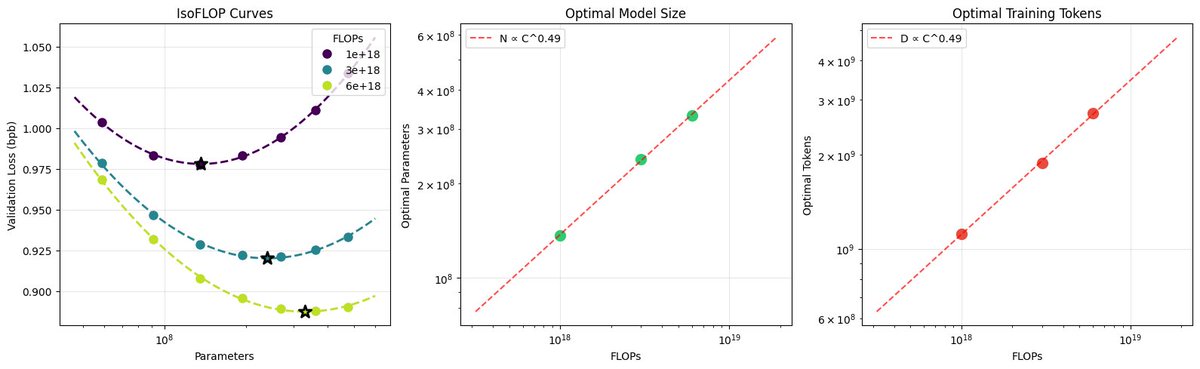
New post: nanochat miniseries v1 The correct way to think about LLMs is that you are not optimizing for a single specific model but for a family models controlled by a single dial (the compute you wish to spend) to achieve monotonically better results. This allows you to do careful science of scaling laws and ultimately this is what gives you the confidence that when you pay for "the big run", the extrapolation will work and your money will be well spent. For the first public release of nanochat my focus was on end-to-end pipeline that runs the whole LLM pipeline with all of its stages. Now after YOLOing a few runs earlier, I'm coming back around to flesh out some of the parts that I sped through, starting of course with pretraining, which is both computationally heavy and critical as the foundation of intelligence and knowledge in these models. After locally tuning some of the hyperparameters, I swept out a number of models fixing the FLOPs budget. (For every FLOPs target you can train a small model a long time, or a big model for a short time.) It turns out that nanochat obeys very nice scaling laws, basically reproducing the Chinchilla paper plots: Which is just a baby version of this plot from Chinchilla: Very importantly and encouragingly, the exponent on N (parameters) and D (tokens) is equal at ~=0.5, so just like Chinchilla we get a single (compute-independent) constant that relates the model size to token training horizons. In Chinchilla, this was measured to be 20. In nanochat it seems to be 8! Once we can train compute optimal models, I swept out a miniseries from d10 to d20, which are nanochat sizes that can do 2**19 ~= 0.5M batch sizes on 8XH100 node without gradient accumulation. We get pretty, non-itersecting training plots for each model size. Then the fun part is relating this miniseries v1 to the GPT-2 and GPT-3 miniseries so that we know we're on the right track. Validation loss has many issues and is not comparable, so instead I use the CORE score (from DCLM paper). I calculated it for GPT-2 and estimated it for GPT-3, which allows us to finally put nanochat nicely and on the same scale: The total cost of this miniseries is only ~$100 (~4 hours on 8XH100). These experiments give us confidence that everything is working fairly nicely and that if we pay more (turn the dial), we get increasingly better models. TLDR: we can train compute optimal miniseries and relate them to GPT-2/3 via objective CORE scores, but further improvements are desirable and needed. E.g., matching GPT-2 currently needs ~$500, but imo should be possible to do <$100 with more work. Full post with a lot more detail is here: github.com/karpathy/nanoc… And all of the tuning and code is pushed to master and people can reproduce these with scaling_laws .sh and miniseries .sh bash scripts.
Andrej Karpathy tweet mediaAndrej Karpathy tweet mediaAndrej Karpathy tweet mediaAndrej Karpathy tweet media
English
226
673
5.4K
712K
Yuchen Jin
Yuchen Jin@Yuchenj_UW·
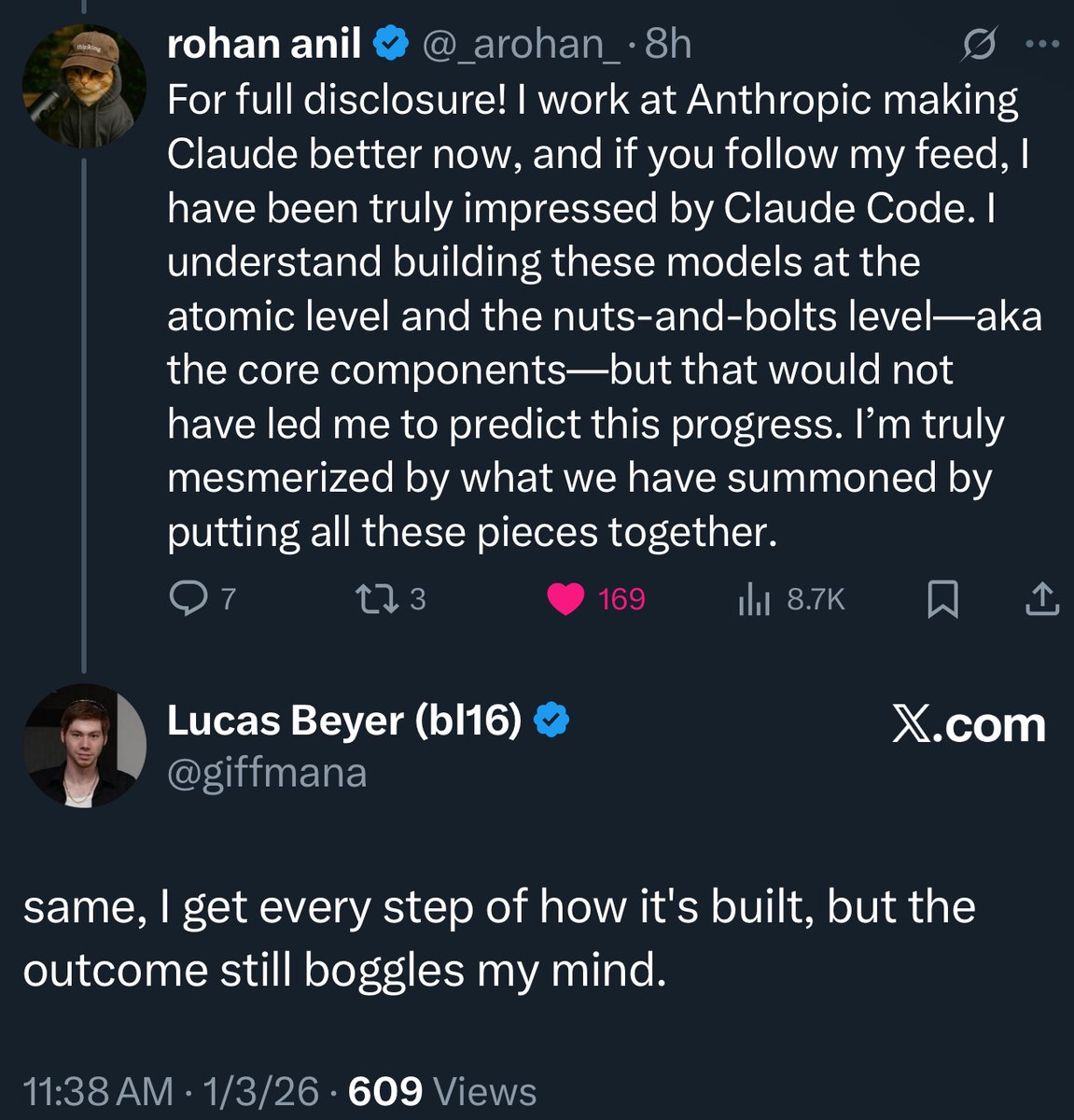
Roban (Gemini co-author, now at Anthropic) and Lucas (ex-DeepMind/OpenAI, now at Meta) understand models like Claude Opus down to the atomic level. And yet, Claude Code still blew their minds. This happens all the time in AI. Even the people who build these systems are shocked by the intelligence that emerges, just like Demis being stunned by AlphaGo’s “Move 37.” That mystery is what pulled me into AI research during my PhD. AI is mysterious and unpredictable, yet deeply attractive. The models just want to learn. Buckle up. Fast takeoff ahead!
Yuchen Jin tweet media
Yuchen Jin@Yuchenj_UW

ex-Google and Meta distinguished engineer, Gemini co-author @_arohan_: “if I had agentic coding and particularly opus, I would have saved myself first 6 years of my work compressed into few months.” This matches my experience. AI collapses the learning curve, and turns junior engineers into senior engineers dramatically fast. New-hire onboarding on large codebases shrinks from months to days. What used to take hours of Googling and Stack Overflow is now a single prompt. AI is also a good mentor and pair programmer. Agency is all you need now.

English
155
245
3K
1.2M
X Freeze
X Freeze@XFreeze·
Jensen Huang: "I think what Elon and the X team did, what they achieved, is singular. It's never been done before Just to put it in perspective, a hundred thousand GPUs....that’s easily the fastest supercomputer on the planet as one cluster A supercomputer that you would build would normally take three years to plan, and then they deliver the equipment and it takes one year to get it all working Yes, we’re talking about 19 days"
English
381
901
6.5K
8.4M
PLR.99
PLR.99@PLR99Uni·
@binghe 过于真实,期待英伟达、AI的发展
中文
0
0
0
7.3K
冰河
冰河@binghe·
某人的2026年预测,有道理吗? 国内不能发了,一发就被封号。。这有啥啊。。还不让胡扯了。。。
冰河 tweet media
中文
392
592
4.2K
1.5M
Robinson · 鲁棒逊
Robinson · 鲁棒逊@python_xxt·
关于今天 委内瑞拉 这个新闻,推荐大家阅读下 刘瑜老师 的 《可能性的艺术:比较政治学30讲》 里面对于委内瑞拉,多有着墨,其中还有专门一节,就讲的委内瑞拉,把前因后果讲的明明白白,相信各位看完,一定会有所收获。 以下为原文摘录: 27. 委内瑞拉: 如何毁掉一个国家 这次课,我们来谈谈另一个拉美国家——委内瑞拉。同为拉美国家,可以说,智利和委内瑞拉在过去二三十年来,走了一个完全相反的道路。智利在走向民主转型的同时,经济也获得了长足发展,而委内瑞拉在民主崩溃的同时也出现了经济崩溃。将这两个国家进行比较,会带来丰富的理论和政策启示。 一个当代经济噩梦 上次课我们讲到,智利转型以来,经济从拉美的中下游水平一路上升到名列前茅,贫困率从46%降到3.7%。委内瑞拉则正相反,1999年查韦斯上台之际,它的人均购买力GDP在拉美顶端,但是20年后的今天,委内瑞拉经济成为一片废墟,贫困率高达90%。 当然,这片经济废墟,你光从委内瑞拉的官方GDP数据上是很难看到的,因为委内瑞拉经济从2015年左右开始崩溃,于是,政府从2015年开始停止发布GDP数据,可谓现代版的掩耳盗铃。但是,网上流行的一句话说得好:世界上有三种东西是不可能隐藏的,喷嚏、爱情还有贫穷。委内瑞拉经济现在糟糕到什么程度呢?有几个数据可以反映。 一个是通货膨胀率。根据国际货币基金组织的估算,2018年这一年,委内瑞拉的通货膨胀率高达1,000,000%。这是什么概念?就是钱几乎没有意义了。你一个月的工资可能只能买两盒鸡蛋,三个月的工资买一瓶橄榄油。所以,才发生委内瑞拉老百姓宁愿用钱当厕纸用也不去买厕纸的情况,因为厕纸比钱贵多了。有一个CNN的记者,为了取钱,2018年的一天花了4小时、跑了4家银行,才取出来1万玻利瓦尔。而100万玻利瓦尔当时也就买一杯咖啡。 更糟的是,历史上的超级通胀,大多是来得快去得也快,但是委内瑞拉的超级通胀,从2016年左右开始到现在,已经4年多了,还没有结束。最近的数据显示,2020年8月,其通货膨胀率还是2,000%多。这几乎是现代史上延续时间最长的超级通货膨胀了。 除了通货膨胀,另一个指标是难民数据。说起难民,我们通常想起叙利亚、也门、阿富汗之类的战乱国家。但是,另一个我们几乎从不谈及的难民危机,发生在委内瑞拉,而它的规模与叙利亚的难民危机旗鼓相当。根据布鲁金斯学会的一个报告,叙利亚内战导致480万难民外逃,委内瑞拉呢?截至2019年底,有460万人,也就是其人口的16%外逃。委内瑞拉医生去哥伦比亚端盘子,律师去秘鲁扫大街,老人儿童在墨西哥沿街乞讨,这样的故事太多了。和平年代出现如此之多的逃难者,委内瑞拉的确是创造了“奇迹”。 其实,即使委内瑞拉政府不发布GDP数据,纸也是包不住火的。根据国际货币基金组织的估算,从2013年到2019年,委内瑞拉的真实GDP缩水了65%,几乎是过去半个世纪左右全球最严重的经济衰退,唯一比它更严重的衰退是内战期间的利比里亚。 这些数字不仅仅是数字,背后是无数人的命运。2017年的一项调查显示,63%的委内瑞拉人因为饥饿体重减轻,减幅平均高达23磅。所以委内瑞拉人开玩笑说,“马杜罗餐”是历史上最见效的减肥餐——马杜罗是他们的现任总统。 在我读过的各种报道中,印象最深的是两条:一个是说委内瑞拉的小学门口经常是救护车的呼啸声,因为上课的学生不停地因为饥饿而晕倒。另一条是一个需要做癌症手术的老太太,医生对她表示,你可以来做手术,但是,你必须自带手术用品——绷带、药品、麻醉剂、消毒剂等,因为医院里真的什么都没有了。这样的荒诞,可以说小说家都编不出来。 查韦斯的「21世纪社会主义」蓝图 一个显然的问题是,何以至此?为什么拉美地区曾经最富有的国家,在短短20年间,会走向经济崩溃?毕竟,委内瑞拉是个先天条件很好的国家,盛产各种矿产资源。很多人不知道的是,委内瑞拉是世界上石油储备最丰富的国家。它的石油储量,甚至超过沙特阿拉伯,这也是它在20世纪70年代以来走向经济繁荣的主要原因。油田就是一个哗哗地往外喷钱的地下取款机,但是,明明抱着一个取之不尽的取款机,委内瑞拉经济却走向了崩溃,为什么? 这就必须从一个人讲起:委内瑞拉的前总统查韦斯。查韦斯,何许人也?一言以蔽之,一个左翼民粹主义者。这个人是个贪污腐败的窃国贼吗?其实不是。不但不贪,甚至可以说,他是一个同情心爆棚的现代罗宾汉。他曾说:“当我看到社会不公的时候,看到孩子因饥饿而死去的时候,我会痛哭。”他的一生,也是与“社会不公”斗争的一生。 1992年,还是一个普通军官的他,因为对委内瑞拉的贫富悬殊不满,对“新自由主义经济模式”充满怨恨,加入了一场政变。政变失败了,当时,他作为军人代表在电视直播中表示:“遗憾的是,我们没有达成目标,我对失败承担全部责任。”事后,他被投进监狱。 但是,当时全国民众都记住了这张年轻、勇敢的脸庞。1994年他被新总统特赦出狱的时候,受到了民众英雄凯旋般的欢迎。1999年,人们干脆抛弃了那些传统政党,以压倒性的优势把这个现代罗宾汉选上了台去。现在,他终于可以抛弃“新自由主义经济模式”,大刀阔斧地施展自己的经济蓝图了。他给这个蓝图起了一个名字,叫作“21世纪的社会主义”。 “21世纪的社会主义”使命是什么?就是打击豪强、扶弱济贫、实现“社会正义”,用查韦斯自己的话来说,就是“挑战特权精英,把权力交还给穷人”。为了实现这些目标,他一边改组委内瑞拉最大的石油企业PDVSA,以确保石油收入能够流入国库当中;另一边用滚滚而来的石油收入,建设各种扶弱济贫的“社会项目”。左手取钱,右手撒钱,可谓行云流水。 我简略介绍几个此类社会项目: Mission Mercal:针对穷人的食品补贴项目,保证穷人能够买到物美价廉的食品。高峰期雇用了8万多人,1000多万穷人受益。 Mission Barrio Adentro:“走入贫困社区”的医疗项目。高峰期有3万多个医生在其中工作,包括1万多个外援的古巴医生。 Mission Robinson:针对贫困人口的教育扫盲运动。政府动员大量士兵深入偏远地带,挨家挨户普及识字。 Mission Zamora:土地改革项目,大量再分配农村土地,并追认城市贫民窟住房的产权。 这些项目显示出,查韦斯真的是“一颗红心为人民”。为了确保这些项目不被官僚集团破坏,查韦斯还成立了无数的“社区委员会”,让普通民众参与决策和监督。截至2010年,全国成立了大约两万个这样的委员会。除了“社区民主”,查韦斯也特别强调“企业民主”,认为生产过程都应该由工人来控制。 经济上扶弱济贫,政治上推动基层民主,外交上,查韦斯则是个不畏强权的“反美斗士”。他在电视上高呼“打倒美帝国主义”,把小布什称为“魔鬼”和“蠢驴”,称布莱尔为“帝国主义走狗”。与此同时,他和阿萨德、穆加贝、卡扎菲等敢于挑战美国的领导人称兄道弟。 正是这些激进左翼理念,让查韦斯赢得了无数人心。从1998年当选后的15年里,查韦斯和他支持的力量赢得了几乎所有选举或公投。他在底层民众中的领先优势不断扩大,哪怕他去世几年后,2017年的调查仍显示有79%的民众视其为“最喜爱的总统”。不仅在国内,他在国际上也拥有桑德斯、科尔宾、西恩·潘、奥利弗·斯通等知名拥趸。 委内瑞拉何以至此? 这样一个“穷人的领路人”,为什么将委内瑞拉带入了经济灾难?有人说是因为继任者马杜罗太差。这种说法不对,因为马杜罗完全继承了查韦斯的遗产。两人的真正区别在于国际油价。 查韦斯执政期间,赶上了国际油价大幅上升,从1999年的20美元一桶爬升至他去世时的110美元左右。马杜罗上台后,油价开始节节下跌,从110美元跌到40美元上下。倒霉的马杜罗,接过了盛宴,却发现冰箱里已经弹尽粮绝。 虽然油价下跌是拐点,但这并非破产的最根本因素。俄罗斯等石油国家也面临油价下跌,但没有哪个像委内瑞拉摔得这么惨(GDP缩水65%)。智利同样依赖矿产,但通过反周期的财政模式保持了稳定。委内瑞拉经济危机的根本原因,在于其错误的经济理念: 过度开支,寅吃卯粮。依赖不可持续的石油收入进行巨额社会开支。 大搞国有化,打击民营经济。查韦斯征收了一千多个企业和农场,加上种种管制,导致私有企业生存空间缩减。1999年有49万个私人公司,到2018年只剩28万个。 煽动经济民族主义。强行以极低价格征收外国石油公司股份。 马杜罗上台后,变本加厉地发动“经济战争”,派军队“占领商店”防止涨价。结果在生产成本通胀的情况下,商店只能关门,短缺经济变得更加荒诞——人们甚至需要按身份证尾号轮流出门排队买东西。 经济乌托邦主义倒推政治独裁 还有一种说法:政策是好的,但查韦斯和马杜罗走向了独裁,把好经念歪了。我认为,因果关系恰恰相反:是他们的经济蓝图倒推出了威权政治。 因为他们的经济模式太依赖政府集中资源和一套“敌我话语”,必须依靠强力去“专政”那些所谓的反对派势力——资本家、店主、媒体等。为了神圣的“人民利益”,镇压这些“邪恶势力”成了被迫的选择。 查韦斯上台后,通过改组议会、司法系统“大换血”等方式打击制衡力量。议会多次授权总统实行“政令统治”,允许其无须经过议会批准就制定政策。这种“不自由的民主”在民意的拥护下逐渐走向集权。2009年,民众通过公投赋予了查韦斯无限期连任的权力。 马杜罗没有个人魅力,更多地诉诸强力。当2015年反对党赢得议会选举时,马杜罗通过最高法院剥夺了新议会的权力,并另立了一个听话的“制宪议会”。马杜罗之所以能如此操作,正是因为查韦斯当年已经完成了对司法系统的驯服和对军队的渗透。 最神奇的是,马杜罗把经济崩溃变成了政治资产。当资源极度短缺时,政府控制的救济食品成了控制民众的武器。为了生存,民众不得不更加“听话”。 海妖塞壬的歌声 委内瑞拉走到今天,不是源自个人的贪婪腐败,而恰恰是源自“好人”的道德激情。查韦斯真诚地热爱底层人民,甚至会因饥饿的儿童而痛哭。但当正义感变得不容置疑,当平等成为唯一的宗教,恶的大门也可以被善的手指敲开。 历史上,无数通往悲剧的道路是由道德激情铺就的。恶一旦被启动,往往需要更大的恶去掩盖。更令人悲哀的是,这种道德激情极其顽固,即使在模式破产后,仍有许多一贫如洗的委内瑞拉人挂着查韦斯的肖像。 这让我想起希腊神话:海妖塞壬的歌声太动听,所有路过的船员都会被魅惑,最后触礁沉没。奥德修斯为了安全通过,必须让人把自己死死绑在桅杆上。委内瑞拉的故事就是一个当代的希腊悲剧,海妖的歌声太美好了,人类一再为其触礁,而海底的每一艘沉船,都是对人类理性之傲慢挥之不去的讽刺。 这本书 ☆☆☆☆☆ 推荐
Robinson · 鲁棒逊 tweet media
中文
64
343
1.4K
227.4K
PLR.99
PLR.99@PLR99Uni·
@huangyihe 看了很多 OB+AI 视频,确实很方便,很容易个人定制
中文
0
0
0
368
huangyihe
huangyihe@huangyihe·
个人知识库的终极解决方案,你就记住这两点: 1、自己的东西,放到Obsidian里。 2、别人的东西,放到NotebookLM里。 自己的东西,那一定是要local-first的。绝对不要相信任何公司,即使它再如日中天。放到Obsidian里,一条笔记就是一个Markdown文档,对AI极其友好。你可以用Obsidian的AI插件处理,也可以用Claude Code处理,很方便,可以高度定制化。 别人的东西,你就不用考虑什么隐私了,追求性能吧。NotebookLM是当下最合适也是最强大的工具。如果实在用不了,用ima之类的凑合一下也行。
中文
27
152
948
127.5K