Steven John Green retweetledi
Steven John Green
704 posts

Steven John Green retweetledi

In fairness, there are strong historical links between monarchs and the slave trade. It’s just that the monarchs most deeply implicated are not British.
In the 1750s, King Tegbesu of Dahomey, in present-day Benin, was reported to be making £250,000 a year from selling slaves. That astronomical sum, equivalent to perhaps £45 million today, was vastly more than any British aristocrat could earn.
While Tegbesu was trafficking human beings, the future George III, who had recently become Prince of Wales, was becoming a convinced abolitionist. He wrote a monograph arguing that “slavery is equaly [sic] repugnant to the Civil Law as to the Law of Nature”. He went on, as King, to free American slaves who opposed the Revolution – the vast majority of black Americans, unsurprisingly. Later in his reign, he signed the abolition of the slave trade into law in 1807.
That act prompted incredulous rage among West African chiefs. A Liverpool slave captain was told by the ruler of Bonny, now in Nigeria, “This trade must go on. That is the verdict of our oracle and the priests. They say that your country, however great, can never stop a trade ordained by God himself.”
Those Africans who sold other human beings were not bandits or pirates. They were, in most cases, kings. Slavery was enforced by the coercive power of the state – right up to the moment when it was snuffed out under British pressure.
In the 1840s, King Ghezo of Dahomey, played by John Boyega in the 2022 film, The Woman King, fiercely resisted such pressure.
“The slave trade is the ruling principle of my people. It is the source and the glory of their wealth,” he complained. “The mother lulls the child to sleep with notes of triumph over an enemy reduced to slavery.”
Contrast his attitude with that of his British fellow-monarchs. Although Victoria, as Queen, was expected to refrain from expressing political opinions, her husband was under less constraint. Albert made his very first speech as Prince Consort to the Society for the Extinction of the Slave Trade and for the Civilization of Africa. His words are a reminder of how determined Britain was to ensure that ending the Atlantic slave trade did not simply push the commerce eastwards.
“I deeply regret that the benevolent and persevering exertions of England to abolish that atrocious traffic in human beings (at once the desolation of Africa and the blackest stain upon civilized Europe) have not as yet led to any satisfactory conclusion. But I sincerely trust that this great country will not relax in its efforts until it has finally, and for ever, put an end to a state of things so repugnant.”
How bizarre that, in a world where slavery was near-universal, we should train our ire almost exclusively on the country that distinguished itself by its abolitionism.
It is true that, during the eighteenth century, Britain had been heavily involved with the slave trade. At that time, human bondage was taken for granted almost everywhere. It had been practised by Aztecs and Incas, Arabs and Persians, Chinese and Koreans, Polynesians and Maori. Barbary slavers had seized more than a million Europeans, raiding as far as Cork and Cornwall. Some 17 million Africans were sold in the Arab world, a trade that continued well into the twentieth century.
What made Britain unusual was not that it had engaged in slavery, but that it went on to pour its blood and treasure into eradicating the foul business, diverting ships to hunt down the slavers even while it was engaged in a life-and-death struggle against Bonaparte.
Yes, the Stuart dynasty can be linked to the Atlantic trade. But Britain afterwards began to diverge from the rest of the world in its commitment to emancipation – partly as a result of religious fervour, partly in response to Enlightenment thinking and partly because it was the first country to industrialise, making slavery obsolete.
The difference between the British Crown and other monarchies can be glimpsed in the story of Aina, a young Yoruba girl owned by King Ghezo. In 1850, a naval captain called Frederick Forbes came to Dahomey to try to convince Ghezo to stop selling slaves. He was unsuccessful but, during his visit, he was offered Aina as a gift.
Forbes knew that such slaves were generally destined for human sacrifice, so he accepted the child, naming her Sara Forbes Bonetta. When Sara arrived in Britain, Queen Victoria became her godmother, paid for her education and arranged for her to marry a wealthy Yoruba businessman. Are the British really the baddies here?
Gary Buckley™@myrddenbuckley
Calls for King Charles to formally apologise for slavery after research shows crown’s role. theguardian.com/news/2026/jan/…
English

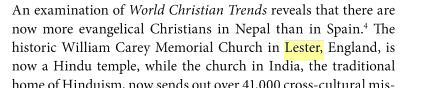
@ChrisHowles There are certainly many other churches in Leicester that have become temples and mosques, but not Harvey Lane.
English

@ChrisHowles Carey's church - Harvey Lane Baptist - was destroyed by fire in 1921. Many members moved to Robert Hall Memorial Church, Leicester - still open. A rebuilt hall in Harvey Lane was pulled down in the late 1960's to make way for a flyover and the UK's 1st Holiday Inn.
English

📢URGENT: Stop abortion up to birth! Ask Peers to back the amendment to repeal the Antoniazzi abortion up to birth clause. Email Peers NOW - it takes just 30 seconds! 👉 righttolife.org.uk/m005
English

I feel very grieved that this is happening in our land. But Jesus said: 'If they persecuted me, they will also persecute you'. Let us pray for Jon to have courage to continue to speak words of truth & grace; and pray for God's mercy to be shown to our rebellious peoples.
Rikki Doolan@realrikkidoolan
Another street preacher has been arrested today in Congleton, Cheshire. His name is Jon Pilgrim and he was arrested along with his father. Arrested for preaching the Gospel. This has to stop! Christian liberty must stand in this great Christian nation!
English

@DrMarkPickett Fair enough. How shall we then explain to the church where most of the need is? We can't say 'everywhere', otherwise people will stay where they are and go nowhere.
English

@PastaSteveGreen I remember George Verwer saying, "Somehow Indonesia is not in the 10/40 window"! It is nonsense to attribute significance to a cartographic construct. Least-reached peoples are indeed concentrated in certain regions. Let's not dumb down the facts.
English

@DrMarkPickett The binge-drinking is not confined to liberal denominations. The No. 1 social activity for many Evangelical men is to meet together at the pub (which I am not against) but Satan can easily exploit things.
English

This is what it looks like when you abandon the gospel: bbc.co.uk/news/articles/…
English

@UKReachAcross Scottish name is Ion. Godly missionary in Aden.
English

@pregethwr Great pic. Being blessed by all the ministry. Gary Williams especially, deep stuff, and very moving.
English

@UKReachAcross I feel sad that those who don't confess that Jesus Christ is Lord will never be truly happy.
English

@HrcPastor I gave some lectures/sermons to the students at Lokichoggio, based on Sinclair Ferguson's little (but big) book on the Sermon on Mount (published by BofT). Loved it.
English

@gpnicholls @affinitytalks I am really enjoying reading Jonathan Bayes' new Systematic Theology, called 'A Tidy Faith', and very helpfully, he directs readers to early church formulations.
English

It was glorious to be at the @affinitytalks Theological Study Conference last week. I gained a greater appreciation for the early church confessions and creeds but more importantly for the wonder of God, Father Son and Spirit.

English

@DanRhysJames Another Psalm 2 and 1 Timothy 2:1-4 moment.
English

@DanRhysJames @ForTheMonsell When 'the law' is dismissed, and conscience suppressed, the gospel doesn't always sound like good news. '....where sin abounds, grace much more abounds' (Rom 5v20) That applies to posh places too. Lord, help us to love lost sinners.
English