Patrick Campbell

18.4K posts

Patrick Campbell

Patrick Campbell

@Patticus

Current: Founder, NewCo Former: Founded @profitwell Deep expertise in pricing, retention, and high output management. How can I help?

Subscribe → Katılım Aralık 2009
183 Takip Edilen52.9K Takipçiler
Sabitlenmiş Tweet
Patrick Campbell
Patrick Campbell@Patticus·
Last year I went from $19k in my bank account to selling my company for $200M+ Then came what I call "The Champagne Problem Cycle": - Existential Crisis - Cocaine energy - 19 gas stations - A move to Puerto Rico Here's exactly what happens when you get rich 👇
Patrick Campbell tweet media
English
190
206
2.3K
1.6M
Patrick Campbell
Patrick Campbell@Patticus·
After: 12 years 50k+ companies using our products $200M+ exit I left Paddle and the subscription economy. Here’s why 👇
Patrick Campbell tweet mediaPatrick Campbell tweet media
English
58
26
542
75.7K
Andrew Wilkinson
Andrew Wilkinson@awilkinson·
My conversation with @ChrisWillx just went live on his podcast Modern Wisdom. This one was really fun. We talk about: - Why many successful people are using their anxiety disorders to fuel productivity - Whether people can change - How I hire CEOs - Why you should embrace laziness And a ton more: youtube.com/watch?v=E-SAY5…
YouTube video
YouTube
English
26
5
224
42.4K
Christian Owens
Christian Owens@christianbowens·
After a decade of building Paddle, two weeks ago I was officially terminated. Was there a coup? Do I have some illness? Not exactly. Here’s why rumors of my death are (mostly) greatly exaggerated 👇
Christian Owens tweet media
English
13
6
285
174.9K
Patrick Campbell
Patrick Campbell@Patticus·
People who say things like this are not serious people. They're well intentioned, but they lack a firm grasp of how currency in the financial system actually works. Let me explain 👇 Something you have to keep in mind is every country faces what's called the "impossible trinity" when setting currency policy. They get to pick two of the following: 1. Exchange Rate Stability - price control 2. Monetary Policy Autonomy - print control 3. Capital Mobility - flow control across borders In the US we chose 2 and 3. The reason this relates to your question is that when you abstract up to global trade and finance, we tend to favor countries that prefer 2 and 3. We also would prefer to find one one main currency. Why? Because it makes trade efficient and fair. There's a ton of transactions going on between countries, businesses, etc and they're moving really, really quickly. You could just let them all work themselves out in a bilateral way, but that's kind of like going back to a barter system. It's a system that has *some* efficiency, but it'd be insanely more efficient if we just used one currency, especially as things move faster and faster. So we want to use "mostly" one currency to make things work quicker, so how do we choose the right one? Well the right currency needs three things: A. Stability B. Trust it will continue to be stable C. Enough of it that using it won't make 2 and 3 fall apart. This means it's gotta be the currency of a big boy economy to literally have enough currency to make stuff happen on a global level, so which big boy should we choose? China? Well, they chose 1 and 2 in the trinity, which means they can control the exchange rates/price. This doesn't really feel fair, because they could explicitly skew things in their favor. It also doesn't seem super trustworthy to not allow capital flows. So no. EU? Could work, but it's not that old and there's instability in the federation since it's made of a bunch of countries that still have too much autonomy apart from the combined entity to make sure it's stable. Everyone else is either not big enough or not stable enough, so that leaves us with the ol' U-S-of-A and the dollar. There are enough dollars. Those dollars are (relatively) stable. And they're backed by a significant amount of soft and hard power. "But Patrick - couldn't that unravel?!" It could, but as of right now the biggest argument against this spiraling out of control is - there's absolutely no other alternative. China and the EU? See above, and they're no where close to solving the trust and stability issues. A new federation of countries like BRICS? Taking several untrusted countries and putting them together multiplies distrust, it doesn't magically make trust. Bitcoin? Oh, the thing that's been around since 2009 and is based on math? Actually, bitcoin is kind of perfect, because the math solves a lot of these problems, but where's the soft/hard power backing it? Maybe it'll work, but not soon. So again - USD. We've been taking advantage of there being absolutely no viable alternative for quite some time by printing money and kind of not caring about how much we print. Our status of being the reserve currency has gone down, but not by much. We currently sit with 59% of global reserves in USD. The next closest is the euro with ~20% of global reserves and the yen with ~6% and the pound with ~5%. Even if we erode to 50% over the next decade or two, that's not a disaster or doom, because most of the world's still going to want dollars. "Wait a second PC, what does this have to do with the USD spiraling out of control or not?" I got you. Being the global reserve currency gives us special privileges: - Everyone loves your debt, because it's a way to get more of the global reserve currency. - You can get away with printing more, because there's enough demand (people will take dollars) So is the debt a big concern? Yes, but it's not because the USD is spiraling out of control and doomed. It's because of intergenerational equity and the budgetary constraints it will cause in the mid and longterm. Assuming we don't have a giant gain in productivity and GDP (the likes of which we haven't seen in a while, but maybe AI?), entitlement programs will have to be cut back. That probably won't happen, because populism, so if you can't cut costs, what do you do? You raise money - ie raise or attack taxes. The result is potential brain and financial drain of the wealthiest folks since tax avoidance is possible and easiest for them, so you are left taxing the middle class. This doesn't go well to keep an economy growing, so you end up losing the funds to wield our hard and soft power; all of which results in the erosion of American hegemony. How does the world respond? It becomes a lot more regionalized (which is already being accelerated by the next phase of capitalism) and likely still keeps using the dollar. We become a value stock, instead of a growth one. It's not a bad living. It's not catastrophic or doom. But it makes the next 100 years not as good as the last, which is sad and I'd argue not "the American way." How we respond will make or break things, but I've still got hope. Anyways, had some fun writing this, so hope it was helpful. It's a really good question that gets sensationalized a lot, even if there are some very, very valid things to think about and solve here. Couple of notes: - I'm generalizing in a number of places for brevity (ironically) and clarity. All of this has more nuance and complications. Even with those, some very smart people who know what they're talking about would disagree with me, as they'd prioritize certain aspects I think are less important. - The unique privileges we have as the global reserve currency has sort of sparked "Modern Monetary Theory", which in general believes the government can print endless money (I'm generalizing). I think if the State continues to gain more and more control and more and more spending as a percentage as GDP this could be very true. Even if true though, I don't think that's a good world to live in. Different tradeoffs. - People like to tweet about "oh a scary new trade agreement is going to settle trades in X currency instead of USD between Y and Z countries". These are not serious people. They don't know that trade currency != reserve currency. Also I can't think of a single announcement like that where a consequential amount of dollars was at risk. - If you want to read very deeply on this to get a good understanding, check out Susan Strange. She invented the field of "International Political Economy" and discussed all of these issues/topics (including most of Balaji's takes, digital currencies, etc) in the 1980s. I recommend her book States and Markets for a foundation and then The Retreat of the State for topics around currency and some of the turmoil we're dealing with.
English
20
10
103
26.6K
Jason Cohen
Jason Cohen@asmartbear·
What's the counter-argument to the claim that USD is spiraling out of control?
Cole Walmsley@Cole_Walmsley

This is insane. This is INSANE. This is a blatantly obvious sign of the impending doom of the U.S. Dollar and all fiat currencies. *This is as important as anything you will read this year* The United States Treasury issues bonds and other investment securities. They call these, “treasuries.” The U.S. Treasury issues treasuries when the U.S. Federal Government spends past their budget, resulting in a “budgetary deficit.” The sale of treasuries makes up for the loss. The treasuries are sold and tacked on as debt. This is the substance of the big $34 trillion debt number in the United States. Key point: The U.S. Federal Government has been in a budgetary deficit in 49 of the last 53 years, with the last surplus year being in 2001. But yet, even in that 2001 “budgetary surplus” year, the total debt amount increased. Why? Because a whole bunch of debt from years past came due. The U.S. Treasury issues their treasuries with time periods of ownership ranging from 4 weeks to 30 years. So, in 2001, the government had debt coming due that was issued to investors in 1971, as well as 1981, 1991, 1994, 1996, 1998, 1999, and the previous year. The debt that was due in 2001 exceeded the budgetary surplus (debt issuance is not a part of the budget), thus, the government had to issue new debt to pay off the old debt, adding on further to the debt total. Key point: The U.S. Treasury, which is part of the U.S. Federal Government, has to sell new debt to new investors to pay off the old debt from old investors. This is because of 1) the constant budgetary deficits and 2) the debt from years past coming due. Key point: Being that the definition of a Ponzi scheme is, “An investment scheme where new investor money is used to pay off old investors.” …The U.S. Federal Government is running a Ponzi scheme. To the tune of $34.7 trillion, and counting. Trillion is just a word. Let’s make sure we note the significance. A *billion* seconds ago was 1993 (31 years ago). A *trillion* seconds ago was 30,000 B.C. And then multiply that trillion by 34.7. That’s the scale of the United States debt bill. But WAIT. It gets worse. Key point: The U.S. Treasury always has to have buyers of its debt, because if they don’t, they won’t be able to pay off 1) their deficit spending and 2) the old debt coming due (and the interest on the debt). If they fail to pay those off, the Government would default and collapse. Well, then, who buys all the U.S. Government debt? Key point: The largest buyer and owner of the U.S. Federal Government debt is THE U.S. FEDERAL GOVERNMENT THEMSELVES. Don’t trust, verify: TAKE A SECOND TO CONTEMPLATE HOW INSANE THAT IS. The U.S. Government spends in a budgetary deficit, then issues treasuries to pay for the spending, then, at a bigger rate than anybody else, buys the treasuries to cover the loss. An unbelievable Ponzi scheme. The U.S. Government is the director of the Ponzi scheme, the old investor, and the new investor. A true masterclass. But how do they do this? They have a money printer. It's that simple. The debt might as well not be real. Key point: The United States is not the only country that runs this playbook. 182 of the 222 countries in the world are in budgetary deficits. The Ponzi scheme is everywhere. The U.S. is the kingpin of the modern monetary world. They are the head honcho, the high priest, the big cheese. The current global financial economy is built on the backs of the United States. There would be a massive problem if the United States had debt buyer troubles. In short, an increasing amount of investors are growing scared of the United Stages debt situation, turning them away from the purchasing of U.S. Treasuries. Recent headlines: “Treasury bond auction runs into weak demand amid fears that soaring US debt will overwhelm Wall Street” -October 12, 2023 “30-Year Treasury Auction Breaks Bad, Sinks Stock Market” -November 9, 2023 “World to Drown in U.S. Debt; Moody’s Downgrades Country’s Debt” -November 17, 2023 “5-Year Treasury Auction was a Dud” -January 24, 2024 “Treasury's $16 billion auction of 20-year bonds produces 'very ugly' results” -February 21, 2024 "Highest Treasury Yields of Year Fail to Tempt Buyers to Auction" -April 11, 2024. With lower demand, and as quote tweeted below, the U.S. Treasury is starting a "treasury buy back operation," aimed to, as they say, "improve liquidity in the treasury market." What's really happening is that the Treasury is using their money printer to directly buy the treasuries they are issuing, ensuring those low demand treasury auctions don't continue. This causes inflation in the money supply, which is a dangerous outcome. Here's where the cookie crumbles: The United States central bank, the Federal Reserve, has a 2% inflation target. Inflation has not been at 2% recently, and, in fact, has been accelerating higher for three months in a row. The Federal Reserve has set high interest rates, currently at 5.25%, as a method of discouraging borrowing, spending, and taming inflation. But it's not working. And there's a bigger problem. Key point: The U.S. Federal Government pays interest to investors that own the treasuries, and this interest is part of the budget. Higher interest payments = more federal spending = bigger budgetary deficits = more debt issuance = higher supply of treasuries = lower demand = less buyers = Treasury printing = higher inflation = higher interest rates = higher interest payments. A catastrophic feedback loop. The interest paid out by the Federal Government has spiked in recent years: The United States Dollar is screwed. The Federal Reserve has set high interest rates to tame inflation, but that's not working. High interest rates are causing bigger interest payments, causing larger budgetary deficits. This is causing the U.S. Treasury to issue more debt, which investors are getting scared of (because of runaway inflation and compounding debt levels), which is now causing the Treasury to print money and provide "liquidity" to stabilize the treasury market, adding fuel to the inflation fire once more. The Federal Reserve can further raise interest rates to cool inflation, but that would increase interest payments and deficit spending, requiring even more debt issuance and "liquidity," which fuels inflation. An increase in interest rates could also cause a massive recession or depression, which would grind the economy to a halt, which would mean that the government is taking in less tax revenue, while still spending exorbitantly on entrenched government programs and stimulus, which would only increase budgetary deficits and debt issuance once more. The Federal Reserve can lower interest rates, but that would immediately cause an uptick in inflation, as people are encouraged to borrow and spend with lower interest rates, which would then force the Fed to raise interest rates again. The Federal Reserve can admit defeat and raise their inflation target to 3 or 4%, but that would signal that the system is failing, which would cause a further loss of confidence, which would result in less treasury buyers, resulting in more inflation, and would create demand for higher interest rates (because treasury investors want to keep up with inflation), which, again, causes bigger interest payments and so forth. This is a debt spiral. There is no way out. You are witnessing it live. These are years that will go down in the all-time history books. Every fiat currency has failed, and for the same reason. Turning on the money printer is too tempting. Don't forget, the U.S. Government will never let the treasury market fail, because that would result in an automatic default on the debt and an unbelievably chaotic avalanche of collapse. They will always turn to the money printer to bail things out. The Treasury will continue to print more money to keep the system afloat, as evidenced by their upcoming "buy back operation." But inflation is the fatal flaw. The Ponzi scheme is in its final chapter. The endgame is here. The inflation train has left the station, and it's never coming back. Covid put the ruin into hyperdrive. Inflation ran away, now it cannot be tamed. It is feeding on itself, and will continue to do so, over and over, gradually, then suddenly. And then, poof. It's gone. Worthlessness. If you haven't noticed, the U.S. Dollar has been heading toward the "worthless" direction for quite some time. It is inevitable. The U.S. Dollar, and all fiat currencies, will die. The Phoenix will then rise from the ashes. An innovative, specifically designed, global, unprintable, unable to be manipulated, verifiable, instantaneous, digital monetary system will emerge, unchained from the grasp of bankers and governments, once and for all. ...and the world was fixed. Fix the money, fix the world. #Bitcoin

English
83
11
121
149.5K
Michael Girdley
Michael Girdley@girdley·
This is my first serious beard attempt in my life. I’ve gotten five compliments saying it looked good. CONCLUSION I’m never shaving again. (And that is being a boring 50-year old Subaru driving dad in a nutshell.)
Michael Girdley tweet media
English
41
0
79
31.5K
Patrick Campbell
Patrick Campbell@Patticus·
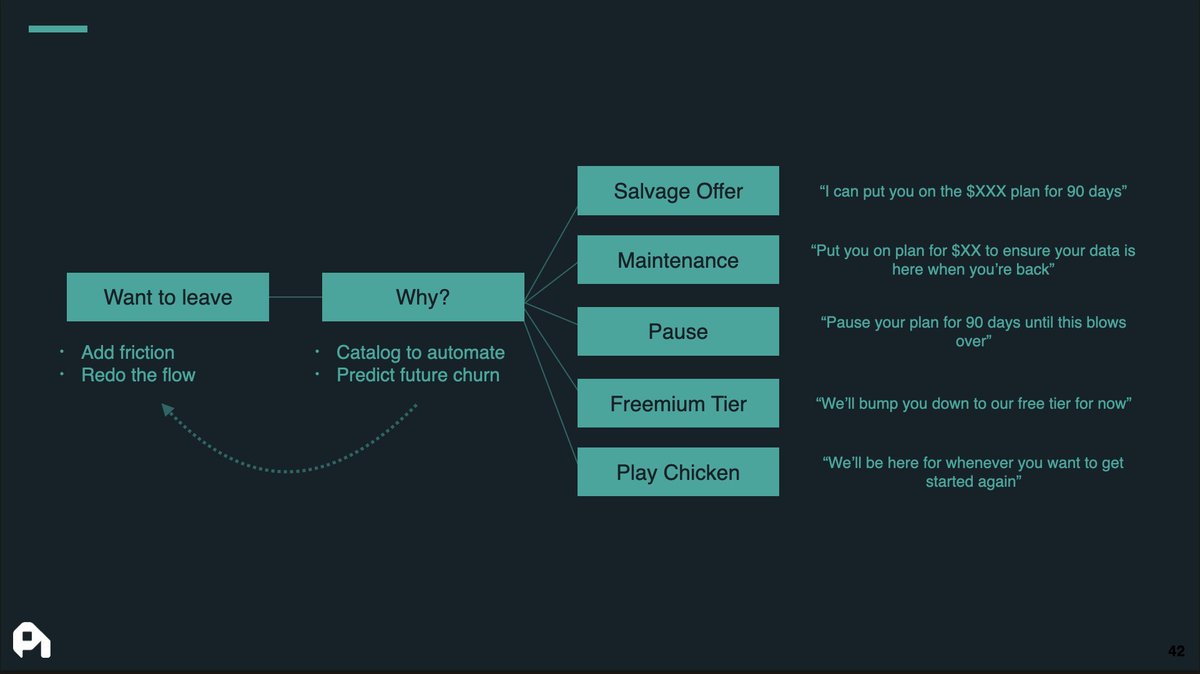
@gregisenberg It lowers cancellations by 10-25%. :) Here's data from a bunch of subscription/saas companies.
Patrick Campbell tweet media
English
1
1
11
580
GREG ISENBERG
GREG ISENBERG@gregisenberg·
I went to cancel my Amazon Audible subscription It asked me to pause it instead of cancel and to check back in 30,60 or 90 days. It's brilliant and evil at the same time. Every SaaS company should introduce a pause feature. Probably increases revenue 20%+
GREG ISENBERG tweet media
English
55
13
262
45K
Patrick Campbell
Patrick Campbell@Patticus·
@snoopeh @gregisenberg Ha, so I've got a whole protocol for this when we finally do the pod Greg. :) Important piece: these are shown based on customer data and interaction, but MOST importantly you need to prime them.
Patrick Campbell tweet media
English
1
0
5
428
Patrick Campbell
Patrick Campbell@Patticus·
Oh amigos - I've lost 70 on @MyBodyTutor already. I'm doing really freaking well thanks to them. This was more for a health thing I'm working on. Trying to get more ideas of what people struggle with and what they're doing. I messed up my joke in the original post, so that intent got lost a bit :)
English
1
0
2
67
Harry Sudock
Harry Sudock@harry_sudock·
@aaronsw deserves his story to live on. Cypherpunks write code. 🫡🫡
English
1
0
3
85
Ryan Hoover
Ryan Hoover@rrhoover·
I'm slowly weaning off of caffeine (coffee). Wish me luck.
English
121
0
215
196K
Mike Newton
Mike Newton@thetealetter·
@Patticus @gregisenberg This was a masterclass, Patrick. I literally thought of the pricing talk you gave at @nickgraynews's birthday jam when I saw this Zapier email come through. Delighted to find you on here killing it too!
English
1
0
0
775
GREG ISENBERG
GREG ISENBERG@gregisenberg·
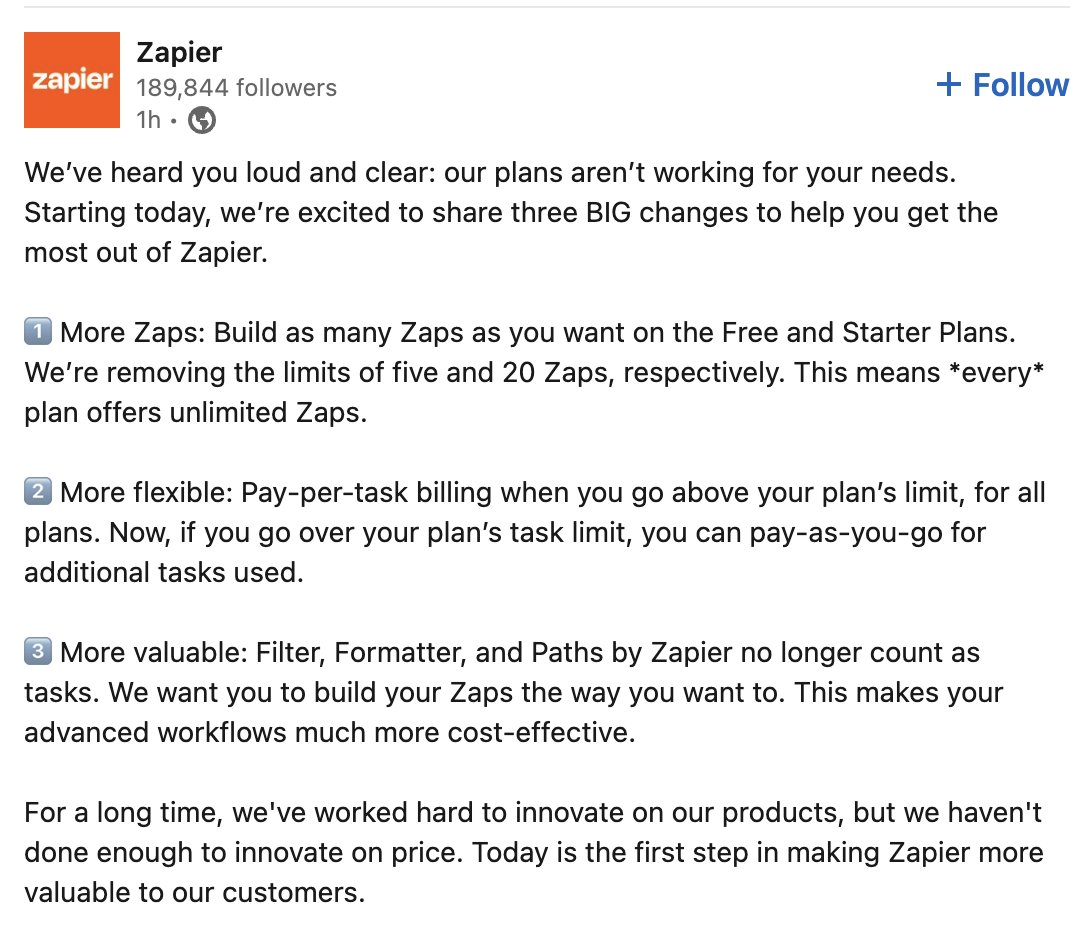
SaaS as we know it is dying and no-one is talking about it 1 hour ago, Zapier ($5B company) started charging "pay-per-task" instead of only monthly subscriptions When you can align customer incentives with your business model, it's a beautiful thing Bullish.
GREG ISENBERG tweet media
English
164
244
2.6K
1M
Alex Hormozi
Alex Hormozi@AlexHormozi·
**BIG Announcement** I just made the largest investment of my life into Skool.com — a platform with millions of users that makes starting your own online business simple, easy, and fun. I’ve been looking for an opportunity to make starting a business accessible to EVERYONE. And after four years…I finally found it. Skool is that opportunity. To give you an idea, users are joining Skool communities so fast that host payouts are growing by 62%...PER. MONTH. (Not a typo). If that sounds interesting…we’ve got something big coming. It involves business. Competition. Money. Prizes. And most importantly, you. It’s like nothing you’ve ever seen before. You’re gonna love it. More Details to follow…stay tuned. Skool 🚀🌙
Alex Hormozi tweet media
English
485
248
5.9K
877.3K
Suleman "Suli" Ali
Suleman "Suli" Ali@sulemanali·
@Patticus With you - anytime, anywhere Patrick. Except isn't it Day 2 of your new new thing today?
English
1
0
2
496
Syed Balkhi
Syed Balkhi@syedbalkhi·
This happened to me in 2023 - Year in Review - syedbalkhi.com/this-happened-… TLDR: 🌎 Visited 8 Countries 🚀 Passed 25 million websites using our software milestone 🤯 Completed 12 business acquisitions + 4 growth fund investments (avg of 1 per month!!) 😍 Started $100k charity lunch for Balkhi Foundation (inspired from Warren Buffett) ✅ Launched new products 💡 Learnt a ton of lessons ... and a whole lot of new experiences. Here's an even better 2024!
Syed Balkhi tweet media
English
14
8
76
48.4K
GREG ISENBERG
GREG ISENBERG@gregisenberg·
@Patticus you're a legend for typing this up, appreciated. tons of insights in here.
English
2
0
41
15.4K
Patrick Campbell
Patrick Campbell@Patticus·
@gregisenberg @saastrash Ha. I did write a book on SaaS pricing if interested. :) Also hosted a show called "Pricing Page Teardown", so lots of tidbits!
English
1
0
5
452