A Pawn Made Flesh
632 posts
A Pawn Made Flesh
@PawnMadeFlesh
Chess author, FM, Fair Play activist. Past U.S. Junior Open Co-Champ, Penn. Open Champ, 2x Greater NY HS Champ, Board 1 on tied-1st Pan Am Intercollegiate team
Katılım Kasım 2024
329 Takip Edilen37 Takipçiler

@PawnMadeFlesh @NewInChess It's not winning instantly..but the position is much better
English


English


🇺🇸 Hikaru Nakamura: “I’m the second best player in the world”
Hikaru Nakamura was asked today if he is satisfied with his career, and this was his answer:
"Of course I'm satisfied with my career. Why would I not be satisfied? ... In 2019, my rating went off a cliff and I was down to something like number 19 or 20 in the world, and at that point, I really thought that my professional chess career was over."
The chess world has completely lost its ability to remember anything beyond... beyond the past month. They have. Like if Sindarov goes and has one or two bad tournaments now after the Candidates, everyone's going to be like 'Oh Sindarov is terrible, he’s washed, Gukesh is suddenly the favorite again.' The world of chess is so messed up with how they look at players and their ratings and everything else.”
He also responded to people who question the accuracy of ratings and his current place as the world number two:
"I think the ratings don't actually lie. I would say that in general, I had one bad tournament but Magnus correctly says that the rating list and results in top tournaments of all formats say that I'm the second best."

English

@WHombravella @ZibbitVideos Not so easy to see …Rd1 though. In the combination from the musical mentioned in my earlier comment ( facebook.com/share/v/18BVBc… ), everyone at any level will consider the Move 1 sac … but can you find White’s Move 3?
English

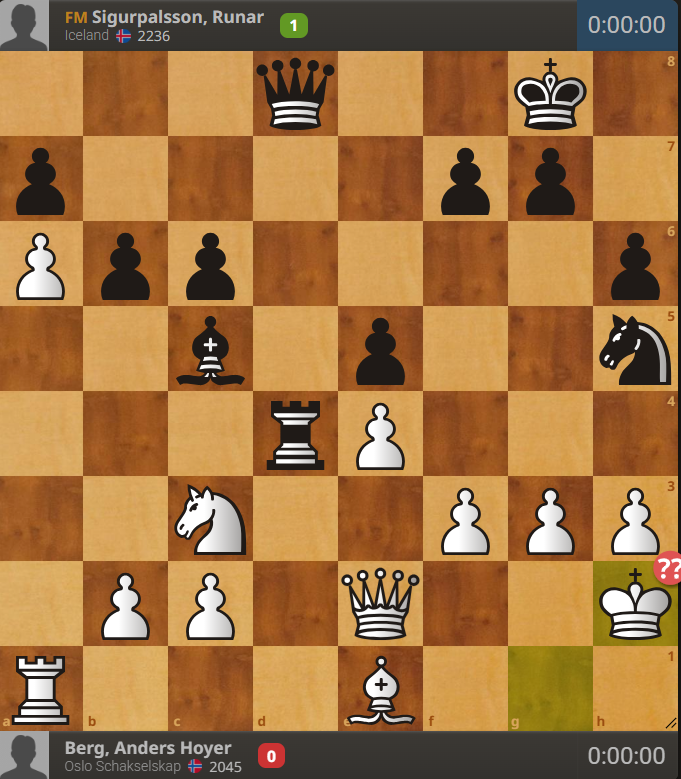
@ZibbitVideos Sin duda... caballo x g3 funciona y es fácil de ver en un ejercicio de tactica... pero verla en una partida es otra historia...
Español

Chess would be a lot easier if someone could just tap you on the shoulder when there’s a tactic. I am sure my friend Runar would have spotted it if he was tapped 😅♟️
Black to move. Can you spot it?
#chess #chesstactics #chesspuzzle
English
@ZibbitVideos @SGradijan It took me a couple of minutes evrn with the hint, and I’m still not positive I got the correct answer. As in the game snippet from the London musical “Chess” facebook.com/share/v/18BVBc… (but is omitted ffom the NY version), Moves 1 & 2 are easy but Move 3 is the killer.
English
@MaxMurrayX @anishgiri You’ve got it reversed. Human play will continue absorbing human interest BECAUSE of its imperfections, NOT despite it. Meanwhile, engine-vs-engine games (including AI “engines”) will always remain boring to most chess people outside the tiny niche of correspondence players.
English

Anish, you are in for a rude awakening when AI chess players with enterprising styles and personalities play against each other while both AI talking heads explain and comment on their own moves for a general or specialised human chess audience. Will we meatbags continue to play and watch human events? Of course, because being interested in other people is part of our species. But, AI will carve out a huge piece of the chess performance and commentary pie. Chess is far, far from a pure symbol of human thought. Engines show we meatbags are actually pretty damn bad at the game. All of us.
English
As more and more of our thinking is done “together” with AI, the intimate act of playing competitive chess will only further cement itself as one of the purest symbols of human thought.
English
@justme_3k @emilysbremer Actually saw a constructed “real life” example of that in a recently watched Black Mirror episode called “Bete Noir”
English

@emilysbremer Schrodinger's typos. They're not there until after you hit the SEND button.
English

The best way to find typos is to reread the draft you’ve already circulated.
English
@Wisdom_HQ Wrong. You should “times it” by TWENTY. So that all your family’s resources will gradually migrate to the families of the restaurant owners (mostly), servers and staff (small fractions of the “tip” amounts). Who being far smarter than you, will make better use of those funds.
English
@absurdistoic Since I recall @HansMokeNiemann fared much better than Sindarov just fared vs Dubov, in two separate multiformat matches (Dubov beat Niemann by tiny margins in both I think), draw your own conclusions.
English

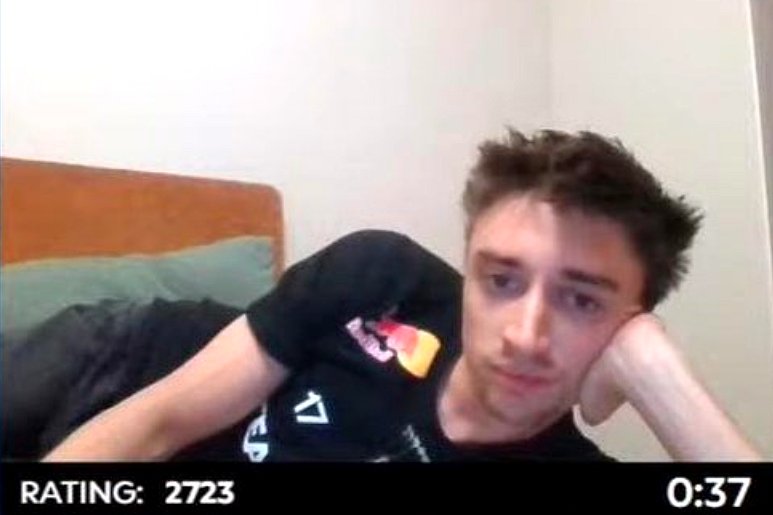
Daniil Dubov just went 3-0 against Candidates Champion Javokhir SINDAROV while being in this position ☠️‼️
chess24@chess24com
We will see Carlsen vs. Keymer and Nihal vs. Dubov in the Winners Quarterfinals!
English
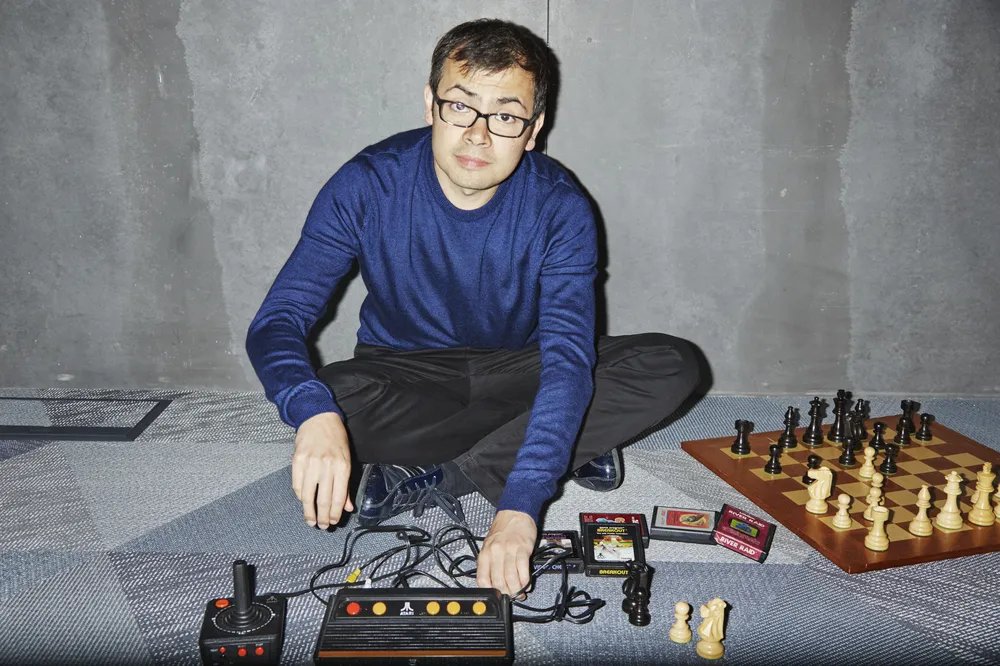
@ihtesham2005 One thing this OP proves is that even authors outside the chess world who view chess FAVORABLY, don’t care to get details straight about it. Demis Hassabis is undoubtedly a genius, and in youth showed promise as a chessplayer… but never got near International Master:….
English

A British kid became a chess master at 13, then a bestselling video game designer at 17, then a PhD neuroscientist at 33, then the CEO of the AI lab that won the 2024 Nobel Prize in Chemistry.
People called him unfocused for twenty years. He was running the most deliberate career plan in modern science.
His name is Demis Hassabis, and the thing almost nobody understood while he was doing it was that every single step was feeding the same underlying obsession.
Here is the thread that connects the whole career, and why it matters for how anyone should think about building toward a hard goal.
The chess came first. He was born in London in 1976 and started playing at age four. By eight, he was the London champion for his age group. By thirteen, he had an international master rating that put him in the top fifty players in the world under his age bracket. He was on a track that would have made him a professional player for the rest of his life.
He walked away.
The reason he gave later, in interview after interview, is the part most people miss. He said chess forced him to think constantly about thinking itself. Every move required him to simulate what his opponent was simulating about him. He became fascinated not with winning the game, but with the process the human brain was running in order to play it. He decided chess was too small a container for the real question he wanted to answer, which was how intelligence actually works.
The video games came next. He used the money he won from chess tournaments to buy a ZX Spectrum. He taught himself to code. By seventeen, he was a lead programmer on a game called Theme Park that sold millions of copies. He could have stayed in that industry and built a career as one of the top game designers in Britain.
He walked away from that too.
He went to Cambridge, did a double first in computer science, and then made the move that looked like the strangest pivot of his life. He enrolled in a PhD in cognitive neuroscience at University College London. He was thirty. His peers from Cambridge were already running companies. He went back to graduate school to study how the human hippocampus builds memories and imagines future scenarios.
His 2007 paper on the link between memory and imagination was named one of the top ten scientific breakthroughs of the year by Science magazine. But the paper was never the point. The point was that he had spent three decades quietly building the exact combination of skills nobody else in the world had put together.
Deep intuition for how intelligent agents behave in complex systems, from a lifetime of chess. Hands-on engineering fluency, from years of shipping commercial software. And a rigorous scientific understanding of how biological brains actually produce cognition, from a PhD in neuroscience.
In 2010, he used that combination to co-found DeepMind with Shane Legg and Mustafa Suleyman. The mission statement he wrote was two sentences long and sounded absurd to most people who heard it. Solve intelligence. Then use it to solve everything else.
For the first six years, DeepMind worked almost entirely on games. Atari. StarCraft. Go. People outside the field could not understand why a lab that claimed to be building artificial general intelligence was spending hundreds of millions of dollars teaching computers to play Pong.
Hassabis kept explaining the reason in interviews and almost nobody was listening. Games were not the goal. Games were a controlled environment where you could iterate on general-purpose learning algorithms fast, measure their progress precisely, and prove to yourself that you had built something that could transfer between domains.
In 2016, AlphaGo beat Lee Sedol, the world champion at Go, in a match that had been considered decades away. And the day after that match ended, Hassabis sat down with his team lead David Silver and asked what they should do next.
The answer was the thing he had been working toward his entire life.
They turned the same deep reinforcement learning approach at a problem biology had been stuck on for fifty years. Protein folding. Given an amino acid sequence, predict the three-dimensional shape the protein would fold into. Every drug discovery effort in the world depended on it. The best computational methods could only solve a small fraction of proteins. Experimental methods took years per structure and millions of dollars per protein.
AlphaFold2 was released in 2020. Within a year, it had predicted the structure of almost every protein known to science. Two hundred million structures. Made freely available to the entire research community. More than two million researchers from a hundred and ninety countries have used it since.
In October 2024, Demis Hassabis and John Jumper were awarded the Nobel Prize in Chemistry for that work.
The line almost nobody quotes from his speeches is the one that explains the whole career. He has said, many times, that he did not build AlphaFold to solve protein folding. He built AlphaFold to prove that the approach he had been developing for thirty years could actually work on a real scientific problem. Protein folding was the demonstration. AGI was always the goal.
The chess taught him how to think about adversarial systems. The games taught him how to ship software. The neuroscience taught him how the only existing example of general intelligence actually worked. DeepMind used all three to build a method that could transfer between domains the way the human brain does. And the moment the method was ready, he pointed it at the single most important unsolved problem he could find in a domain where a breakthrough would save millions of lives.
Most people looking at his career from the outside, at any point before 2016, would have called it scattered. A chess prodigy who gave up chess. A video game designer who walked away from a gaming career. A computer scientist who detoured through neuroscience. A startup founder who burned six years on board games.
From the inside, it was the most focused career in modern science. Every step was quietly answering the same question. How does intelligence actually work, and what would it take to build one that could solve problems humans have not been able to solve alone.
The people who change a field are almost never the ones who looked focused along the way.
They are the ones who were obsessed with a single question so deep and so long that the path they took to answer it looked like chaos from the outside and like a straight line from the inside.
And they almost never get credit for the plan until decades later, when the Nobel Committee calls.
English
@Jakec9292 @JackyJRE @business “I know this steak I’m eating isn’t real. But that doesn’t make it taste any less good.”
But the thing is: CIPHER WAS NOT MEANT TO BE ROLE MODEL FOR US. If his way is good enough for you, then you are either a bot or are in effect asking to be treated as one.
English


Scientists at Sony AI have developed a table tennis robot with enough speed and precision to beat even some expert ping pong players in the latest matchup between biological and artificial intelligence. bloomberg.com/news/articles/…
English
@tars75 @afozsn If the guy you're replying to is not a bot (this platform isn't named Cesspool for nothing, after all), then he's one of those folks who are allergic to learning. Since he already advertised what he is by pissing on a GM's advice, why are you wasting your breath talking to him?
English

@afozsn It's not slop purely because you don't like the response. That a GM won't dignify you with their own take should give you pause for thought about how daft your comparison is. I'm guessing it won't though.
English

Sindarov's interview, where he said he didn't study classical players or read books, created unwarranted debate. Outliers will always do things differently and still reach the top. That doesn't mean well-tested methods are wrong.
Sindarov is an authority on playing chess, not on teaching it. Using his personal story as proof of a general method is survivorship bias. Most players should still follow classical training methods: studying classic games (they illustrate mistakes and punishment clearly), solving puzzles, analyzing their own games, and working with a coach.
But his existence proves something else: there is no single right way to train. Which is exactly how we get colorful, strong players.
You can follow different training methods or create your own. However, you will have significantly better chances if you include established methods in your training path.
Emilchess@EmilSutovsky
Javokhir Sindarov’s brilliant victory has prompted chess fans to draw comparisons with Kasparov, Tal, and other classics. Yet in an interview with Leontxo Garcia, the hero himself said that he had never studied Capablanca’s or Botvinnik’s games, had not read Kasparov’s "My Great Predecessors", and in general does not like reading at all. Today, the methods of preparation are different. Let me say right away: I see nothing outrageous in these words. It is a completely different era, with entirely different ways of honing one’s skill. More than 20 years ago, Nakamura said that he did not know Smyslov’s games. And indeed, from the standpoint of acquiring new knowledge, there is nothing sacred in the battles of the titans of the past. A collection of a great chess player’s games is, from a practical point of view, merely a convenient selection. For instance, I still recommend Rubinstein’s games to all players rated under 2400. Yes, one can work through individual examples separately and absorb the patterns in other ways, but it remains a magnificent example of strategic game construction in a concentrated form. It has not become outdated. At the same time, it is far from the only path. The days when chess had to be studied in that way, and only that way, are gone forever. And these changes happened long ago. In 21st century almost nobody spends 20 minutes walking before a game, as Botvinnik did; almost nobody avoids post-game analysis, as he advised; and few people do morning exercises (though almost everyone goes to the gym). The advent of engines inevitably led to the discovery of countless mistakes in the games of the giants of the past, and that naturally diminished the sense of piety. It changed the prep, and expanded understanding of the game. And the ability to play hundreds of over-the-board games a year and thousands online has made it possible to absorb the patterns through actual play and develop chess culture by working through every imaginable structure and type of position. All of that is true. But! There are two major “buts.” First, only truly exceptional talents are capable of systematizing fragmented knowledge in this way and independently extracting what is useful for them. And even then, it usually happens under the guidance of a coach, and more often several coaches. Millions of people play and solve, yet their level does not grow dramatically. They keep repeating the same mistakes, and studying classical games and patterns would have helped them. Sindarov, Firouzja or Nakamura - and maybe few dozens of others are rather the outliers. They have this gift - which very few possess. But as a general advice, “just play, solve puzzles, and you shall find” simply does not work. You may not read the books, but then you'd rather have a coach who read them, and shares with you the knowledge. As a rule, no engine or AI can teach you a thought process that would take you to the level, from where you can work it out alone. Second, chess culture and tradition have always mattered, both for how we perceive ourselves and for how our game is perceived from the outside. If you imagine chess stripped of everything that offers no direct practical benefit, then all that remains is gaming. And gamers are paid for views. Presidents do not receive them. Governments, donors, and sponsors, who care about a certain image, would not allocate required funding . And for gamers, if there are no views the are no million-dollar fees. But chess is too complex for the average spectator, so we will never be able to compete on equal footing with video games. Yes, this is not Sindarov’s concern, and in general, a chess player’s task is simply to play as well as possible by any fair means. And he plays great. More than that, the level of play he has shown in the Candidates Tournament makes one think seriously about comparisons with Kasparov. So yes, above all, a chess player must deliver results. But thinking about the image of chess is the responsibility of every top player. One may admire Praggnanandhaa’s honesty when he said: we are ordinary people, we just happen to play this game very well. But first, that is far from true for everyone - I recall sitting next to Gukesh during the closing dinner in Toronto-2024, answering his nunerous questions about the history of chess - it was clear he was genuinely interested; and second, the notion "chess players are just good at chess" is strategically harmful for our game. Not because it offends the likes of Lasker, Botvinnik, Kasparov and other brillliant minds who were much more than just great chess players. It harms the perception of chess in the general public. And yet, I am not going to criticize the younger generation. At most, I will gently chide them a little, while, as in Sindarov’s case, admiring his phenomenal play. We often demand a certain wisdom and sense of responsibility from twenty-year-olds, forgetting that their success has become possible in part because they spend nearly twice as much time on chess as players of the older generation did. When are they supposed to reflect on eternal things? But when/if Javokhir becomes the world champion, I promise I will speak to him on the matter)
English
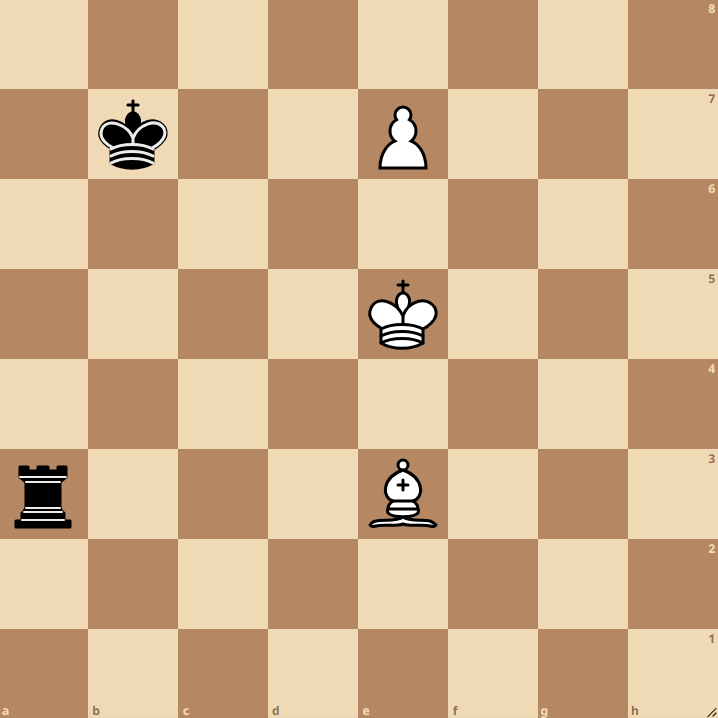
@IMIljaSirosh No one commenting here has “cracked it” yet. You haven’t done so until you wrestle with not only the obvious and failing defense 1.Ba7 Kxa7, but also with the alternative 1…Ra1
English
♟️Can you crack it in under 60 seconds?
White to move and win!
English
@kramnikstudent @IMIljaSirosh Consider Black’s other possible defenses too. 1…Kxa7 is not forced.
English

@IMIljaSirosh 1 Ba7! (took time for me to grasp that after Ka7 , Ra8 is not possible
English
@kingnuscodus @IMIljaSirosh But to solve a study you need to consider Black’s BEST defense… not only the most obvious (and obviously failing) one. 1…Kxa7 is far from forced.
English

@IMIljaSirosh It took me a while. 1.Ba7! bloquing immediate access to the backrank by the rook and guarding e3 at the same time:
1..Kxa7 2.Kd4! and the pawn will promote after a few spite checks:
2..Ra4+ 3.Kc5,Ra5+ 4.Kd6,Ra6+ 5.Kd7 etc
English
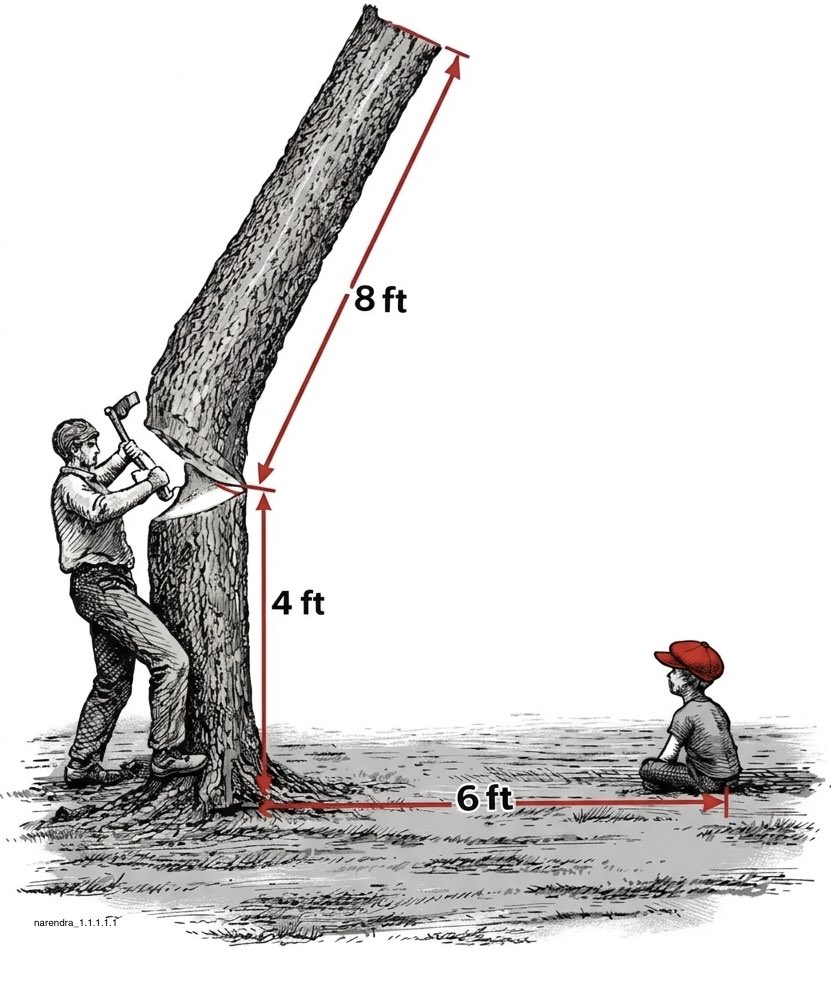
@pitboxer_crafts @H0H0v All that’s irrelevant in a trig problem. From the standpoint of math, child is obviously supposed to be treated as a point.
English
I cannot be held to blame that 70% of the commenters are sheep unwilling to or incapable of reason.
As I have pointed out to you twice now, the question had insufficient data to answer if the child would be struck from the triangle perspective.
Also, if you have ever felled a tree, you would know this log would land on the ground.
English