Peter Kocsis
272 posts

Peter Kocsis
@Peter4AI
PhD student at TUM, Visual Computing & Artificial Intelligence Group


📢 Intrinsic Image Fusion for Multi-View 3D Material Reconstruction 📢 We combine generative material priors with inverse path tracing: 1) define a parametric texture space 2) fuse monocular predictions across views into consistent textures 3) optimize low-dimensional parameters for physically-grounded reconstructions. The results are relightable PBR textures for 3D scenes: check out the result on a real-world 3D scan from the ScanNet++ dataset! 🌍peter-kocsis.github.io/IntrinsicImage… 🎥youtu.be/-Vs3tR1Xl7k Great work by @Peter4AI @LukasHollein!

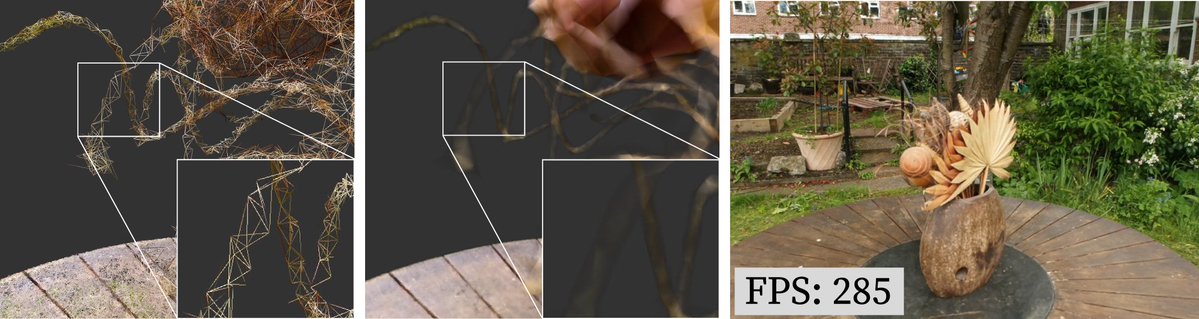
🚀 Announcing Echo — our new frontier model for 3D world generation. Echo turns a simple text prompt or image into a fully explorable, 3D-consistent world. Instead of disconnected views, the result is a single, coherent spatial representation you can move through freely. This is part of a bigger shift in AI: from generating pixels and tokens to generating spaces. Echo predicts a geometry-grounded 3D scene at metric scale, meaning every novel view, depth map, and interaction comes from the same underlying world — not independent hallucinations. Once generated, the world is interactive in real time. You control the camera, explore from any angle, and render instantly — even on low-end hardware, directly in the browser. High-quality 3D world exploration is no longer gated by expensive equipment. Under the hood, Echo infers a physically grounded 3D representation and converts it into a renderable format. For our web demo, we use 3D Gaussian Splatting (3DGS) for fast, GPU-friendly rendering — but the representation itself is flexible and can be easily adapted. Why this matters: consistent 3D worlds unlock real workflows — digital twins, 3D design, game environments, robotics simulation, and more. From a single photo or a line of text, Echo builds worlds that are reliable, editable, and spatially faithful. Echo also enables scene editing and restyling. Change materials, remove or add objects, explore design variations — all while preserving global 3D consistency. Editing no longer breaks the world. This is only the beginning. Echo is the foundation for future world models with dynamics, physical reasoning, and richer interaction — environments that don’t just look right, but behave right. Explore the generated worlds on our website and sign up for the closed beta. The era of spatial intelligence starts here. 🌍 #Echo #WorldModels #SpatialAI #3DFoundationModels Check it out: spaitial.ai

📢 IntrinsiX: High-Quality PBR Generation using Image Priors 📢 From text input, we generate renderable PBR maps! Next to editable image generation, our predictions can be distilled into room-scale scenes using SDS for large-scale PBR texture generation. We first train separate LoRA modules for the intrinsic properties of albedo, rough/metal, normal. Then, we introduce cross-intrinsic attention using a rerendering loss with importance-weighted light sampling to enable coherent PBR generation. Our method outperforms text -> image -> PBR methods both in generalization and quality, since directly generating PBR maps does not suffer from the inherent ambiguity of intrinsic image decomposition. In addition, our design choice facilitates SDS-based PBR texture distillation. 🌍 peter-kocsis.github.io/IntrinsiX/ 🎥 youtu.be/b0wVA44R93Y Great work by @Peter4AI, @LukasHollein

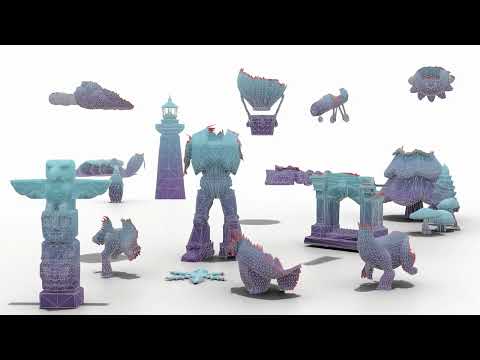
Congrats to @yawarnihal for winning the @MdsiTum best paper award for his amazing 𝐌𝐞𝐬𝐡𝐆𝐏𝐓 work🎉 MeshGPT autoregressively generates compact, artist-style triangle meshes by tokenizing faces into a learned discrete vocabulary (VQ-style codebook) and training a decoder-only transformer to predict those face tokens — because discrete tokenization + attention lets GPT-style models learn long-range geometric & topological patterns and produce coherent, high-fidelity 3D assets. MeshGPT's use cases go far beyond traditional content creation applications in computer graphics. For instance, the method was developed in collaboration with @Audi to help rapid prototyping of car designs, where explicit and precise mesh design are essential. In the research community, there have already been many follow ups such as MeshAnything, MeshXL, Meshtron, and many more - finally, we can use AI to generate high-fidelity 3D content :) Project: nihalsid.github.io/mesh-gpt/ Video: youtu.be/UV90O1_69_o


All six of our submissions were accepted to #NeurIPS2025 🎉🥳 Awesome works about Gaussian Splatting Primitives, Lighting Estimation, Texturing, and much more GenAI :) Great work by @Peter4AI, @YujinChen_cv, @ZheningHuang, @jiapeng_tang, @nicolasvluetzow, @jnthnschmdt 🔥🔥🔥