
Peter Knowles
131 posts

Peter Knowles
@Peter_R_Knowles
Passionate about: #Decarbonization #EnergyTransition #RenewableEnergy #EnergyStorage #Sustainability #CarbonMarkets #Wind #Solar #Hydro
USA Katılım Temmuz 2022
200 Takip Edilen56 Takipçiler

@ChrisGillett @tylerhnorris Nice summary, agree off grid and bridge to grid to enable faster than grid connect is very much alive. I would add on the replacing load, that Data Center load is not the same as a smelter, in terms of its variations, which can be mitigated with on site flexible resource.
English

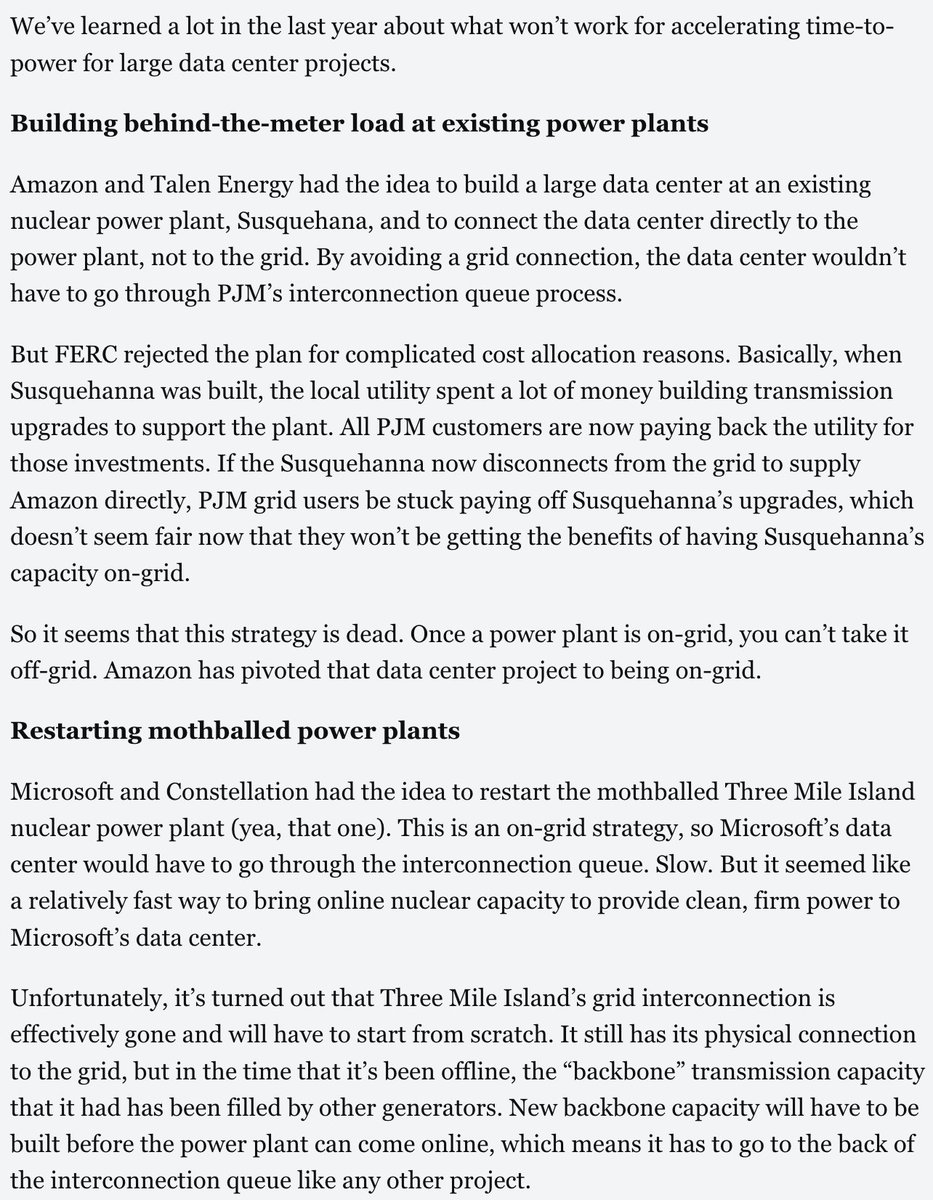
New article: Three Time-to-Power Strategies that Failed in 2025
chrisgillett.org/three-failed-t…

English

Wow.
No elected official or CEO can work with a company on a critical technology if this is their response.
Drew Pavlou 🇦🇺🇺🇸🇺🇦🇹🇼@DrewPavlou
Holy fuck Dario Amodei is literally retarded
English

I spent 6 years at Enron right out of college, including through the bankruptcy, but I didn’t really grasp what happened until I studied GE. It’s basically the same story.
GE was an industrial company that transformed into a conglomerate under a hard-charging, visionary CEO. Early success and a high-growth culture led to significant expansion and a variety of business lines, including heavy industry, healthcare, media, appliances, financial services, and insurance.
The p/e multiple of each unit independently would have been roughly 10x (GE Capital) to 30x (Healthcare). But with years of high and consistent earnings growth, GE transcended their peer group and traded over 50x at the peak. But, this was dependent upon high and consistent earnings growth. If GE ever missed earnings, the company would be rerated. It wouldn't drop 10%; the stock would be cut in half. The pressure from the CEO to division heads was clear: make earnings or else.
This led to a culture of aggressive accounting practices, including using the financial arm to prop up underperforming units. Jack Welch defended this practice even after leaving the company, saying earnings management was a sign of operational excellence. GE Capital, the pension fund, actuarial assumptions in the insurance business, and a portfolio of appreciated real estate became an endless well that was used to manage earnings, at least for a long time.
Eventually severe underperformance in certain units, particularly insurance, after the 2000 bubble led to questions about quality of earnings, particularly in light of Enron's bankruptcy. The stock rerated over several years, falling 60% by 2003, where it stabilized until the GFC. By this point, GE Capital was roughly 50% of total earnings. It was easier to sell consumers more loans than refrigerators. The company had effectively become a bank, though avoided the capital requirements of one.
The financial crash in 2008 was the exogenous shock that sent the company into crisis as it was undercapitalized for the portfolio risks and dependent on Wall Street for financing. Having lost the market's trust, the company couldn't roll over its short term debt and the company was days away from bankruptcy in October '08. Worried about contagion effects, the Federal Reserve and FDIC decided to guarantee over $200 billion of new GE debt. Without this, GE would have met the same fate as Enron.
Still, GE was severely weakened and had to go back to its core. It took nearly 15 years for the company to recover and start to thrive again.
Enron was a similar story but a different ending. Enron was an industrial company (pipelines) that transformed into conglomerate under its own hard-charging, visionary CEO. Early success and a growth culture led it to expand into finance (trading and merchant bank) and then retail electricity, international assets, and broadband.
The alchemy of the agglomeration was similar to GE. Enron traded at 30-40x multiple for a collection of businesses that would have been worth <10x (trading) to maybe 20x (retail) if independent. During the broadband bubble in 2000, the p/e reached a staggering 60x.
Enron transcended its peer group because of high and consistent earnings growth. And like GE, the knowledge that the stock would substantially rerate if it ever missed estimates created a culture of "make the numbers," which led to aggressive accounting. Like GE, underperformance in some units was hidden by both real and managed profits in the financial unit. It was easier to give the traders more risk capital than grow an electric utility in Brazil that it owned for some reason.
The trigger for the initial decline was similar. A few outsiders pointed out major red flags in Enron’s financials, particularly the gap between reported profits and actual cash flow, which the company failed to adequately explain. This started a steady decline from the peak in 2000 through 2001. The broadband bubble popped, more accounting questions arose, the CEO resigned (within 1 month of Jack Welch leaving GE), and 9/11 happened. There was also a realization that the company, like GE, was heavily reliant on its trading operation. A credit downgrade could have jeopardized that entire unit.
With outsiders, internal accountants, and external auditors digging into the company's financials, the company announced a $618 million loss for 3q '21. That triggered the announcement of an SEC investigation. Like GE, Enron had significant exposure to the short-term, commercial paper market. With Wall Street skittish post 9/11, significant debt maturing in the near-term, questions about undisclosed liabilities, and no government bailout coming, the company’s collapse became inevitable. The credit agencies downgraded the debt, triggering collateral calls and restricting access to capital. Four days late, in December, 2001, Enron declared bankruptcy.
The similarities were stark: valuation that transcended the sector, earnings management, ‘growth at all costs’ culture, opaque and growing financial arms, reliance on short term debt, hyper-aggressive/illegal accounting, praise by analysts and media, weak internal controls, and hubris. Only government intervention in the case of GE kept their fates from being the same.
English
Peter Knowles retweetledi

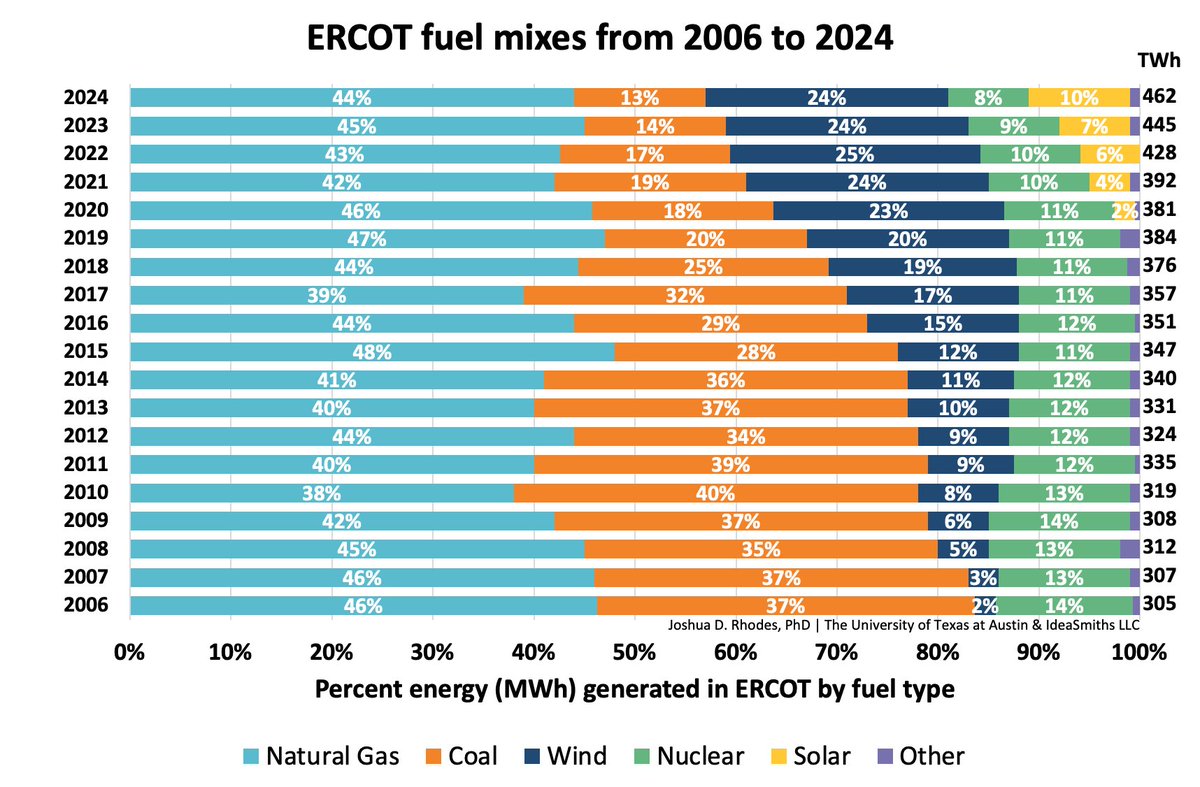
@joshdr83 Hard to see but ~300 to ~450 TWhs… some impressive load growth…
English

@DavidSacks It was a lot of fun to watch Governor Sacks in Sacramento…
English

Peter Knowles retweetledi

@chamath Watch for the tricks… “Natural Flavor” …. Apparently the fourth most prevalent ingredient… “anything derived from an animal or plant” vague enough?
English

@Jason NostraCalacanis… between you and the Sith Lord Darth @DavidSacks…. Can you guys DM me the Mega Millions numbers?
English

18 days ago I told you about the speed run primary (rebranded “blitz”)
@jason@Jason
"HOT SWAP SUMMER" TURNS TO "SPEED RUN PRIMARY" BY DEMS! JOE IS GONNA RESIGN DEMOCRATS ARE DOING A "SPEED RUN PRIMARY" ALSO: KAMALA IS FIRST FEMALE PRESIDENT SHE GETS PROMISED SCOTUS NOD SHE GETS TO DO THE SPEED RUN PRIMARY
English

@johnarnold Hopefully that is where government grants and support help along with funding from segments of the private sector and philanthropists who can afford it.
English

Great podcast by besties (@theallinpod ) interesting to hear @sama discuss efficiency improvements in AI algorithms and how adaptation and hardware improvements may reduce the power supply bottlenecks. Exactly the point @johnarnold recently made on the hype about demand growth.
The All-In Podcast@theallinpod
apple: bit.ly/alline178 spotify: bit.ly/alline178spot youtube: bit.ly/alline178yt
English

@johnarnold Well said, efficiency gains will be factor and what model and chips are needed to run them. Feels like that will perhaps slow the growth in demand but likely lagged, slow not flatten.
English

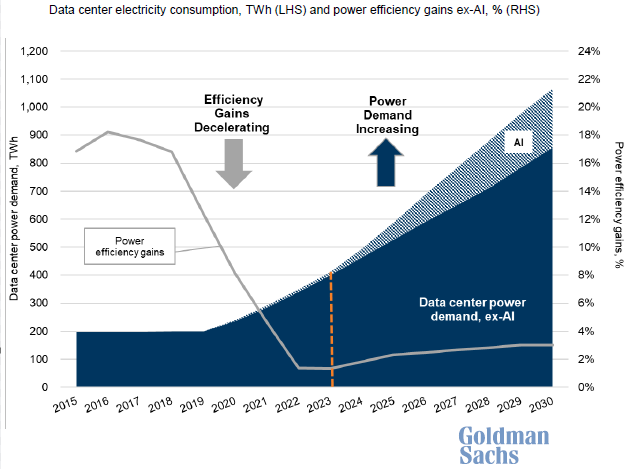
A lot has been written about the coming power demand from AI data centers. The actual impact will be determined by a big unknown, future efficiency gains.
Growth doesn't always equal increased load. US power demand was flat from 2007-22 as efficiency gains offset economic growth. Same was true of data center load from 2015-19. This changed starting in 2020 as the easy efficiency gains had already been enacted. Since then, growth overwhelmed new efficiencies, translating to increased load.
What's changed now is the immense focus and incentives on finding ways to decrease energy consumption per pFLOPS. The cost of power has become a very significant and quickly growing cost. AI companies are worried power will end up being the constraint on models. The strain on the grid is causing municipalities to rethink the net effect of new centers.
Every developer is intensely focused on cutting energy demand today. Nvidia has clearly heard this and stressed the efficiency of its new Blackwell platform. I'm sure the numerous other efforts to make chips are focused on power consumption.
Data center load forecasts like the one below assume gains, though at historically low levels. The pathway to ensuring there's enough power to run future models and minimizing the environmental footprint of AI will be getting much higher levels of efficiency.

English

@johnarnold Austin is up to 26th biggest metro area as well… the growth rate there has been very high, however that is pricing people out of the market…
English

Houston has bad weather, no natural beauty, and little history. But that’s a feature, not a bug. It means government has to be responsive to the people to create a place people and businesses want to locate. It must be efficient with taxpayer money and consider tradeoffs. It must create an ecosystem that leads to a high quality of life for its residents. Lose this focus and the city fails. There is no presumption that residents must acquiesce to the city; the city must work for the residents. Turns out there’s great demand for this concept: the city has gone from the from the 45th largest in the US to the 4th largest in 100 years. It's a simple concept but one I find wanting in many legacy cities with more natural advantages.
English

@theallinpod @friedberg For @friedberg, “How would you change the political system in the US to enable the ability to address multi decade structural issues like national debt or climate change?” Topical one given last week’s pod, and the risk of policy flip flopping between administrations.
English

some news!
we are doing a short q&a session with each bestie
we'll post these as clips across our social feeds on x, instagram, tiktok, and youtube
any questions for @friedberg? (he's up first)
English

@johnarnold You may have missed 5) customers going off grid (C&I) making it harder to not increase rates for the remaining customers and 6) Need to maintain existing, and build new T&D, and ensure it enables two way energy flow where it makes sense….
English