
Sandra Petersmann

10.7K posts

Sandra Petersmann banner
Sandra Petersmann

Sandra Petersmann

@PetersmannS

Back in India for Germany's international broadcaster Deutsche Welle (DW). Many tweets on Afghanistan, but interested in lots of things. Story tips welcome.

New Delhi Katılım Ekim 2013
1.1K Takip Edilen5K Takipçiler
Sabitlenmiş Tweet
Sandra Petersmann
Sandra Petersmann@PetersmannS·
"Misogyny is the invisible hand that edits a woman's choices." Patriarchy and misogyny go hand in hand — together, they drive a global pandemic of violence against women. How do Indian women navigate this reality? Watch here 👇👇👇 youtube.com/watch?v=Nv-bPn…

YouTube video
YouTube
English
2
1
4
1.1K
Sandra Petersmann retweetledi
Kaitlan Collins
Kaitlan Collins@kaitlancollins·
President Trump on the future of the Strait of Hormuz: "It'll be jointly controlled." By whom? "Maybe me. Maybe me. Me and the Ayatollah. Whoever the Ayatollah is, whoever the next Ayatollah is."
English
517
383
1.7K
227.5K
Sandra Petersmann retweetledi
Sidhant Sibal
Sidhant Sibal@sidhant·
EAM Jaishankar says India, Russia increasing engagement, calls to conclude trade pact, & utilize skilled Indian work force in Russia. Full address: twitter.com/DrSJaishankar/…
English
2
39
282
10.3K
Sandra Petersmann retweetledi
Narendra Modi
Narendra Modi@narendramodi·
Spoke with President Dr. Masoud Pezeshkian and conveyed Eid and Nowruz greetings. We expressed hope that this festive season brings peace, stability and prosperity to West Asia. Condemned attacks on critical infrastructure in the region, which threaten regional stability and disrupt global supply chains. Reiterated the importance of safeguarding freedom of navigation and ensuring that shipping lanes remain open and secure. Appreciated Iran’s continued support for the safety and security of Indian nationals in Iran. @drpezeshkian
English
3K
5.7K
40.2K
20.4M
Sandra Petersmann retweetledi
Raj Malhotra
Raj Malhotra@Rajmalhotrachd·
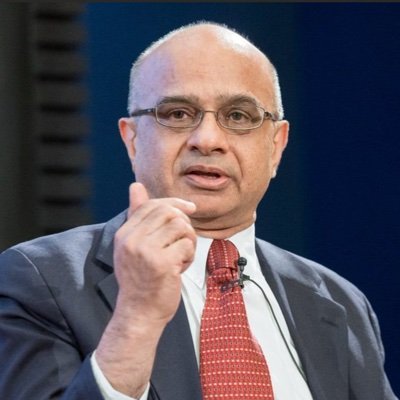
The Middle East or West Asian crucible is currently undergoing a tectonic restructuring, and New Delhi’s response is a masterclass in civilizational statecraft. To truly fathom India’s strategic calculus, we must decode the profound minds shaping the discourse: @ShashiTharoor, @MohanCRaja, @pbmehta, @HappymonJacob, @johnstanly, & @suhasinih. A definitive deep-dive into the Indian geopolitical psyche. 👇 #MiddleEast #WestAsia #IranWar#Geopolitics #IndianForeignPolicy #IR
Raj Malhotra tweet media
English
3
10
60
21.9K
Sandra Petersmann retweetledi
Dr. S. Jaishankar
Dr. S. Jaishankar@DrSJaishankar·
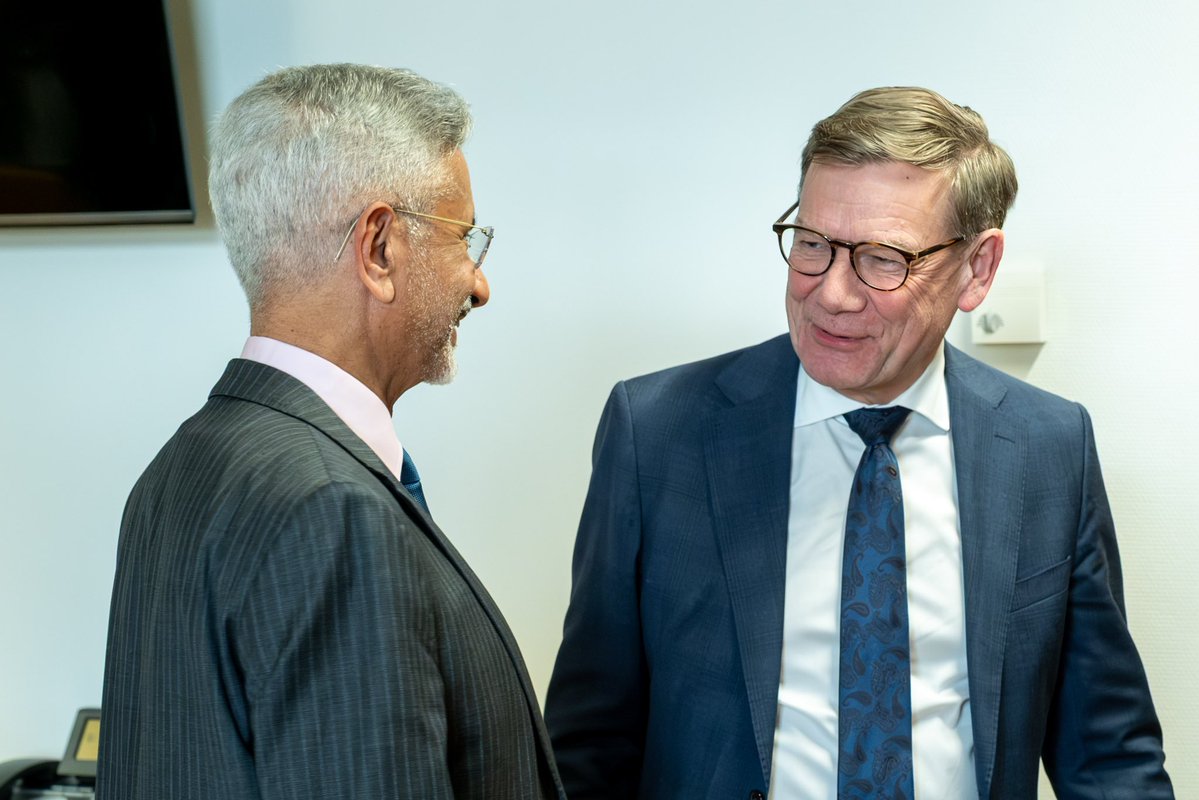
Great to meet FM @JoWadephul of Germany. A valuable exchange of notes on the conflict in West Asia. Also took stock of the progress of our bilateral relations following the State visit of @bundeskanzler Friedrich Merz to India. 🇮🇳 🇩🇪
Dr. S. Jaishankar tweet mediaDr. S. Jaishankar tweet media
English
24
211
1.6K
34.4K
Sandra Petersmann retweetledi
Dr. S. Jaishankar
Dr. S. Jaishankar@DrSJaishankar·
Thank the Government and the people of Armenia for facilitating the safe evacuation of over 550 Indian nationals from Iran so far. Appreciate their support in these challenging times. @AraratMirzoyan 🇮🇳 🇦🇲
English
113
2K
16.6K
295.4K
Sandra Petersmann retweetledi
Dr. Brahma Chellaney
Dr. Brahma Chellaney@Chellaney·
Deal With Tehran Gets India’s Tankers Through Hormuz: Under a deal struck between New Delhi and Tehran, India allowed about 180 Iranian sailors to return home on a chartered flight last night, while Iran permitted two liquefied petroleum gas (LPG) tankers bound for India to safely cross the Strait of Hormuz. Several oil tankers are also reaching Indian ports after being permitted to transit the strait. India is now negotiating safe passage for additional oil and gas tankers as the conflict continues to disrupt shipping through the vital waterway. The chartered aircraft, arranged by Iran, departed from Kochi carrying sailors from the Iranian naval vessel IRIS Lavan, which had docked there after the U.S. torpedoed and sank the Iranian frigate IRIS Dena. Another Iranian naval vessel, IRIS Bushehr, docked in Sri Lanka. Under U.S. pressure, Sri Lanka has refused to allow the return of its 208 crew members or the 32 survivors of the sunken frigate. Sri Lanka did, however, permit the same chartered aircraft to carry 84 bodies of Iranian sailors killed in the U.S. attack. The bodies of an unknown number of sailors remain missing.
English
38
298
1.2K
138.4K
Sandra Petersmann retweetledi
Suhasini Haidar
Suhasini Haidar@suhasinih·
The request from Tehran for a BRICS statement to “condemn the military aggression against Iran”, could prove awkward as India has thus far not criticised the U.S.-Israel strikes on the country, or a U.S. submarine’s torpedoing of an Iranian Ship returning from India in the Indian Ocean last week. It condoled but didn’t condemn the assassination of Iran’s Supreme leader Ayatollah Ali Khameini. However, the government “expressed grief” on Thursday (March 12, 2026) over the killing of schoolgirls at a school in Mubin on February 28.
Suhasini Haidar@suhasinih

BRICS should play a role in supporting global security, says Iran’s FM Araghchi, calls for condemnation of U.S.-Israeli strikes. Officials tell @the_hindu India, as chair, is engaging all BRICS partners, no word on statement yet. Reporting @the_hindu thehindu.com/news/national/…

English
53
279
831
53.3K
Sandra Petersmann retweetledi
Devirupa Mitra
Devirupa Mitra@DevirupaM·
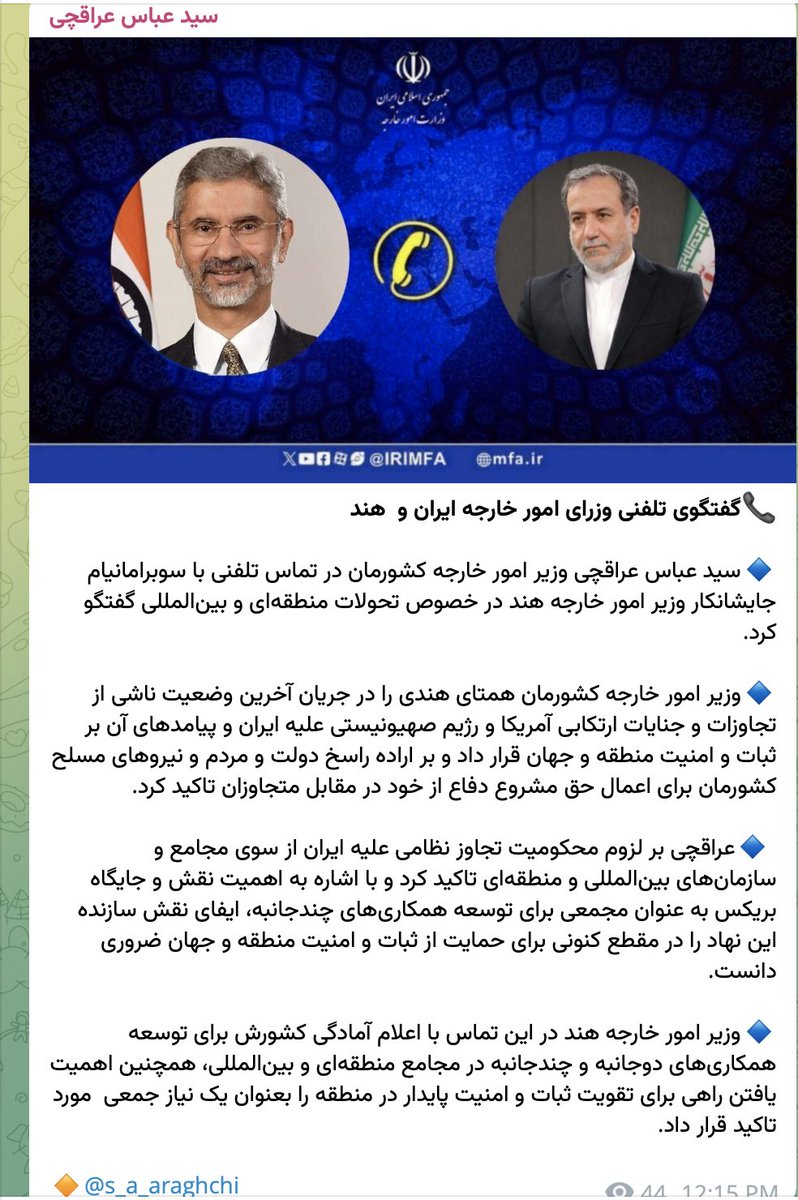
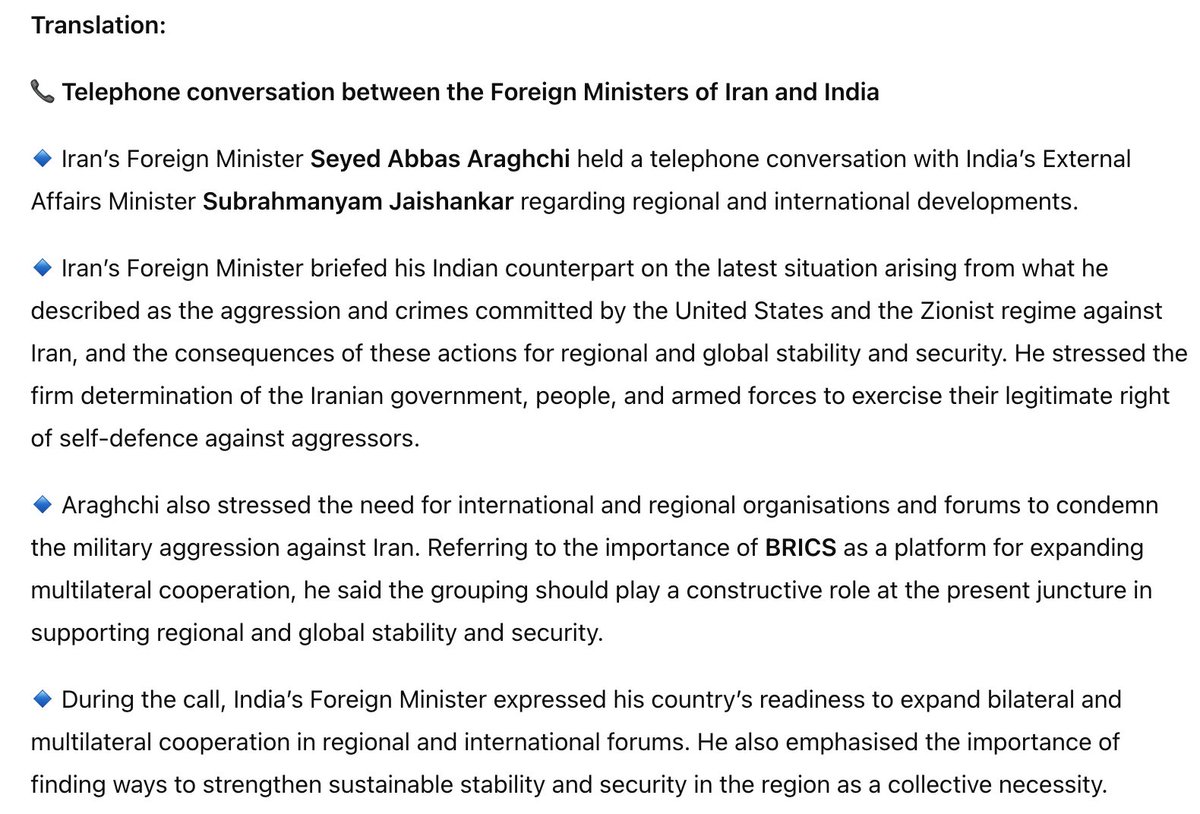
Iran foreign ministry announces 4th phone call between Indian and Iranian foreign ministers. This time, Araghchi specifically raises BRICS role. India is chair of BRICS, which has so far not issued any statement on the ongoing conflict R: machine translation of Iranian readout
Devirupa Mitra tweet mediaDevirupa Mitra tweet media
English
23
258
672
58.2K
Sandra Petersmann retweetledi
Frederik Pleitgen
Frederik Pleitgen@fpleitgenCNN·
It is raining oil in Tehran this morning after major airstrikes on oil facilities in the South and West of the Iranian capital. @CNN @cnni
English
1.1K
10.6K
38.9K
11.9M
Sandra Petersmann retweetledi
Hamidreza Azizi
Hamidreza Azizi@HamidRezaAz·
#Iran War Update No. 8 (focus on Iranian strategic narrative): 🔹The war appears to be entering a new escalation phase centered on economic and civilian infrastructure. U.S. and Israeli strikes targeted multiple Iranian oil storage facilities, Mehrabad civilian airport in Tehran, and a desalination plant on Qeshm Island, while Iran claims it retaliated by striking the Haifa oil refinery with ballistic missiles. 🔹Iranian officials warn that targeting water infrastructure could mark a dangerous “precedent.” Iranian Foreign Minister Abbas Araghchi framed the strike on the Qeshm desalination facility as a “blatant and desperate crime.” Iranian hardliners have started calling for retaliation against desalination plants elsewhere in the region, both in Israel and in Gulf countries. 🔹At the same time, the scale of the U.S. campaign continues to grow. U.S. CENTCOM stated that more than 3,000 targets inside Iran have been struck since the start of the war and that 43 Iranian naval vessels have been damaged or destroyed, indicating a systematic effort to degrade Iran’s military capabilities. 🔹Some Iranian analysts interpret the pattern of strikes as an attempt to gradually dismantle Iran’s military and security infrastructure, potentially creating conditions that, even in the absence of regime change, would result in lasting weakening of the state or even state collapse. 🔹Inside Iran, however, officials are projecting defiance. The IRGC stated that the country is prepared to sustain at least six months of full-scale war, pushing back against interpretations in Washington that recent Iranian messaging reflects weakness. 🔹Iranian military sources also claim that earlier attacks have degraded U.S. regional radar and early warning systems, arguing that this has made missile targeting easier and allowed Iran to partially offset its loss of long-range air defense. 🔹Iranian forces reported shooting down 13 Israeli and American drones in a 24-hour period, including MQ-9 and Hermes systems. While the figures are disputed, several incidents appear to reflect improved short-range air defense performance. 🔹Iranian commentary increasingly frames the conflict as a race between Israel’s airpower and Iran’s missile capacity. In this narrative, Israel relies on costly fighter sorties while Iran retains the ability to launch large numbers of comparatively inexpensive missiles across a vast geographic theater. 🔹The war has also once again highlighted Iran’s decentralized command structure after President Pezeshkian said Iranian armed forces operate according to a “fire at will” approach. Following earlier losses among senior commanders, operational authority appears to have shifted toward local commanders. Although this has long been a pattern in the IRGC, some Iranian sources say the current modus operandi is partly inspired by Hezbollah’s earlier wartime practices. 🔹Meanwhile, internal political tensions remain visible following President Pezeshkian’s controversial remarks apologizing to neighboring countries for recent attacks. Senior figures including Ali Larijani, Mohammad Bagher Ghalibaf, and the armed forces leadership publicly reaffirmed that U.S. bases in the region remain legitimate targets. 🔹Pezeshkian’s statement has also fueled growing calls for the Assembly of Experts to convene as soon as possible to select a new Supreme Leader. At the same time, there are reports of disagreements within the assembly about who should ultimately be chosen. 🔹Iranian armed forces also issued an unusually direct warning toward Azerbaijan, demanding that “Israeli presence” be expelled from the country. Such rhetoric toward Baku is unprecedented and may indicate rising tensions on that front. 🔹In the Persian Gulf, the IRGC reportedly carried out a large-scale drone strike against Al-Dhafra Air Base in the UAE, while Iranian officials reiterated that any country allowing U.S. forces to launch attacks from its territory could face retaliation. 🔹The Strait of Hormuz remains under partial disruption. Rather than formally closing the waterway, Iran appears to be enforcing what officials call “smart control,” targeting vessels that ignore warnings while allowing others to pass. Shipping traffic through the strait has reportedly declined sharply, although at least one Chinese ship was reported to have exited the strait today. 🔹The war is also beginning to affect military supply dynamics. Reports indicate that the United States is rapidly expanding weapons production, particularly missile interceptors such as Patriot and THAAD, after large numbers were consumed in ongoing operations. 🔹Russia is attempting to position itself diplomatically, reportedly exploring mediation between Iran and Gulf states. At the same time, the conflict indirectly benefits Moscow through higher oil prices and the diversion of U.S. interceptor missiles that might otherwise support Ukraine. 🔹On other fronts, Hezbollah continues limited but persistent engagement in Lebanon, while Iraqi militias claimed dozens of operations against U.S. interests. 🔹The Houthi role may also be evolving. So far, their involvement appears primarily aimed at deterring Saudi Arabia and the UAE from entering the war, but speculation is growing that the Houthis could begin launching missiles toward Israel once Iranian strikes have further strained regional early warning systems and Israeli air defenses. 🔹Saudi Arabia has reportedly warned Iran not to strike its territory or energy infrastructure, raising the stakes further. 🔹Overall, Day 8 suggests that the war is simultaneously widening and deepening. Attacks on economic infrastructure are intensifying, internal political tensions in Iran remain unresolved, and multiple regional actors appear poised on the edge of deeper involvement.
English
1
266
820
248.2K
Sandra Petersmann retweetledi
GermanForeignOffice
GermanForeignOffice@GermanyDiplo·
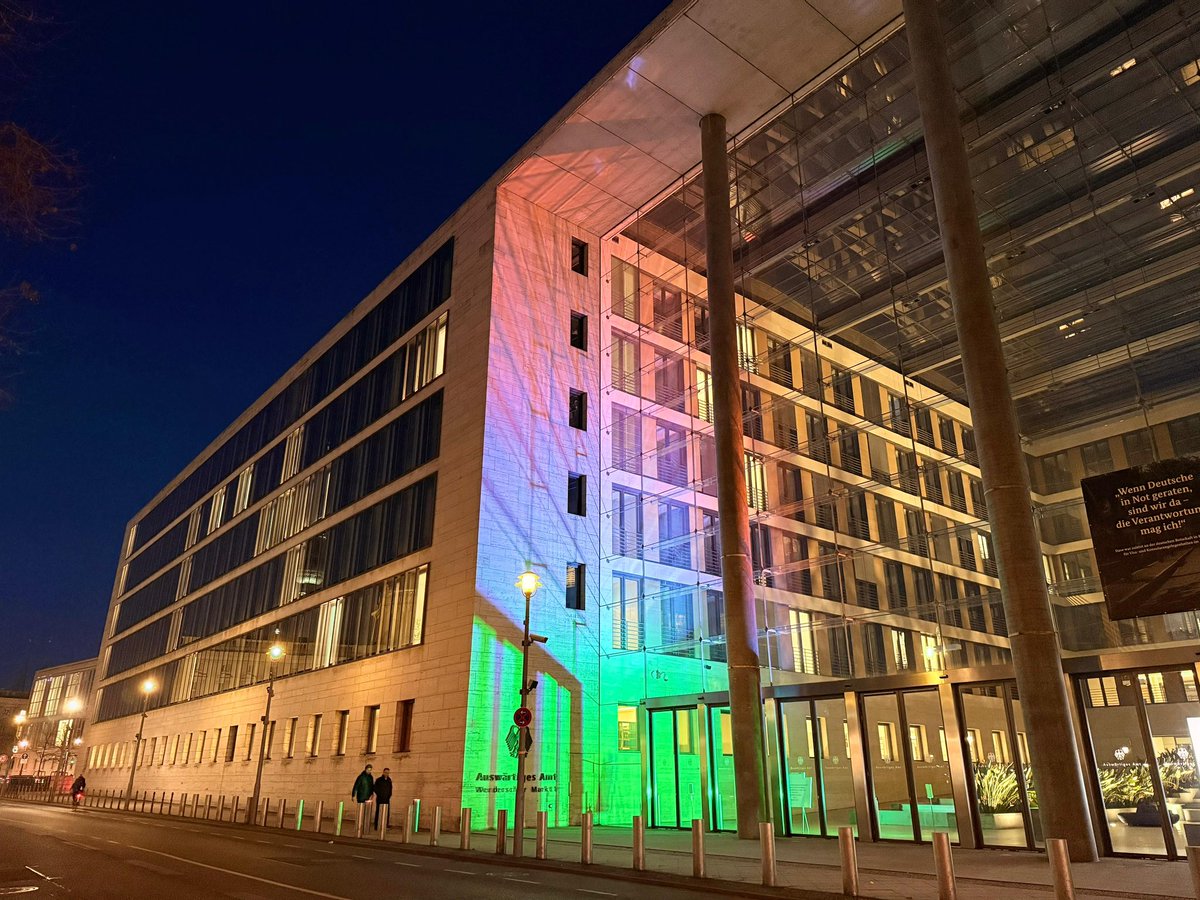
We are celebrating 75 years of diplomatic relations with #India – and the German Foreign Office is shining in India's colors 🇮🇳. Today, we are bound by a vibrant strategic #partnership, from economic topics to #security 👉 diplo.de/2759174
GermanForeignOffice tweet media
English
44
185
1.3K
22.8K
Sandra Petersmann retweetledi
Hamidreza Azizi
Hamidreza Azizi@HamidRezaAz·
Day 5 of #Iran vs. U.S./Israel conflict (focus on Iranian strategic narrative): 🔹There is growing concern in Iran that decapitation has become a continuing war strategy rather than a one-off strike. Iranian sources believe Washington and Tel Aviv may attempt to target the heads of Iran’s government branches or members of the interim leadership council. 🔹This fear extends to whoever becomes the next Supreme Leader, with Iranian commentators referencing the precedent of Hezbollah, where Nasrallah’s successor was reportedly targeted shortly after assuming leadership. 🔹Israeli and U.S. strikes have continued across western and central Iran, including in cities such as Shiraz, Khorramabad, Kermanshah, Qom, Ahvaz, and Tabriz, with western regions and the capital remaining the primary focus. 🔹At the same time, Iranian sources acknowledges that several missile bases have been hit, including installations near Kermanshah. Damage to access points and infrastructure may be affecting the tempo of missile launches. 🔹The decline in Iranian missile strikes on Israel therefore appears linked both to operational constraints caused by Israeli air dominance and to Iran’s possible effort to conserve its remaining arsenal. 🔹Instead, Iran appears to be still prioritizing strikes on U.S. interests and regional energy infrastructure, aiming to raise the cost of the war for Washington and its regional partners. 🔹Iranian missiles have reportedly targeted additional THAAD early warning radars, including systems in Jordan following earlier strikes in Qatar and the UAE. 🔹If accurate, these attacks suggest a strategy aimed at degrading the regional missile-defense architecture that helps protect both U.S. bases and Israel. 🔹Iranian sources also claim that communications and radar infrastructure at several U.S. bases – including facilities in Bahrain, Qatar, Kuwait, Saudi Arabia, and the UAE – have been damaged. 🔹The objective appears to be disrupting command-and-control systems and weakening coordination between U.S. and Israeli air-defense networks. 🔹At the same time, Iranian air defenses appear to have had greater success targeting Israeli reconnaissance drones, including additional Hermes 900 systems. 🔹Some analysts suggest that improvements in Iran’s short-range air-defense network may be responsible for these successes, even though long-range systems remain degraded. 🔹On the proxy front, Iraqi armed groups have continued attacks on U.S. bases, even after heavy U.S.-Israeli strikes on PMF positions in Anbar, Diyala, and Samawah. 🔹Hezbollah has also continued its operations, including missile and drone attacks against Israeli targets in northern Israel and the Golan Heights. 🔹The Houthis, meanwhile, remain largely outside the conflict. Some Iranian sources claim they are being deliberately held in reserve as a deterrent against Saudi Arabia or the UAE joining the war. 🔹Energy warfare remains central to Iran’s strategy. QatarEnergy has declared force majeure and halted LNG production following attacks on energy infrastructure. 🔹These disruptions are reinforcing Iran’s effort to sustain pressure on global energy markets, particularly given uncertainty about how long the Strait of Hormuz can remain closed. 🔹At the same time, the war has begun to generate secondary instability across the region, including protests in Pakistan and Bahrain in response to the killing of Khamenei and the ongoing conflict. 🔹Within Iran itself, supporters of the Islamic Republic have continued to organize demonstrations calling for retaliation and resistance. 🔹Authorities are also warning against internal dissent. The chief justice has stated that any actions aligning with U.S. or Israeli objectives will be treated as wartime collaboration. 🔹Iran’s leadership is simultaneously attempting to reassure Gulf countries. President Pezeshkian and parliamentary speaker Qalibaf have emphasized that Iranian strikes are directed at U.S. forces rather than host states. 🔹Iranian officials have also reaffirmed commitment to the China-brokered 2023 Beijing agreement with Saudi Arabia, signaling an effort to prevent Gulf states from joining the conflict. 🔹China has reportedly dispatched a special envoy to the region to explore mediation options, reflecting Beijing’s concern over disruptions to energy flows through the Strait of Hormuz. 🔹Meanwhile, the Kurdish issue is emerging as a major security concern for Tehran. Kurdish insurgent groups have recently formed a broader coalition, raising fears that they could be used as ground forces against the Islamic Republic. 🔹Tehran has reportedly warned KRG officials that if Kurdish groups launch attacks from Iraqi Kurdistan, Tehran could directly target the Kurdistan Regional Government itself. 🔹The war has also produced a potentially dangerous incident involving Turkey. A missile launched from Iran was intercepted by a NATO air-defense system over Hatay while reportedly heading toward the U.S. base at Incirlik. 🔹Although the intention remains unclear, one interpretation is that Iran’s decentralized missile-launch structure may increase the risk of accidental escalation or uncoordinated moves. 🔹International monitoring agencies have also assessed damage near Iranian nuclear facilities. Satellite imagery shows limited damage near the Isfahan site, but the IAEA reports that no nuclear material has been affected. 🔹Concerns remain particularly high around the Bushehr nuclear power plant, where Russian personnel operate the facility and where nearby explosions have been reported. 🔹Inside Iran, discussions have also begun about the country’s future nuclear policy after Khamenei. Some argue that the war demonstrates the need for a nuclear deterrent and that the next Supreme Leader my move toward that direction. 🔹The Assembly of Experts continues deliberations on selecting a new Supreme Leader. 🔹Overall, the fifth day of the war suggests a continuation of existing patterns rather than a dramatic shift: sustained Israeli air operations inside Iran, Iranian efforts to impose costs on U.S. interests and regional energy markets, and a widening regional and proxy dimension to the conflict. 🔹The trajectory of the conflict increasingly resembles a prolonged regional confrontation in which both sides are attempting to reshape the strategic balance over time rather than achieve rapid military victory.
English
3
395
1.6K
389.6K
Sandra Petersmann retweetledi
Alexander Stubb
Alexander Stubb@alexstubb·
Travelling on a state visit to India. I will meet with President of India @rashtrapatibhvn and Prime Minister @narendramodi as well as other members of the state leadership. The visit will further strengthen the relations between Finland and India – including in the area of trade.
English
261
952
8.5K
14.4M
Sandra Petersmann retweetledi
Randhir Jaiswal
Randhir Jaiswal@MEAIndia·
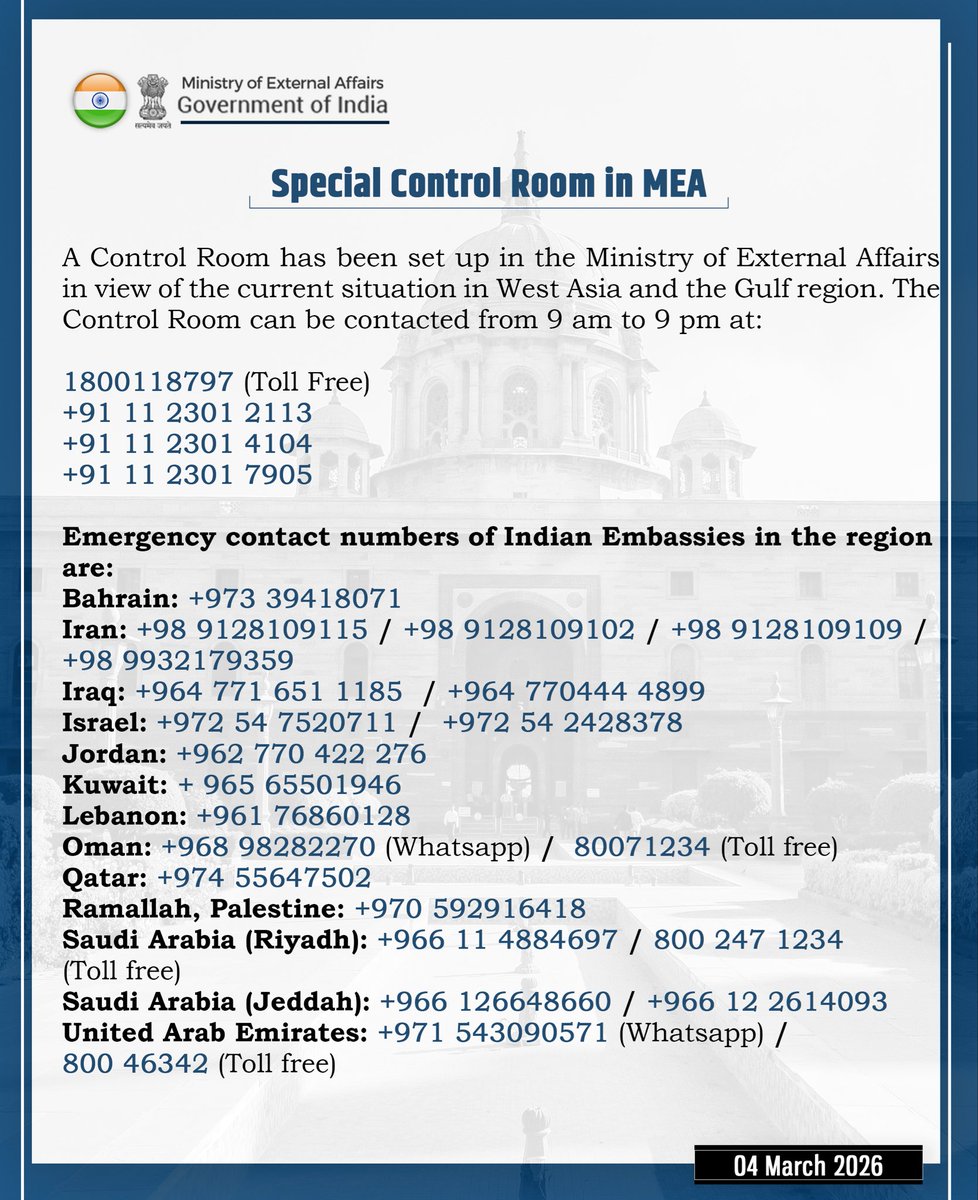
A Special Control Room has been set up in the Ministry of External Affairs in view of the current situation in West Asia and the Gulf region. Details are as below ⬇️ 🔗 bit.ly/3NhDKDr
Randhir Jaiswal tweet media
English
93
833
1.6K
110.6K
Sandra Petersmann retweetledi
Randhir Jaiswal
Randhir Jaiswal@MEAIndia·
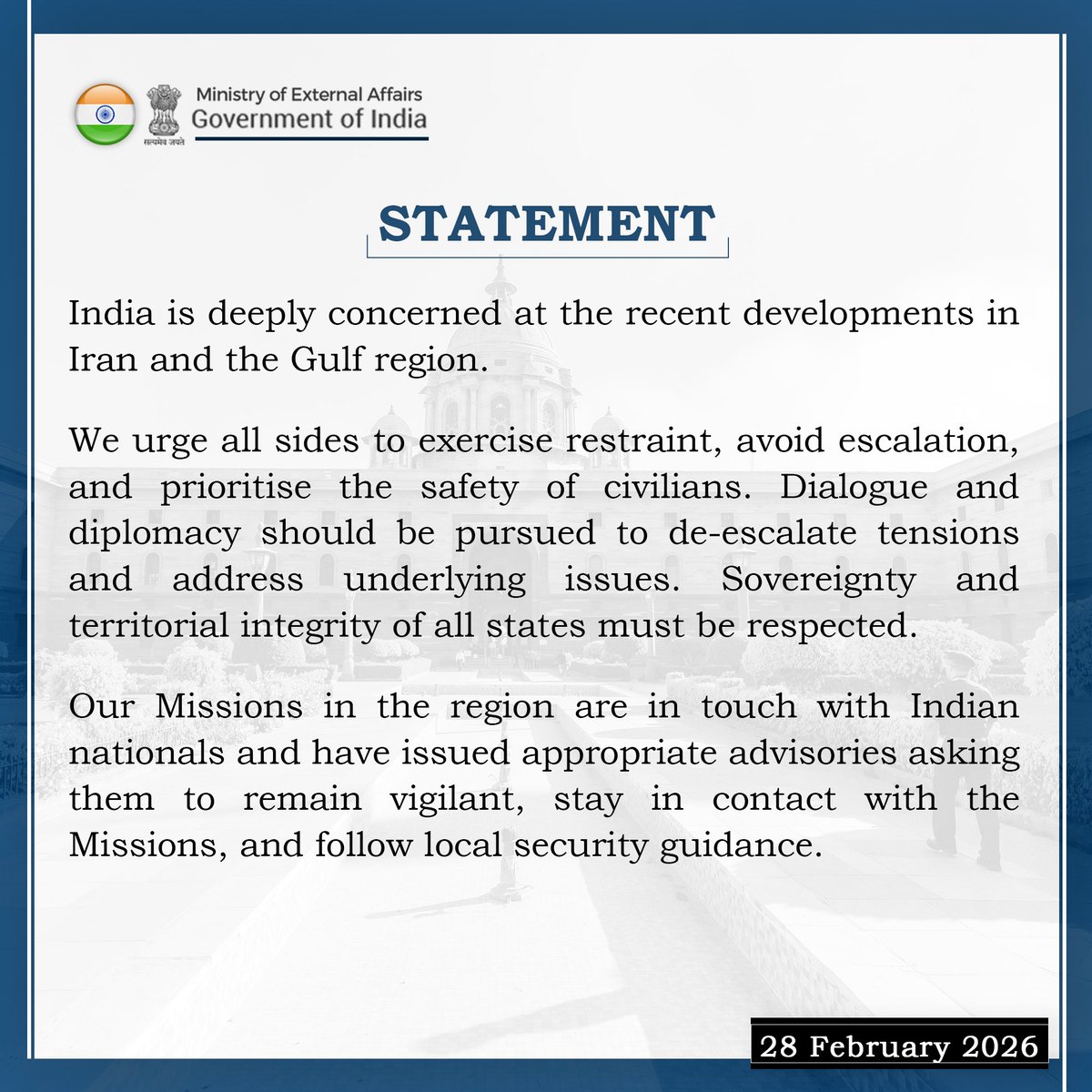
Our statement on the evolving situation in West Asia ⬇️ 🔗 bit.ly/47aOVV5
Randhir Jaiswal tweet media
English
248
806
3.7K
391.3K
Sandra Petersmann retweetledi
Emmanuel Macron
Emmanuel Macron@EmmanuelMacron·
En route to India! Three days from Mumbai to New Delhi to take our strategic partnership even further. On board with me: business leaders and the economic, industrial, cultural and digital players who give real, tangible life to the ties between India and France. Together, we will go even further in our cooperation. See you tomorrow, my dear friend @NarendraModi!
Emmanuel Macron tweet media
English
1.1K
2.8K
26.9K
5.7M