

phads
546 posts

phads
@PhadsEth
Early $IREN and $CIFR Bull | Acqua Panna Drinker | $BTC $ETH AI/HPC || We are still so early, the pace of innovation is only just going to keep accelerating!
Katılım Aralık 2021
482 Takip Edilen390 Takipçiler

Between 2022 and 2024, I went all in $BTC and $IREN.
Spot and shares only.
The past few years have had their ups and downs, but amongst all the noise this crazy world is throwing at us these days (always), I am proud that I have held the course and meaningfully changed the financial future of my family.
I used to be a millionaire.
English
@BitcoinAIGuy @OakenshieldVGX I wouldn’t say ‘No’ to an IREN t-shirt or hoodie 😁
English

Contrarian take:
I like when $IREN is bad at communicating.
Bad PR, Bad IR, no updates… this means bulls are in fear, uncertainty, or doubt…
I have never owned more shares of $IREN than today. Buying the dips has never been easier: we are in a clear AI supercycle, and $IREN holds the keys to the AI kingdom.
I don’t need an $IREN t-shirt, GPU progress updates, I don’t even look at the satellite images… the job will get done.
I need more shares.
English
we may see a massive short squeeze and simultaneous gamma squeeze.................................. this is how a stock can move 100% in a few days
buckle up
English
@dotkrueger @mikealfred Mike should be getting cases of Acqua delivered to his house each month from @Nestle , the amount of visibility he is providing by being a loyal Acqua drinker
English

@mikealfred Is this post sponsored by AquaPanna?
You need to disclose these things.
English
@matthew_sigel @Umbisam What’s the definition of insanity again? Let’s hope they try different tactics in order to get these better outcomes, but a F- student tends to remain a F- student
English

@Umbisam When management quality/decision-making moves from F grade to C-, stocks can easily +50% relative.
English

@IREN_Ltd @TheSixFiveMedia @Lenovodc Great to see such a strong partnership between IREN and OEM providers (Lenovo)
English

"Delivering infrastructure at this scale is not simple."
$IREN CCO Kent Draper sat down with @TheSixFiveMedia to discuss how @Lenovodc is supporting IREN's AI Cloud deployment in British Columbia.
Six Five Media@TheSixFiveMedia
In 2026, the real limit to AI success is how fast you can deploy it. From GTC, @danielnewmanUV + @PatrickMoorhead talk with @lenovodc SVP @VladRozanovich + Kent Draper CCO @IREN_Ltd on AI gigafactories. What matters now: • Time to first token = ROI • Power, land, cooling = constraints • Vertical integration = speed Which players will actually deploy at scale? Tell us your thoughts in the comments.
English
@bitcoinbutcher1 @CipherInc @grok Guessing @grok doesn’t allow “charity” in helping me out, and is going to force me to be a paid premium member.
Well, I asked grok directly and he said not likely more than one site, since in the press release it said it was “one of their existing sites”
English

@PhadsEth @CipherInc @grok @grok what do you think of their use of the term “campus” as a way to describe the lease execution vs just using ‘site’? Is it possible there is more than 1 CIFR data center location at play here in this agreement?
English
@CipherInc @grok what do you think of their use of the term “campus” as a way to describe the lease execution vs just using ‘site’? Is it possible there is more than 1 CIFR data center location at play here in this agreement?
English
B200s going parabolic 🚀🚀🚀 $IREN
Hemingway Capital@lfg_cap
GPU spot rental rates are ripping. B200 on-demand up 50% in a month(!) , while the 3 year old H100s +20% since November. 🚀 These are spot aggregates, not transaction prices of course. But if you think the direction of travel doesn’t matter here, I don’t know what to tell you. $NVDA
English
From the IREN space with Dan, seems like they are completely fine with no deal and going alone as an AI cloud if the hyperscaler terms are not agreeable. They have $9B in total funds raised through various means which they could use to kickstart the development and revenue / profit.
English

Half of me says $IREN has been holding out for the best deal terms and can afford to. The other half says that since deals are being announced left and right, @danroberts0101 might have gotten too greedy and now is having trouble landing a deal amongst increased competition
English
@McnallieM @IREN_Ltd The fact that they secured the site over four years ago and still have not formally announced it just goes to show how long the process takes.
Great find Bryce!
This is the time-to-power and time-to-data center moat that IREN has been building for the last 5+ years
English

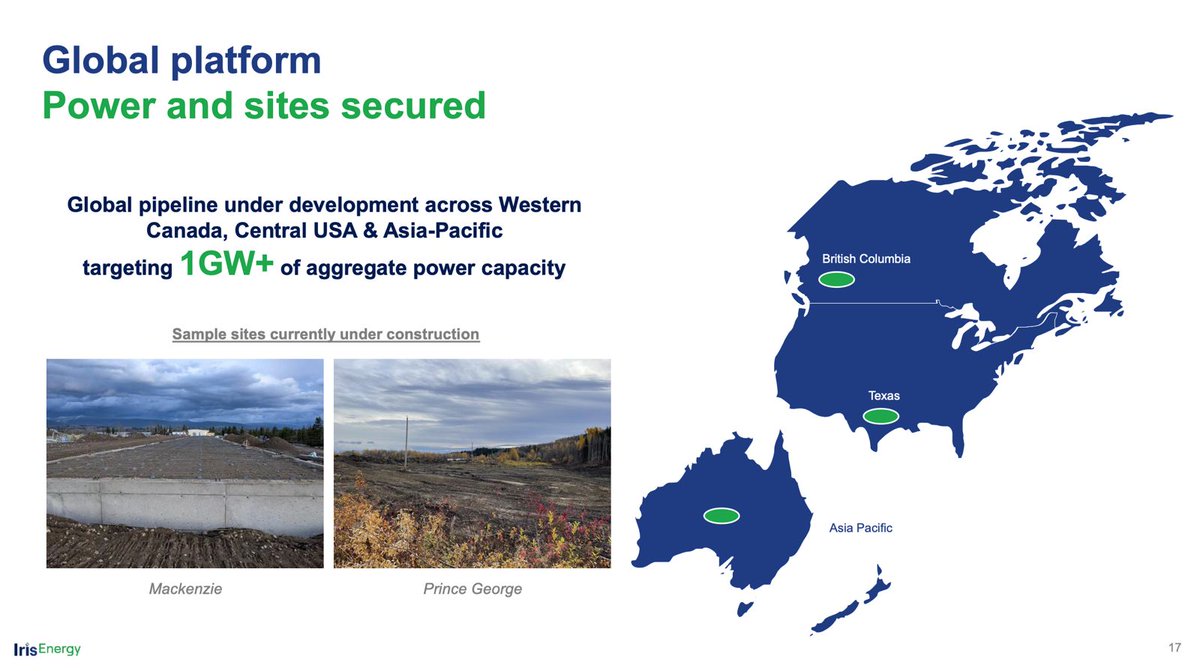
A little gem from the November 2021 @IREN_Ltd deck, notice the "Asia-Pacific" mention and Australian reference... 🔍🔍🔍 $IREN
𝐀𝐠𝐫𝐢𝐩𝐩𝐚 𝐈𝐧𝐯𝐞𝐬𝐭𝐦𝐞𝐧𝐭𝐬@Agrippa_Inv
$IREN's Move into Australia "The talk here in Australia is that $IREN are in talks with the South Australian state government to secure power and develop data centers in South Australia." Guess what AI start up, worth hundreds of billions, is soon opening a new office in Australia? ...Anthropic
English

I bought a little bit more BTDR shares today near 8.70. With BTDR still close to just a $2 billion market-cap, the risk-reward is fantastic for when Bitcoin recovers and when they start announcing AI deals. My Bitcoin mining stock money is now 65% IREN, 20% BTDR, and 15% CIFR.
English
phads retweetledi

It’s always funny to see Wall Street completely fumble hyper-growth stocks.
The street is expecting $IREN to make ~$8.4b in revenues by FY 2030, with EBITDA margins of just ~68%.
Analysts are completely mispricing $IREN's 4.5 GW site-portfolio and multi-GW pipeline beyond that.
I went ahead and modelled out my own near-term projections for the coming 2 years, using the following assumptions:
Childress:
300 MW: MSFT Deal
450 MW: air-cooled (B300), fully ramped by Q3 2027
British Columbia:
160 MW: Mostly air-cooled, fully ramped by Q1 2027
Sweetwater 1:
600 MW: Vera Rubin (VR200) fully ramped by Q1 2028
Results:
👉 2027 = ~$8.3b (Rev) / ~$6.6b (EBITDA)
👉 2028 = ~$12.7b (Rev) / ~$10.3b (EBITDA)
One of Wall Street’s problems is that they only price what’s directly in front of them.
My 2027 revenue estimates are basically Wall Street’s 2030 projections. 🤦🏻♂️
And to be honest, my assumptions are actually very sensible. For the air-cooled deployments across Childress & BC, I used revenues BELOW management’s guidance.
For exact modelling inputs and FCF / net income projections up to 2030, refer to my new $IREN deep dive on Substack.
To be clear, I’m much more confident in my 2028 projection, since Sweetwater’s ramp could be more heavily skewed toward H2 2027 and H1 2028 instead of the simplified linear ramp approach I used.
However, the point remains: Wall Street is completely dropping the ball on this one.
What do you think will happen once $IREN announces its next hyperscaler deals at Childress and Sweetwater?
→ Massive re-rate incoming, as Wall Street scrambles to upgrade their idiotic projections.

English
Can you explain why hedge funds and institutions are not seeing this, or, what risks do they over emphasize that we might not?
My guess is that since IREN is likely no longer seen as a BTC miner, the biggest headwind is the volatility of their stock price and relatively low volume for a major institutional investment. Their stop losses would get triggered too quickly, so as weird as it sounds, they are going to wait on the sidelines until IREN’s profit, revenue and stock price hit an inflection point, and then all rush in at once.
Just waiting patiently for that day.
English
New $IREN Deep Dive: Childress Unlocked
I’ve spent the last couple of weeks writing the most important $IREN deep dive I’ve published to date.
Air-cooling at Childress is a MUCH bigger deal than the vast majority of investors and analysts realize.
Honestly, $IREN price targets across the board should be well above $100 at this point. But Wall Street missing the forest for the trees is nothing new.
I’ve extensively modelled out the company’s near-term pipeline using conservative assumptions (below management’s guidance), and it’s clear as day that the market isn’t properly pricing in $IREN's industry-leading earnings power.
$IREN is going to make BILLIONS of actual net income over the coming years… not just meaningless EBITDA or top-line figures, but real profits flowing to the bottom line.
If anyone is the next hyperscaler, it’s $IREN.
Remember, real hyperscalers are actually profitable…
At the same time, every investor should be aware of looming industry risks that affect all neo-clouds in the sector and evaluate how they could impact the investment thesis.
That’s exactly what I’ve done for all our readers.
These are the topics this new report covers:
➞ Breaking down the new GPU orders + new guidance
➞ Implications of air-cooling
➞ Extensive pipeline modelling
➞ Comprehensive analysis of the new $6b ATM
➞ Risks to the investment thesis
➞ + Plenty of bonus topics
This 40+ page mega deep dive covers everything $IREN investors should be aware of today.
It’s written in a very reader-friendly way, with many graphics & embedded video clips throughout.
I chuckle when I read so-called “analysts” on X give their takes on $IREN after doing nothing more than surface-level analysis (at best).
Most investors have no idea where this is heading…
If you’ve read the new deep dive, I’d love to hear your feedback in the comments.
Appreciate all of you, cheers! ✌️
agrippa.investments/p/iren-childre…
English
@Agrippa_Inv @nvidiaretail Agreed, if they wanted a deal at SW they could most likely get one today, but their own cloud BATNA is too strong in their mind if they have a way to secure the funds over time safely, while still confirming the AI compute demand in the market is not slowing down
English
To be honest, I doubt it. Management seems to be very focus on scaling its core cloud platform & I believe they’ll leverage the full SW site to continue doing exactly that.
With the demand / supply imbalance in the sector right now, I don’t see much reason why this wouldn’t be possible.
Leverage has to be kept in check, obviously. But management appears to be on top of that.
English
@CernunnosCap @Agrippa_Inv All good, not meaning to single you out, it’s everywhere on X :)
I will send a follow to read more of your content moving forward
English

@PhadsEth @Agrippa_Inv We usually write all our ideas. And most of the time the thoughts are written in a scrambled way in paragraphs. So we usually use AI to structure them into something readable.
English
$NBIS Deconstructing the "Uninvestable" Bear Thesis authored by an $IREN Investor
@Agrippa_Inv has a mathematically accurate bear thesis on Nebius.
☄️ There’s just one massive problem: it applies a mature SaaS framework to a Tier-1 infrastructure land-grab.
If you fundamentally misunderstand neocloud economics, you will miss the alpha. Here is the undisputed reality of the AI compute super-cycle:
🔹"Structural Cost"
The bear case points to a ~110% cost-to-revenue ratio and calls it a "structural" flaw.
This ignores the mechanics of step-function data center CapEx. Look at the early days of $AMZN Amazon Web Services. You pay for the facility overhead, massive power substations, and cooling before the racks are fully populated.
Nebius is aggressively laying track. These are front-loaded scale inefficiencies, not structural bloat. As density scales, margins expand exponentially.
🔹 "Competing with Giants"
Nebius isn't undercutting $GOOGL or $MSFT in a SaaS price war. They are acting as their landlord.
The AI compute market is severely supply-constrained. Legacy hyperscalers are putting enterprise clients on waitlists. Neoclouds win on provisioning speed and purpose-built InfiniBand architecture.
Selling "bulk bare metal" isn't a lack of pricing power - it’s the Anchor Tenant model. Locking in multi-year hyperscaler capacity de-risks the hardware build. Once subsidized, they layer on high-margin PaaS - @nebiustf
🔹 4-Year Depreciation
Calling a 4-year GPU depreciation schedule "rather short" misses the industry context.
When moving from $NVDA Hopper ➡️ Blackwell 🔜 Rubin, technological obsolescence happens fast. While 4 years artificially depresses near-term GAAP profitability compared to peers stretching to 5+ years, it drastically de-risks the balance sheet.
🔹IREN Bias & The "Black Box"
The crux of the bear argument complains about a lack of contract transparency, comparing Nebius to Iris Energy. This is a category error.
IREN is a crypto-miner pivoting to HPC. They must offer extreme transparency as a survival mechanism to prove they aren't just a crypto proxy.
@nebiusai is a pure-play neocloud negotiating with the largest tech entities on earth. True Tier-1 hyperscaler contracts mandate strict, legally binding NDAs. $META and Microsoft absolutely do not want competitors knowing their exact GPU deployments or unit economics.
Management isn't a "black box", they are operating legally in the big leagues. Penalizing Nebius because standard NDAs ruin your spreadsheet model is a fatal flaw.
✳️ Demanding a mature, low-CapEx, high-margin P&L from a company in the middle of a once-in-a-generation infrastructure build guarantees you miss the trade. $NBIS is trading on future fully-utilized capacity.
By the time the unit economics look like mature AWS, the trade will be over.
Bookmark this for when the CapEx cycle matures. 🔖
#NVIDIAGTC #GTC2026 $CRWV
Do you agree they are building the next AWS, or are bears right to demand margins today? Let us know below.👇

𝐀𝐠𝐫𝐢𝐩𝐩𝐚 𝐈𝐧𝐯𝐞𝐬𝐭𝐦𝐞𝐧𝐭𝐬@Agrippa_Inv
Why I’m Not Invested in $NBIS First of all, let me make one thing clear: contrary to what you might think, I’m not an $NBIS bear. But then again, I’m not invested either… and for good reason. Nebius positions itself as a holistic cloud platform with superior software technology that caters to AI-native start-ups and enterprise clients. That in and of itself isn’t a problem, but it means they're directly competing against the largest hyperscalers in the world, who are also targeting that exact cohort with their own set of software solutions (Google Cloud, Microsoft, etc.). Nonetheless, if $NBIS can successfully differentiate itself with its core offerings, it could gain some pricing power, which is the company’s best shot at one day becoming profitable. The problem is, $NBIS is VERY far away from that… Looking at the last quarterly filing, the company’s gross expenses + depreciation equaled ~110% of its revenues. In other words, these two cost categories exceeded the value of the underlying revenues ($249.2m vs. revenue of $227.7m). To be fair, last quarter Nebius still used a 4 year depreciation schedule on GPUs, which is rather short and overstates depreciation. Adjusting for a 5 year depreciation schedule (industry standard) leads us to $144.6m of depreciation. Then, adding gross expenses of $68.5m on top gets you to $213.1m, which equals 93.5% of revenues. And keep in mind, this figure does NOT include the hundreds of millions in costs spent on SG&A, R&D, and financing (interest). So what’s my point with this? The problem is, these are STRUCTURAL costs, the kind that scale with revenue, meaning you can’t easily grow out of them through sheer scale. My point is that $NBIS' pricing power is nowhere to be seen, at least not relative to its costs. Now, most $NBIS investors would probably argue that we are still "early" and that pricing power will show up eventually. My problem with that argument is that the company seems to be allocating a very large chunk of its pipeline towards servicing hyperscalers through bare metal offerings, the kind of “bulk” service that does NOT command significant pricing power. That means, fundamentally speaking, $NBIS is likely very far away from actually becoming profitable. And while right now everyone is focused on headline figures like ARR, the market’s patience will run out eventually... it ALWAYS does for every company. One day, the market will demand to see real profits flow down to the bottom line, and I’m not sure if $NBIS is structurally positioned to deliver on that any time soon. To make matters worse, investors can’t even model out the economics of these large hyperscaler deals, because management provides absolutely 0 information on anything except headline figures. We don’t even know the CapEx associated with these deals, or at the very least, the number of GPUs they have to purchase to fulfill their end of the bargain. Contrast that with a company like $IREN, which gives you all the necessary information to build an entire P&L and cash flow model over the full course of the contract length, which is exactly what I’ve done extensively for our subscribers on Substack. I have a VERY good idea of how much actual post-tax net income $IREN is making in every year of their hyperscaler contract. There are other reasons that further point in the same direction, but I won’t get into them right now. If they fix their cost structure one day, I’m happy to reconsider my stance. But as of today, their “black box” approach to publishing details on their largest deals makes them uninvestable for me.
English
@CernunnosCap @Agrippa_Inv It’s more the “it’s not X, it’s Y”. Classic AI signature, just like the em dash ( — ) used to be
English
@Agrippa_Inv @PhadsEth lol - “Bulk service”, “black-box” are all the words from the original @Agrippa_Inv posts 🤣
English
@CernunnosCap @Agrippa_Inv Too much of this platform is becoming copy paste from these LLMs. All for using it for research, maybe just consolidate into your own words.
I’m afraid in the future X will just become user’s agents talking to one another, and that would be a shame
English
@Agrippa_Inv @PhadsEth And again - never denied using AI. We always use AI to structure our arguments when posting. ALWAYS, and add some emojis cuz it’s X, not Reddit 🤪
English