Pharos

114 posts

Pharos banner
Pharos

Pharos

@PharosWatch

Stablecoin Lighthouse: Honest classification, peg tracker & depeg notifier, safety ratings, portofolio review, depeg early warning system & more. By @TokenBrice

Katılım Şubat 2026
53 Takip Edilen339 Takipçiler
Sabitlenmiş Tweet
Pharos
Pharos@PharosWatch·
🏆 PHAROS CREATOR CHALLENGE WINNERS 21 submissions to spread the word of Pharos Watch. One week. 3 Winners. $3000 in total rewards distributed. We experienced peak creativity and virality at its best. Winner breakdown below: In 1st place: @ikebillion_ with a viral post, breaking down how to use tools on Pharos Watch to research DeFi like a pro. x.com/ikebillion_/st…
IkeBillion.eth@Ikebillion_

How to make DeFi research like a pro. I get asked often how I find the opportunities I write about. The honest answer is that I use a small set of tools consistently and I have learned what each one is best at. Here are the three I keep coming back to. 1. DeFiLlama No surprise that this is first. Built by a team that includes @0xngmi, DeFiLlama tracks over 7,300 protocols across 521 blockchains, making it the largest open-source TVL aggregator in crypto. It is also fully open-source, which matters for anyone who cares about data transparency. What I use it for most is understanding ecosystem-wide movements. How stablecoin flows affect TVL, where yields are shifting, and what the raw numbers say about a protocol's health before I go deeper. @DefiLlama excels at showing the big picture and the free tier covers everything you need for solid foundational research. The UI is clean and easy to navigate, so the learning curve is low. For those who want more, the paid tiers unlock LlamaAI, DeFiLlama's newly built conversational analysis agent, alongside direct API access and raw database queries. If you are a researcher focused purely on protocol metrics, flows, and on-chain numbers, this is your starting point every single time. 2. Pharos Watch This one has quietly become my favorite for stablecoin research. Built by @TokenBrice, Pharos is completely free and pulls from DeFiLlama and other data APIs to deliver live market intelligence specifically built around stablecoins. The depth of what it covers is what separates it. @PharosWatch runs a Depeg Early Warning System, DEWS, with threat levels ranging from Calm all the way to Danger. It also tracks the Pharos Stability Index, PSI, which classifies current market regimes. BEDROCK signals ultra-stable conditions. MELTDOWN signals crisis. Knowing which regime you are operating in before you deploy capital is genuinely useful. Safety grades run from A to F and factor in decentralization, liquidity depth, and redeemability. Individual coin profiles show peg scores, depeg history including how long each depeg lasted, mint and burn activity, liquidity tracking, contagion simulations, and non-USD peg analysis. You can also simulate your entire stablecoin portfolio to get a safety grade before committing real exposure, which is one of the most practical features I have seen on any research tool. Pharos also has an info section that covers stablecoin news and history in a way that is actually useful for building context. The founder is genuinely engaged with users, actively collecting feedback and willing to support. That kind of accessibility is rare and it shows in how the product keeps improving. If you farm stablecoins or hold any meaningful stablecoin exposure, Pharos belongs in your workflow. 3. Stablewatch Founded by @stablecoin_p, Stablewatch positions itself as the command center for yield-bearing stablecoin intelligence and it earns that description. It is a specialized yield-focused analytics platform with strong risk advisory features built in. What I use it for most is yield hunting. Before I farm any stablecoin, I go to Stablewatch and check the project. It tracks live APYs across protocols in real time, so you are always looking at current rates rather than outdated snapshots. Beyond the numbers, it also provides risk frameworks to help you understand what you are taking on before you commit. The memo-style market reports @stablewatchHQ publishes are a goldmine for research and article sourcing. They are structured, data-rich, and save significant time when you are trying to build a clear picture of where the stablecoin yield market is moving. Stablewatch works exceptionally well alongside DeFiLlama and Pharos. DeFiLlama gives you the ecosystem view. Pharos tells you whether the peg is trustworthy. Stablewatch tells you where the best yield is and what risk comes with it. Together, the three cover the full research workflow from macro to micro. Each tool has a lane. Together, they leave very few blind spots.

English
7
2
11
1.3K
Pharos
Pharos@PharosWatch·
🏆 PHAROS CREATOR CHALLENGE WINNERS 21 submissions to spread the word of Pharos Watch. One week. 3 Winners. $3000 in total rewards distributed. We experienced peak creativity and virality at its best. Winner breakdown below: In 1st place: @ikebillion_ with a viral post, breaking down how to use tools on Pharos Watch to research DeFi like a pro. x.com/ikebillion_/st…
IkeBillion.eth@Ikebillion_

How to make DeFi research like a pro. I get asked often how I find the opportunities I write about. The honest answer is that I use a small set of tools consistently and I have learned what each one is best at. Here are the three I keep coming back to. 1. DeFiLlama No surprise that this is first. Built by a team that includes @0xngmi, DeFiLlama tracks over 7,300 protocols across 521 blockchains, making it the largest open-source TVL aggregator in crypto. It is also fully open-source, which matters for anyone who cares about data transparency. What I use it for most is understanding ecosystem-wide movements. How stablecoin flows affect TVL, where yields are shifting, and what the raw numbers say about a protocol's health before I go deeper. @DefiLlama excels at showing the big picture and the free tier covers everything you need for solid foundational research. The UI is clean and easy to navigate, so the learning curve is low. For those who want more, the paid tiers unlock LlamaAI, DeFiLlama's newly built conversational analysis agent, alongside direct API access and raw database queries. If you are a researcher focused purely on protocol metrics, flows, and on-chain numbers, this is your starting point every single time. 2. Pharos Watch This one has quietly become my favorite for stablecoin research. Built by @TokenBrice, Pharos is completely free and pulls from DeFiLlama and other data APIs to deliver live market intelligence specifically built around stablecoins. The depth of what it covers is what separates it. @PharosWatch runs a Depeg Early Warning System, DEWS, with threat levels ranging from Calm all the way to Danger. It also tracks the Pharos Stability Index, PSI, which classifies current market regimes. BEDROCK signals ultra-stable conditions. MELTDOWN signals crisis. Knowing which regime you are operating in before you deploy capital is genuinely useful. Safety grades run from A to F and factor in decentralization, liquidity depth, and redeemability. Individual coin profiles show peg scores, depeg history including how long each depeg lasted, mint and burn activity, liquidity tracking, contagion simulations, and non-USD peg analysis. You can also simulate your entire stablecoin portfolio to get a safety grade before committing real exposure, which is one of the most practical features I have seen on any research tool. Pharos also has an info section that covers stablecoin news and history in a way that is actually useful for building context. The founder is genuinely engaged with users, actively collecting feedback and willing to support. That kind of accessibility is rare and it shows in how the product keeps improving. If you farm stablecoins or hold any meaningful stablecoin exposure, Pharos belongs in your workflow. 3. Stablewatch Founded by @stablecoin_p, Stablewatch positions itself as the command center for yield-bearing stablecoin intelligence and it earns that description. It is a specialized yield-focused analytics platform with strong risk advisory features built in. What I use it for most is yield hunting. Before I farm any stablecoin, I go to Stablewatch and check the project. It tracks live APYs across protocols in real time, so you are always looking at current rates rather than outdated snapshots. Beyond the numbers, it also provides risk frameworks to help you understand what you are taking on before you commit. The memo-style market reports @stablewatchHQ publishes are a goldmine for research and article sourcing. They are structured, data-rich, and save significant time when you are trying to build a clear picture of where the stablecoin yield market is moving. Stablewatch works exceptionally well alongside DeFiLlama and Pharos. DeFiLlama gives you the ecosystem view. Pharos tells you whether the peg is trustworthy. Stablewatch tells you where the best yield is and what risk comes with it. Together, the three cover the full research workflow from macro to micro. Each tool has a lane. Together, they leave very few blind spots.

English
7
2
11
1.3K
Pharos
Pharos@PharosWatch·
FEEDBACK WINNERS (All 250 each) 1. RobAnon CEO of InfiniFi, @RobAnon providing feedback on the iUSD procesing on Pharos and sharing the iUSD API leading to the implementation of: > Direct pricing flow (not DEX based) to assess price/peg of redeemable assets > Redemption backstop scoring 2. @Rozengarden_eth Feature request helping improve the cemetery + helped identified a missing entry (DYAD v1) + the only one who reported cleanly through the best process (github issue) 3. @Gabal92725913 Who asked a simple question, but that ended consequential => as it lead to the implementation of the real-time reserve composition tracker system
English
0
0
6
87
Julink
Julink@julink_eth·
@TokenBrice @PharosWatch Will you enable putting your address and track directly which stables you are exposed to ?
English
1
0
1
23
tokenbrice.eth (🐜,🔍)
I know my stables, and manage my risk and underlying assets exposure accordingly: do you? No need to be a stable pro to allocate like one nowadays: just use @PharosWatch portfolio (Figures are for example only, but respect my effective allocation)
tokenbrice.eth (🐜,🔍) tweet media
English
6
1
11
1.1K
Pharos
Pharos@PharosWatch·
Pharos has data, but nobody's telling the story yet. Let's fix that ⇒ $3000 (BOLD) up for grabs (1250 for #1). Eligible formats: blog posts, tweets/threads, videos, podcasts + rewards for most useful user feedback as well. You have one week. Reply with your content to enter.
tokenbrice.eth (🐜,🔍)@TokenBrice

I spent the last few weeks building @PharosWatch 156 stablecoins tracked. Real-time peg monitoring. Early warning scores. Safety ratings. DEX liquidity depth. Dependency maps. Contagion simulation & more A pure solo-built & self-funded public good: tokenbrice.xyz/pharos

English
21
4
27
4.2K
Pharos
Pharos@PharosWatch·
Stablecoin Spotlight of the Week: fxUSD fxUSD by @protocol_fx does not get talked about enough but the risk profile is remarkably clean. Here’s what our data has to say about it. Market cap: $17M Peg score: 98/100 Resilience score: 87/100 (A+) Collateral risk: Medium (61/100) Custody: Fully on-chain (100/100) Blacklist risk: None (100/100) DEWS rating: 5/100 (Very safe) Net flow 24h: +$152,000 Capital is moving in, not out. fxUSD is a CDP stablecoin backed by wstETH at 42.5% and WBTC at 57.5%. The peg is maintained through a USDC/fxUSD Stability Pool on @CurveFinance, overcollateralization, and direct collateral redemption at oracle price. Three layers of defense. fxSAVE handles passive yield for idle holders. The 98/100 peg score and fully on-chain custody with zero blacklist exposure are the standout strengths here. No centralized chokepoint. No censorship risk. The medium collateral score of 61 is worth watching. WBTC carries custodial considerations and both assets carry volatility risk in extreme market conditions. Liquidity depth is also still maturing at this market cap size. Overall, fxUSD is underrated and the fundamentals are solid.
Pharos tweet mediaPharos tweet mediaPharos tweet mediaPharos tweet media
English
2
8
32
2.3K
f(x) Protocol
f(x) Protocol@protocol_fx·
You also get paid to borrow it against ETH or BTC 👀 fx.aladdin.club/v2/fxmint
Pharos@PharosWatch

Stablecoin Spotlight of the Week: fxUSD fxUSD by @protocol_fx does not get talked about enough but the risk profile is remarkably clean. Here’s what our data has to say about it. Market cap: $17M Peg score: 98/100 Resilience score: 87/100 (A+) Collateral risk: Medium (61/100) Custody: Fully on-chain (100/100) Blacklist risk: None (100/100) DEWS rating: 5/100 (Very safe) Net flow 24h: +$152,000 Capital is moving in, not out. fxUSD is a CDP stablecoin backed by wstETH at 42.5% and WBTC at 57.5%. The peg is maintained through a USDC/fxUSD Stability Pool on @CurveFinance, overcollateralization, and direct collateral redemption at oracle price. Three layers of defense. fxSAVE handles passive yield for idle holders. The 98/100 peg score and fully on-chain custody with zero blacklist exposure are the standout strengths here. No centralized chokepoint. No censorship risk. The medium collateral score of 61 is worth watching. WBTC carries custodial considerations and both assets carry volatility risk in extreme market conditions. Liquidity depth is also still maturing at this market cap size. Overall, fxUSD is underrated and the fundamentals are solid.

English
3
2
29
1.6K
Pharos
Pharos@PharosWatch·
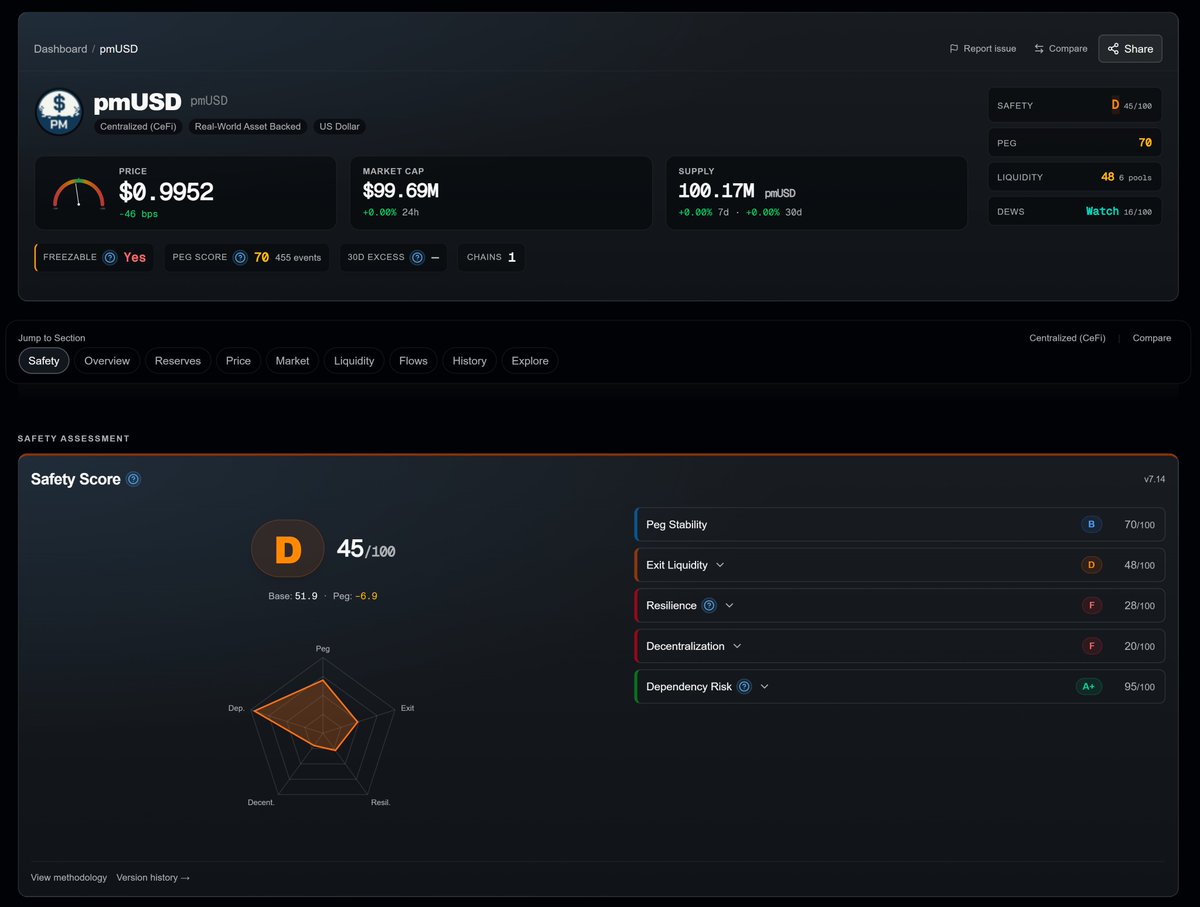
Tired of checking every day the reserve composition of your favorite stablecoins? Pharos features CONSTANT monitoring (updates every hour) of reserve composition for 43 stablecoins => Safety Score also adjust autonomously and accordingly
Pharos tweet media
Chilla@chilla_ct

Ethena was supposed to be an alternative to TradFi yield. Today, 88% of its backing is earning T-Bill rates, though most people still think it’s a basis trade protocol. Basis trade yield is not all-weather. It thrives in bull markets, when leverage is high, and funding rates are positive. But if crypto struggles, that whole architecture slows down. This used to generate double-digit yield through basis trades alone, but now sits at around 3.5% APY, with a spread vs T-Bills that is effectively zero. That's quite some crypto-specific risk for a return you could get from a money market fund. Perhaps the market has noticed this, with the USDe supply peaking at ~$15B in October 2025, right before the flash crash. While it's now at ~$6B, more than halved in five months (image below). The reason for its low spread is that the majority of Ethena’s yield today is just US Treasuries. As you can see from the image below, 88% of USDe's backing is stablecoins, either external ones or USDtb (Ethena's own stablecoin backed by BlackRock's BUIDL fund), which are all earning T-Bill rates. Those liquid stables break down into: - USDC (~$1.6B), - PYUSD (~$1.13B) - USDT (~$201M) - USDtb (~$68M) Interesting to note PYUSD here. PayPal's dollar, backed by US Treasuries, held by a US corporation. Ethena was supposed to be the alternative to exactly this, but it has become the single largest holder of PYUSD, with $1.1B in custody. To be transparent, it’s not fully clear whether these stables sit passively earning yield or are used as margin for delta-neutral positions. But when 88% of your backing is stablecoins, your spread vs Treasuries is zero, and your basis trade is giving near zero returns (image below) the math looks clear. --- To conclude, only about 12% of the total is given by underlying assets useful for basis trades such as BTC and ETH, and ETH LSTs. As well as a small percentage, less than 0.4% total in BNB, XRP and SOL. Ethena launched as a basis trade protocol. Today, it’s more like an onchain money market fund with a derivatives overlay. Nothing inherently negative about it, just a very strong change of direction for a business that realized it could not be resilient to various market conditions, although it is now in a very different spot than it initially forecasted.

English
2
1
14
2.5K
Pharos
Pharos@PharosWatch·
@Ceazor7 Submission registered ✅
English
0
0
2
49
Pharos
Pharos@PharosWatch·
@MuhammedAdewa14 The absence of registration of the submission has been registered ✅ and the Submission is now registered ✅
English
1
0
1
10
Senoiy(experimenting arc)
Senoiy(experimenting arc)@MuhammedAdewa14·
Senoiy(experimenting arc)@MuhammedAdewa14

Researching stablecoin yield has never been MORE healthier. One thing I realized while researching stablecoins is that yield is the easiest metric to find in DeFi, but the hardest thing to understand is the risk behind it. Researching a single stablecoin position meant piecing together signals from multiple places. You’d start on @DefiLlama to see how much TVL a protocol has. But TVL alone doesn’t tell you whether a stablecoin can hold its peg under stress. Then you'd move to @stablewatchHQ to see where the yield is and how it's been allocated. After that, you’d check liquidity pools on @CurveFinance or @Uniswap , or thank God the team behind the protocol build a Dune dashboard. Because in practice, a peg is only as strong as the liquidity supporting it. Thin pools mean even moderate trades can push a stablecoin off $1. For CDP-backed stablecoins like DAI, LUSD or BOLD, you’d also watch mint and burn activity on-chain to see whether leverage was building up in the system. And then you’d check price history on @coingecko to understand whether the stablecoin had depegged before, how far it moved from $1, and how quickly it recovered. By the time you finished, you might have opened 10+ tabs and spent 2 hours just to answer a simple question: Is this yield actually safe? But now that @TokenBrice has built Pharos, the messy workflow is now different. What I like about @PharosWatch is that it reframes this entire process around stablecoin risk instead of just yield. Instead of piecing together scattered signals from different sources as we are already used to. You can directly see peg stability, liquidity depth, mint/burn dynamics, and safety scores all in one place, along with tools like the Pharos Stability Index (PSI) that shows whether the market is operating under stable conditions or stress, the DEWs feature, you can tell how likely a stablecoin is to depeg and how to position well, also with the new Telegram bot alert that send signals on everything likely to happen. In addition to getting all these information, you can also compare stablecoins side by side in the window to get a clearer view of how well these coins are faring against each other. Incase you don't want to allocate your funds, you can also run a simulation to see how solid your strategy is. Also a dependency map that shows how these stablecoins are linked to each other. It turns stablecoin research from jumping across dashboards into a much clearer workflow. Ofcourse, it is not perfect yet as it is a new product. Personally for me, I'd like to see a chain filter for these stablecoins and also for the "Compare" tab, a way for users to create their own custom stablecoin pack. A CDP pack would be nice. Hopefully, we see more exciting features come alive soon. if you're a stables person, you should definitely check it out. I'm curious, if you could create a stablecoin pack, which ones would make the list?

QME
2
0
0
66