Stablecoin Intern@Degenerate_DeFi
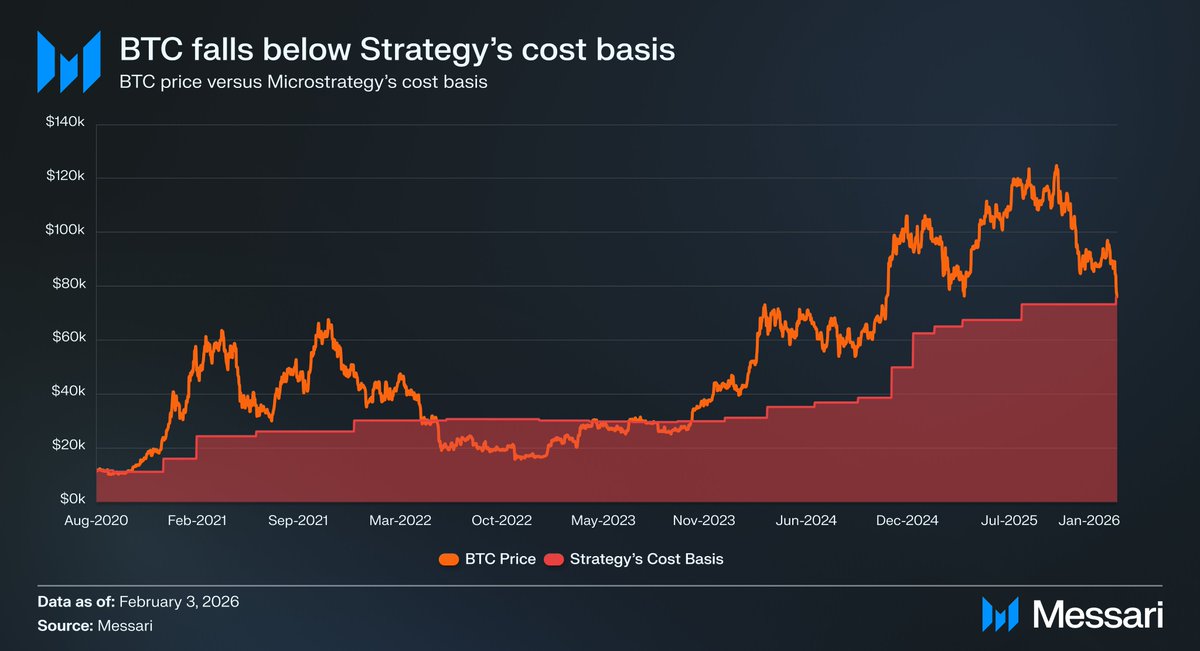
I genuinely fear that $MSTR is one risk-off phase away from a self-fulfilling death spiral.
While there are no debt covenants that force Strategy to liquidate $BTC, the mix of zero FCF, fixed payouts, and growing reliance on equity issuance makes a run on the common stock very plausible.
With funding sources becoming more fragile and fixed obligations in place, Strategy's financing situation resembles a global game scenario. In models of global games, a market outcome can remain stable for extended periods of time, then suddenly flip when investors begin second-guessing each other’s beliefs. When expectations flip, a speculative attack may form due to investor uncertainty about how others will react, even when fundamentals remain stable. This dynamic indicates why currency pegs break, why solvent banks face withdrawals, and why speculative attacks occur without any deterioration in the underlying asset.
Strategy's current funding environment is ripe for this coordination failure.
Strategy owes $767 million annually to service its two obligations: convertible bonds and preferred stock.
> Of that $767 million, Strategy pays $34.6 million towards servicing the convertible bonds. Historically, the convertible bonds were Strategy’s primary debt vehicle, which allowed the company to weather storms due to their low coupon rate (avg 0.421%) and long duration (avg 4.4 years)
> The preferred stock represents a far larger and more urgent pressure. Strategy pays $732 million annually to service its perpetual preferred stock, more than 20 times what it pays to service the convertibles. Strategy introduced its first preferred series in January 2025, and the company has never encountered a bear market while carrying this level of fixed obligations.
> Technically, Strategy can defer dividends on its preferred stock, but it comes with penalties and would likely signal liquidity constraints. If Strategy skips dividends they compound, and the dividend rate increases by 1% for each skipped period. Strategy could also sell BTC to fund dividends, but it would nuke the “levered BTC forever” narrative.
> In addition to the obligations, all four of Strategy’s preferred series performed poorly over the last three months. The poor performance likely caps Strategy’s ability to use this as a funding source in the near-term
Strategy’s software business is effectively breakeven on a cash basis in recent quarters.
> In Q3 2025, Strategy’s software business produced roughly $90 million in gross profit and incurred rougly $90 millon in cash operating expenses across sales and marketing, R&D, and G&A. In other words, if you adjust for the $3.89 billion in unrealized gains/losses on digital assets in Q3 it shows that the software operation broke even for the quarter.
> Strategy itself admits that there is a deficit in its operating model, stating in its Q1’25 filignt that: “...we do not expect our enterprise analytics software business to generate sufficient cash flow to satisfy our obligations over the next twelve months. However, we anticipate being able to use proceeds from equity or debt financing to meet these obligations."
> Strategy effectively has to fund the preferred dividend and convertible coupons through external capital if it wants to avoid selling BTC or skipping dividends.
But Strategy’s primary funding channel is becoming more fragile
> The primary mechanism that Strategy uses to tap into external capital is its at-the-market (ATM) equity offering program. ATMs allow the company to issue and sell shares of $MSTR directly into the market.
> Historically, this wasn’t an issue. In 2025 alone, Strategy has raised over $11 billion through ATMs, more than 15 times its annual obligations. However, prior ATM raises took place when mNAV was well above 1, so new issuance increased BTC exposure per share rather than reducing it.
> Between January 2023 and January 2025, mNAV ranged from 1.81 to 5.58, but has since compressed to 1.18. As mNAV compresses further towards 1 and especially if it falls below 1, each dollar raised through the ATM issues more claims on a shrinking pool of value, making the funding progressively more dilutive to common shareholders.
The interaction between fixed obligations, zero FCF, and a compressing mNAV aligns with the structure of a global game.
> If $MSTR shareholders believe others will tolerate issuance because it increases BTC exposure per share, the game can remain in a stable state where ATMs fund both BTC accumulation and obligations. On the other hand, if shareholders begin to expect issuance below mNAV, selling early becomes the safer move, as holding exposes them to expected future dilution.
> Ironically, the very fear of dilution encourages some holders to sell, and this selling pressure pushes the share price closer to or below mNAV. Trading below mNAV, in turn, makes each dollar of ATM issuance more dilutive to existing holders’ BTC per share. Even though the Strategy’s BTC holdings and dividend schedule remain unchanged, this feedback loop can still move the game from a good equilibrium, where issuance is tolerable, to a bad equilibrium, where expected dilution and price weakness support one another.
> This is a similar dynamic to a speculative attack on a currnency peg that is backed by gold. A currency can be fully backed by gold and still face a run if market participants doubt that authority’s capacity to defend the peg. If investors conclude that Strategy cannot continue funding its preferred stock without issuing equity at or below mNAV, a run on the common stock can occur, even if BTC holdings remain intact.
Full Messari report dropping soon!