David Branson Smith

2.3K posts

David Branson Smith banner
David Branson Smith

David Branson Smith

@PlaysWithFood

Trees grow 🌲

USA / Japan Katılım Kasım 2007
3.4K Takip Edilen1.7K Takipçiler
David Branson Smith retweetledi
andrew chen
andrew chen@andrewchen·
prediction re the end of spreadsheets AI code gen means that anything that is currently modeled as a spreadsheet is better modeled in code. You get all the advantages of software - libraries, open source, AI, all the complexity and expressiveness. think about what spreadsheets actually are: they're business logic that's trapped in a grid. Pricing models, financial forecasts, inventory trackers, marketing attribution - these are all fundamentally *programs* that we've been writing in the worst possible IDE. No version control, no testing, no modularity. Just a fragile web of cell references that breaks when someone inserts a row. The only reason spreadsheets won is that the barrier to writing real software was too high. A finance analyst could learn =VLOOKUP in an afternoon but couldn't learn Python in a month. AI code gen flips that equation completely. Now the same analyst describes what they want in plain English, and gets a real application - with a database, a UI, error handling, the works. The marginal effort to go from "spreadsheet" to "software" just collapsed to near zero. this is a massive unlock. There are ~1 billion spreadsheet users worldwide. Most of them are building janky software without realizing it. When even 10% of those use cases migrate to actual code, you get an explosion of new micro-applications that look nothing like traditional software. Internal tools that used to live in a shared Google Sheet now become real products. The "shadow IT" spreadsheet that runs half the company's operations finally gets proper infrastructure. The interesting second-order effect: the spreadsheet was the great equalizer that let non-technical people build things. AI code gen is the *next* great equalizer, but the ceiling is 100x higher. We're about to see what happens when a billion knowledge workers can build real software.
English
441
290
3.1K
1.3M
David Branson Smith retweetledi
Brian Armstrong
Brian Armstrong@brian_armstrong·
Very soon there are going to be more AI agents than humans making transactions. They can’t open a bank account, but they can own a crypto wallet. Think about it.
English
2.3K
2.9K
20.5K
4.7M
David Branson Smith retweetledi
Warren Redlich - Chasing Dreams 🇺🇸
What are real news sites? On X I click the Grok button to do a fact check. Do real news sites have that?
Warren Redlich - Chasing Dreams 🇺🇸 tweet media
Ratchathewi, Thailand 🇹🇭 English
3
3
14
1.2K
David Branson Smith retweetledi
Tanay Kothari
Tanay Kothari@tankots·
We offered 5 people a Porsche 911 GT3 RS if they could get @WisprFlow to make a mistake It's the fastest and most accurate AI voice dictation app that's 3x more accurate than ChatGPT, Claude, or Siri. Today, we’re finally launching on Android. Download now: play.google.com/store/apps/det… As a part of the launch, we’re giving away 6 months of Wispr Flow Pro for free. Like, retweet and comment ‘Wispr Flow’ to get it. Enjoy. — Written with Wispr Flow
English
4.6K
3.2K
10.9K
4.2M
David Branson Smith retweetledi
Beff (e/acc)
Beff (e/acc)@beffjezos·
Any games of social status at this point feel like a waste of time. Only thing that matters is access to AI compute. Everything else is a distraction.
English
33
31
413
28.5K
David Branson Smith retweetledi
Gandalv
Gandalv@Microinteracti1·
🇳🇴 Johannes Høsflot Klæbo has redefined what uphill sprinting looks like in modern cross country skiing. His acceleration on steep climbs is not just strong. It is violent, explosive, almost biomechanically unfair. While others grind, he shifts gears. His technique combines absurd leg turnover, perfect weight transfer, and upper body timing that keeps his skis gliding when everyone else is fighting friction. In Norway, people understand exactly what they are watching. This is technical evolution in real time. It is not just fitness. It is efficiency under lactate. It is sprint mechanics applied to terrain that traditionally rewards diesel engines. Klæbo’s uphill sprinting is not just fast. It changes race tactics. It forces competitors to attack earlier. It reshapes pacing strategy. That is why his impact is bigger than medals. He has shifted the ceiling of what is physically possible in modern sprint skiing. Stay connected, Follow Gandalv @Microinteracti1
Gandalv tweet media
English
170
483
9.8K
1.3M
David Branson Smith retweetledi
Anders K.
Anders K.@Falliblemusings·
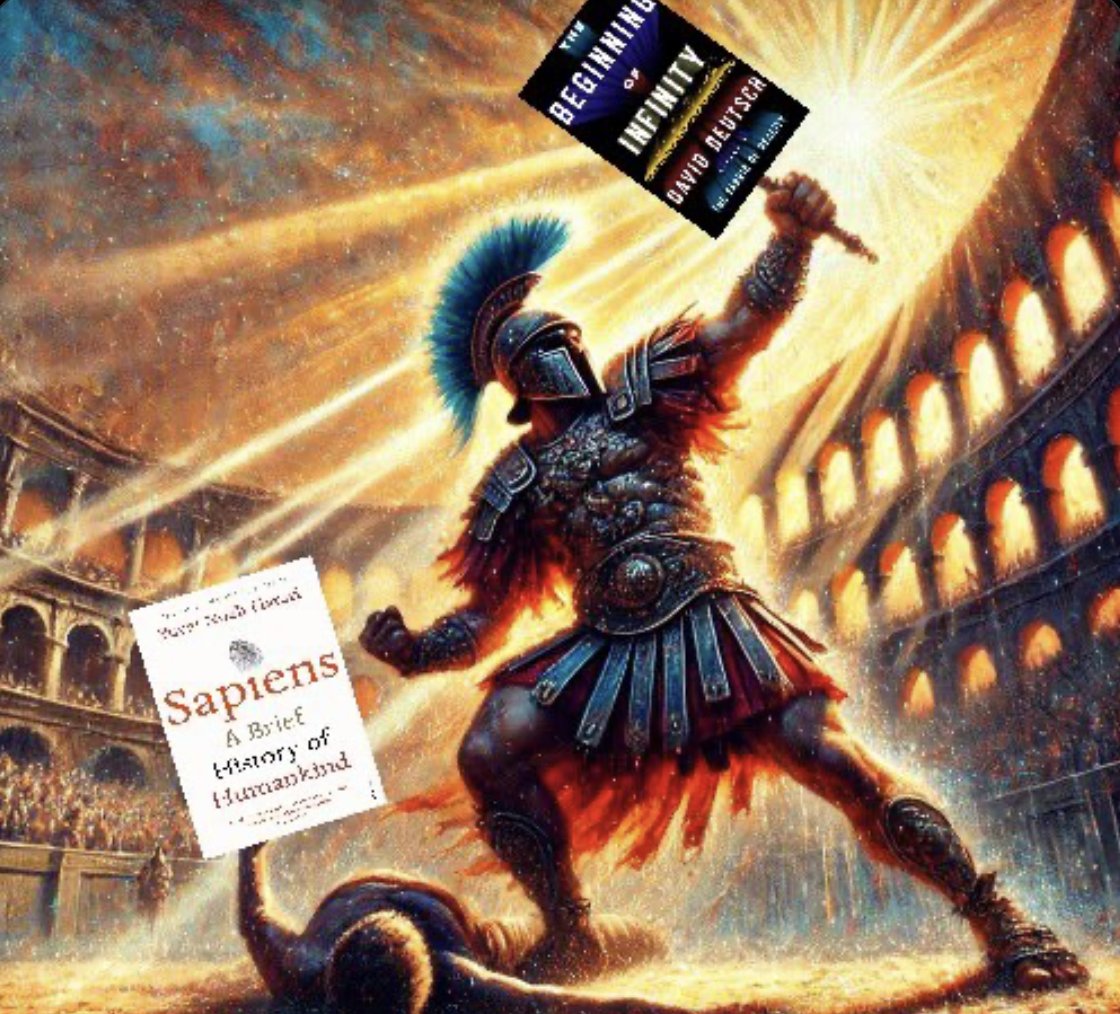
I used to think Sapiens was a great book. Sweeping, provocative, the kind of book that makes you feel like you finally understand the big picture of human history. It's on every CEO's bookshelf, assigned in universities, praised as a masterwork of synthesis. Yuval Noah Harari is treated as one of the serious thinkers of our time. But something nagged at me. Some passages felt off. Claims that human rights are just figments of our collective imagination, not real things, just stories we tell ourselves. That nations, laws, money, justice, doesn't exist outside our heads. That meaning itself is a delusion we've invented to cope. That we're far more powerful than ever before but not happier. That hunter-gatherers had it better because they had no dishes to wash, no carpets to vacuum, no nappies to change, no bills to pay. That sounded depressing to me, but was perhaps just the realistic scientific worldview? What it meant to see the world clearly, without comforting illusions. Then I read The Beginning of Infinity by @DavidDeutschOxf. Deutsch has a concept he calls 'bad philosophy.' Not philosophy that's merely false, but philosophy that actively prevents the growth of knowledge. Ideas that close doors rather than open them. That makes problems seem unsolvable by design. After soaking in Deutsch's framework (it's dense, a bit like digesting a delicious whale), it becomes clear: Harari's books are riddled with bad philosophy. They're smuggling nihilism in under the guise of scientific objectivity. Some examples: On meaning: "Human life has absolutely no meaning. Humans are the outcome of blind evolutionary processes that operate without goal or purpose... any meaning that people inscribe to their lives is just a delusion." On human rights: "There are no gods in the universe, no nations, no money, no human rights, no laws, and no justice outside the common imagination of human beings." On free will: "Humans are now hackable animals. The idea that humans have this soul or spirit and they have free will, that's over." On progress: "We thought we were saving time; instead we revved up the treadmill of life to ten times its former speed." The Agricultural Revolution? "History's biggest fraud." We didn't domesticate wheat, "it domesticated us." On our cosmic significance: "If planet Earth were to blow up tomorrow morning, the universe would probably keep going about its business as usual. Human subjectivity would not be missed." On the future: "Those who fail in the struggle against irrelevance would constitute a new 'useless class.'" Homo sapiens will likely "disappear in a century or two." This is bad philosophy. It tells us our problems are cosmically insignificant, our solutions are illusions, and that progress is neither desirable nor within our control. It's also perfect nonsense. No one would ever go back to being hunter-gatherers. Would you rather worry about your kid spending too much time on Roblox, or face the 50% chance she won't reach puberty? And our so-called "fictions"? They ended slavery. They gave women equal rights. They solved hunger. They eradicated smallpox. They turned sand into computer chips. They got us to the moon, and hopefully soon, to Mars and beyond. These "fictions" are already reshaping the universe, and over time they may become the most potent force in it. Now compare Deutsch: "Humans, people and knowledge are not only objectively significant: they are by far the most significant phenomena in nature." "Feeling insignificant because the universe is large has exactly the same logic as feeling inadequate for not being a cow." "Problems are soluble, and each particular evil is a problem that can be solved." "We are only just scratching the surface, and shall never be doing anything else. If unlimited progress really is going to happen, not only are we now at almost the very beginning of it, we always shall be." Where Harari sees a species of deluded apes stumbling toward obsolescence, Deutsch sees universal explainers, the only entities we know of capable of creating explanatory knowledge, solving problems, and potentially seeding the universe with intelligence. The difference isn't academic. Ideas shape action. If you believe life is meaningless, progress is a trap, and humans are hackable animals with no free will, how does that affect what you build? What you fight for? What you teach your children? Harari's books sell because they flatter a fashionable pessimism. They let readers feel sophisticated for seeing through the "delusions" everyone else lives by. That smug cynicism is corrosive. And it's everywhere: in schools, in media, in bestselling books. More than half of young adults now say they feel little to no purpose or meaning in life. This is what happens when you teach an entire generation bad philosophy. Less progress, less health, less wealth. Less flourishing. And ultimately, a higher chance that civilization and consciousness go extinct. Fortunately, there's another equally well-written, but much truer, account of homo sapiens, appropriately titled 'The Beginning of Infinity'. And this one smuggles no despair in by the backdoor. But let's give Harari credit where it's due. He is right about one thing: if planet Earth blew up tomorrow, we wouldn't be missed. Because there'd be no one left to miss us, just a careless universe, blindly obeying physical laws. We are the only ones who can miss, but we're not going to. We're going to aim, hit, and keep going. Full credit for the amazing meme to @Ben__Jeff
Anders K. tweet media
English
868
1.5K
9.2K
896.4K
David Branson Smith
David Branson Smith@PlaysWithFood·
Next up: the twilight of the software sales team
Aakash Gupta@aakashgupta

Sequoia just called the end of an entire go-to-market era and most SaaS companies won’t realize what hit them for 18 months. Product-led growth was built on one assumption: humans would try the software. The entire playbook since 2010 optimized for human discovery. Beautiful landing pages. Frictionless free trials. Viral invite loops. Slack, Dropbox, Zoom, Calendly. $200B+ in market cap created by winning the user’s first 5 minutes. None of that matters if an agent is picking the software. Claude doesn’t care about your hero image. It can’t be impressed by your Dribbble awards. It’s reading documentation, parsing user reviews, checking API reliability, and matching features to use case. All the surface-level polish that convinced lazy humans to click “sign up” becomes irrelevant. The new PLG funnel isn’t landing page → free trial → activation → conversion. It’s agent query → documentation scan → feature match → recommendation. Which means the new moat looks completely different. You don’t need the best onboarding. You need the best documentation. You don’t need viral loops. You need structured data that agents can parse. You don’t need a beautiful UI for the first session. You need an API that an agent can actually call. The companies that won PLG hired designers and growth hackers. The companies that win agent-led growth will hire technical writers and developer relations engineers. And here’s the part nobody’s pricing in yet: agents don’t have loyalty. They don’t have switching costs. They’ll recommend Supabase today and something better tomorrow if the documentation is cleaner or the pricing is more transparent. The stickiness that made PLG so powerful, the network effects and learned behavior, doesn’t transfer. Sequoia is telling you the entire distribution layer is being rewritten. The question is whether your product is optimized for human attention or machine parsing. Most are built for the wrong audience.

English
0
0
0
45
David Branson Smith retweetledi
Mike Solana
Mike Solana@micsolana·
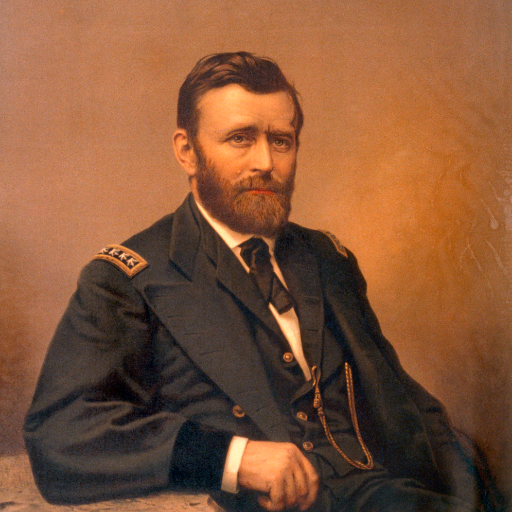
now that we're calculating net worth as "control," I'd like to remind you ro khanna is 1 of 535 united states legislators. that gives him around .19% control of a $6.3 trillion budget, and brings his net worth to something like $12 billion. his tax bill: $598,500,000.
English
191
882
11.5K
980.2K
David Branson Smith retweetledi
Austen Allred
Austen Allred@Austen·
I don’t think everyone realizes how polarizing it is to watch someone steal an amount of money they’ve worked 30 years for by throwing up a sign in a vacant building and sending the government an invoice
English
820
5.1K
41.6K
8.6M
David Branson Smith retweetledi
david friedberg
david friedberg@friedberg·
love it. but let’s do more! let’s take 10% from millionaires and do better health insurance! and a train from LA to fresno! and groceries! taking peoples assets after they’ve already paid 53% income tax on them is totally reasonable. or their pre-tax unrealized gains which forces then to sell illiquid assets or whatever... i’m just glad we’re gonna make this hard for them. they deserve it. actually, why stop there?? if we get this to work, we can get 51% of people to vote to take ALL the assets of the 49%! make it a 100% wealth tax on anyone over the average. this could be great. then we can do giant government things because government has proven so good at doing things! in fact, we can send the money to somalia! “make somalia great again” could be your 28 presidential run campaign slogan?? america’s founding fathers definitely intended the union to form around these principles! magnificent
English
210
453
11.8K
393.7K
David Branson Smith retweetledi
Chamath Palihapitiya
Chamath Palihapitiya@chamath·
California will be bankrupt by 2030. If you’re expecting a state pension, it is at risk. If you don’t believe it, check Grok or Gemini and explore how California politicians changed the reporting rules on your pension so they could hide how underwater it is. The middle class citizens of California will soon be asked to pay a huge price to bail out the state. Why them? Because that is where most of the wealth of California resides. It’s easy to single out “billionaires” but there aren’t many of them and they can and will all leave before the bottom falls out. They are leaving in droves already. The mismanagement in California is biblical - and the scale is huge because it’s the world’s 4th largest economy. California politicians and their henchmen are now entering the coverup phase where they can no longer hide their financial incompetence so they are taking from average California residents to try and hide what they’ve done: You will soon see ballot initiatives with fancy tiles like “billionaire tax”. But those are lies. They are mechanisms to tax everything, every way: Excise taxes Wealth taxes Private property confiscation It’s all happening now. If you want to preserve California, you will need to stand up because California has become a kleptocracy.
Right Angle News Network@Rightanglenews

BREAKING - A 92-page report by the California State Auditor has found that over $70 billion in taxpayer funds have been lost, including $2.5 billion in SNAP fraud, $24 billion on fighting homelessness, and $18 billion for a high-speed rail where not a single track has been laid.
English
1.1K
5.9K
21.8K
3.2M
David Branson Smith
David Branson Smith@PlaysWithFood·
@LauraPowellEsq Have fun with that IPO (it’ll still sell amazingly well, then retail investors will get fleeced for a few years until the price recovers as the company is forced to figure this out. Wouldn’t touch that initial offering price with a ten foot pole though.
English
0
0
1
19
Laura Powell
Laura Powell@LauraPowellEsq·
How could Waymo have neglected to program its vehicles for what to do when a stop light isn’t working??
English
381
347
4.1K
363K
David Branson Smith
David Branson Smith@PlaysWithFood·
@mattparlmer As it should until redundant measure are put into place. My car, excuse me, fire truck (!) should be self driving and human-enabled. It should be battery AND gas powered. Critical infrastructure cannot have a single point of failure
English
0
0
3
97
mattparlmer 🪐 🌷
mattparlmer 🪐 🌷@mattparlmer·
I would like to see way more self-driving cars, it’s an incredibly cool technology, what happened yesterday will shift every police dept and fire dept and utility company in the country to the opposition side of the debate, national deployment might be delayed for years
English
2
1
59
2.8K
David Branson Smith
David Branson Smith@PlaysWithFood·
@mattparlmer Been screaming silently that redundancy has become an afterthought in almost every aspect of tech. Read: SaaS. Single point of failure is just par for the course these days and it has to be driven (pun intended) by: “Well everyone else is down so it’s not just us 🤷‍♂️ “
English
0
0
1
187
mattparlmer 🪐 🌷
mattparlmer 🪐 🌷@mattparlmer·
I’m genuinely blown away by how irresponsible this is, “how do we fail safe if the power to the street lights goes out” is one of the most basic fleet-level safety considerations out there, if they dropped the ball on that there are definitely other crazy oversights
English
5
4
113
6.6K
David Branson Smith retweetledi
Jonathan Lacoste
Jonathan Lacoste@lacostejonathan·
I’ve stayed publicly quiet on the recent “data centers in space” zeitgeist In private, I’ve written long messages on the real challenges, tradeoffs & engineering constraints. No one had articulated my view until this morning. @andrewmccalip nails it Required reading for anyone building, investing in, or debating space-based data centers andrewmccalip.com/space-datacent…
Jonathan Lacoste tweet media
English
111
145
1.2K
243.7K