starecat

153 posts

starecat banner
starecat

starecat

@Poleax_

Audio/thermal Engineer - CAD - 3d soundproofing | pixel artist

Texas Katılım Mayıs 2025
17 Takip Edilen25 Takipçiler
starecat
starecat@Poleax_·
@ThematicTrader pivoting to the memory wall. how could u not be bullish on these engineer studs🐧
English
0
0
0
20
9 Ventures
9 Ventures@ThematicTrader·
$PENG AI Factory Strategy in a nutshell. I always say I don't find neo-clouds to be investable businesses, but pound the table on the 🐧. This is one of the reasons why.
Penguin Solutions@WeAre_Penguin

Following our record quarter, @MarketBeat shared insightful analysis on why Penguin Solutions may be the smartest AI infrastructure operator. “While not technically a pure-play GPU-as-a-Service or neocloud operator, Penguin Solutions (NASDAQ: PENG) is essentially in the same business, but with far less risk.” “The difference is they take on significant risk by owning GPUs, data centers, and the infrastructure to operate them, while Penguin Solutions doesn't.” This article highlighted how "Penguin Solutions is a true enabler, focusing on clients with the capacity to build their own systems and providing them with the engineering, hardware, software, and services to make it all work. This includes long-term contracts for data center operation and maintenance, which is the real story in AI.” “While the data center buildout gets the headlines today, it will be day-to-day operations and maintenance that drive revenue and cash flow in the long term.” Read the full piece from Market Beat for more details on Penguin's Q3 success underpinned by AI demand: finance.yahoo.com/technology/ai/…

English
2
0
30
6.3K
Pdxgtr
Pdxgtr@Pdxgtr_35·
@Poleax_ @JasonL_Capital I got in at $179 on this one. Was up a few weeks ago and I was almost $75k in green. Give it another 6 months and 2 earnings cycles. Marvell as well
English
0
0
1
34
Jason Luongo
Jason Luongo@JasonL_Capital·
Jensen Huang is literally telling you what stocks to buy for the AI supercycle. Here are 10 stocks Jensen has mentioned or invested in. 1. $NOK - Nokia NVIDIA invested $1B directly. Building the AI-RAN platform for 6G together. Trials with T-Mobile starting in 2026. The AI-RAN market is expected to exceed $200B in cumulative sales by 2030.
Jason Luongo tweet media
English
17
77
531
152.9K
tailrisked
tailrisked@tailrisked·
$PENG is probably the least covered / fastest grower in AI that I have come across. crazy its still just twitter talking heads.
English
2
0
4
857
starecat
starecat@Poleax_·
$MRVL $ALAB the foundation
English
0
0
0
38
starecat
starecat@Poleax_·
eight 128 GB DDR5 RDIMMs per server 110TB total memory per data-center rack. In conjunction with nvidia dynamo memory pooling software. I'm pretty bullish $PENG They are the drop-in solution for immediate inference gains🐧
starecat tweet media
English
1
0
3
101
starecat
starecat@Poleax_·
@StalkFinanciero @kevinxu @TheBigBerbowski Start comparing 🐧 KV cache rack to Marvells cxl switches in conjunction to nvidias dynamo software. Penguin is more of a drop-in solution for immediate inference gains. growth is obviously ahead
English
0
0
1
19
Kevin Xu
Kevin Xu@kevinxu·
I'm willing to bet $100 that $SHAZ hits $100 before $PENG does. What do you say @TheBigBerbowski?
Kevin Xu tweet mediaKevin Xu tweet media
English
66
0
65
26.7K
TheBigBerbowski
TheBigBerbowski@TheBigBerbowski·
@kevinxu One is 2B mc with a bullish recent sentiment, the other is 4B mc after senior notes news. Nice try tho. Instead of the price, let's see who will get to 2b revenue faster.
English
2
0
6
1.6K
noface
noface@noface_trdr·
@Poleax_ @kevinxu @TheBigBerbowski Honestly I haven't looked at either one, but knowing one is doubled the other's market cap, along with recent news/notes, doesnt seem to be an even bet
English
2
0
2
30
starecat
starecat@Poleax_·
@NataniaMarshall expanding their borders to become a supernation. They topple governments to do this
English
0
0
0
44
Natania Marshall ✞
Natania Marshall ✞@NataniaMarshall·
Israel is not an ally to the United States. Israel is just using America for their benefit while destroying our economy.
English
123
748
4.8K
31.5K
Bilaal- BD investing
Bilaal- BD investing@bdinvestingg·
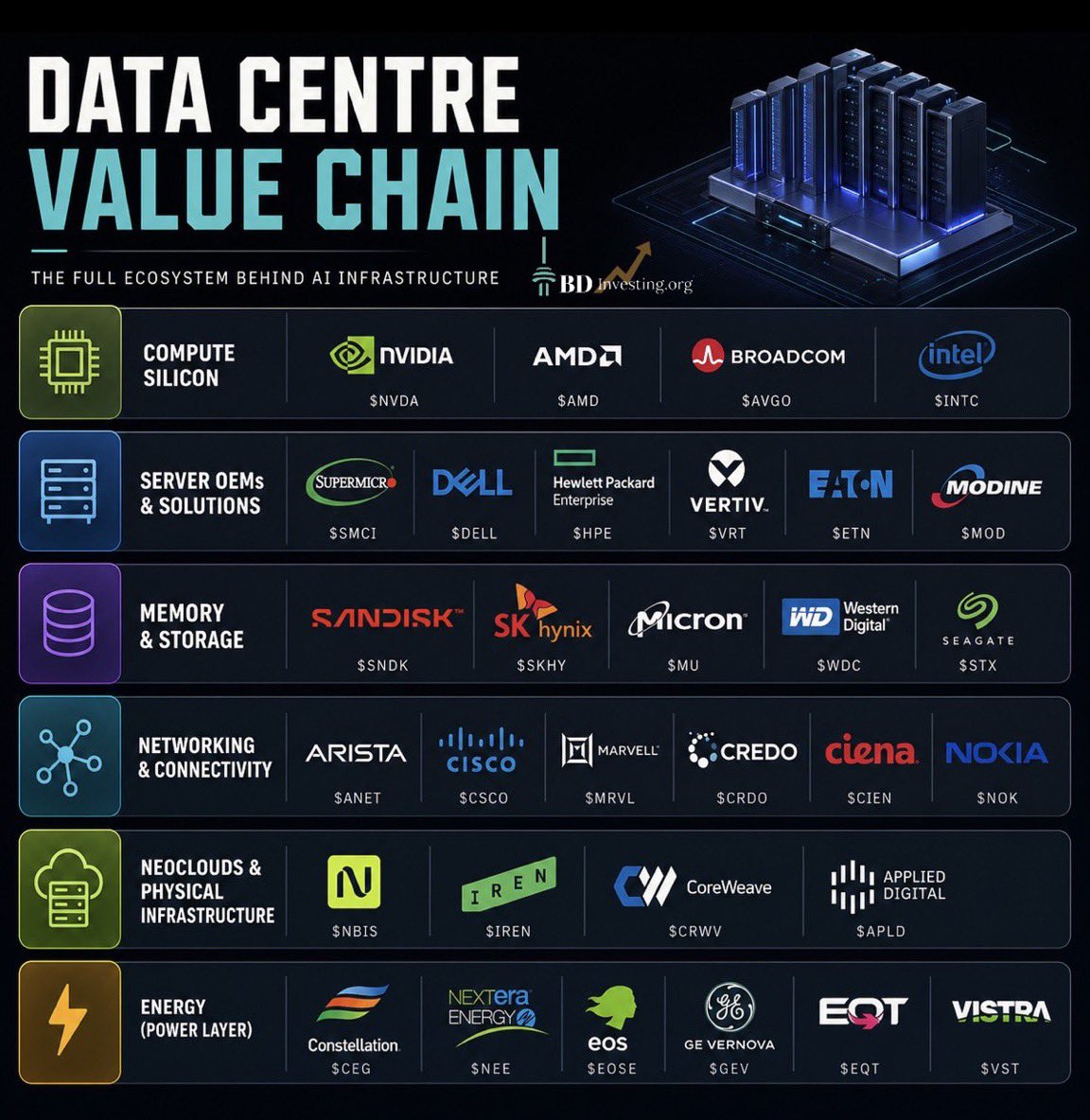
This dip is a buying opportunity. Key stocks in the data centre value chain. $MU — HBM memory; feeds data to GPUs at speed. $AMD — CPU compute for AI training and inference $VRT — Cooling and power delivery for dense GPU clusters. $NBIS — Deploys and operates GPU clusters as a service. $CRDO — High-speed networking chips connecting GPUs, servers, and AI data centers efficiently. $MRVL — Custom AI chips, networking, and optical interconnects powering next-generation AI infrastructure. $IREN — Cheap-power GPU hosting; miner pivoting to AI compute. $VST — Grid-level power generation feeding data centre demand.
Bilaal- BD investing tweet media
English
10
52
253
16.4K
starecat
starecat@Poleax_·
@gulVasikova growth is exploding and they know it. did you guys see their memory pooling rack? Nvidia CXL dynamo infrastructure is rolling out.🐧
English
0
0
0
11
GUL
GUL@gulVasikova·
Investor’s Perspective At first glance, this looks like bad news. $PENG announced a $650 million convertible notes offering, and the stock fell more than 11% in after-hours trading. That’s a common reaction because investors immediately think about dilution. But I think the market may be focusing on the headline instead of the bigger picture. The company isn’t raising money just to stay afloat. It’s using the proceeds to refinance existing debt, repay $100 million of borrowings, reduce potential future dilution through capped call transactions, and strengthen its balance sheet. That’s very different from a company raising cash because it’s running out of money. Convertible notes aren’t automatically bullish or bearish. What matters is how management uses the capital. If Penguin invests this capital wisely and continues growing its AI infrastructure and enterprise business, today’s financing could create much more value than the dilution it causes. If growth doesn’t materialize, then shareholders will feel the downside. We’ve seen this story before. Companies like $NVDA and $TSLA raised capital multiple times during their growth years. Investors initially worried about dilution, but those funds helped finance expansion, and the businesses became much larger over time. On the other hand, companies that continually raise money without improving their business eventually destroy shareholder value. That’s why I don’t judge a financing announcement on day one. I judge it by what the company looks like two or three years later. For $PENG, the key things to watch are revenue growth, AI demand, margins, cash flow, and whether management turns today’s capital into stronger earnings tomorrow. Bottom line: The market sold the news because dilution is easy to see. Long-term investors should focus on whether this refinancing strengthens Penguin’s business. If management executes well, today’s selloff may end up looking like a short-term reaction rather than a long-term problem.
GUL tweet media
English
1
0
3
259
Gublo
Gublo@Gubloinvestor·
$PENG is screwing its shareholders. All these AI companies are just issuing more shares, Insiders are selling, more dilution and less buybacks. History is repeating here..
English
22
0
55
18.2K
RJC
RJC@RJCcapital·
$PENG - tweets raising alarm bells over the offering as "massive" dilution are overblown. The stock should be up not down. > The $650M headline is principal amount, not equity issuance; offering size as a percentage of market cap is not the dilution rate > $PENG existing $350M of 2029/2030 convertibles are deeply in the money at $21/$28 conversion prices. At current $77 share price, they already embed approximately 7.2–8.1M net shares after capped calls, equivalent to 14–16% existing dilution > Shares issued through the new offering crystallize this existing dilution while eliminating the corresponding conversion. Estimated net-new dilution from the refinancing is approximately 0–1%. > The new 2031 notes create future dilution if $PENG exceeds the new conversion price (30% premium to closing price) and settles the value above principal in shares > Capped calls offset that conversion dilution up to a higher cap price. Above the cap, the hedge no longer provides a full offset and net dilution increases as the stock appreciates Economically, the transaction resets a deeply in-the-money $21/$28 conversion overhang to a substantially higher strike. Final dilution depends on the new conversion premium, capped-call ceiling and exchange consideration. For the truly economically illiterate on here I have created this simple graphic showing the dilution at set share prices. Please correct me if anything you see here is incorrect.
RJC tweet media
English
9
4
125
37K
Trade Whisperer
Trade Whisperer@TradexWhisperer·
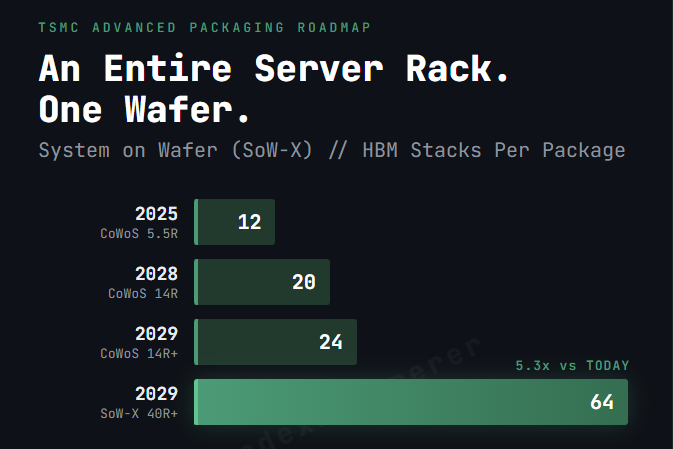
$TSM $MU $SKHY $DRAM TSMC's SoW-X: 64 HBM stacks on a single wafer. Today's best? 12. Today (CoWoS): 8 to 12 HBM stacks 2028 (CoWoS): 20 HBM stacks 2029 (CoWoS): 24 HBM stacks 2029 (SoW-X): 64 HBM stacks The leap is staggering.
Trade Whisperer tweet media
English
13
10
139
28.9K
starecat
starecat@Poleax_·
@junnyBCap simple breakdown: Hyperscalers burning cash, semis printing it. Google & microsoft deals still waiting to be announced? 🤔
English
0
0
0
11
Junny
Junny@junnyBCap·
$GLW erased $52B in market value in 4 days. That same company just took a $3.2B investment from Nvidia, signed 3 hyperscaler deals worth up to $6B each, and grew its AI segment 36% last quarter. Someone is wrong. Let me show you who. 1. What actually happened Corning ran 256% over 12 months. Up 105% in 2026 alone. Then it dropped 24% in 4 days on zero company news. No earnings miss. No guidance cut. No contract loss. It was pure AI de risking, the same rotation that hit every semi and AI infrastructure name that week. When a stock falls 24% and the analysts respond by RAISING targets, pay attention: BofA: $223 to $243, Buy reiterated. Oppenheimer: $210 to $230, Outperform. UBS: modeling ~$30B revenue by 2028 and $40B by 2030. Corning did $14.5B in 2024. That's nearly a 3x. 2. The business everyone can see: fiber Q1 2026 numbers: Total revenue: $4.35B, up 18% YoY. Beat. EPS up 30% YoY. Optical Communications: $1.85B, up 36% YoY, against $1.7B consensus. Optical segment net income: $387M, up 93% YoY. Income growing 2.6x faster than revenue. That's operating leverage, not a demand blip. Solar: $370M, up 80%. Why it's durable and not one quarter of hype: $META signed a multiyear deal worth up to $6B for fiber. Then Corning announced two MORE hyperscaler agreements, each similar in size and duration. That's up to ~$18B of contracted demand from 3 customers. Then $NVDA committed up to $3.2B and is building 3 new US fiber factories with them (North Carolina and Texas). Nvidia doesn't invest billions into suppliers. It did it for Corning. The reason: an AI data center needs roughly 10x the fiber of a traditional one, and networking is shifting toward optics (CPO) as copper hits its bandwidth wall. 3. The business almost nobody is pricing: glass substrates This is the part smart money is watching. Every AI chip sits on a substrate. Today those substrates are organic (plastic resin). Organic worked fine until AI chips got enormous. Now it's the industry's biggest physics problem: Silicon expands at ~3 ppm per °C when heated. Organic substrate expands at ~7. Bond them together, heat them in packaging, and the whole thing warps like a potato chip. Yields die. AI accelerators have blown past the 858mm² reticle limit into 2 and 3 reticle packages. The bigger the package, the worse the warpage, the higher the risk of cracked interconnects. Glass fixes this. Glass expands at nearly the same rate as silicon (~3.2 ppm). Warpage under 10 microns. Through glass vias at 40 micron pitch, far denser interconnects than organic can do. Flatter, stiffer, better signal integrity. This isn't theoretical anymore: $TSM published its first glass validation data for CoWoS: 16% warpage improvement over organic. It pulled forward its CoPoS (panel level, glass) roadmap starting late 2025, pilot line targeted mid 2026. That's now. And Corning, the company that has led glass science for 175 years, is already positioned: its Glass Core substrate program, the GlassWorks AI data center platform, Glass Bridge for co packaged optics, and a 3 year packaging MOU with BOE. The glass substrate market is ~$200M today. Projected $2B+ by 2030. And that projection assumes nothing goes faster than planned. Semiconductor transitions rarely go slower once TSMC commits. 4. The honest risks Mass production of glass substrates is 2027 to 2029. This is a thesis, not next quarter's revenue. Competition is real: AGC, Schott, SKC's Absolics, Samsung. Corning leads in glass science but this race isn't over. After a 256% run, the fiber growth is partly priced in. The substrate optionality mostly isn't. 5. The setup The chart looks exhausted because the sellers are exhausted. Five straight red days, 24% off highs, on macro rotation while the company signed $18B+ of contracts and Nvidia wired them $3.2B. Fiber is the business you're paying for. Glass substrates are the business you're getting for free. You're not buying a glass company. You're buying the floor every AI chip will sit on.
English
2
0
5
813
Beventov
Beventov@Beventov1·
@kevinxu No shot you just took a picture when it was down 11%, it has already recovered ~6% and this was a move that will most likely be eaten up
English
4
0
1
416