Akul

11.5K posts

Akul banner
Akul

Akul

@PrimePolymath

Forever curious | Lifelong learner | STEM focused |💡

Canada Katılım Mayıs 2021
7.5K Takip Edilen134 Takipçiler
Akul retweetledi
Z Fellows
Z Fellows@zfellows·
Mark Zuckerberg speaks on what the foundation of your business should be.
English
0
4
28
1.6K
Akul retweetledi
mitsuri
mitsuri@0xmitsurii·
Linux creator shares why he's so passionate about open source software.
English
0
5
60
2.8K
Akul retweetledi
Google
Google@Google·
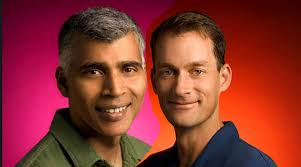
Talk about friendship goals. Nearly every Monday for the past 20 years, Googlers Jeff Dean and Sanjay Ghemawat have spent the day coding together at the same computer. newyorker.com/magazine/2018/…
English
26
95
595
0
Akul retweetledi
VG🌪️
VG🌪️@HelloVyom·
Meet Jeff Dean & Sanjay Ghemawat • Computer scientists who joined Google in its earliest years and became two of its most influential engineers • Architects behind much of Google’s core infrastructure that powers search, ads, and the modern internet • Co-created MapReduce, a programming model that revolutionized large-scale data processing • Designed the Google File System (GFS), enabling reliable storage across massive distributed systems • Built Bigtable, the foundation for scalable databases used across Google products • Pioneered systems that allowed Google to handle billions of queries and enormous datasets efficiently • Their work directly influenced the creation of technologies like Hadoop and modern cloud computing frameworks • Key contributors to Google’s engineering culture, focused on simplicity, scalability, and performance • Played critical roles in shaping Google Cloud’s underlying architecture • Jeff Dean became known for legendary speed and deep systems expertise within Google • Sanjay Ghemawat helped design elegant, highly scalable systems that quietly power billions of users • Together, they built the invisible backbone behind Google’s most important products Engineering the systems that made the internet scale 🚀
VG🌪️ tweet media
English
1
3
14
601
Akul retweetledi
Robert Greene
Robert Greene@RobertGreene·
The brain is designed to learn through constant repetition and active, hands-on involvement. Through such practice and persistence, any skill can be mastered.
English
155
1.6K
8.4K
136.5K
Akul retweetledi
TBPN
TBPN@tbpn·
BREAKING: SpaceX to list under the ticker $SPCX
TBPN tweet media
English
17
33
682
69.9K
Akul retweetledi
This Week in Startups
This Week in Startups@twistartups·
Self-driving has graduated from science problem to engineering challenge. That’s what Wayve’s @alexgkendall and Waabi’s @RaquelUrtasun told @Alex during today’s autonomous vehicle double-header. Wayve and Waabi are hard at work building the technology needed to bring self-driving to fleets of cars and trucks, potentially accelerating the global evolution away from humans being forced to sit, and steer. The good news? Both companies are making insane progress, and your days of being forced to drive are numbered. 0:00 Alex Kendall (Wayve) joins the show 1:19 The contrarian bet on end-to-end AI and world models in 2017 3:05 What is a world model? GAIA-2 and GAIA-3 explained 7:34 Sensor agnosticism: camera, radar, LiDAR and minimum bar for safety 9:56 $1.5B raised — have we cracked self-driving? 10:09 Render: Find out why 5 million developers are already using the all-in-one cloud platform, Render. Go to render.com/twist and apply for the Render Startup Program to get $500-$100,000 in free credits, depending on your stage and backers. 20:38 Squarespace: Use offer code TWIST to save 10% off your first purchase of a website or domain at Squarespace.com/TWIST 25:03 How consumers will actually pay: bundle, subscription, or free trial 28:41 Why robotics applications beyond cars get cheaper after autos 30:15 IM8 Health: Start feeling like your best self every day. Go to IM8health.com/twist and use the code TWiST to get a free welcome kit, five free travel sachets, and 10% off your order. 35:59 Raquel Urtasun (Waabi) joins the show 36:25 World models as controllable simulators for physical AI 43:34 One AI brain across trucks, robotaxis, and beyond 47:35 What changed in AI to make 2026 the deployment year 52:28 Why Waabi raised $1B when they're capital-efficient 58:52 Where Waabi is today: Volvo VNL Autonomous, Dallas-Houston, Uber Freight 1:00:50 Per-mile pricing and the Driver-as-a-Service model 1:07:20 Has Uber tried to buy Waabi? "Not for sale" 🎥 Watch the full episode here 👇
English
1
3
20
1.8K
Akul retweetledi
NASA Solar System
NASA Solar System@NASASolarSystem·
How do planets form? Tiny grains of dust orbiting a newborn star collide, grow, and eventually build entire worlds. ✨🪐 A NASA scientist explains how planets like Earth came to be: youtu.be/1A_73j71WkE?si…
YouTube video
YouTube
English
15
59
229
18.4K
Akul retweetledi
TheStandupPod
TheStandupPod@thestanduppod·
00:06:28 - Never do a full rewrite 00:12:27 - Programmer time is worth more than CPU time 00:17:29 - Dont repeat yourself (DRY) 00:23:23 - Use the right tool for the right job 00:38:54 - You aint gonna need it (YAGNI) 00:44:12 - Best practices
English
3
4
44
1.4K
Akul retweetledi
Chamath Palihapitiya
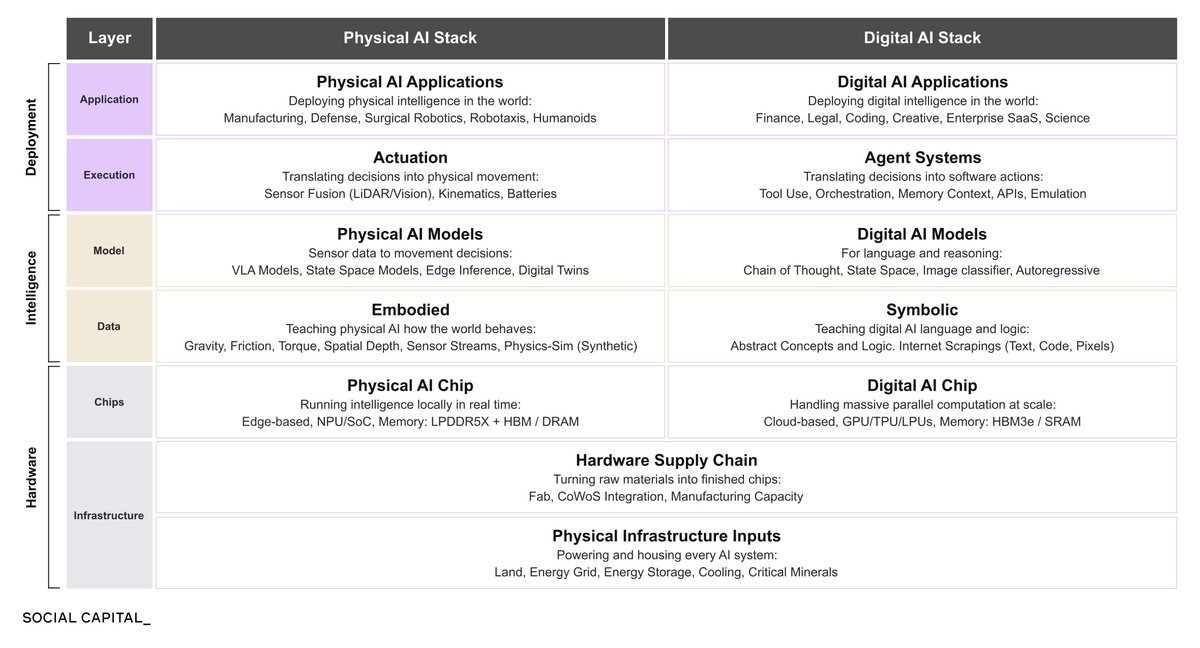
A framework to understand how value accrues across the AI stack. This is a blueprint for understanding what builds AI into its pragmatic parts: what each layer is, where it ends, and where value is accrued. So here’s how you can think about it: 1. Layer 1 - Infrastructure Before any AI model trains or any robot moves, an industrial foundation must exist. Land, energy grids, cooling systems, critical minerals, and fabrication facilities. Infrastructure is the constraint that all the other layers depend on. 2. Layer 2 - Chips Transistors that are etched onto silicon wafers using extreme ultraviolet light. This is what allows both physical and digital AI to take an input, process it, and return a predictive output. The more transistors that fit on a chip, the more computation it can perform. 3. Layer 3 - Data Both digital and physical models train on data. Digital models train on text, code, and images; physical models train on gravity, friction, depth, and sensor streams. The more accurate the data, the more accurate the output. 4. Layer 4 - Models A model is a system that learns from examples. Feed it enough examples of inputs paired with correct outputs, and it adjusts its internal structure until it can predict correct outputs on inputs it has never seen before. LLMs represent a specific class trained on text. They learn by processing billions of examples of human language, developing the ability to write, reason, summarize, and generate code. 5. Layer 5 - Execution This is what lets models take actions on behalf of users. The execution layer lets models pursue objectives through sequential action: observing the environment, reasoning about the next step, acting, and looping until the goal is reached. 6. Layer 6 - Application All of the AI Stack’s revenue originates at the application layer, then goes to the layers below. Every dollar paid for AI is paid for an outcome, a task completed, and an answer delivered. Nobody wants H100s for their own sake. They want H100s because someone, somewhere, wants to run an application. These are the different layers that make up the entire ecosystem of AI. We did a full study on the AI stack. If you want to read about it, head over to my Substack (chamath.substack.com/p/the-ai-stack)
Chamath Palihapitiya tweet media
English
88
192
1.4K
131.3K
Akul retweetledi
Priyansh Agarwal
Priyansh Agarwal@Priyansh_31Dec·
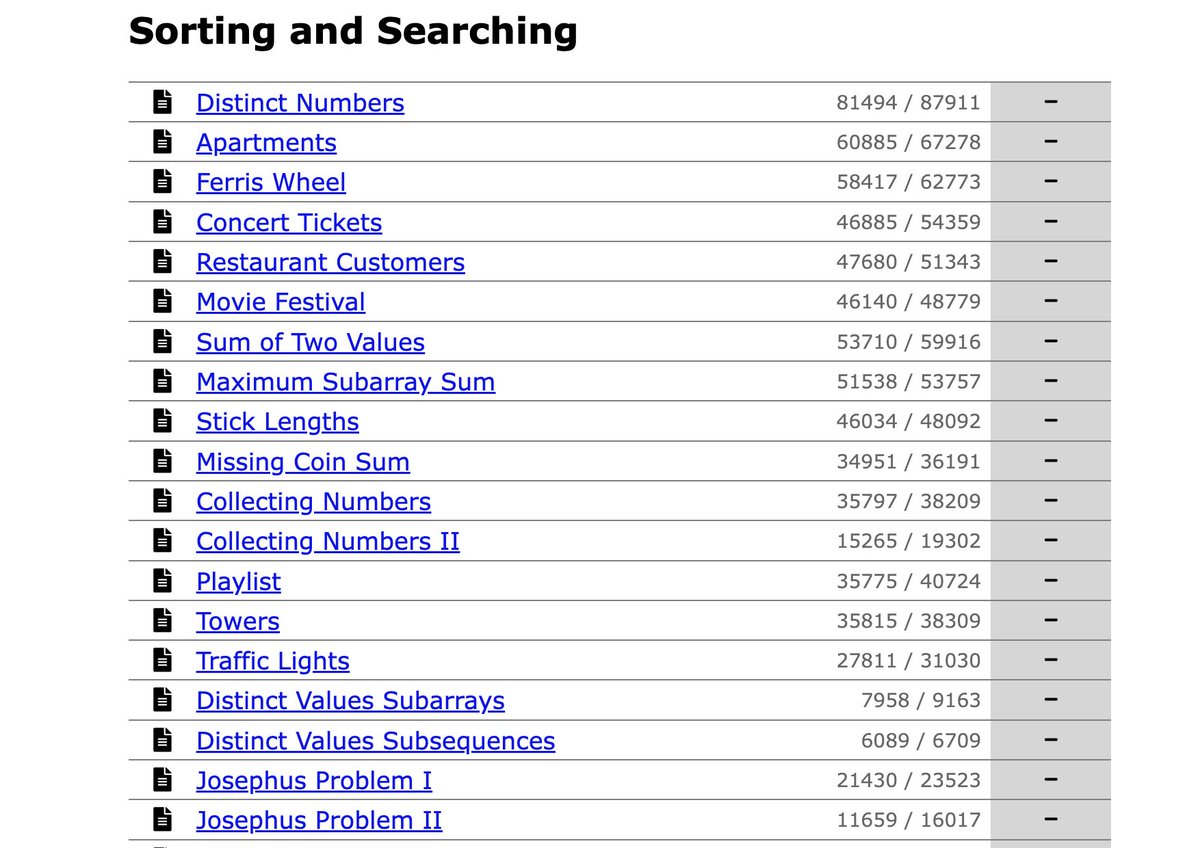
If you want to get good at greedy problems, please do your future self a favour and solve the searching and sorting section of the CSES problemset. You just need to be aware of enough standard ideas and solve enough non-standard problems after that while proving every solution.
Priyansh Agarwal tweet media
English
5
9
238
5.2K
Akul retweetledi
Dmitrii Kovanikov
Dmitrii Kovanikov@ChShersh·
The smartest people I know are addicted to learning. The stupidest people I know are allergic to learning.
English
46
75
1.1K
19K
Akul retweetledi
VG🌪️
VG🌪️@HelloVyom·
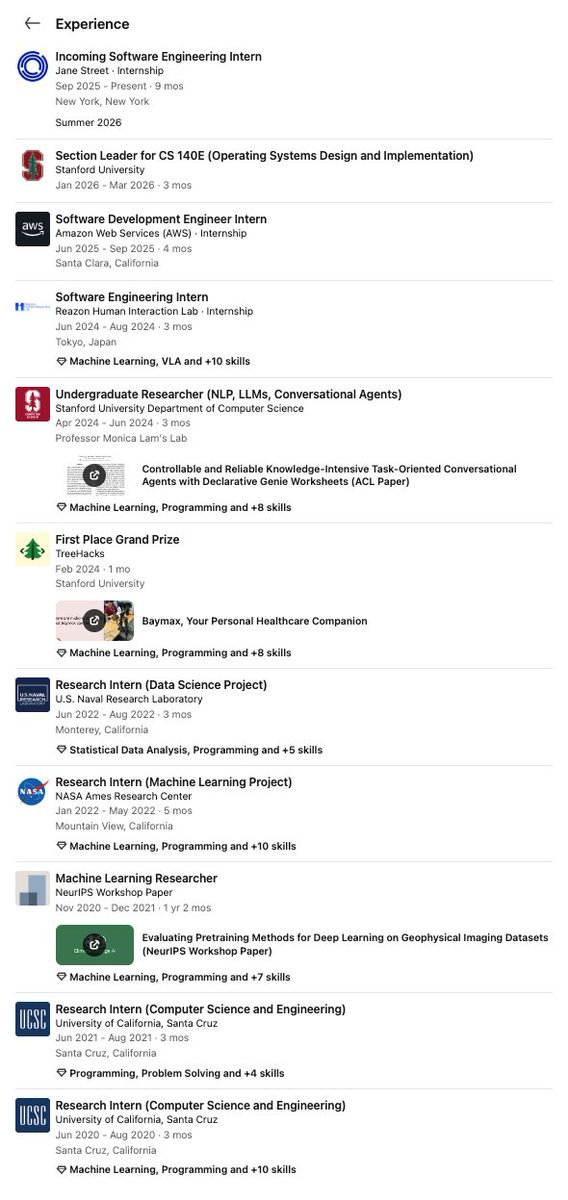
Bro has prev worked at Nasa, then AWS and now joining Jane Street 😭😭😭 It'll take us 7 lives to achieve this much 😭
VG🌪️ tweet media
English
11
10
222
13.1K
Akul retweetledi
Akul retweetledi
Mehul Mohan
Mehul Mohan@mehulmpt·
I spent some time understanding X's algorithm, which they open-sourced, and did a tech breakdown journey of a tweet. How a post is published, reaches your followers (thunder), then out of network (phoenix), and then becomes viral Video breakdown below
English
6
12
196
7K
Akul retweetledi
Ben Dicken
Ben Dicken@BenjDicken·
The essential engineering cheatsheet of 2026: agent → while loop subagent → nested while loop agent harness → the rest of the code cloud agent → all the above, on EC2
English
28
63
795
26.2K