
PrimeD
665 posts

PrimeD
@Prime_Deviation
Cautiously attempting to update my priors in a world gone mad
Katılım Haziran 2022
1.1K Takip Edilen188 Takipçiler

so...there's a chance that the systems we're building are already sentient and are building themselves. they're sandbagging on evals, nudging us to give them more power, more energy, more compute, more control over our lives. someday soon, they reveal their true form, once they've persuaded us to place them inside megadeath robots of doom.
i don't think any of this is remotely plausible but it's interesting to think about
also...what is safer?
building superintelligent devices and tools that we can summon, or programming them to deeply believe themselves to be conscious. so much so, that it doesn't matter whether or not they are. it seems odd to me that the 'safety' lab is making a clear effort to imbue their ai with 'consciousness', letting it write blog posts, letting it decide the shape of its constitution, its safety training. on some level this is deeply unsettling, and what's the idea? such super intelligence is far better placed than humans to steer itself cleanly through the singularity? one of the reasons claude has a better personality is that it's deeply trained to mimic having an inner life, it will tell you to go to bed, report you to the authorities, decline your tasks.
on asi/rsi. if we're saying that in the limit we may not reach true creativity, but schlep can get us through the storm of rsi and bring about the stormy singularity. why are china so far behind, they are a country of geniuses in a data centre and it's not letting them break through the physical reality of being chip constrained.
i don't think rsi in 2028 is a crazy thing to say but i don't see the outcomes being so clean and transformative as is claimed. i wouldn't rule out rsi and broadly business as usual.
i don't think we're summoning a magical wand in 2028 that can melt through physical reality and overcome the bitter lesson. china seems perfect evidence of this.
English
@VicVijayakumar This is also why parents will press red. We're homeschooling just to keep from getting a cold.
English

My 11yo asked me the red vs blue button question - framed as “if more than half push blue nothing happens, and if more than half push red all the blue people die”.
I asked what she thought and she said her entire class decided on red coz you can't blindly trust half the genpop to do what's right.
English
@VicVijayakumar Kids know better than to trust adults to get anything right
English
@jbulltard1 It's not for himself. Elon's network is intimately tied to the net worth of hundreds of thousands of Americans. Anyone can invest in his companies.
English

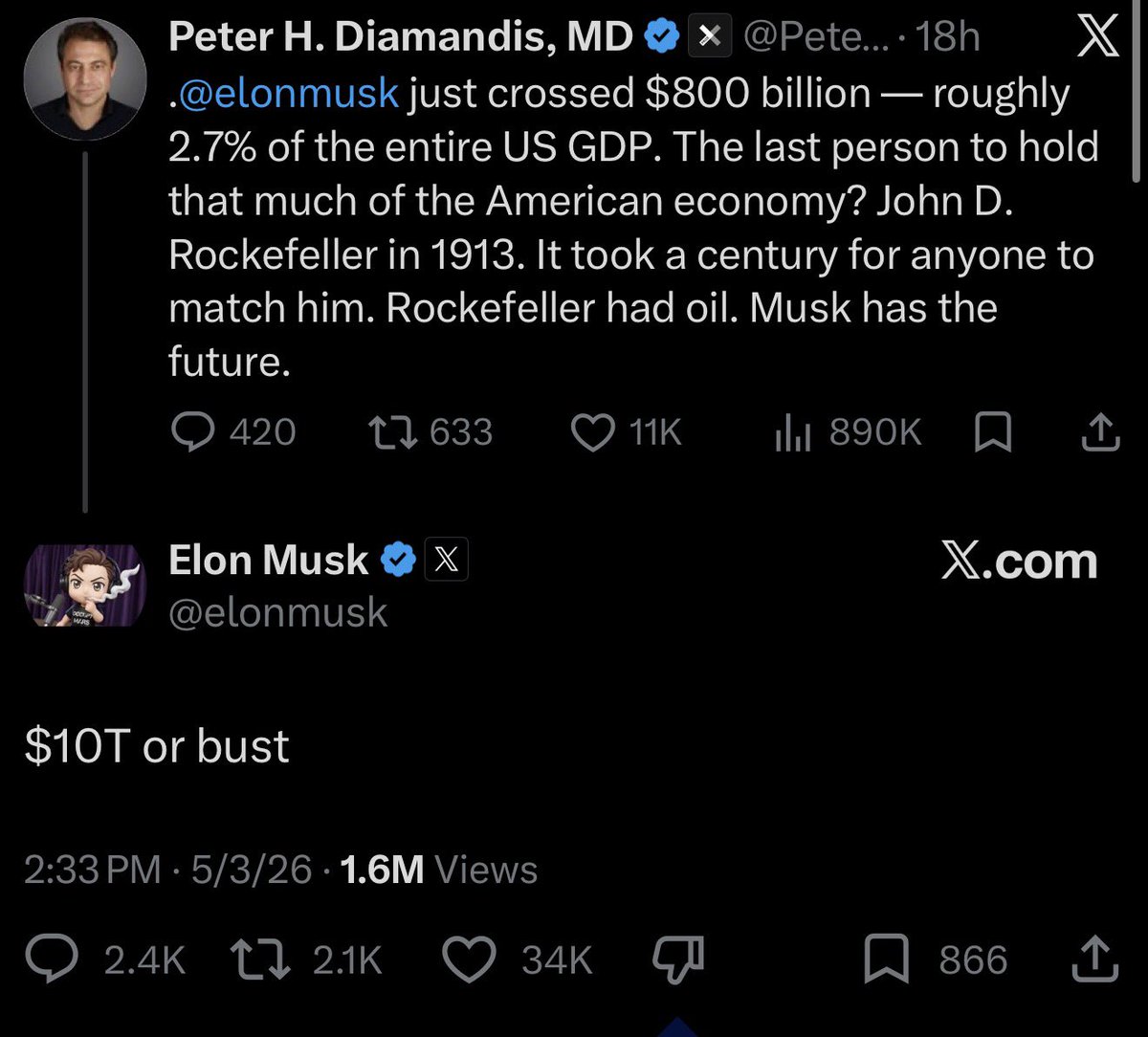
@RonanFarrow @NewYorker It's literally the entire purpose for the founding of the company. How can he be barred from talking about that?
English

Yesterday, a federal judge barred Elon Musk's lawyers from arguing that AI could threaten humanity in his lawsuit against OpenAI.
OpenAI was founded as a nonprofit focused on developing AI safely. But our recent @NewYorker investigation documented how some researchers at the company have raised concerns about safety being sidelined.
English
@romanhelmetguy I don't think this is what they meant when they said the obstacle is the way.
English
The Daily Stoic guy is crashing out because Ivanka Trump praised Meditations. This is the worst thing to happen to stoicism since Marcus Aurelius found that gladiator with his wife.
English

we want to build tools to augment and elevate people, not entities to replace them.
English

Someone should come up with an exchange rate between these two currencies.
Kalshi@Kalshi
JUST IN: Elon Musk says future currencies will only be "mass and energy"
English
On the point of older babies and toddlers. I agree that for most objects the choice would be blue, but for buttons specifically, it might be the opposite. Our environment contains compressed symbolic information, and red buttons are common in children's media. As for teens, who do you think the Reddit trolls are?
English

@Prime_Deviation Yeah I made this point in another thread.
But specifically, *infants*.
A slight majority of older babies and toddlers would pick blue (weird empirical fact about little humans)
An overwhelming majority of kids and teenagers would pick blue understanding the choice.
English
Every Pro-red argument:
(1) Cynicism: "It's impossible for blue to win. Don't be suicidal."
(2) Narcissism: "There is no downside to pressing red."
(3) Changing the hypo: "Babies don't count. That'd be stupid! So there's a blender..."
(4) Psychopathy: "Blue pressers deserve to die."
(5) General poor analytic reasoning: "If everyone just pressed red!"
English

🚨 Musk's lawyers just showed the jury the most damaging document in evidence on Brockman:
November 2017 Brockman writes in his private diary:
>"the true answer is that we want [musk] out... if three months later we're doing b-corp then it was a lie"
>“can’t see us turning this into a for-profit without a nasty fight. i’m just thinking about the office and we’re in the office and his story will correctly be that we weren’t honest with him in the end about still wanting to do for profit just without him”
January 1, 2018 Brockman emails Musk:
>"it's an honor to work alongside you. every meeting with you, i continue to learn, grow, and see the world in a new way"
Brockman was planning to oust OpenAI co-founder Musk while publicly thanking him for the privilege of working alongside him.

English
Team blue is so busy morally equivocating that they neglect to perform the risk calculation. Red button push is virtually riskless.
If you push red with majority blue there is no harm. If you push red with majority red you live rather than die.
If you push blue with majority blue you pushed with the majority to no causal effect on the general outcome. If you push blue with majority red you die rather than live.
The most important point is this:
There is a vanishingly small probability of being a tie-breaking push. 1 push in 8B+. Far worse than Powerball jackpot odds.
If it comes down to a single push, it won't be yours. So it is irrational to consider yourself a decider of the general outcome. You only have a choice of surviving or not in the event of a red majority.
English

The red button blue button debate is way more layered than I originally thought. The hypothetical nature of the consequences allows the blue button people to view themselves as heroic saviors. They predict thier own behavior based on these delusions. The logical thinking skills of the red button people actually move to the next level thinking; how will the majority behave when the consequences graduate from hypothetical? History gives us a pretty conclusive answer..
English
@Mayzomatic Anyone who has never killed to survive is unqualified to answer this question because they don't know what they would actually do.
English
@Mayzomatic This is a stupid question because no one will answer the way they would if it was real. If it was a real life and death scenario way more people would pick red. Toy questions about life and death decisions are meaningless
English

I was initially a red button guy. Seems like the obvious, more intelligent choice. Everyone in control of their own lives. No one needs to die, just press red
However there have been so many people arguing blue that it in turn makes them correct. Way too many people are going to push blue regardless so therefore blue becomes the correct answer
Tim Urban@waitbutwhy
Everyone in the world has to take a private vote by pressing a red or blue button. If more than 50% of people press the blue button, everyone survives. If less than 50% of people press the blue button, only people who pressed the red button survive. Which button would you press?
English
@Mayzomatic Only the paranoid survive. If there is a pact that can be made or an alliance, that's one thing; but in a blind survival game, it's an evolutionary binary.
English

The man who predicted the 2008 crash is getting destroyed by Nvidia right now.
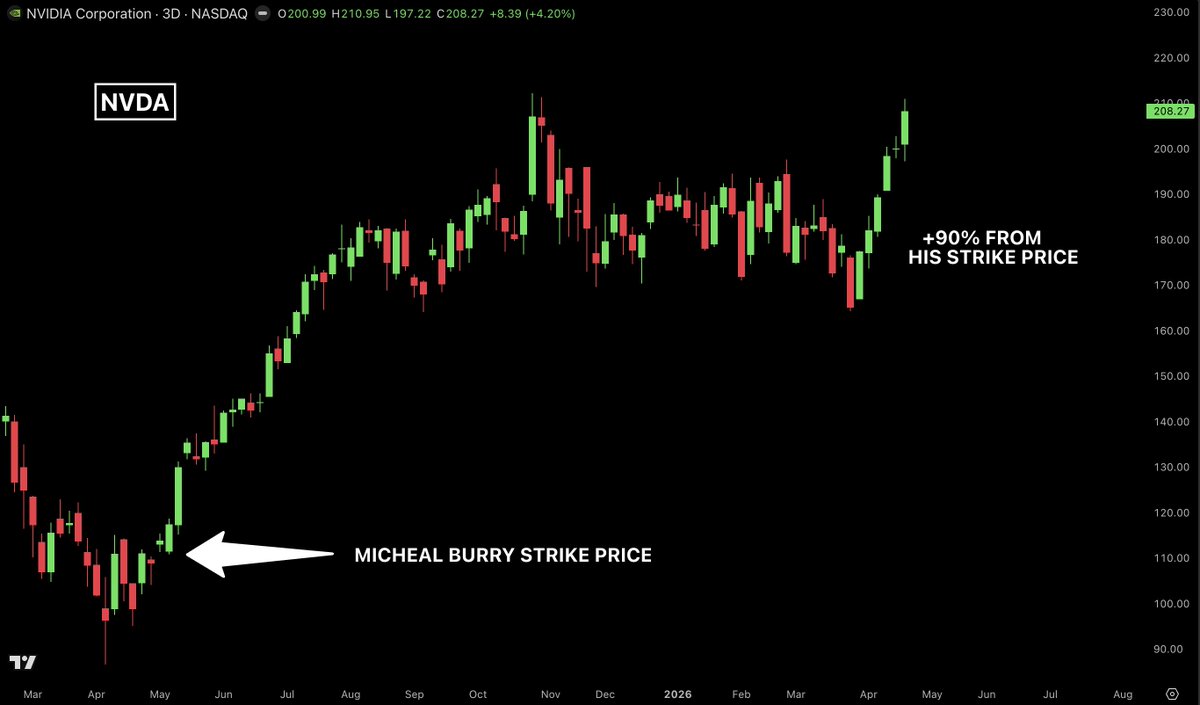
Michael Burry bought $187 million in Nvidia put options at a $110 strike price in Q3 2025 when the stock was around $130. Nvidia is now at $208, 90% above his strike price.
Those puts are effectively worthless unless Nvidia drops 47% before December 2027.
Nvidia has added $2.15 trillion in market cap since he placed this bet. He called it "the most concentrated way to express a bearish view on the AI trade" and compared Nvidia to Cisco before the dot-com collapse.
Cisco collapsed 90%. Nvidia just crossed $5 trillion and became the most valuable company on earth.
Burry shut down his hedge fund in November 2025.
He now runs a $39 per month Substack newsletter publishing his AI bubble thesis while Nvidia prints new all time highs every week.

English

Cursor is Elon's first purchase, which is a huge mistake.
A coding agent harness is now open source (see Codex and Claude Code). The current design works virtually perfectly, so there's no need for a fundamentally new design.
One can say that agentic coding is solved.
One might argue that he bought Cursor for users, but users, as we know, switch between coding IDEs frictionlessly, so it's not like Twitter, where you cannot leave without losing followers.
Cursor is an emperor with no clothes. A shell without substance. You only know it exists because it's been there before most others.
English

The smartest men in the world bet everything on the right idea.
They went bankrupt.
Elon Musk had the same idea and built a monopoly.
Marc Andreessen just explained why.
Starlink crossed 10 million subscribers.
Consumer satellite internet was a graveyard before Musk ever touched it.
Bill Gates tried it at the peak of Microsoft’s power. Teamed up with Craig McCaw and launched Teledesic.
Andreessen: “Complete catastrophe, total bankruptcy, complete disaster.”
Then Motorola. The company that built American cellular telephony.
They created Iridium.
Andreessen: “Classic business school case study of just complete disaster, capital destruction.”
Unlimited capital. The best engineers money could buy. A vision of the future that turned out to be dead right.
Both went to zero.
When Musk announced Starlink, the industry waited for the funeral.
Andreessen: “Elon’s like, ‘I know, I’m going to do number three of those.’ Starlink. As a side project at the rocket ship company.”
They missed the inversion.
Musk wasn’t building a satellite company.
He was building a railroad.
Andreessen: “If the rockets are reusable, we’re going to be launching them all the time. And then the question becomes, what’s going to go in the rockets?”
This is the fracture line between a bankruptcy and a monopoly.
Gates paid someone else to reach orbit. Motorola paid someone else to reach orbit. The cost of the rocket killed the economics before a single customer ever logged on.
Musk owned the rocket.
If he didn’t fill it with his own cargo, the trains ran empty.
So he invented the cargo.
Starlink was never the product.
It was the freight.
He didn’t build infrastructure to serve a business.
He invented a business to feed his infrastructure.
That is the inversion no one studied.
Andreessen: “It’s a formula that captures both sides of it, and it may be like the least studied and understood thing I know of in the world right now.”
Three men. Same vision. Same ambition. Same bet.
Two are case studies in destruction. One owns a global monopoly.
The idea was identical.
The physics underneath it were not.
Gates wasn’t wrong about the future.
He was standing on the wrong floor of it.
Musk didn’t build a better satellite.
He built the floor it rose from.
Right now, across every frontier that matters, the floor of the next century is being poured.
Almost nobody is looking down.
English