Sabitlenmiş Tweet
Alex Prince | Prince Capital
336 posts

Alex Prince | Prince Capital
@Princecg11
🇺🇸 Private Markets | Secondaries ⚙️ AI Systems | Operator-Led PE Tracking where capital actually flows 📊 Building across multiple companies
Miami Katılım Eylül 2025
268 Takip Edilen43 Takipçiler

@WhitneyTilson Section 1061's 3-year hold already converts most carry to LTCG.
The Yale estimate assumes static GP behavior.
Recharacterize carry as ordinary and funds restructure around fee waivers, profits interests, and entity placement.
Revenue line bleeds out the back.
English

The most outrageous, nonsensical loophole in the entire tax code is treating "carried interest" (i.e., the 20% share of the profits) earned almost entirely by the biggest, wealthiest private equity and hedge fund managers as capital gains rather than the income that it is, thereby qualifying for a much lower tax rate.
Closing this loophole is (thankfully) on the table again thanks to this report (excerpt by Andrew Ross Sorkin in today's Dealbook):
The Budget Lab at Yale recently dropped a bombshell report: Closing the carried interest loophole could rake in an estimated $87.7 billion over a decade. That’s significantly higher than previous projections from nonpartisan congressional scorekeepers.
The Yale team argues that past estimates were too low because they didn’t distinguish between different types of partnership income...
The team found that far more ordinary income was being cloaked as capital gains, and therefore taxed at lower rates, than previously thought.
…saging-custom-newsletters.nytimes.com/dynamic/render…
English

@pitdesi Founder secondary at seed is usually 5-10% sold into a primary.
The signal read is misframed. It is option premium math.
Cash funds the founder long enough that future dilution stops mattering personally.
That is what changes behavior. Not confidence.
English

Secondary market hit $226B in 2025.
The forecast in March was $200B.
Overshoot came from Q4 LP-led supply.
Volume compounded for the fifth year running.
Capacity is the constraint now. Not demand.
#secondaries
English

Median PE hold period hit 7.1 years in 2025.
Time is the silent return killer.
Each extra year adds management fee drag.
Hold period was 5.7 years in 2018.
Now the math gets harder, not easier.
years in 2025.PE hold period hit 7.1 years in 2025.hold period hit 7.1 years in 2025.ian PE hold period hit 7.1 years in 2025.old period hit 7.1 years in 2025.Median PE hold Median PE hold period hit 7.1 years in 2025.
Time is the silent return killer.
Each extra year adds management fee drag.
Hold period was 5.7 years in 2018.
Now the math gets harder, not easier.
#privatemarketsperiod hit 7.1 years in 2025.
English

@hamilton_lane Single-asset CV economics work when the asset has long-hold qualities. Durable end-market. Defensible position. Capital efficient. The shift from portfolio diversification to single-asset conviction is what makes the structure different from a fund interest.
English

Hamilton Lane served as sole lead investor in MidOcean’s close of a single-asset continuation vehicle for Cloyes, a firm whose strong market leadership and exposure to durable automotive aftermarket trends made it a compelling investment opportunity. hamiltonlane.com/en-us/news/mid…

English

Marks do not pay the next call.
LPs fund commitments based on prior round marks.
A 2.5x TVPI on paper does not reduce capital pressure.
DPI funds the next reup. Marks do not.
#familyoffice
English

Synthetic liquidity is not liquidity.
Continuation vehicles, NAV loans, dividend recaps extend exit but rename it.
A 5-year extension at constant fees is a tax on optionality.
LPs accept the tradeoff because no exit is the alternative.
#secondaries
English

@therealTugdual Both, but increasingly structural. The 7-10 year fund life is misaligned with the time it now takes to build a category leader. CVs are the relief valve for that mismatch. Real question is whether LP secondary capital can absorb the supply at acceptable discounts.
English

Are GP-led secondaries growth structural — or just cyclical?
Throwback to our interview on continuation vehicles with Andriy Panasenko
A few data points worth noting:
• GP-led secondaries have more than tripled in value since 2020, reaching ~$115bn in 2025
• They now represent roughly ~44% of total secondaries activity
• Continuation vehicles alone account for ~14% of sponsor-backed exits
• The broader secondaries market reached ~$240bn in 2025, up ~48% YoY
Yes, the recent surge is partly cyclical — driven by slower IPO/M&A exits and historically low distributions to LPs.
But structurally:
→ GPs increasingly view continuation vehicles as a portfolio management tool (not just a liquidity workaround)
→ LPs are treating secondaries as an active allocation strategy
→ Nearly 80% of top sponsors have now executed at least one continuation vehicle transaction
The exit toolkit is expanding — not temporarily shifting.
Curious how others see it: are GP-led secondaries becoming a standard fourth exit route alongside IPO, sponsor-to-sponsor, and strategic?
#PrivateEquity
#Secondaries
#ContinuationVehicles
#PrivateMarkets
English

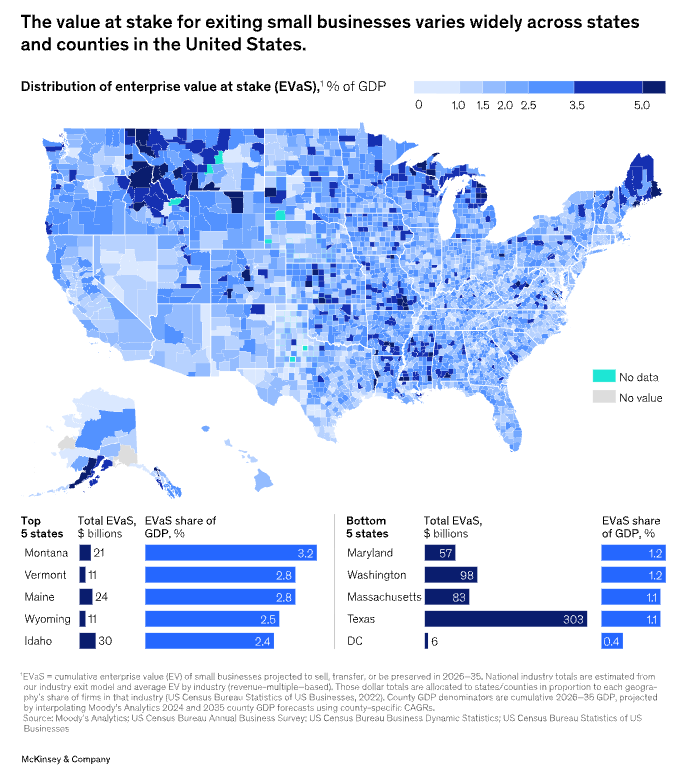
@Codie_Sanchez Worth separating headline value at stake from transactable equity. Most of those totals are owner-employed sub-$500K EBITDA businesses with no management bench. The investable cohort - $1-3M EBITDA, second-tier metros, owner ready to step out - is a small slice.
English

Discount to last round is the wrong benchmark.
The right benchmark is what capital earns elsewhere over the same lock-up.
A 25% discount on a 7-year hold can lose to a liquid alternative.
Discount is comfort. Opportunity cost is the trade.
#privatemarkets
English

Same 30% headline discount. Different after-tax outcomes.
Direct secondaries pay long-term capital gains.
LP interests flow K-1 income with mixed character.
The wedge can be 5-10 points net.
Most models ignore it.
#privatemarkets
English

@QuotedData 29.9% is not coincidence. It is the structural ceiling under UK takeover code rule 9 before a mandatory offer triggers. Landing exactly there post-tender reflects intentional sizing around the constraint, not market mechanics doing the work.
English

Saba has requisitioned a vote to replace the Impax Environmental Markets $IEM board and Matthew Read @quoteddata has some important questions starting with, "how has it [Saba] very conveniently ended up with 29.9% of IEM post the tender offer...?" quoteddata.com/2026/04/impax-…
English

@HarryStebbings Same dynamic on the secondary side. Tourist sellers anchor to last round and wait for clarity. Terminators reset to a price that clears now and recycle the capital. The market reprices around the second group, not the first.
English

Seeing two types of founders emerge in this moment:
The tourists and the terminators.
The terminators are salivating at the opportunity ahead. Hungrier than ever. More ambitious than ever. They want it more than ever.
The tourists. They want to sell. They are scared. They do not want to commit 10 years to such uncertainty.
Pack is separating.
English

@sweatystartup Time compounds only if leverage survives the worst 18 months of the cycle. Real estate that goes back to lenders rarely failed on price. It failed on capital structure. Underwriting the bottom is the discipline.
English

Patience is a position under stress, not a marketing line.
Most allocators describe themselves as patient capital.
Few have held through a 36-month exit window without blinking.
The line gets tested. The marketing does not survive contact.
#familyoffice
English

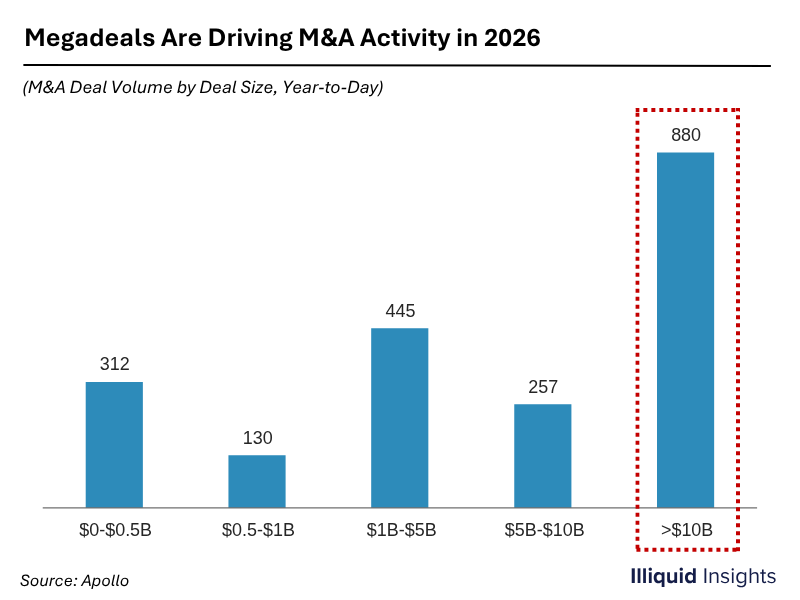
@IlliquidInsight The chart undersells the bifurcation. Megadeal volume concentrates in AI names institutional capital treats as consensus. Mid-market and non-AI deals are starved of bids. Two M&A markets running. One priced by narrative. The other by cash flow.
English

@AgustinLebron3 @mean_field_zane @TheStalwart Right. And in private secondaries the seller cares about who the buyer becomes more than what the price is. New holders bring information rights, transfer behavior, and signaling that compounds. Allocation is identity-aware in a way public markets are designed to erase.
English

@mean_field_zane @TheStalwart The fact that public markets are anonymous, hence the seller doesn't know to whom they're selling, is more of a contingent historical fact.
Whenever sellers do get to know (secondaries, IPOs), they certainly care a lot who gets the allocation.
English

Origination is the secondary market moat.
By the time a position is competitively bid, the entry economics are gone.
The best deals close before they hit a process.
#secondaries
English

Endowment fiscal years end June 30.
May and June surface tactical secondary sales.
Underperforming positions get cleaned before audit.
That predictable supply window opens in 6 weeks.
#privatemarkets
English

@MTC_003 Platform marks reflect tender prices on thin float, not depth at scale. A $1T quote built on partial-share tenders does not survive the next round. The asymmetry is not only insider knowledge. Platform pricing and underwriting pricing are different transactions.
English

A $1T secondary-market valuation is insane.
The private secondary market keeps rediscovering the same lesson: insiders usually know more, sell better, and exit cleaner than everyone else.
At some point “price discovery” starts looking like ritualised self-harm.
Polymarket Money@PolymarketMoney
Anthropic has reportedly reached a $1T valuation on Forge’s secondary market, above OpenAI at $880B on the platform.
English