Animalscientist

80 posts

Animalscientist

Animalscientist

@Privy_m

Grow what you go through

zimbabwe Katılım Mayıs 2013
154 Takip Edilen51 Takipçiler
Animalscientist retweetledi
VaZhou
VaZhou@Va_Zhoou·
Yvonne Tivatye station manager Capitalkfm the face behind the confusion why would one do that to his/her workers being given a car and money is not a sin. that policy is just a nonsense one.
VaZhou tweet media
sir_wicknell.@wicknellchivayo

GRATITUDE SHOULD NOT CREATE SUCH CONFUSION…🇿🇼🇿🇼🇿🇼 I recently attended an interview at CAPITALK FM and had a WONDERFUL time with the entire team. After the interview, and purely out of APPRECIATION for the hospitality and professionalism shown to me, I asked the General Manager Mr. COMFORT MBOFANA whether I was permitted to give the workers some money for lunch, to which he responded, “YES WITH PLEASURE.” I then asked him how many people were on duty during that particular shift and he advised me there were 30 employees. I GRACIOUSLY offered USD1,000 per person and the GENERAL MANAGER personally escorted me to my car where he received the money on behalf of the staff members. I further requested permission to buy DJ PHATHISANI SIBANDA, who interviewed me, a TOYOTA FORTUNER GD6 and another young lady employee a TOYOTA AQUA, to which he also APPROVED without hesitation. I am therefore PROFOUNDLY SURPRISED to now hear different versions circulating on SOCIAL MEDIA suggesting that there was something improper about a simple act of GRATITUDE towards hardworking Zimbabweans performing NATIONAL SERVICE. As a PATRIOTIC citizen, whenever I visit GOVERNMENT institutions or companies OWNED by the State, I naturally have a SOFT SPOT because I openly and unapologetically support the RULING PARTY, ZANU PF which governs our country. In my humble view, people who dedicate themselves daily towards informing, educating and entertaining the nation deserve APPRECIATION and ENCOURAGEMENT rather than unnecessary RED TAPE and excessive BUREAUCRACY that ultimately punish ordinary workers who have done absolutely NOTHING wrong. If indeed what is being said is the POLICY of the radio station, I am PLEASED to advise that MADZIBABA CHIPAGA of ENTERPRISE CAR SALES is apparently selling a BRAND NEW Toyota Fortuner 2.4D GD6 for ONLY USD100 and a Toyota Aqua for ONLY USD50. He has indicated that this is a SPECIAL PRICE applicable ONLY to these two individuals. I was equally surprised by the PRICE myself, but his response was simply that “NO LAW restricts me from selling my property or assets at ANY PRICE of my choice.” Madzibaba CHIPAGA is truly a GOOD MAN and may GOD bless him abundantly for his GENEROSITY and kind heart. Accordingly, Mr. PHATHISANI SIBANDA and the other employee can CHOOSE, if they so wish and can afford, to go and see the seller DIRECTLY and purchase their vehicles on their own WITHOUT my involvement. With regards to the remaining USD27,000 which I am advised can no longer be distributed in the manner I had instructed, I am sending my lawyer MR SIKHUMBUZO MPOFU today WITHOUT FAIL to collect the money from Mr. COMFORT MBOFANA. After all, he probably needs it MORE than I do and I am sure it can assist significantly with unleaded FUEL for his latest RANGE ROVER AUTOBIOGRAPHY. 😂🤣 May we never reach a stage where expressing GRATITUDE to hardworking Zimbabweans is treated as if it is a CRIME or result in unnecessary work place GRIEVANCES. Rather, let us encourage SUPPORTTING and APPRECIATING those who dedicate their lives towards serving our nation with professionalism and PATRIOTISM #An_Attitude_of_Gratitude #Capitalk_FM #Patriotism

English
1
1
2
150
Animalscientist
Animalscientist@Privy_m·
Transparency & Accountability: A Question of Figures Did you know that over $150,000 was raised under the Citizens Initiative 501(c)(3) (EIN 84-4964958) banner, yet official IRS 990-N e-postcard filings for 2022–2024 report annual gross receipts of less than $50,000?
Animalscientist tweet media
English
1
30
21
964
Animalscientist
Animalscientist@Privy_m·
Transparency is the bedrock of public trust. To bridge this gap, a full, transparent ledger is essential. Where are the official receipts? It’s time for full disclosure to ensure every dollar is accounted for.
English
1
10
6
227
Animalscientist
Animalscientist@Privy_m·
4 Days left much was said,you can also send your submissions till close of date.your voice your right. #CA3
English
0
1
0
47
Animalscientist retweetledi
VaZhou
VaZhou@Va_Zhoou·
Under the Constitution of Zimbabwe, there is a very specific "road map" that must be followed before Constitutional Amendment Bill No. 3 can be passed. Here is what happens next after the 4 days that are left has passed: ​1. Compilation of the Portfolio Committee Report ​Now that the 4-day physical outreach will br over, the Parliamentary Portfolio Committee on Justice, Legal and Parliamentary Affairs (and potentially the Thematic Committee on Gender) will meet to consolidate all the feedback. ​Written Submissions: Even though the physical meetings are done, the public typically has until the end of the 90-day gazetting period (which ends around May 17, 2026) to send written views to the Clerk of Parliament. ​The Report: The Committee will write a report summarizing whether the public supported or rejected the Bill (including the clause on merging the Gender and Human Rights Commissions). This report is then tabled in the National Assembly. ​2. The 90-Day "Waiting Period" ​According to Section 328 of the Constitution, a Constitutional Bill cannot even be introduced for debate in Parliament until 90 days have passed from the date it was first published in the Government Gazette. ​Timeline: Since the Bill was gazetted on February 16, 2026, Parliament cannot vote on it until after May 17, 2026. ​Purpose: This period is a "cooling off" time designed to prevent the government from rushing through changes to the supreme law without adequate national reflection. ​3. Debate and the "Two-Thirds" Rule ​Once the 90 days are up and the Committee report is ready, the Bill moves to the Second Reading stage in the National Assembly. ​The Vote: Unlike ordinary laws that require a simple majority, this Bill requires a two-thirds majority in both the National Assembly and the Senate. ​The Opposition Factor: If the ruling party does not hold a two-thirds majority on its own, it would need to win over opposition votes or "independent" members to pass the Bill. ​4. Presidential Assent ​If both houses of Parliament pass the Bill by a two-thirds majority, it is sent to the President for his signature (Assent). Once signed and published in the Gazette as an Act, the Zimbabwe Gender Commission would officially begin the process of merging into the Zimbabwe Human Rights Commission. #CA3
VaZhou tweet media
English
2
12
10
243
Animalscientist retweetledi
Prof Jonathan Moyo
Prof Jonathan Moyo@ProfJNMoyo·
Mzukulu wami, @ProfMadhuku neither raised a "core concern" nor proved any CAB3 flaw to engage him on. Instead he charged without any evidence besides his mere say-so that those pushing CAB3 are "committing a crime against humanity". That's an outrageous charge, and U'm choosing to engage him on that outrage against reason. It's out of the ordinary in an extraordinary way for a respected professor of law, a senior member of the bar and a leader of a political party who has contested the presidency over at least two decades; to take to the media to claim that those pushing for CAB3 [who are his opponents in an important national debate] "are committing a crime against humanity". That's not just hyperbolic Mzukulu, it's way, way below the rational test; and this is being done by someone who is highly respected and whose politics should be way, way above that test!
English
24
74
70
3.7K
Animalscientist
Animalscientist@Privy_m·
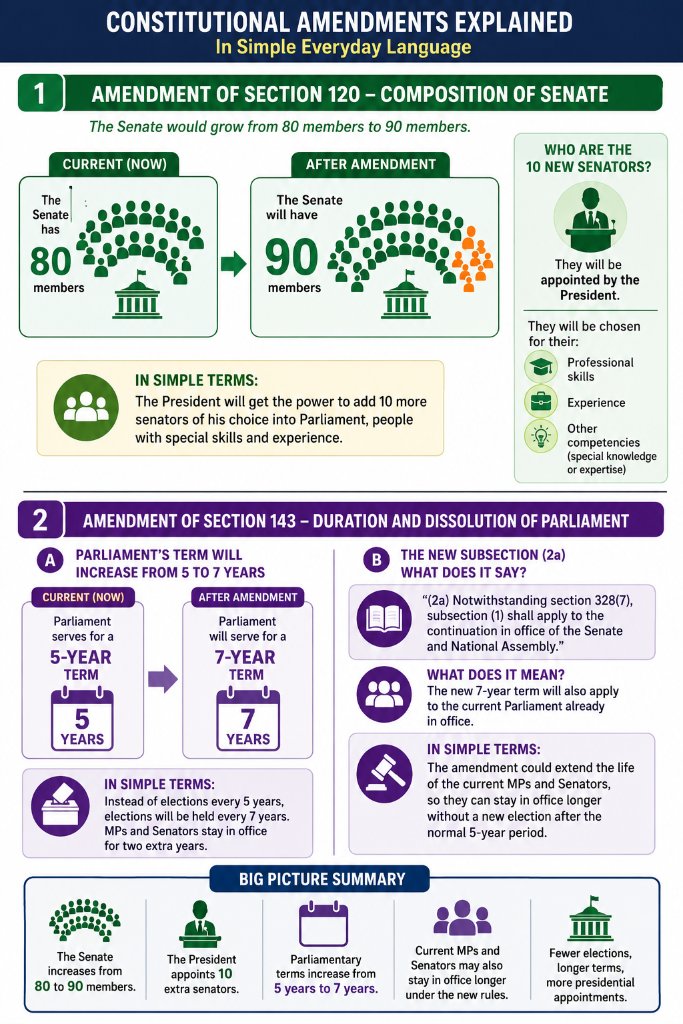
Constitutional Amendment Bill3.# CA3
Animalscientist tweet media
Català
0
0
0
15
Animalscientist retweetledi
Professor Sigabade iNdethi yaseMhlangeni
Well said @glenmpani the level of intellectual laziness we see in these corridors is so shocking!
Glen Sungano Mpani@glenmpani

I rarely respond to posts that are malicious, intellectually dishonest, or authored from behind faceless profiles masquerading as serious commentary. What is striking here is not the critique itself, but the inability to distinguish between two completely separate discussions. My article was never intended to be a constitutional law thesis on the procedural mechanics of amending presidential election systems. It was a political and policy reflection on the merits and implications of direct versus indirect presidential elections, and whether an indirect system may, in certain contexts, better serve Zimbabwe. To attack an article for not addressing a question it never set out to answer is not intellectual rigour. It is either careless reading or deliberate misrepresentation. One would expect an award-winning journalist of Blessed’s supposed calibre to appreciate the elementary difference between a policy argument and a constitutional analysis. Conflating the two is not sophisticated criticism. It is analytical laziness dressed up as commentary. The constitutional process of effecting such a change is indeed an important discussion. It deserves its own serious and technically grounded article. Perhaps that is the article he should focus on writing instead of shadowboxing arguments that were never made @bbmhlanga

English
26
31
37
2.3K
Animalscientist retweetledi
Bete 𝕏 
Bete 𝕏 @Bete263·
Glen Mpani’s piece in the Sunday Independent is worth your time. His core argument: direct elections in Zimbabwe haven’t produced legitimacy, they’ve produced spectacle. Ethnic arithmetic, winner-takes-all fury, five more years of institutional rot. The ballot paper feels democratic. The morning after usually isn’t. The most interesting part is the campaign shop talk. He explains, from inside the machine, what an indirect system does to political behaviour. Suddenly every parliamentary seat matters. Suddenly parties need real policy platforms instead of a charismatic face on a poster. The skills required to win become the skills required to govern. He doesn’t pretend the idea is clean. Indirect systems create distance between citizens and their leaders, he says, and that makes parliamentary oversight, press freedom, and judicial independence more critical, not less. The risks are real but manageable. That’s an honest argument.
TheNewsHawks@NewsHawksLive

Rethinking Presidential Elections: Why an indirect system may serve Zimbabwe better By Glen Mpani I HAVE closely followed the debate around Constitution of Zimbabwe (Amendment No. 3) Bill with keen interest. Working in political campaigns, I have reflected deeply on what the Bill’s proposed changes mean, not just for governance, but for how campaigns are designed, executed, and won. That perspective has shaped my thinking in ways I did not initially anticipate. There is a fundamental question at the heart of Zimbabwe's political future: how should a president be chosen? Read full article below: iol.co.za/sundayindepend…

English
25
53
43
2.6K
Animalscientist retweetledi
Glen  Sungano Mpani
Glen Sungano Mpani@glenmpani·
Rethinking Presidential Elections: Why an indirect system may serve Zimbabwe better I HAVE closely followed the debate around Constitution of Zimbabwe (Amendment No. 3) Bill with keen interest. Working in political campaigns, I have reflected deeply on what the Bill’s proposed changes mean, not just for governance, but for how campaigns are designed, executed, and won. That perspective has shaped my thinking in ways I did not initially anticipate. There is a fundamental question at the heart of Zimbabwe's political future: how should a president be chosen? Direct elections have long been treated as the gold standard of democracy. Citizens vote, a leader emerges, and legitimacy is assumed. Yet this assumption deserves scrutiny. Across Africa, most presidential systems rely on direct elections. Yet this has not consistently translated into stability or public trust. According to Afrobarometer, trust in elections and electoral bodies across many African countries frequently falls below 50 percent. High participation does not automatically produce legitimate outcomes. In Zimbabwe specifically, direct elections have personalised politics to a damaging degree, intensified winner-takes-all dynamics, and consistently elevated tribal emotion over policy substance. The ballot paper feels empowering. The aftermath frequently is not iol.co.za/sundayindepend…
English
6
61
51
4.6K
Animalscientist retweetledi
Glen  Sungano Mpani
Glen Sungano Mpani@glenmpani·
I rarely respond to posts that are malicious, intellectually dishonest, or authored from behind faceless profiles masquerading as serious commentary. What is striking here is not the critique itself, but the inability to distinguish between two completely separate discussions. My article was never intended to be a constitutional law thesis on the procedural mechanics of amending presidential election systems. It was a political and policy reflection on the merits and implications of direct versus indirect presidential elections, and whether an indirect system may, in certain contexts, better serve Zimbabwe. To attack an article for not addressing a question it never set out to answer is not intellectual rigour. It is either careless reading or deliberate misrepresentation. One would expect an award-winning journalist of Blessed’s supposed calibre to appreciate the elementary difference between a policy argument and a constitutional analysis. Conflating the two is not sophisticated criticism. It is analytical laziness dressed up as commentary. The constitutional process of effecting such a change is indeed an important discussion. It deserves its own serious and technically grounded article. Perhaps that is the article he should focus on writing instead of shadowboxing arguments that were never made @bbmhlanga
Dhara Blessed Mhlanga@bbmhlanga

The debate is not whether or not a president must be elected directly or indirectly. It’s about the process of effecting that change in law. Parliament can not vote to give itself powers to elect a president. Glen not only misses the tree, but is shooting in the wrong forest.

English
62
93
85
43.5K
Animalscientist retweetledi
Glen  Sungano Mpani
Glen Sungano Mpani@glenmpani·
Blessing, one of the greatest crises in public discourse today is the inability to read for comprehension before rushing to perform outrage. I clearly outlined the categories of critics I rarely engage, and unfortunately your response positioned itself perfectly within that category. You completely missed the central thrust of the article and instead constructed arguments around issues that were never being debated. That is not intellectual engagement. It is intellectual carelessness disguised as analysis. More importantly, your certainty on whether the Bill withstands constitutional scrutiny is itself part of a deeply contested legal and political debate. Serious constitutional questions are rarely as simplistic and absolute as social media commentators like to imagine. Unfortunately, Zimbabwe’s discourse has increasingly rewarded noise over nuance, confidence over competence, and performance over depth. Political campaign practitioners fully understand the point the article was making because they appreciate the distinction between analysing political systems and analysing constitutional procedure. There is a reason why serious practitioners often say, “mastery has boundaries.” The tragedy begins when individuals wander far outside their area of competence while still convinced they are authorities on every subject. My advice to you is simple. Finish your law degree. Travel more. Read wider. Expose yourself to how political systems evolve across different jurisdictions before presenting yourself as the final authority on complex constitutional and political questions. One of the tragedies of our generation is how mediocrity has been elevated to the point where individuals with very shallow engagement suddenly believe they possess complete mastery of complicated subjects. Read the article again carefully. You may yet learn something from it. I suspect I have already afforded this exchange far more time than it deserves. Have a great day. Adeus. @bbmhlanga
Dhara Blessed Mhlanga@bbmhlanga

@glenmpani Nhai Glen do you know what is faceless, you are engaging in discussion from a false premise, I have a face, a name and you are the one being dishonest. Yes your submission is not Constitutional law, it can’t survive that measure, it does not take away the fact that it’s not sound

English
41
92
79
21.7K
Animalscientist retweetledi
Glen  Sungano Mpani
Glen Sungano Mpani@glenmpani·
Hi my brother @Chofamba, I will be writing another piece sharing my reflections on the advantages and possible risks of moving the voters’ roll from ZEC to the Registrar’s Office. This is a subject I am particularly comfortable writing about because it sits at the very anchor of my work in political campaigns. In campaign strategy, we often say an election is ultimately a voters’ roll. Everything else flows from that foundation. As always, the intention is to provoke deeper thinking around the architecture of elections and voter management systems beyond the usual emotional reactions that dominate public discourse. Looking forward to reading your response and engaging further on the subject.
Chofamba@Chofamba

With due respect, I find @glenmpani’s argument disingenuous. We need not go too far before the entire subjective agenda is exposed. Here’s @DougColtart’s very sound exposure of how CAB3 is designed to rig the election before we even get to Parliament: youtu.be/u4S_JyHGrZw?si… So Glen wants us to focus on Parliament, but mbudzi inenge yatovhiyiwa yatodyiwa kare ku voters roll kwa the new Mudede nekuDelimitation Committee!

English
32
82
65
5.5K
Animalscientist retweetledi
Glen  Sungano Mpani
Glen Sungano Mpani@glenmpani·
Dear Chofamba @Chofamba The question is not whether people are clamouring for a political system. The real question is whether that system resolves a political problem. My intervention is anchored on a simple but critical reality. Zimbabwe has endured a perennial cycle of disputed presidential elections. That is the political problem I am interrogating. Serious constitutional and political reforms are not born from noise or popularity contests. They are born from the need to create stability, legitimacy, and public confidence in governance systems. History shows that many political systems across the world were not initially demanded by the masses. They emerged because political actors recognised structural weaknesses that threatened national cohesion and institutional legitimacy. My reflection on the proposed amendments is therefore straightforward. Do they meaningfully address the recurring crisis of disputed presidential outcomes or do they merely preserve the status quo? To argue that political reform should only be guided by what people are currently clamouring for is to reduce statecraft to sentiment instead of problem solving. Leadership is not only about responding to public emotion. It is also about anticipating and resolving structural political risks before they become national crises.
Chofamba@Chofamba

.@glenmpani one key question you should have no problems answering: When did Zimbabweans ever clamour for a change in how they elect their President? This “debate” you’re “contributing” to - where among Zimbabwean citizens has it arisen from? Ndepapi uye ndiriini ruzhinji rweZimbabwe parwakati tiri kunzwa shungu yokushandura masarurirwo emutungamiri wenyika? Of course, the question is redundant, because this is a contrived debate. It is not organic; it’s imposed by E.D’s cabal and fuelled by his consultant narrative builders - yourself, @ProfJNMoyo and others - to try and make it a real thing.

English
49
103
94
10.5K
Animalscientist retweetledi
Glen  Sungano Mpani
Glen Sungano Mpani@glenmpani·
Dear @AnnahBengesai My argument in my article was centred on one fundamental question: what electoral system can best serve Zimbabwe in light of the country’s repeated cycle of disputed presidential elections? Most of the responses I received were not necessarily about the merits or weaknesses of indirect presidential election itself, but about the process of changing the Constitution to effect such a system. That, however, demonstrates why constitutional process and policy issues are related but separate conversations. A constitutional process answers the question: how should a proposed system be structured, designed, adopted, limited, and implemented within the constitutional framework of the state? Policy issues answer the question: what should government do with that power once it is constituted? The Constitution is the architecture of the state. Policy is what happens inside that architecture. For example, whether a President is elected directly by citizens or indirectly through Parliament is a constitutional design question. It concerns legitimacy, stability, dispute resolution, accountability, succession, and the mechanics of political power. Whether government should improve healthcare, reduce taxes, build roads, or subsidise agriculture are policy questions. Those are choices made within the constitutional framework. The mistake many make in political debates is collapsing the two into one conversation. A person may disagree with indirect presidential election because they fear elite capture. Another may support it because they believe it reduces disputed elections and political instability. Both are debating the structure and design of power, not whether government should provide jobs or improve service delivery. Constitutions are designed to manage political behaviour, conflict, succession, and stability over generations. Policies change from administration to administration. That is why countries with completely different policy directions can still operate under the same constitutional framework. In simple terms, the Constitution decides how the game is played. Policy decides what players do during the game. If we fail to separate those conversations, we end up judging constitutional design emotionally through current political frustrations rather than asking the deeper institutional question: “What constitutional arrangement best produces stability, legitimacy, accountability, and governability over time?”
Annah Bengesai@AnnahBengesai

@glenmpani Glen, help me understand how constitutional process and policy issues are separate conversations.

English
23
101
84
1.7K