Priya Panday, MD

55 posts

Priya Panday, MD banner
Priya Panday, MD

Priya Panday, MD

@PriyaPanday27

Chief Cardiology Fellow @MSHCardsCT | IM @NYUlangone and @BellevueHosp | MD @NYUgrossman

New York City Katılım Mayıs 2019
138 Takip Edilen24 Takipçiler
Priya Panday, MD
Priya Panday, MD@PriyaPanday27·
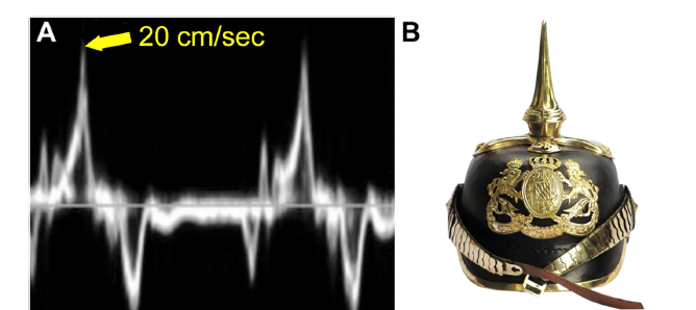
Superior displacement of the mitral valve into the LA increases traction exerted on the papillary muscles. As a result, the myocardium beneath the papillary muscles is pulled into the LV cavity. This causes the LV crest as well as the posterior annuus and the attached posterior leaflet to rotate (as a unit) in the counterclockwise direction. This motion is called curling. Papillary muscle traction also pulls the basal posterior wall in the apical direction. This brisk motion causes a prominent s’ wave on tissue Doppler imaging. An s’ > 16 cm/s is called the Picklehaube sign. #ASEchoJC
Priya Panday, MD tweet media
English
0
5
11
332
Priya Panday, MD
Priya Panday, MD@PriyaPanday27·
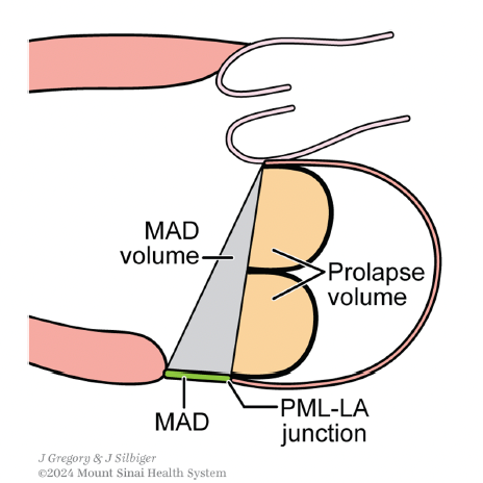
When MAD and MR are present in patients with MVP, some of the blood that might otherwise be ejected into the aorta and regurgitated into the LA instead expands the (potential) space between the LV crest and PML-LA junction (MAD volume) as well as the potential space contained within the mitral valve (prolapse volume. Since these volumes are retained in the LV they contribute to LV volume overload apart from the contribution of MR volume. The increase in LV end-diastolic volume resulting from MAD and prolapse volumes might account for what some authors attribute to MVP-related cardiomyopathy. #ASEchoJC
Priya Panday, MD tweet media
English
1
4
14
373
Priya Panday, MD
Priya Panday, MD@PriyaPanday27·
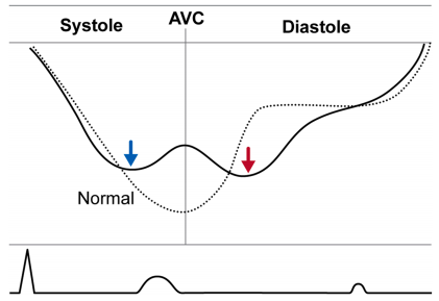
Arrhythmic MVP is associated with ventricular arrhythmias and in some cases sudden arrhythmic death. Echo findings which are associated increased arrhythmic risk include: bi-leaflet prolapse, thick long leaflets, MAD length > 8.5 mm, Picklehaube sign, curling, severe MR. Strain findings include: the double peak sign and mechanical dispersion. #ASEchoJC
Priya Panday, MD tweet media
English
1
4
10
496
Priya Panday, MD
Priya Panday, MD@PriyaPanday27·
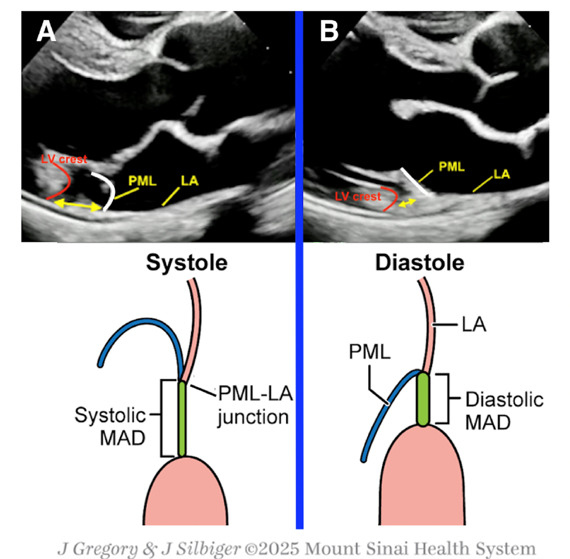
The normal mitral annulus is a compact collagenous, more or less circular structure that connects the LV and LA. In contrast, the disjunctive annulus is elongated and its length is dynamic. During systole the annulus reaches its maximal length. During diastole it recoils and decreases in length. In patients with a markedly redundant posterior leaflet, the leaflet’s base gets pressed against the LA, simulating systolic MAD. This is called pseudo-MAD. Unlike true MAD, there is no elongated separation between the LA and LV in pseudo-MAD. The increased leaflet length associated with pseudo-MAD increases MR severity. MAD is believed to be an echo marker in increased arrhythmic risk especially when it is located along the P2 scallop. In addition, the circumferential extent of MAD may increase MR. #ASEchoJC
Priya Panday, MD tweet media
English
0
3
20
853
Priya Panday, MD
Priya Panday, MD@PriyaPanday27·
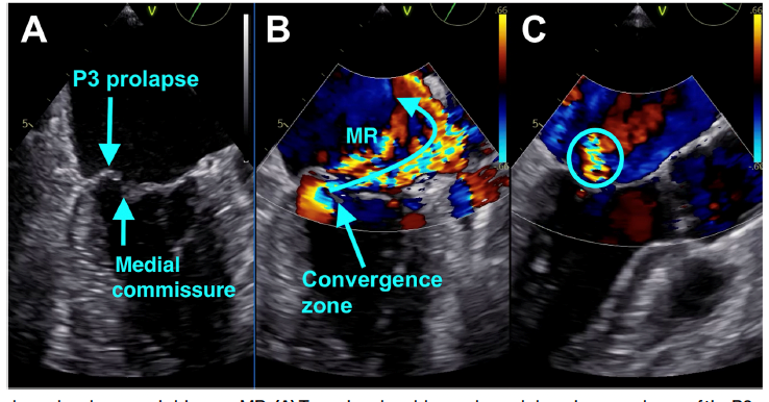
In general, jets due to MVP course away from the prolapsing leaflet. Jets which arise near the LV wall, i.e., those due to commissural prolapse, sometimes course along the atrial surface of the mitral valve (“sideways MR”). When viewed in the 3 chamber view these jets can be underestimated because they are seen en face. Moreover, commissural jets arise close to the LV wall. As a result, their convergence zone is truncated. When EROA is calculated a correction factor must be used: ß/180°, where ß is the angle formed by the LV wall and the base of the convergence zone. Another pitfall in measuring EROA is failure to recognize that MR is late systolic. Since there is no MR is early systole, any MR measurement that is instantaneous, e.g., jet area, EROA, vena contracta, will overestimate MR severity. #ASEchoJC'
Priya Panday, MD tweet media
English
0
2
8
385
Priya Panday, MD
Priya Panday, MD@PriyaPanday27·
The major syndromic forms of MVP are associated with inherited connective tissue disorders, particularly Marfan syndrome, Loeys-Dietz syndrome, and Ehlers-Danlos syndrome. These disorders affect connective tissue integrity and predispose patients to myxomatous degeneration of the mitral valve, resulting in leaflet prolapse and mitral regurgitation. Because MVP occurs as part of a systemic disorder, affected individuals may also have aortic, skeletal, skin, and joint abnormalities that require ongoing surveillance and management. #ASEchoJC
English

0
3
3
860
Priya Panday, MD
Priya Panday, MD@PriyaPanday27·
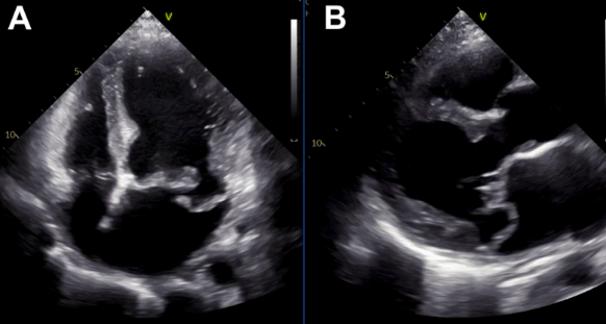
However, fibroelastic deficiency is a localized degenerative process, usually involving the P2 scallop (Figure C), with thin leaflets and chordae and relatively normal surrounding valve tissue. Generally it presents in older patients and often becomes clinically evident after chordal rupture causes acute or subacute severe holosystolic mitral regurgitation. #ASEchoJC
Priya Panday, MD tweet media
English
0
2
6
184
Priya Panday, MD
Priya Panday, MD@PriyaPanday27·
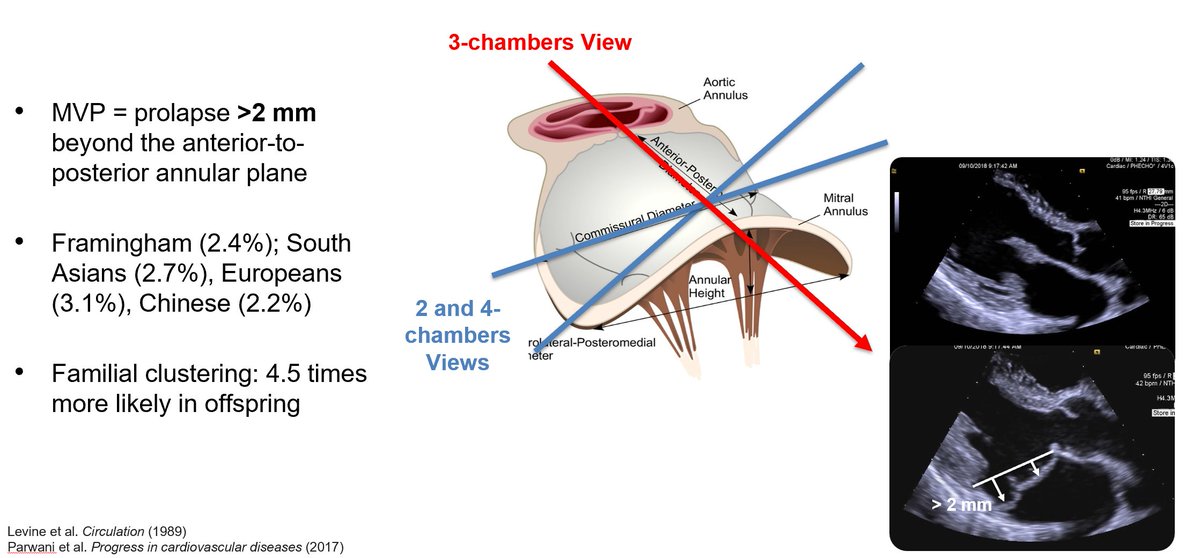
Great question! Mitral valve prolapse (MVP) is defined as >2 mm systolic displacement of one or both mitral valve leaflets beyond the annular plane into the left atrium, best seen in the parasternal long-axis view. MVP affects approximately 2–3% of the population and is not always benign. It is associated with heart failure, infective endocarditis, ventricular arrhythmias, myocardial fibrosis, and sudden cardiac death in a subset with “arrhythmogenic MVP,” wherein bileaflet prolapse, mitral annular disjunction (MAD), fibrosis, and ventricular ectopy coexist. #ASEchoJC
English

1
5
8
457
Priya Panday, MD retweetledi
Mount Sinai Cardiology - Clinical Track
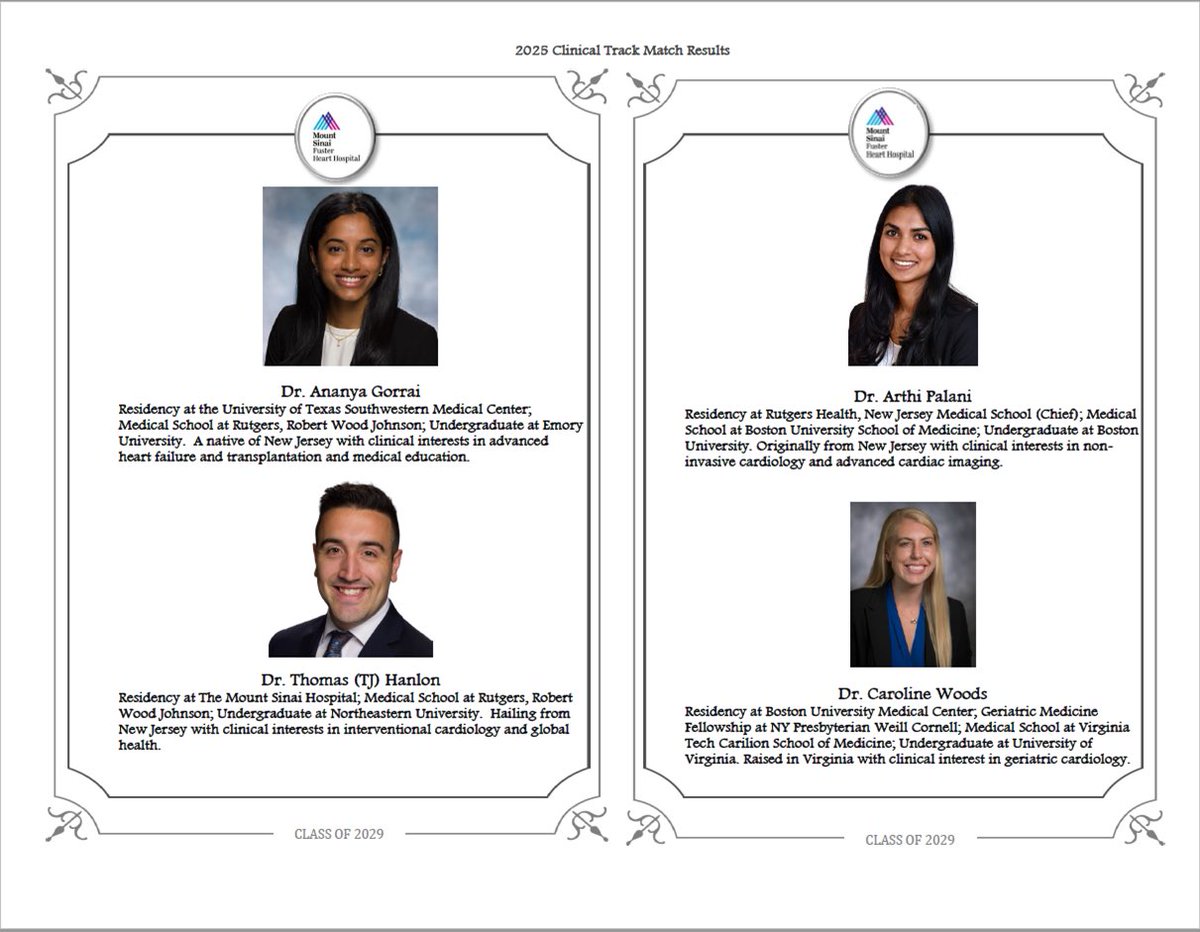
Huge congratulations to our newest class of fellows joining us in July 2026! Welcome to the team!
Mount Sinai Cardiology - Clinical Track tweet media
English
0
2
53
5.1K
Priya Panday, MD retweetledi
Karen Attiah
Karen Attiah@KarenAttiah·
Black and brown people around the world who were subject to horrendous cruelties and economic deprivation under British colonialism are allowed to have feelings about Queen Elizabeth. After all, they were her "subjects" too.
English
716
9.8K
46.8K
0
Priya Panday, MD retweetledi
Sam Ghali, M.D.
Sam Ghali, M.D.@EM_RESUS·
Just a friendly reminder that what has become routine to you, may be one of the scariest times in your patient’s life.
English
107
1.7K
9.7K
0
Priya Panday, MD retweetledi
Wajahat Ali
Wajahat Ali@WajahatAli·
My latest @TEDTalks was posted on YouTube. Free for everyone, and I hope it helps. I offer 3 ways in which you can invest in hope in what seems like hopeless times. youtu.be/bIw5ZLITSfo
YouTube video
YouTube
English
2
2
19
0
Priya Panday, MD retweetledi
Eugene Gu, MD
Eugene Gu, MD@eugenegu·
Wearing a mask protects others from you much more than it protects you yourself. But if everyone wears a mask, then everyone is protected. The only reason why some people refuse to wear a mask is because of a selfish lack of concern for others. Enough. We’re all in this together.
English
40
301
1.3K
0
Priya Panday, MD retweetledi
Ed Gaines
Ed Gaines@EdGainesIII·
3/ major hospital based specialists will be significantly cut in’21 by Medicare in the midst of a global pandemic—@emergencydocs -6%, anesthesiologists-8%, radiology -11% and IR -9%. Congress & @CMSGov here they come—Table 90, page 899.
Ed Gaines tweet mediaEd Gaines tweet media
English
10
39
57
0
Priya Panday, MD retweetledi
Sarah (she/her) 🇵🇸🇸🇩🇨🇩🔻😷
Hello #medtwitter friends, I just got into a huge fight with my parents because they told me that my future career is at risk from all my anti-police brutality protesting. So I want to be very clear: no career is worth the lives of any more Black people.
English
140
503
5.2K
0