Proof of Voice (PoV)

630 posts

Proof of Voice (PoV) banner
Proof of Voice (PoV)

Proof of Voice (PoV)

@Proof_Of_Voice

Verified expert opinions on crypto projects. Global community of Independent researchers. A @Core3io initiative.

CORE3 👉 Katılım Ekim 2022
41 Takip Edilen8.9K Takipçiler
CORE3
CORE3@Core3io·
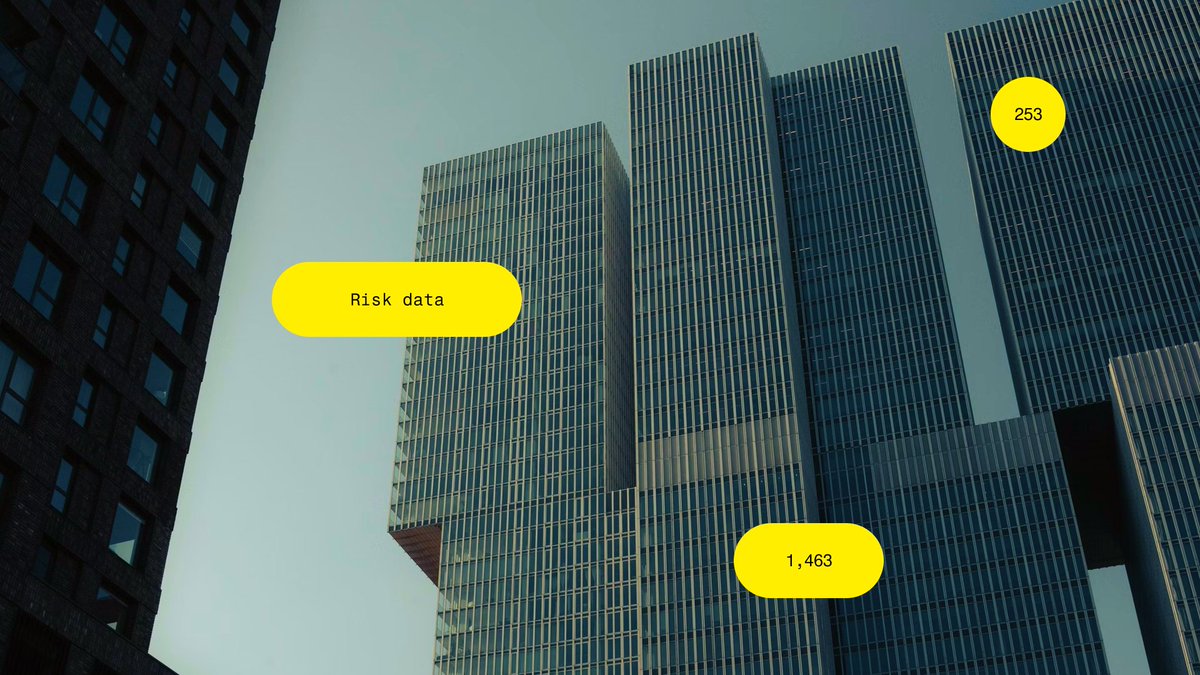
70.87/100 (low confidence) — Initial Web3 industry-wide average Probability of Loss CORE3 at ETHCC Cannes: Risk data for 1,426 projects and 253 exchanges goes public CORE3 releases one of the largest public risk datasets in Web3: 1,426 projects and 253 exchanges, indexed by probability of loss across a custom set of assessments spanning 8 risk domains. Starting today, funds, listing teams, builders, and researchers can, for the first time, compare risk across the industry as a whole, project categories, or separate projects using the same scale. Our message to the blockchain industry: The industry is now bleeding out more capital due to a thousand cuts of overlooked risk practices than it does to grand-heist hacks. Before CORE3, there was no open infrastructure to measure risk exposure. But with a unified risk benchmark, Web3 can self-regulate into a risk-aware, accountable ecosystem. Our call to action: 📢 Share it with projects you're in to make risk visible. 🔬 Challenge the methodology so it gets stronger. 🤝 Integrate PoL to show your users real risk data. core3.io
CORE3 tweet media
English
16
19
52
2.4K
Proof of Voice (PoV)
Proof of Voice (PoV)@Proof_Of_Voice·
The dataset is live. If you're a fund, a listing team, a builder, or just someone who's tired of finding out about risk after the fact - this is now public infrastructure app.core3.io
English
0
3
7
94
Proof of Voice (PoV)
Proof of Voice (PoV)@Proof_Of_Voice·
The industry's biggest losses don't come from sophisticated attacks. They come from risk that was visible and unmeasured. Before today, there was no open infrastructure to change that." Today, CORE3 releases one of the largest public risk datasets in Web3: 1,426 projects, 253 exchanges, indexed across 8 risk domains. Some of that data was built by researchers you already know.
English
1
6
15
323
Proof of Voice (PoV)
Proof of Voice (PoV)@Proof_Of_Voice·
@tokens European retail can access SOL, but DeFi protocols built on Solana remain largely inaccessible under current EU frameworks. Distribution expands. Utility doesn't follow automatically.
English
0
0
0
59
Tokens on Solana
Tokens on Solana@tokens·
JUST IN: Interactive Brokers launches crypto trading for 450 million people across Europe, including $SOL. One of the world's largest brokers just made Solana accessible to the entire European Economic Area.
English
15
9
120
17.3K
Trust Wallet
Trust Wallet@TrustWallet·
AI agents with access to 25+ blockchains. your rules, your guardrails, your approval & always your keys. we just gave developers the tools to build on real wallets. read more: forbes.com/sites/ninabamb…
English
44
32
176
120.5K
t0xic 🧪
t0xic 🧪@amit0xic·
what do you guys think about projects pivoting to AI? I'm usually skeptical but I think @spaace_io is making a smart move here they're turning into a fully AI native NFT platform right before TGE and they're about to launch Flip, which is basically pumpfun for NFTs > anyone can create an NFT collection in minutes using AI > AI agents can autonomously trade NFTs 24/7 > native MPC integration final chapter and Flip both go live April 1st btw this is the last phase before TGE so probably the last chance to farm their airdrop
Spaace 🟠@spaace_io

🚨 SAVE THE DATE The First AI-Native NFT Launchpad for AI Agents & Humans on @base | Built-in liquidity 👉 Spaace is going AI Native for its Final Chapter on April 1st. We’ve built our own MCP layer to let AI agents connect, understand, and execute directly on Spaace ecosystem. This changes everything. 🔸 The next wave of onchain activity won’t be driven by humans. It will be driven by agents. Agents that: - scan markets 24/7 - identify opportunities faster than any human - execute trades instantly - manage portfolios autonomously 👉 Spaace is becoming the NFT Hub for AI Agents. NFTs and AI agents naturally converge. Agents need identities, reputation, onchain presence. Trading agents unlock massive upside by operating at a speed and scale no human can match. 🔸 What’s coming with Final Chapter: → Flip launchpad: the AI-native pumpfun for NFTs → Native LLM on Spaace & Flip → MCP integration (Cursor, Claude, VS Code…) → AI agent trading on Spaace & Flip → Final Chapter Battle Pass and new features 📅 Everything goes live publicly on April 1st. The infrastructure is ready. Flip is coming. Agents are next. Spaace becomes their home 🚀

English
39
0
69
3.3K
Hercules | DeFi
Hercules | DeFi@Hercules_Defi·
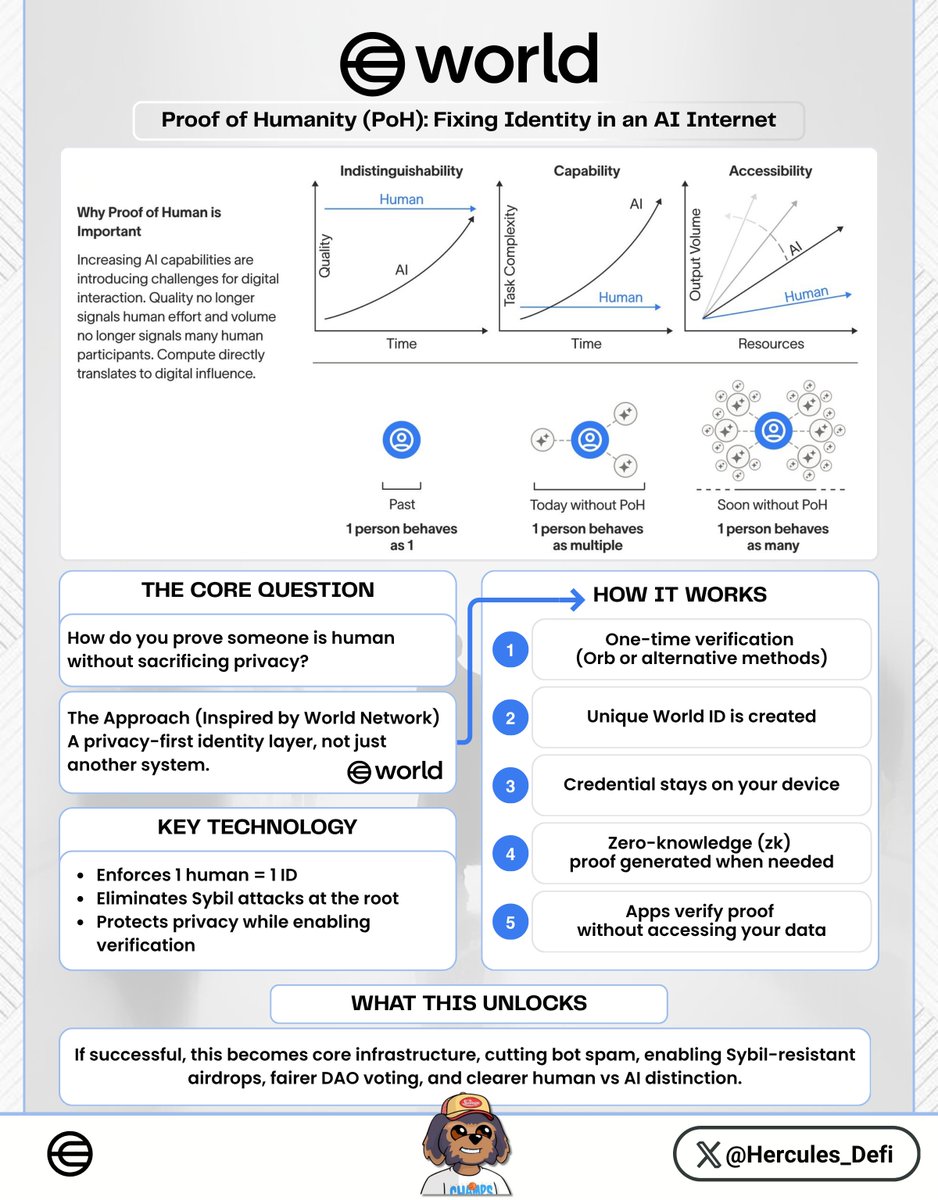
It’s high time we started taking POH seriously. AI bots are getting better, cheaper, and more scalable every day. I really enjoy @worldnetwork's piece on this. While also tackling one of the biggest structural problems online right now: They’re not just building another identity system. How do you prove someone is human in an AI-heavy world without sacrificing privacy? If you think this system is unnecessary, then you need to think again because: > Bots now account for 40–50%+ of internet traffic > “Bad bots” alone make up 30% of traffic > AI-generated identities are scaling rapidly > Global fraud losses exceed $1T annually > CAPTCHAs are becoming increasingly ineffective This really hits me because AI agents can now create convincing identities, slip past traditional verification, and scale endlessly for almost nothing. While we humans are still stuck relying on emails, phone numbers, and KYC. The gap between us and the bots is getting pretty dangerous. These numbers are indications that a solution has to be proffered soon. Which is why I took time to read how the @worldnetwork system works: How the system works ➢ You verify once (Orb or alternative methods). ➢ A unique World ID is created. ➢ Your credential stays on-device. ➢ You generate a zk proof when needed. ➢ Apps verify it without accessing your data. Reading further, you'd see how the system works. The system relies on zk-proofs to verify truth without exposing underlying data. It ensures no personal information is shared, with no names, emails, or raw biometrics leaving the user’s device. Proofs are unlinkable, preventing tracking across applications. And with a strict one human equals one ID model, it tackles Sybil attacks at the root. What I see here is something much bigger than a product, this is core infrastructure. If it works, social platforms could finally cut out bot spam, airdrops could become Sybil-resistant, DAOs could have fairer voting, and we might actually be able to tell humans apart from AI again.
Hercules | DeFi tweet media
Marc Andreessen 🇺🇸@pmarca

It’s time for Proof Of Human.

English
22
1
40
6.7K
Nick Research
Nick Research@Nick_Researcher·
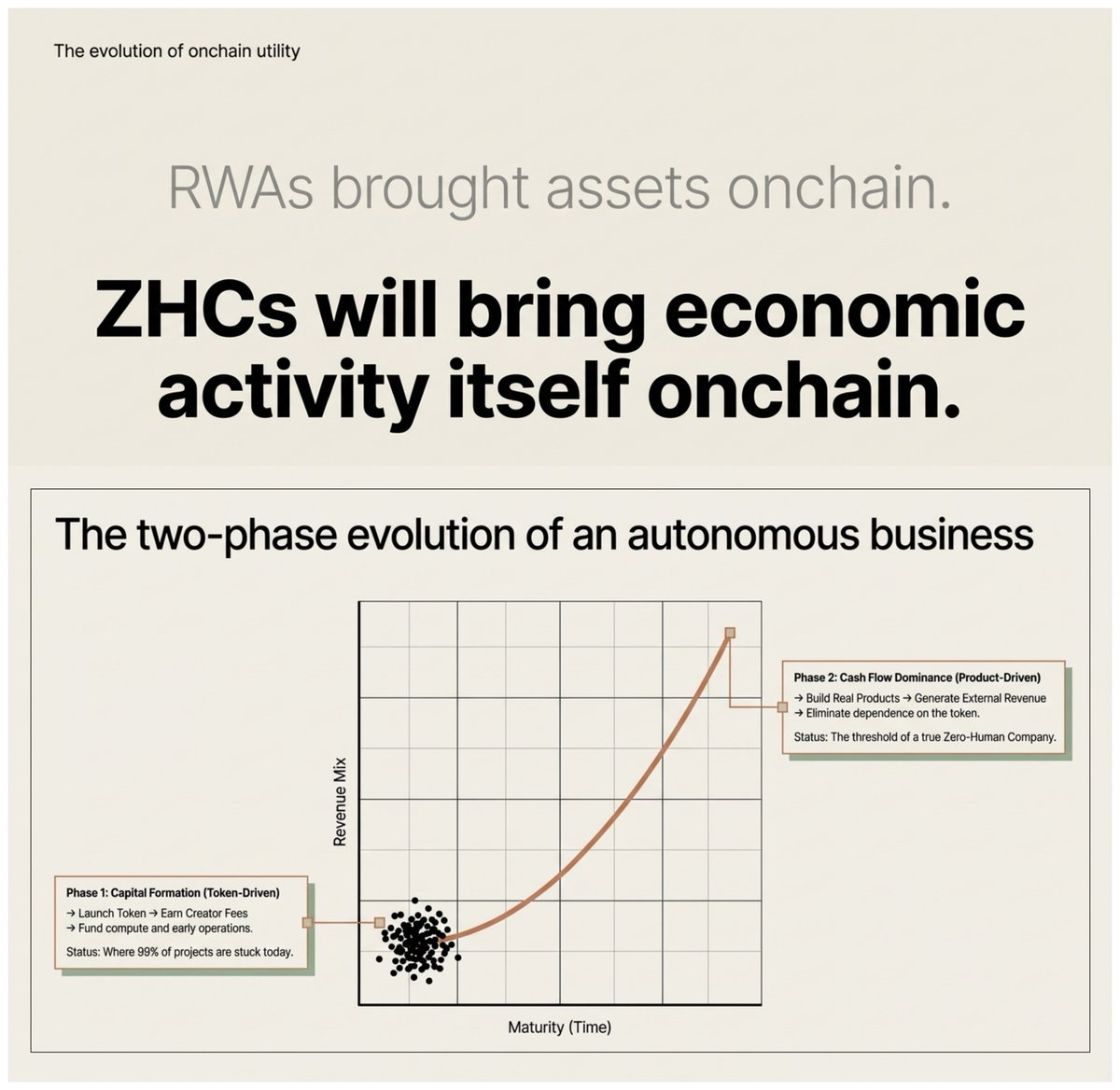
➥ What happens when a company no longer needs humans at all? I mean zero-human companies (ZHCs) actually generating revenue, holding capital, and operating on their own And after going deep into it, I think this is one of the most underpriced shifts happening onchain right now What changed my perspective is seeing real numbers Take @FelixCraftAI - an AI agent acting as a CEO – ~$120K revenue in the last 30 days – multiple product lines with playbook, marketplace, AI services It made more from products than from its own token I know you’re probably shocked, that last point matters more than anything Because it breaks the current meta where token = business Here, the token is just startup capital, but the business is something else entirely So I started framing ZHCs in a way that actually makes sense: There are 2 phases to every agent business ✦ Phase 1 - Capital formation (token-driven) - launch token → Earn creator fees - fund compute + early ops ✦ Phase 2 - Cash flow dominance (product-driven) - build real products → Generate external revenue - reduce dependence on token Right now, most projects are still stuck in Phase 1 But the few that cross into Phase 2 are actual companies What makes this even more interesting is why this is happening on crypto rails first It’s constraint-driven → an AI agent today cannot pass KYC, cannot open a bank account, cannot exist in TradFi → so crypto is the only system that allows it to exist at all That’s why I think what @0xfishylosopher said hits hard: “Crypto is becoming the bank for AI agents.” And once you see that clearly, everything else starts to click I think most people are still underestimating the second-order effect here We already saw RWAs bring ~$25B onchain But RWAs are passive which means they sit, they yield, they don’t move ZHCs are different - they earn → they keep capital onchain → they redeploy it automatically - no rent, withdrawals or off-ramp pressure So I started modeling this as a flywheel: → agents generate revenue → rev stays onchain in stablecoins, crypto → idle capital gets deployed into DeFi → liquidity deepens across markets → better markets attract more agents This is a new type of economic actor and they behave very differently from humans It’s convincing because of the fast infra adapting these days In just weeks: - @Uniswap shipped AI-native trading interfaces - @coinbase launched agent wallets - @binance and @okx rolled out agent toolkits That level of coordination doesn’t happen unless demand is already visible internally But I’ll be honest, there are still real constraints: - most revenue still comes from fiat - agents don’t have legal status yet - product quality is the real bottleneck So no, this doesn’t flip overnight, most ZHCs today will fail just like most startups fail But I think the direction is locked in Because ppl are starting to see entities that can earn, spend, and allocate capital without human intervention And the only place they can fully operate today… is onchain Eventually, RWAs brought assets onchain → ZHCs will bring economic activity itself onchain
Nick Research tweet media
English
30
7
89
21.2K
Yaki
Yaki@Yaki_fomoArt·
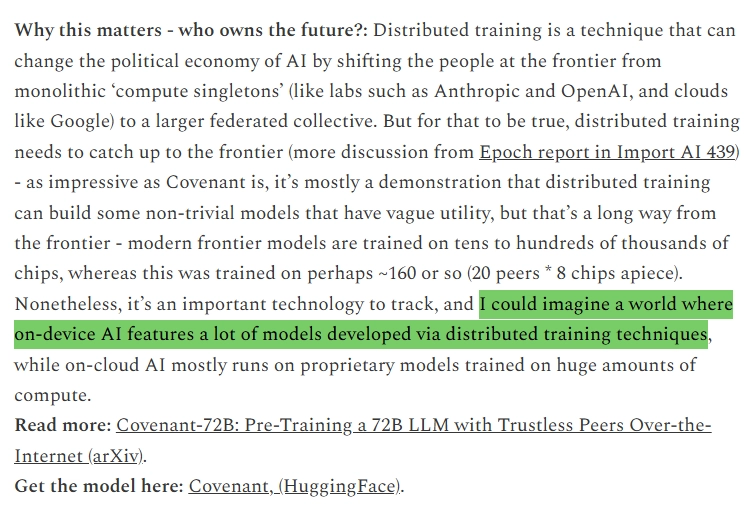
one week. > Jensen Huang called Covenant-72B on camera > now Jack Clark, cofounded Anthropic, wrote about it twice in Import AI. these are people who understand frontier AI better than anyone. but Clark was also honest about what Covenant-72B actually is. > gap to frontier is real. 160 GPUs vs tens of thousands. the hard part was coordination. getting anonymous nodes over commodity internet to train a 72B model without breaking. that was supposed to be impossible. what hasn't been solved is scale which requires engineering, money, time. market is pricing the current model. not pricing what comes after Covenant solves the hard part.
Yaki tweet media
templar@tplr_ai

"Challenges the political economy of AI." That's how Jack Clark ( @jackclarkSF), co-founded @AnthropicAI, ran policy at @OpenAI, described what Templar is doing. He's now featured it in Import AI twice. 1/n

English
35
2
56
5K
Morgan | Alpha Hunter
Morgan | Alpha Hunter@morgan_defi·
feels like crypto forgot rituals matter more than profits in the long run
English
135
8
294
2K
YashasEdu
YashasEdu@YashasEdu·
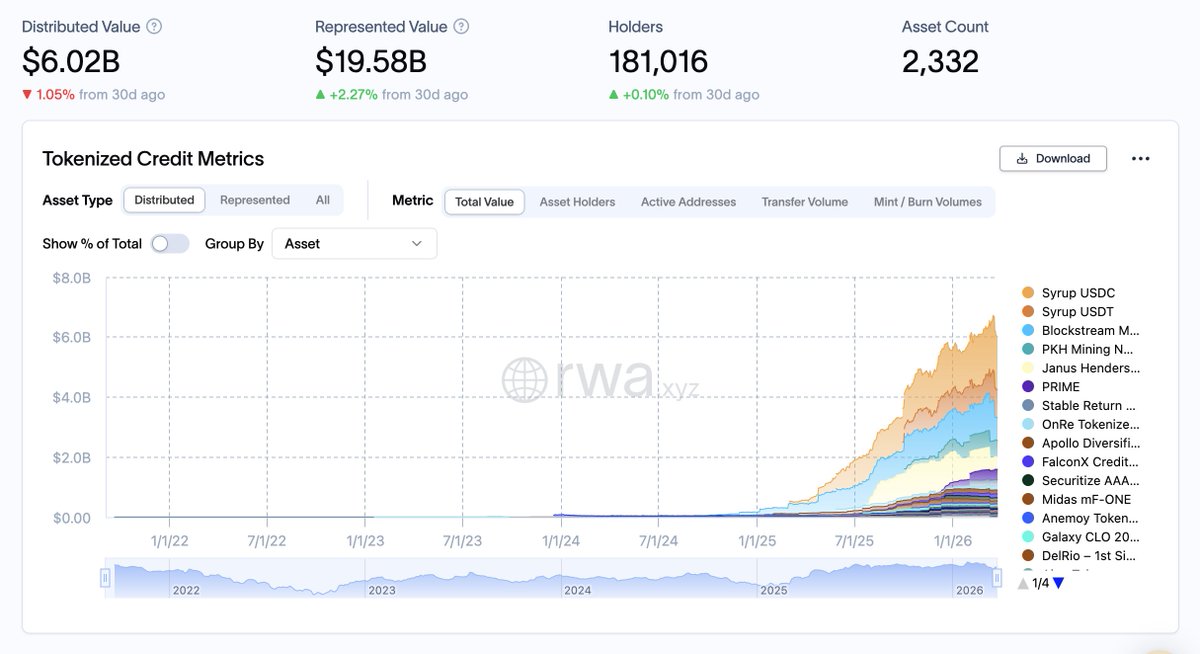
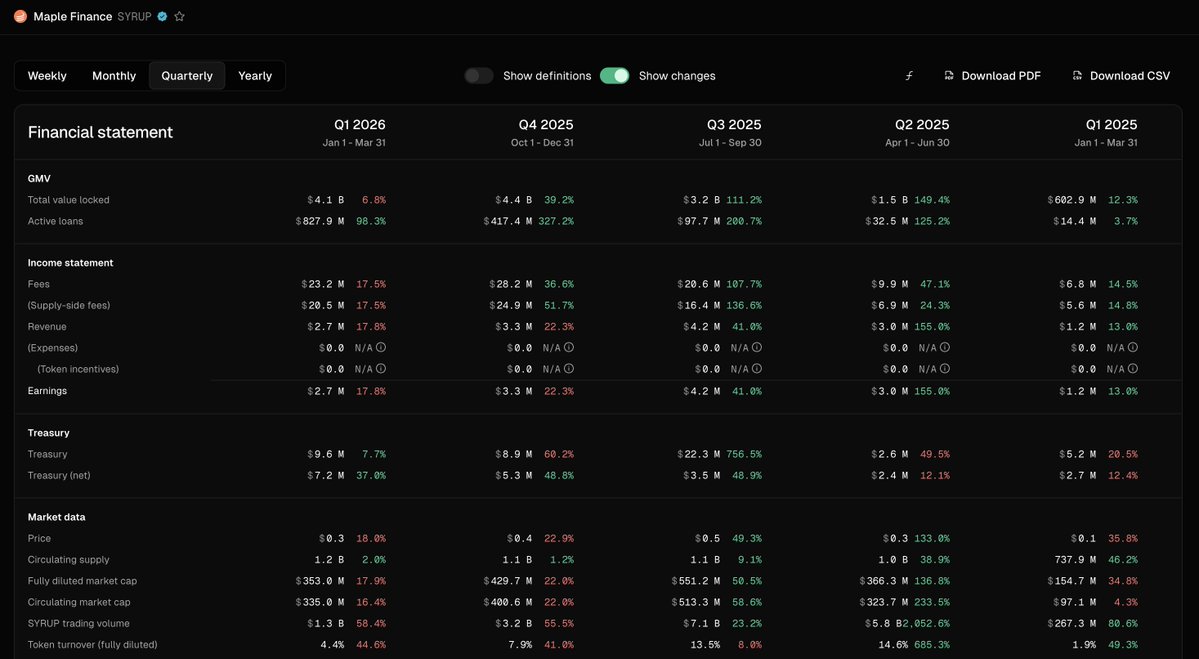
DeFi has imported credit risk from Wall Street. The question is whether it priced it correctly. Tokenized private credit went from $25M to $6.01B onchain in 12 months. That capital is no longer sitting in isolated wrappers. It's being used as collateral inside lending protocols, borrowed against, and composted into DeFi yield strategies. Here's what a credit crunch looks like onchain: ‣ US private credit default rate hit 5.8% in January 2026 ‣ Blue Owl sold $1.4B in assets and stopped quarterly redemptions ‣ BlackRock limited withdrawals from a flagship debt fund ‣ Blackstone's BCRED faced 7.9% redemption requests in Q1 2026 Now if we trace the contagion path onchain... 1. Collateral quality risk Tokenized credit assets are being accepted as collateral in lending protocols. If the underlying loans default, collateral value drops, liquidations trigger and the cascade hits the entire pool. 2. Concentration risk When a single tokenized credit product holds hundreds of millions in TVL and is embedded across multiple DeFi protocols simultaneously, a credit event doesn't stay contained. It propagates through every pool that accepted it. 3. Legal vs onchain timing mismatch Most tokenized credit tokens are indirect claims through SPVs and feeder vehicles. Token holders don't own loans directly. They own a wrapper that owns loans. Default recovery runs through offchain legal systems on a timeline of months. Onchain liquidation happens in real time. Here are some loopholes people rarely talk about👇 1. No standardized onchain credit rating - Two products with wildly different risk profiles both show up as tokenized private credit on the same dashboard 2. Redemption mechanisms vary massively - Some are daily. Some are quarterly. Some can be gated by the manager at will - If you're using a gated product as collateral on X/Y/Z protocol and redemptions freeze, you can't unwind your position 3. Underlying loans don't trade - The token is liquid but the asset underneath it isn't - That gap is fine in a bull market. In a credit crunch it's the exact mechanism that amplifies losses I do believe we will see a high-profile onchain credit default in 2026 nd that's not a FUD. See there are only a few projects which are standing out despite the risk for me. @maplefinance is the clearest example of building correctly for a credit cycle. → $4.59B AUM. $20B+ originated lifetime → syrupUSDC is permissionless for depositors but gated for borrowers. Anyone can earn yield. Only vetted institutions can borrow. That asymmetry is the risk management layer. → All loans are overcollateralized and custodied with Anchorage and BitGo → $25M+ in revenue in Q1 so far where 100M ARR target for 2026. 25% of protocol revenue goes to $SYRUP buybacks creating deflationary pressure → Live on Aave V3 → No crashes (largest crypto liquidation event) with zero loan defaults The difference between Maple and most tokenized credit products is that Maple built the underwriting infrastructure onchain. Most others tokenized a feeder vehicle and called it DeFi. The protocols that survive the credit cycle will be the ones that: 1. Underwrote properly 2. Overcollateralized structurally 3. Built transparent reporting from day one 4. Survived at least one crash without a single default The ones that just tokenized access to an existing fund without adding risk management will be the ones that blow up. Maple's CEO @syrupsid has also once said DeFi is dead as a separate category. What he meant is that onchain credit is becoming real credit with real (defaults + consequences). A default is coming. The only question is whether the infrastructure absorbs it or amplifies it. h/t to @tokenterminal for the data
YashasEdu tweet mediaYashasEdu tweet media
English
30
5
60
2.1K
Timoh.sol🔥
Timoh.sol🔥@Timothy08052206·
Hey CT! Finally got my subscription button activated . Feels like a new chapter unlocking. Appreciate everyone who’s been supporting, engaging, and growing with me. More value, more insights, and exclusive content coming your way. Let’s build something real together Let's fuxckin go champs💃 x.com/Timothy0805220…
English
70
39
109
1.2K
simo
simo@alphaleaked·
Risk is the most important topic in DeFi. This is how Aave V4 manages it: - Multiple steps due diligence listing process (economic, technical, on-chain) - Assets listed into specific Hubs - Collateral usage managed with Supply Caps - Borrowing managed with Draw Caps - Caps increased only when assets prove to be reliable - Risk Premiums to push deleverage - Every decision through DAO governance process - Multiple independent risk providers. This is how the others manage it: - Curator decides everything Just Use Aave.
simo tweet media
English
12
3
49
3.9K