
Protocol Labs
8.4K posts

Protocol Labs
@protocollabs
We are an innovation network of 700+ teams and projects, driving breakthroughs in computing to push humanity forward.


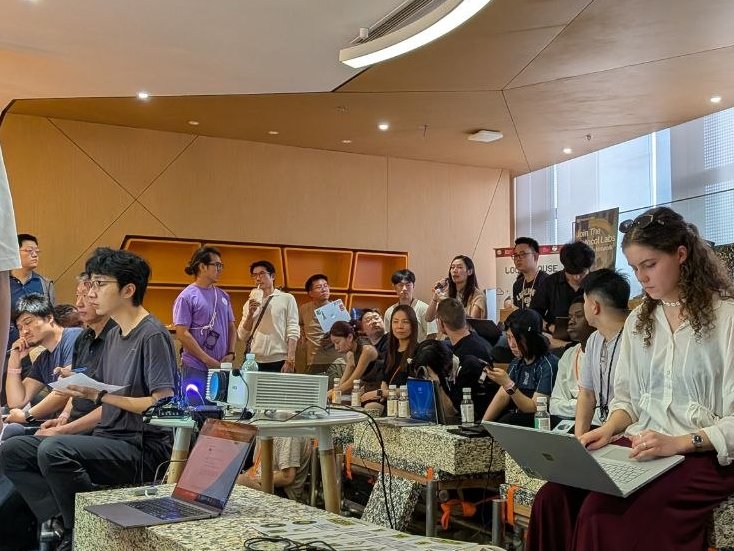
What happens when AI digital twins help allocate a treasury? Our experiment with @dwddao's Simocracy: at Frontier Tower, community leads' AI twins read the proposals, argued their priorities, and deliberated together. With @hypercerts @OctantApp @ProtocolLabs @GainForestNow


Here is Episode 2 of my new podcast dedicated to conversations on the future of neurotech, computing, intelligence, and more. My guest Dr. Ben Rapoport is co-founder and CSO of Precision Neuroscience (@PrecisionNeuro_), Assistant Professor of Neurosurgery at the Icahn School of Medicine at Mount Sinai, and Scientific Director at Mount Sinai. Previously, he co-founded Neuralink and Simbionics (acquired by Apple). Precision is building a minimally invasive brain-computer interface (BCI) that reads from thousands of points on the cortex without penetrating it. The Layer 7 device is implanted through a one-millimeter slit in the skull rather than the larger borehole other approaches require. It is also fully removable. Precision seeks to help the 5 million people living with severe paralysis in the US (including 800,000 new stroke cases per year). In March 2025, Precision received FDA clearance for a temporary wired version of the system. Over 85 patients have been implanted with and used the device in clinical studies (50 at the time of our conversation). Wireless implants are planned for 2027. We go deep on the history of Neurotech from the 1980s to the ML inflection points that triggered Neuralink's founding, why surface ECoG was a contrarian bet that's now paying off, the path to treating paralysis and stroke at scale, and why Ben believes neural data is at the same inflection point genomic data was in 2000 — a whole class of biological problems about to become tractable as computer science problems. Chapters 00:00:00 Introduction 00:04:39 Paralysis as a lens to understand the brain 00:05:36 The 1980s breakthrough: population encoding and the birth of BCI 00:14:36 Google Translate, ML, and the founding of Neuralink 00:23:08 What is the long-term vision of Precision Neuroscience 00:31:56 Layer 7 and why transformative technology looks impossible at first 00:50:21 The surgery: a slit in the skull, not a borehole 00:55:19 The clinical program: who are the patients 01:04:16 FDA clearance and the path to wireless implants in 2027 01:08:32 The patient population: paralysis and stroke at scale 01:16:26 Neural data as the new genomics 01:30:06 BCIs, AI, and the future of the human-machine interface 01:31:22 From medical necessity to lifestyle technology 01:40:36 Precision as a platform — and an optimistic vision If you're interested in these kinds of discussions, subscribe to the podcast. And if there’s anyone you’d like to see or hear on the podcast, reply with your suggestions. Full Episode 2 here and in other platforms below.

Here is Episode 2 of my new podcast dedicated to conversations on the future of neurotech, computing, intelligence, and more. My guest Dr. Ben Rapoport is co-founder and CSO of Precision Neuroscience (@PrecisionNeuro_), Assistant Professor of Neurosurgery at the Icahn School of Medicine at Mount Sinai, and Scientific Director at Mount Sinai. Previously, he co-founded Neuralink and Simbionics (acquired by Apple). Precision is building a minimally invasive brain-computer interface (BCI) that reads from thousands of points on the cortex without penetrating it. The Layer 7 device is implanted through a one-millimeter slit in the skull rather than the larger borehole other approaches require. It is also fully removable. Precision seeks to help the 5 million people living with severe paralysis in the US (including 800,000 new stroke cases per year). In March 2025, Precision received FDA clearance for a temporary wired version of the system. Over 85 patients have been implanted with and used the device in clinical studies (50 at the time of our conversation). Wireless implants are planned for 2027. We go deep on the history of Neurotech from the 1980s to the ML inflection points that triggered Neuralink's founding, why surface ECoG was a contrarian bet that's now paying off, the path to treating paralysis and stroke at scale, and why Ben believes neural data is at the same inflection point genomic data was in 2000 — a whole class of biological problems about to become tractable as computer science problems. Chapters 00:00:00 Introduction 00:04:39 Paralysis as a lens to understand the brain 00:05:36 The 1980s breakthrough: population encoding and the birth of BCI 00:14:36 Google Translate, ML, and the founding of Neuralink 00:23:08 What is the long-term vision of Precision Neuroscience 00:31:56 Layer 7 and why transformative technology looks impossible at first 00:50:21 The surgery: a slit in the skull, not a borehole 00:55:19 The clinical program: who are the patients 01:04:16 FDA clearance and the path to wireless implants in 2027 01:08:32 The patient population: paralysis and stroke at scale 01:16:26 Neural data as the new genomics 01:30:06 BCIs, AI, and the future of the human-machine interface 01:31:22 From medical necessity to lifestyle technology 01:40:36 Precision as a platform — and an optimistic vision If you're interested in these kinds of discussions, subscribe to the podcast. And if there’s anyone you’d like to see or hear on the podcast, reply with your suggestions. Full Episode 2 here and in other platforms below.