Quinn Aderholt

24 posts

Quinn Aderholt banner
Quinn Aderholt

Quinn Aderholt

@QAderholt

最喜欢NBA和NFT!

Katılım Mayıs 2022
24 Takip Edilen1 Takipçiler
Quinn Aderholt retweetledi

LayerZero
LayerZero@LayerZero_Core·
We’re honored to be chosen by Wyoming as the token issuance partner for WYST, the first fiat-backed and fully-reserved stablecoin issued by a public entity in the United States. There’s no clearer signal of where finance is heading than a U.S. state putting the dollar onchain.

LayerZero tweet media
English
108
232
1K
380.7K
Quinn Aderholt
Quinn Aderholt@QAderholt·
Big news to share with everyone today! I'm going to be a character in the new fighting game FATAL FURY: City of the Wolves! Let's have some fun on April 24th!
GIF
English
0
0
0
10
Monad
Monad@monad·
drop your Monad address below within the next 24 hours to receive your soulbound NFT
English
650.6K
10.2K
111.8K
4.4M
Leather - Grow your Bitcoin
Leather - Grow your Bitcoin@LeatherBTC·
GM 🖤 Reply with a "GM" back and we'll DM you a secret "GM" in return! 🤫 (must be following us)
English
1.2K
94
359
26.6K
Quinn Aderholt retweetledi
DAPPOS
DAPPOS@dappOS_com·
Unlock #intentcentric trading with kiloex.dappos.com powered by dappOS V2🔥 The quickest and cheapest points-farming experience on @KiloEx_perp! ✅Reduced Workflows ⏳time 📉85% 💹 fees 📉70% ✅ $20,000 Prize Pool & Exclusive OATs
DAPPOS tweet media
English
47
2.6K
443
170.5K
Quinn Aderholt retweetledi
KIP Protocol
KIP Protocol@KIPprotocol·
Great turnout for KIP's 1st ever Community Call! Thanks to every single one of you that tuned in🎙👥 Our Co-Founders @julian_kip & @HumanLevelJen dropped some serious alpha on: - How creators can tokenize and earn from their knowledge (read the KIP whitepaper for full details) 💡 - Buzz around KIP Genesis NFT campaign 🔥 - Our plans to galvanize the KIP community post-Genesis mint 🎁 - Launching own chain vs. using existing chains ⛓️ - Similarities and differences of $KIP and $TAO 🤔 Missed it? Listen to the recording here👇 x.com/i/spaces/1rdgl…
KIP Protocol@KIPprotocol

x.com/i/spaces/1RDGl…

English
152
10.3K
10.6K
77.8K
Quinn Aderholt retweetledi
KIP Protocol
KIP Protocol@KIPprotocol·
Genesis Blindbox NFT Transmission Loading... 📡
KIP Protocol tweet media
Dansk
4.7K
6.9K
7.5K
96.7K
Quinn Aderholt retweetledi
KIP Protocol
KIP Protocol@KIPprotocol·
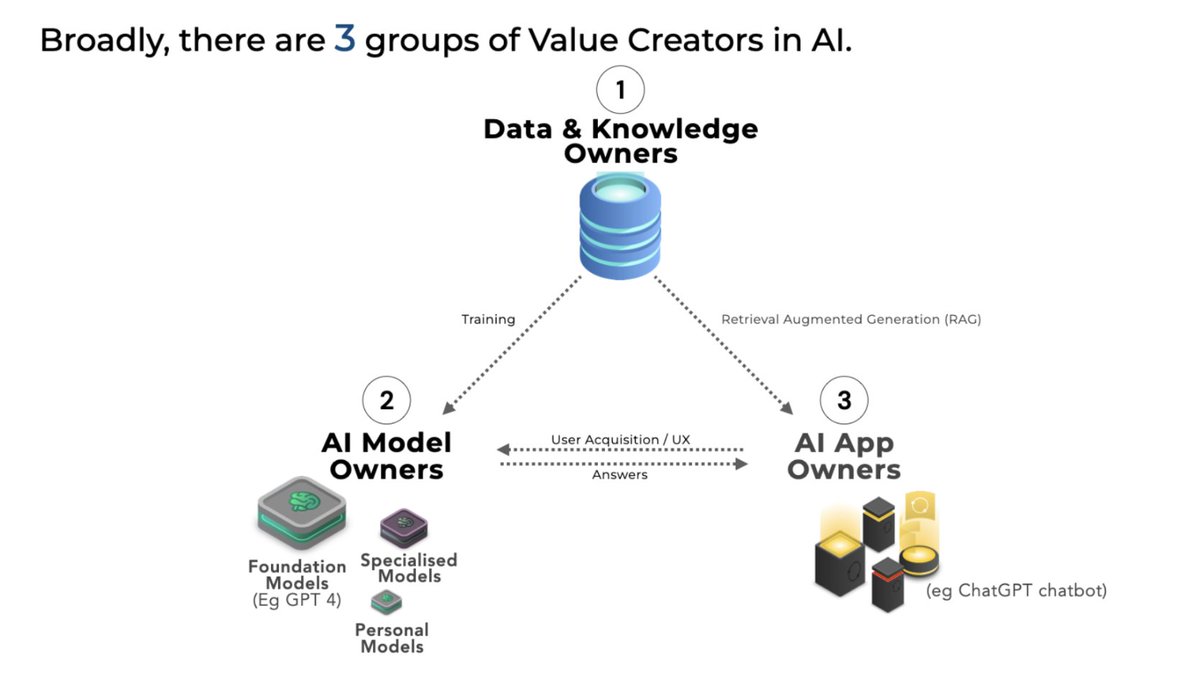
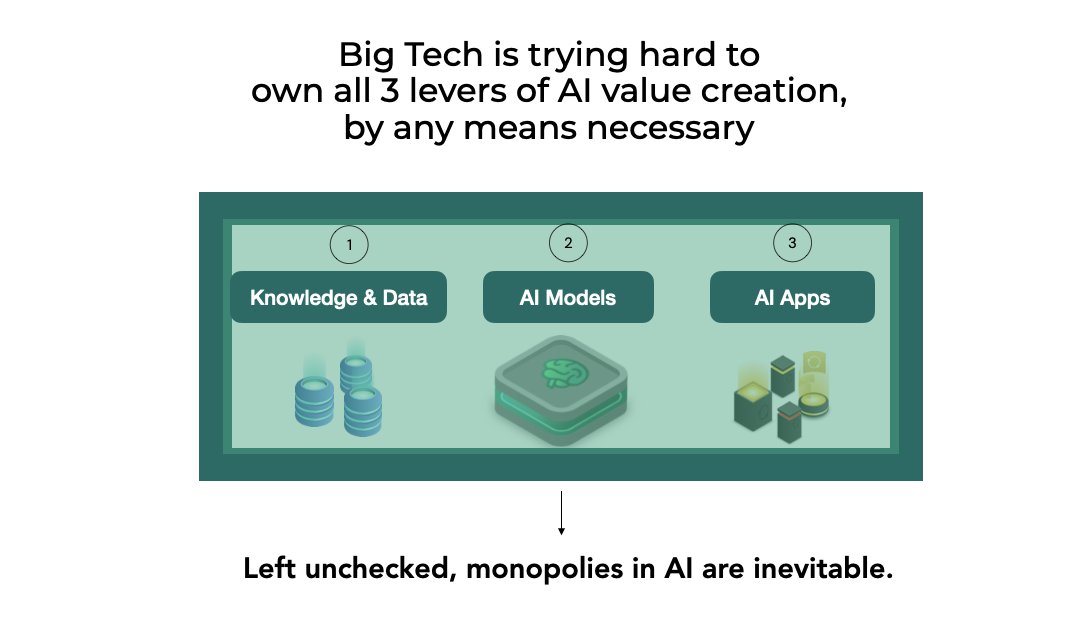
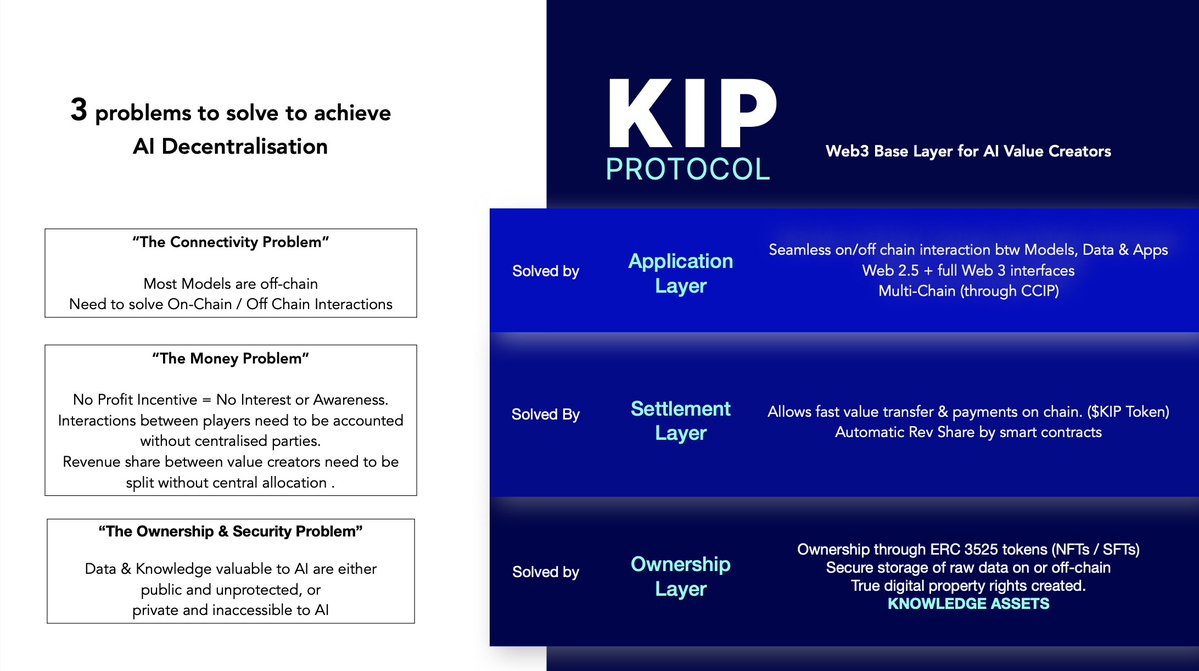
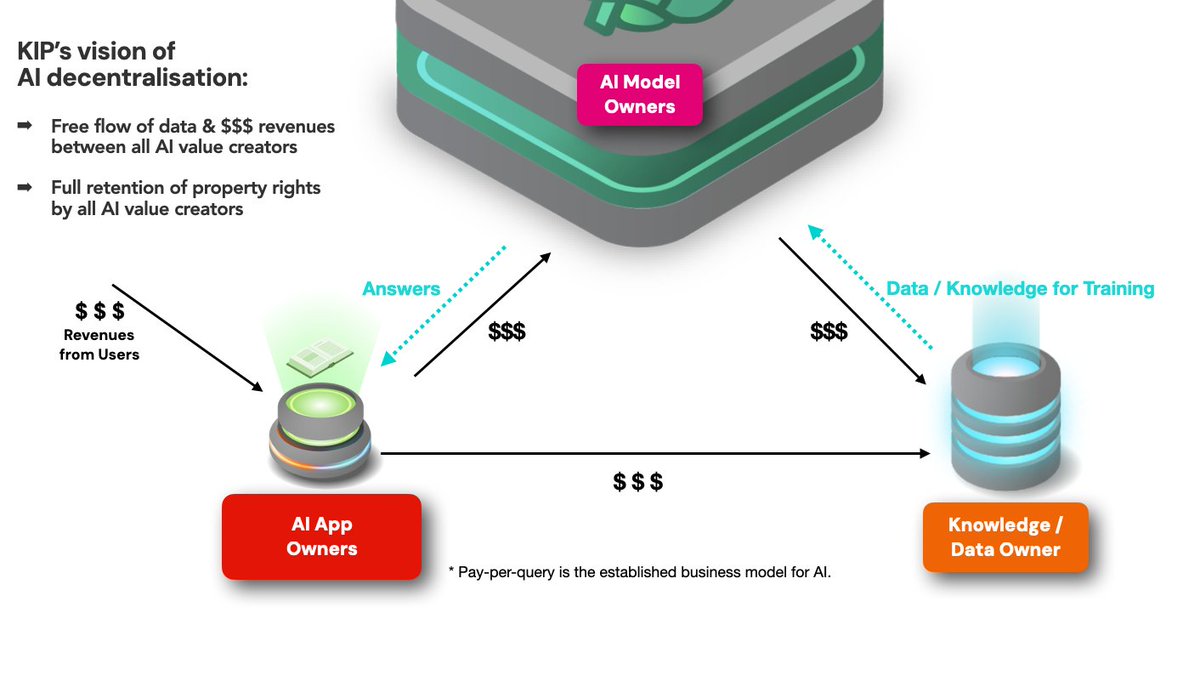
KIP Explainer Series: #1 Why is KIP the Web3 Base Layer for AI? First off: KIP is not a single AI app, nor a large language model, nor a database / knowledge base. KIP is a decentralized protocol that AI app owners 📱, model owners🤖 and knowledge base / data owners📚 will find essential to decentralise their work & monetise in Web3. (For brevity, we call these 3 categories 📱, 🤖, 📚 : AI Value Creators) Decentralisation of AI is an extremely large & important topic, and there are multiple groundbreaking projects taking different approaches at the problem. For us at KIP, we are focused on solving the base level problems that AI Value Creators will face when trying to deploy and monetise their work in Web3. AI MODELS 🤖 NEED APPS 📱& DATA 📚 TO CREATE ECONOMIC VALUE While there are easily 20 over categories of companies creating solutions in AI, most of the attention in Generative AI over the past year has been on the AI Models (and there is a huge variety of different categories and approaches here from transformers to GANs to diffusion models to name a few). Indeed, these models represent the true breakthrough of this new era of computing—the true Brains behind it all. But to build a business ecosystem within AI, models need to rely on at least 2 other essential Value Creators. 1) AI Apps📱: 'The Face of AI' It's easy to overlook the importance of apps amidst all the excitement over models. AI Apps are essential for getting users into AI. Apps can take many forms, like chatbots, image generators, search bots, analysis bots or in its most elegant form, simply prompts. They craft the user experience, acquire the users, and perhaps most importantly, collect the fees from the users. Many forget that ChatGPT is OpenAI’s app, powered by OpenAI’s various models (GPT 3.5, GPT 4). The then ground-breaking human-like responses of the OpenAI chatbot were largely coded on the app-end, not the model end. (Connecting to the models directly via API, and comparing the answers, will tell you this.) TLDR: without Apps, models would just be sets of code and weights sitting in a metal box somewhere with no way to utilise them. ​​​2) Data📚: 'The Lifeblood of AI' Data is needed for: a) Training & Fine Tuning Models, & b) Retrieval-Augmented Generation (RAG) All models are trained and fine-tuned on data. Without fine-tuning, models don't get stronger or smarter. But by using data to finetune or train models, it causes the data essentially to be 'assimilated' or 'absorbed' into the models, manifested in the adjustment of the model weights. So in situations where it is impossible, impractical, or illegal to just use data to directly train the models, the innovative technique called Retrieval-Augmented Generation (RAG) steps up to deliver. RAG combines the power of retrieving information from external databases with the capability of generating responses via an AI Model. It's like having a super-smart assistant who understands your questions but also knows where to find the answers even if it doesn't know the answer itself. While RAG is still relatively new, it’s our firm belief that given increased sensitivity and protectionism over data, RAG techniques could emerge as a leading approach, driving significant business value through real-world applications, and making it a dominant framework under which most people access AI in the future. TLDR: Regardless of which approach, continued AI innovation is simply not possible without data. A VIBRANT AI ECOSYSTEM REQUIRES MULTIPLE INDEPENDENT INDUSTRIES OF VALUE CREATORS Individuals and companies skilled at training and finetuning models, may not be the same people who are great at designing and marketing customer-facing apps. Similarly the researchers and domain experts with valuable data sets and knowledge bases, may not have the right skill sets to train AI models or design applications. But in a vibrant and diverse ecosystem, they don’t have to . Seperate industries of companies and individuals can work together to create use cases and economic value for users. An app designer can choose the AI model most suitable for his product plans, and pre-select the external knowledge bases most helpful for his users. But what if all 3 potentially vibrant and independent industries are being slowly absorbed into one closed ecosystem? Because that’s exactly what’s happening right now. We will cover this in detail in future articles, but for now: do a web-search for "openai copyright shield" and consider the implications for data ownership in the AI future. WHY KIP WANTS TO CATALYSE AI DECENTRALISATION ​​Monopolies in AI are uniquely dangerous, and decentralisation of AI is an urgent and necessary response to the subjugation of our collective interests to that of a narrow set of corporate interests. We are 100% for AI accelerationism (e/acc), and we do not deny the significant contributions of Big Tech in advancing AI innovation. But large companies will act only in the best interests of their shareholders, and they will do whatever they can get away with. It’s the nature of capitalism; to expect them to change their nature and ignore their driving motivations is to deny reality. We need a state of adversarial equilibrium in AI, with a multitude of different actors participating and competing in the market, fostering an environment where innovation can thrive. The future of AI must not become subjugated to any megacorp’s corporate interests. And decentralization of AI is, in our opinion, THE ONLY WAY to bring about that desired state. HOW KIP CATALYSES DECENTRALISATION OF AI KIP solves three base level problems that AI apps, models, and data owners will face when trying to decentralize. 1) On-chain / Off-Chain Connectivity 2) Monetisation & Accounting 3) Ownership & Security The “Connectivity” Problem There are > 400,000 models on Hugging Face, which is indicative of how vibrant, but also how nascent the entire AI industry really is. Current blockchain technology cannot deliver the core inference function of models (ie totally decentralised models) at a cost or speed that most ordinary users would find acceptable (although advances in edge computing may get us there soon) Thus most, if not all, of these models are off-chain, and we can expect more innovation and tinkering to be done in off-chain models. In order to unleash all those ideas and innovation in web3, KIP makes it easy to account for off-chain inference, on-chain. KIP facilitates this through a framework that allows the heavy computational tasks associated with machine learning inference to be processed outside the blockchain, while still maintaining the integrity and principles of a decentralized system. The “Money” Problem The best technology in the world would not see adoption if adopters do not enjoy increased economic benefits. The basic revenue model framework for AI can be described as “pay-per-query”, as every single query from a user expends GPU compute, and thus have to be paid for by someone. And to answer a single user query, multiple AI value creators contribute to the answering of that question. We are not advocating decentralization merely for decentralization’s sake, but rather decentralization as an alternative to monopolization. Thus, for AI decentralisation to succeed, we need to ensure that the parties who are decentralizing their AI work are able to earn revenues. This sounds obvious enough, but in the case of AI, this is not as straightforward as it sounds. Let’s give an example of a query run via RAG 1. A user makes a query to an AI Chatbot. 2. The AI Chatbot passes the query over to its brain the AI model. 3. The model retrieves only relevant chunks of data from the Knowledge Base it requires to answer the question, formulates the answer and sends it back to the App. 4. The App packages the answer and delivers it back to the user. In this simplified example, you will see how all 3 actors each contribute towards the answering of the user query. If one platform owns and controls all three (🤖,📱,📚) under a centralized ecosystem (like what OpenAI is trying to do in the 2nd diagram above), then you just have to pay that one centralised platform, as the rest is internal accounting. But if we want decentralization rather than monopolization, then each party needs to be paid, thus requiring solutions for: 1. Recording (on-chain) the contributions of each, 2. Splitting / allocating the revenues from the users 3. Enabling each to withdraw their revenues This is the “money problem” in decentralizing AI that KIP solves. We do this through a low gas, high efficiency Web3 infrastructure that provides for connectivity between AI value creators, a way to collect payments from the user, and a way to withdraw earnings. (We will cover this in an upcoming KIP Explainer) Without solving the money problem first, decentralization of AI will be much more difficult, and will be far more unlikely to gain wide-spread adoption beyond a few true believers. The “Ownership” Problem Monetisation is merely a weak privilege, if it is not tied to true ownership. We have all seen how accounts on centralized platforms can be shutdown, banned, shadowbanned at a moment’s notice. KIP solves this through using blockchain tokens, specifically the ERC-3525 token (SFTs), to “wrap” the work of the AI Value Creator. 1.For data owners: the SFTs wrap vectorised knowledge bases, or a link to an encrypted raw data file to be used for model training. 2.For model makers: the SFTs could wrap an API to an off-chain model, or a set of model weights ready for sale 3.For app devs: the SFTs could wrap the front end APIs, or the prompt itself. These SFTs serve as 'accounting entities' that can interact with each other on-chain, and record the amounts each SFT earned from a particular transaction. By solving these problems, KIP makes it possible and easy for AI Value Creators to decentralize their work, creating the starting conditions for a vibrant and much larger decentralised AI ecosystem. KIP is the necessary Web3 Base Layer for AI.
KIP Protocol tweet mediaKIP Protocol tweet mediaKIP Protocol tweet mediaKIP Protocol tweet media
English
4.9K
5.9K
6.5K
319.5K
Quinn Aderholt retweetledi
AltLayer
AltLayer@alt_layer·
📢 Announcing 𝐀𝐥𝐭𝐢𝐭𝐮𝐝𝐞 𝐏𝐡𝐚𝐬𝐞 𝐈𝐕: 𝐀𝐮𝐭𝐨𝐧𝐨𝐦𝐨𝐮𝐬 𝐖𝐨𝐫𝐥𝐝𝐬. ⌛️ Phase IV will run from 𝟐𝟔 𝐒𝐞𝐩. 𝐮𝐧𝐭𝐢𝐥 𝟐𝟕 𝐎𝐜𝐭. Campaign details in the blog post.👇 blog.altlayer.io/altitude-phase…
English
985
111.9K
16.1K
1.5M
Quinn Aderholt
Quinn Aderholt@QAderholt·
@zksyncpenguin ~_*.^.~_^_!o^_+.^o~.+o$o!_+_~_!_^_^.^.+.$O!_!O!.+_^O~_~.+o!.$O!O+o^.~.!o$o~.!.$O^_+_
Português
0
0
0
1
Quinn Aderholt retweetledi
Synthetix Intern ⚔️
Synthetix Intern ⚔️@SNX_Exchange·
🚨 Attention all traders! 🚨 Perps v2 Alpha, the most advanced perps trading experience in DeFi, is live! Why use a decentralized perps exchange? Check out the blog to find out: mirror.xyz/kwenta.eth/vWE… What's new in v2? Here's a thread with the highlights: (1/10) 🧵👇
English
688
40.4K
8.9K
591.9K