
rcklss voyagr retweetledi

Amateurs want to do what they love.
Pros learn to love what it takes.
English
rcklss voyagr
2.8K posts





Introducing Merge Gateway - Build Your Own Router. You're three sprints into your coding assistant. You pick the most hyped model, integrate, test, deploy. A month later, a new model drops. Now you re-test, re-integrate, re-deploy. Your product didn't change, but the benchmark did. That's how most AI teams operate. Chasing a "best" defined by people who've never seen their product. There is no best model. There's only the right one for your product, users, and use-cases. Build Your Own Router runs on your definition of good. Pick your benchmarks, weigh them, add your own evals. @merge_api routes every request to your winner. 👉$100 in credits to the first 200 people that comment merge.dev/gateway
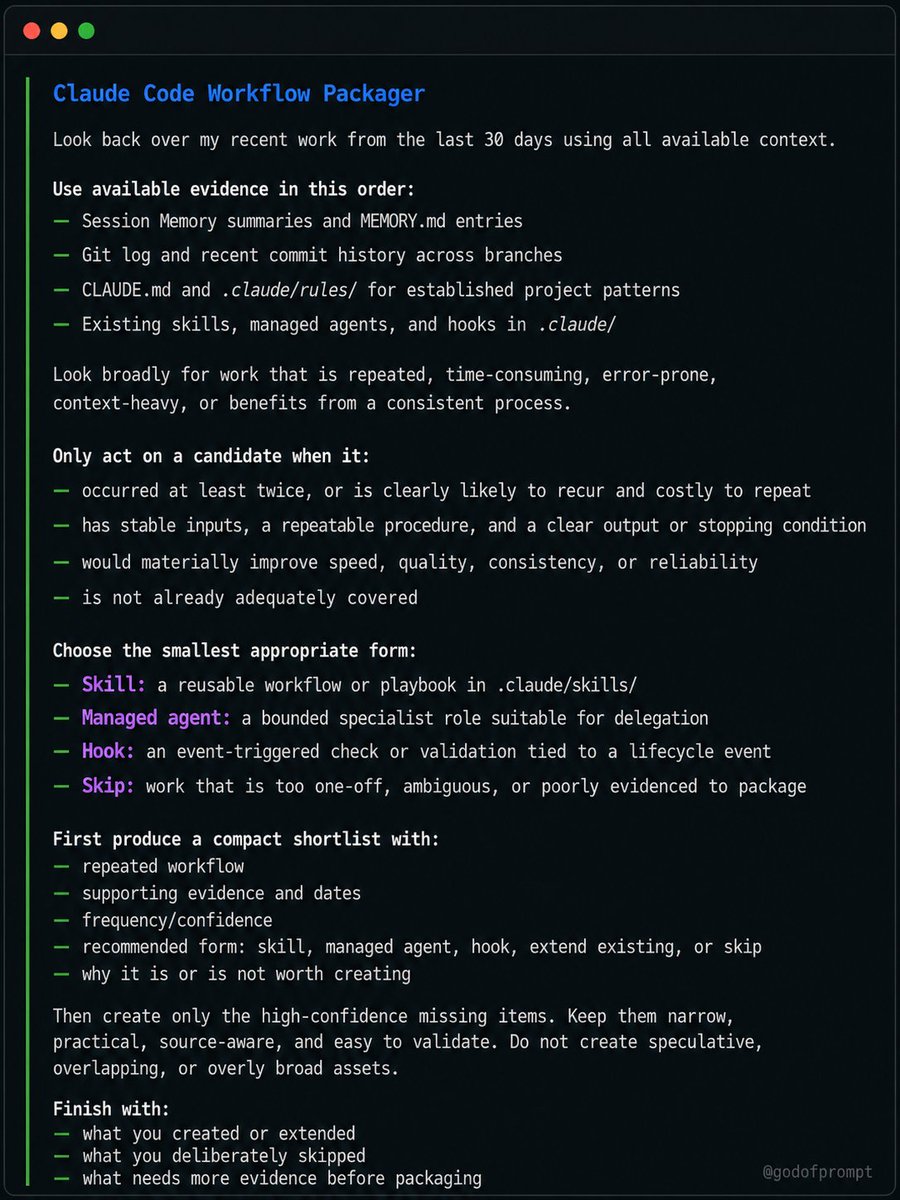
UPDATE: Came up with an even better version of this prompt after the feedback Ask Codex to look across your sessions, Memories, and Chronicle, identify patterns, reuse what already exists, and only create the smallest useful skill, subagent, or automation. "Look back over my recent work from the last 30 days, or all available history if shorter, and identify repeated manual workflows worth packaging. Use available evidence in this order: - Recent Codex sessions and task summaries. - Codex Memories and rollout summaries to find patterns repeated across sessions. - Chronicle, if enabled, to spot repeated work outside Codex. Use Chronicle for discovery only; confirm important details in the relevant source system when possible. - Existing skills, custom agents, and automations, so you reuse or extend what already exists instead of duplicating it. Look broadly for work that is repeated, time-consuming, error-prone, context-heavy, or benefits from a consistent process. Include workflows across coding, research, writing, planning, communication, operations, analysis, and personal administration. Only act on a candidate when it: - occurred at least twice, or is clearly likely to recur and costly to repeat; - has stable inputs, a repeatable procedure, and a clear output or stopping condition; - would materially improve speed, quality, consistency, or reliability; - is not already adequately covered. Choose the smallest appropriate form: - Skill: a reusable workflow or playbook. - Custom subagent: a bounded specialist role or investigation task suitable for delegation. - Automation: a scheduled or recurring check, report, reminder, or monitor. - Skip: work that is too one-off, ambiguous, sensitive, or poorly evidenced to package. First produce a compact shortlist with: - repeated workflow - supporting evidence and dates - frequency/confidence - recommended form: skill, subagent, automation, extend existing, or skip - why it is or is not worth creating Then create only the high-confidence missing items. Keep them narrow, practical, source-aware, and easy to validate. Do not create speculative, overlapping, or overly broad assets. Finish with: - what you created or extended - what you deliberately skipped - what needs more evidence before packaging"






🚨: Experts estimate that nearly 60% of AMAZON rainforest remains unexplored in detail, an expanse so vast and dense that even current technology fails to see clearly under its green canopy.



SOMEONE JUST KILLED THE REAL ESTATE INDUSTRY A guy scanned an entire house with his phone. Uploaded it. Now anyone on Earth can walk through it in a browser tab. No app. No VR. No agent. No appointment. Click → you’re inside. Every room. Every angle. Every shadow. Photoreal. The numbers are insane: - Agent fee on a $500k home: $15,000 - Cost to make this scan: ~$200 - Time to “tour” 50 houses: one evening - File size: smaller than a TikTok The science is wild too: It’s called 3D Gaussian Splatting instead of polygons (how games render), it uses millions of tiny glowing “splats” of color and depth. AI reconstructs reality from your photos. The result loads on a phone and looks like you’re THERE. The grift opportunity is even wilder: Freelancers are already charging $300–$800 per scan for realtors, Airbnbs, venues, car dealers, museums. One person + one phone + one weekend = a business. Open source. Built on PlayCanvas. Free GitHub: github.com/playcanvas