
Radnor Capital
7.4K posts

Radnor Capital
@RadnorCapital
Dad, Husband, Investor | Views are my own


Additional context on why we are all so interested in $VRT, and their clear upside now with thier Q4 2025 of $8.1B in orders. Inflection points everywhere in AI infra but shift from air to liquid cooling is a big one with only a few beneficiaries.


My Tech Sales Black Friday Guide 1. Macbook Air 15”, most performant laptop for the money. Long battery life for travel and enough compute to do any task. 2. Wired USB-C headphones. Easy, reliable connection to your computer or iphone. Don’t have to worry about charging, you won’t drop one on an airplane or on the train tracks and you aren’t frying your brain with nnEMF. 3. Some premium AI subscription. I personally don’t use ChatGPT Pro or any $200/mo plans though may be looking to upgrade. I pay for Gemini and OpenAI $20/mo plans and they’re perfect companions for my role. 4. All forms of magnesium. If you’ve followed me for a while you know this is non-negotiable. Protects your sleep, reduces stress, keeps your mind sharp and helps your operate at your best. Magnesium Taurate, Malate in the AM, Mg Chloride in your drinking water, Glycinate before bed. 5.. @theoutgoingco This is a miracle formula to take before a big meeting. Calm nerves, clear focus. 6. Back up cables and chargers for your travel bag. Don’t even have to think about grabbing anything last minute. @AnkerOfficial 7. @stratechery subscription. IMO the best bang for your buck to keep up on the business of tech and AI. Industry and tech knowledge is infinitely more valuable to having high-value customer conversations than memorizing discovery questions. 8. Chase Sapphire Reserve credit card. Besides the “coupon” benefits the travel perks and Sapphire Lounge access at a few major airports makes work travel suck a little bit less.


Gold loves rate cutting cycles and will continue to move higher. Lower opportunity cost, dollar weakness, safe-haven demand, etc. Gold also has a strong negative correlation to "real" rates (nominal interest rates - inflation rate) - when the Fed cuts, nominal interest rates fall, and those lower rates ultimately stimulate inflation, which leads to even lower (and sometimes negative) "real" rates. Gold has and will continue to discount this phenomenon. On a related note, I've never been a Fed critic (there are already too many and it's an impossible job) but if the Fed needs a September jobs report to get comfortable with a cut later this month, they are missing the bigger picture. Clear signs of employment pressure and disinflation should be empowering. Remember, we are just trying to get back to neutral... On the jobs front, when average weekly jobless claims start to approach ~300k, its already too late. Moreover, "shelter" accounts for ~35% of the CPI index and that component was up +3.6% in August vs. the overall reading of +2.9%. Shelter is considered a lagging indicator in CPI because the changes in shelter costs, particularly rents, are incorporated into the index gradually rather than immediately. For context, the S&P Cotality Case-Shiller U.S. National Home Price Index (more accurate and direct measure) recently came in at +1.7%. Adam Crisafulli calculated the following: if you substitute the +1.7% home price number for the +3.6% shelter number, CPI would be only +1.4%... The Fed needs to cut, and gold loves that. Three clear counterpoints to the above around interest rate cuts: 1) we haven't seen the full impact of tariffs on prices - however, this is a one time change in the level of prices vs. recurrent inflation. Regardless, needs to be monitored. 2) consumer spending is resilient and business activity remains robust, leading to strong corporate earnings. S&P 500 earnings will grow >10% this year. 3) risk appetite appears elevated, with equity valuations around record highs (P/E >20x) and credit spreads close to record tights (HY OAS <300bps). AI euphoria (some of which is justified) is also supporting this confidence among market participants. A counterpoint to gold loving rate cuts: for heavily indebted economies, lower rates lead to lower interest expense, which leads to lower deficits. I value gold at 1/T, where T is Trust in the financial system. Lower deficits, all else equal, increase Trust, leading to a lower price of gold. However, the US is so indebted with so much "mandatory" spending, that even with less interest expense, we will run deficits as far as the eye can see.


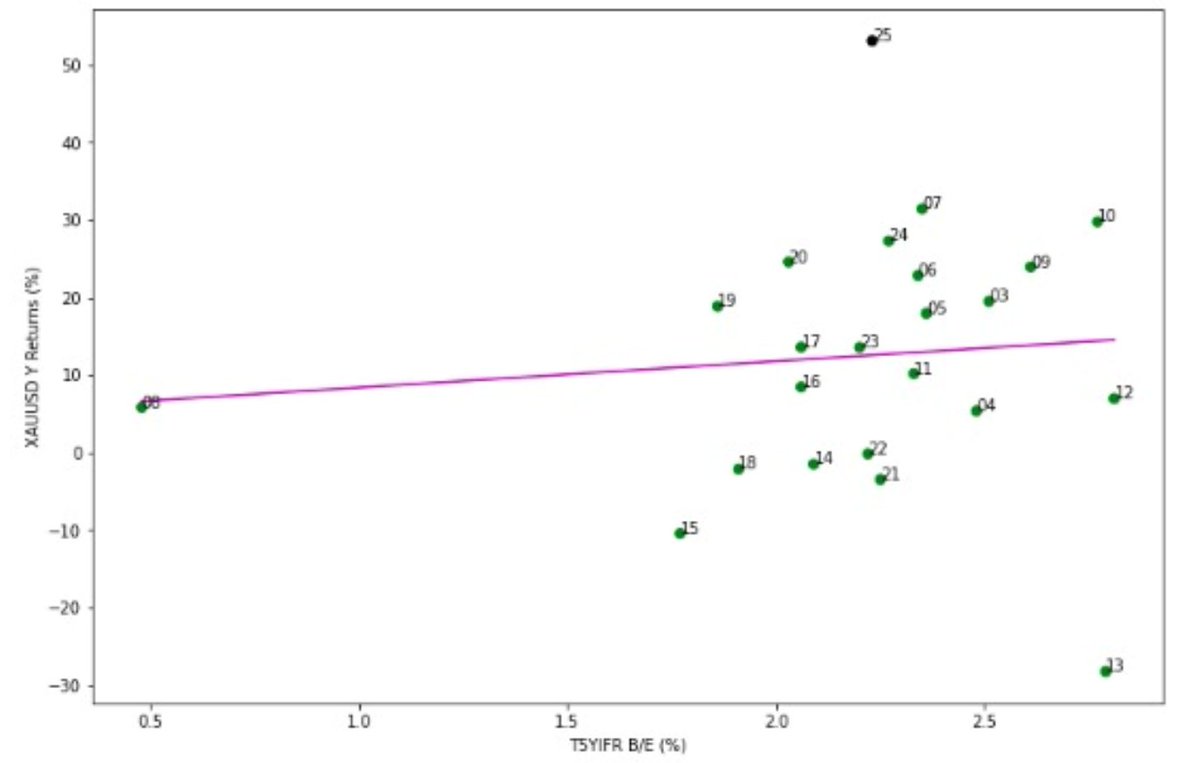








I continue to see bitcoin and gold as important elements of an investment portfolio. Both protect against the debasement of fiat currencies and fiscal irresponsibility. Those of us that get paid in USD often forget the importance of a "store of value." Ask anyone in countries like Argentina, Sudan, Zimbabwe, Turkey, etc. I continue to own both, with bitcoin being the larger allocation given recent price action. I have also added to my bitcoin position since the election. Bitcoin feels more levered to a risk-on environment and has more torque around the adoption thesis, while gold is more levered to fear, with thousands of years of back tested history. Gold quietly around all-time highs is telling us something about the direction of real interest rates. More importantly, its telling us there is growing distrust in fiat currencies. The best way to track the value / depreciation of the US Dollar is through the dollar price of gold, not a basket of other currencies. Let’s also not forget that owning high quality stocks (the S&P 500) can protect against dollar debasement (priced in USD) and inflation (pricing power) and are far easier to value, given the cash flow characteristics. This is the bulk of my personal portfolio.


Gold loves rate cutting cycles and will continue to move higher. Lower opportunity cost, dollar weakness, safe-haven demand, etc. Gold also has a strong negative correlation to "real" rates (nominal interest rates - inflation rate) - when the Fed cuts, nominal interest rates fall, and those lower rates ultimately stimulate inflation, which leads to even lower (and sometimes negative) "real" rates. Gold has and will continue to discount this phenomenon. On a related note, I've never been a Fed critic (there are already too many and it's an impossible job) but if the Fed needs a September jobs report to get comfortable with a cut later this month, they are missing the bigger picture. Clear signs of employment pressure and disinflation should be empowering. Remember, we are just trying to get back to neutral... On the jobs front, when average weekly jobless claims start to approach ~300k, its already too late. Moreover, "shelter" accounts for ~35% of the CPI index and that component was up +3.6% in August vs. the overall reading of +2.9%. Shelter is considered a lagging indicator in CPI because the changes in shelter costs, particularly rents, are incorporated into the index gradually rather than immediately. For context, the S&P Cotality Case-Shiller U.S. National Home Price Index (more accurate and direct measure) recently came in at +1.7%. Adam Crisafulli calculated the following: if you substitute the +1.7% home price number for the +3.6% shelter number, CPI would be only +1.4%... The Fed needs to cut, and gold loves that. Three clear counterpoints to the above around interest rate cuts: 1) we haven't seen the full impact of tariffs on prices - however, this is a one time change in the level of prices vs. recurrent inflation. Regardless, needs to be monitored. 2) consumer spending is resilient and business activity remains robust, leading to strong corporate earnings. S&P 500 earnings will grow >10% this year. 3) risk appetite appears elevated, with equity valuations around record highs (P/E >20x) and credit spreads close to record tights (HY OAS <300bps). AI euphoria (some of which is justified) is also supporting this confidence among market participants. A counterpoint to gold loving rate cuts: for heavily indebted economies, lower rates lead to lower interest expense, which leads to lower deficits. I value gold at 1/T, where T is Trust in the financial system. Lower deficits, all else equal, increase Trust, leading to a lower price of gold. However, the US is so indebted with so much "mandatory" spending, that even with less interest expense, we will run deficits as far as the eye can see.

Steppe Cement trades at 0.92x TBV. Market cap is $52m vs TBV of $57m. The market is basically saying this business won’t earn money again. EV/5Y FCF ratio = 5 P/5Y FCF ratio = 5 FCF has been positive 100% of the time in the last 10 years. The business sells cement in Kazakhstan. Earnings swing with construction demand, energy costs, and local pricing power. Shareholder returns have been patchy with 12% 5-yr yield, mostly dividends, with occasional buybacks. You don’t often get asset-heavy industrials at a discount when they’re still producing and paying out. If cement demand recovers, it could be 30%-50% upside. (Concrete is the second most used material on earth apparently). I like a little more upside personally, so I am passing. Sharing in case anyone here likes it. Let me know what you think

