Raffaele Mazzolari

482 posts

Raffaele Mazzolari banner
Raffaele Mazzolari

Raffaele Mazzolari

@RaffaeleM28

Postdoc at the Medical University of Innsbruck. Exercise physiologist with a passion for applied statistics and endurance performance research.

Katılım Eylül 2016
395 Takip Edilen263 Takipçiler
Raffaele Mazzolari
Raffaele Mazzolari@RaffaeleM28·
In about 4 weeks, our research group will be opening a new funded PhD position in sports medicine/sport science. Interested candidates are welcome to send pre-enquiries to: Anne.Hecksteden@uibk.ac.at Full details and the official application link will be announced soon.
English
1
4
7
556
Raffaele Mazzolari
Raffaele Mazzolari@RaffaeleM28·
Our research group is offering a fully funded, four-year postdoctoral position in sports medicine/sport science. German language skills are not required. Interested candidates are invited to send pre-application inquiries to: anne.hecksteden@uibk.ac.at lfuonline.uibk.ac.at/public/karrier…
English
0
0
1
212
Raffaele Mazzolari
Raffaele Mazzolari@RaffaeleM28·
@DerekGriffin86 This is perhaps a suitable question for a non-inferiority design, provided there is solid evidence for the reference strength training intervention.
English
0
0
1
133
Derek Griffin
Derek Griffin@DerekGriffin86·
We know that strength training is associated with improved running economy. In this study, there was a 4% improvement with just doing heavy ISO calf raises. This is similar to interventions involving multiple exercises. Stuck for time? Do calf raises! royalsocietypublishing.org/doi/full/10.10…
English
3
5
54
3.1K
Raffaele Mazzolari
Raffaele Mazzolari@RaffaeleM28·
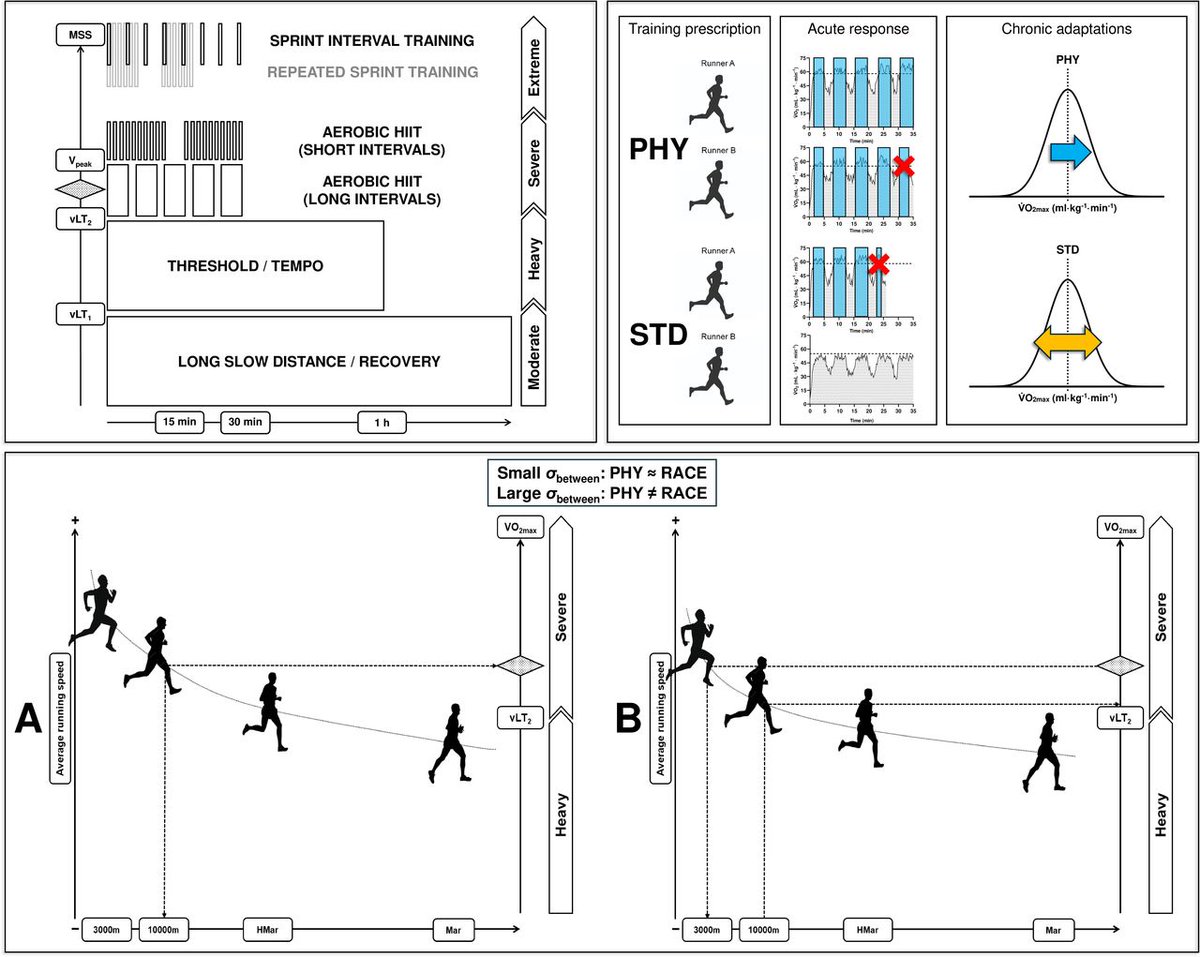
@John__McT @brady_h 1:2 The final article has yet to be published. The physiological approach was based on 50% of the time to exhaustion at ∆50 (the speed halfway between the second lactate threshold and peak treadmill speed)
English
3
0
3
145
Brady Holmer
Brady Holmer@Brady_H·
Is there a best way to prescribe interval training? In his PhD work, Raffaele Mazzolari (@RaffaeleM28) compared three distinct ways of prescribing high-intensity interval training for distance runners: one based on physiological thresholds, one based on race pace, and one standardized ("cookie-cutter") approach. Physiological: Athletes ran at the midpoint between the second lactate threshold (vLT₂) and their peak treadmill speed (Vpeak) with the interval duration tailored to 50% of their maximum sustainable time, and a 2:1 work-to-rest ratio. Race: Runners completed 1000-meter intervals at 110% of their 10k race pace with a 300m jog recovery (about 2 minutes). Standardized: All runners followed the same fixed HIIT protocol based on group averages from the Physiological group—no individualization was used. All groups were otherwise matched for HIIT volume and structure. • VO₂ max improved most with Physiological training—increasing the runner’s aerobic capacity by 5.0 ml/kg/min compared to RACE and 3.5 ml/kg/min compared to Standard. • RACE led to the biggest performance gain. Despite its inferior VO₂ max improvements, the RACE group improved their 10k speed by 0.4 km/h more than Physiological training. • Standard training underperformed on both fronts. Group-based prescriptions were the least effective in improving either VO₂ max or race pace. DOI: 10.1136/bjsports-2025-110186
Brady Holmer tweet media
English
9
39
224
25.7K
Raffaele Mazzolari
Raffaele Mazzolari@RaffaeleM28·
@John__McT @brady_h 2:2 which resulted in an average interval distance of approximately 1 km, with moderate inter-individual variability (around 300 m). If I recall correctly, the average duration was slightly less than 4 minutes.
English
0
0
2
45
Shabnam Parveen
Shabnam Parveen@shabnam_774·
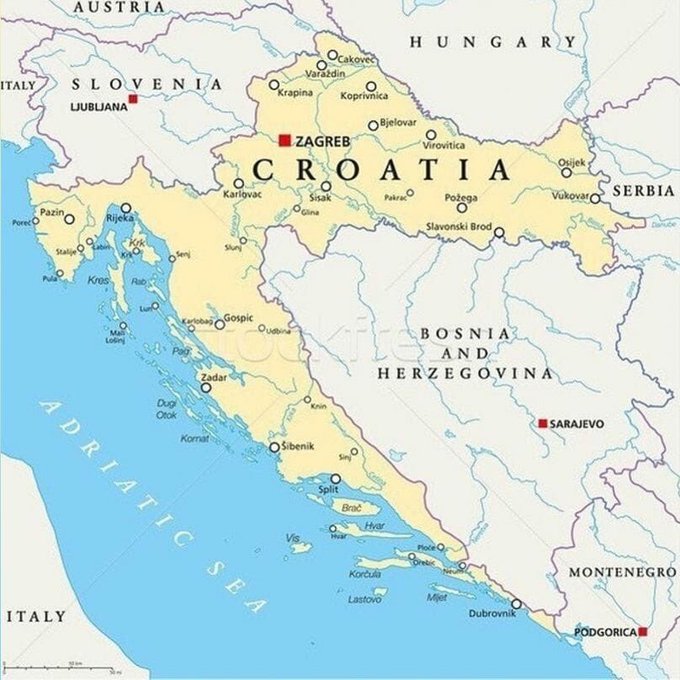
The 15 hilarious and Coolest maps you've probably never seen before: 1. Bosnians: I wanna swim Croatia : No
Shabnam Parveen tweet media
English
818
7.4K
137.5K
34.1M