
Sabitlenmiş Tweet
Steve Anderson
9.2K posts

Steve Anderson
@Rashomon2
Truly disruptive transport technology. Past: VP of Vehicle Engineering, Bond Mobility; Buell; Erik Buell Racing; Cycle World; Williams International; M.I.T.
Around and about Katılım Mayıs 2009
1.3K Takip Edilen1K Takipçiler
I can't look at a picture like this set in 1912 and not wonder what happened to these kids. A little research shows that all four children—Walther (Walter), Hans (Hanns), Lotte (Charlotte), and Edeltraud (Edeltrude)—survived both World War I and World War II. They lived long lives well into the postwar decades in Austria.
English

Two beautiful studies of light & shadow by the Austrian–German photographer Heinrich Kühn, who took these amazing Autochrome shots of his children 114 years ago. I find them incredibly evocative - children whispering in the shadows - what deeds are they plotting? What mysteries are they solving? So many stories to be conjured! The children's names were Walther, Hans and Lotte in photo 1, joined by their sister Edeltraud in photo 2. I have cleaned-up & enhanced these images which were taken in colour in 1912 and are not colourised. 😍


English
@MorlockP Also, within 100 years, various fusion drives (of either pulsed or more continuous design) will be possible. That would make possible a larger probe, if perhaps a slower one. We personally may be stuck in this system, but humanity will not be.
English

5/
I expect that the first humans around Alpha C will be raised from embryos by robots.
Small lightsail probes race there in < 50 year total trip time, von Neumann machines build colonies, then build embryos from digital records.
x.com/albo_alt/statu…
alboalt@albo_alt
@MorlockP You have the generation ship issue there--future generations may forget what they're doing and where they are going
English
this is so wrong
with the technology of just 100 or so years from now we can use giant lasers to accelerate small microsail ships to 0.25 c, drop a mirror, use the same laser to decelerate, arrive in < 50 years, use von neumann machines controlled by AIs to build colonies
Fred Krueger@dotkrueger
We're not going to travel beyond the solar system, according to Leonard Susskind. And neither are aliens, coming to visit us. We may not be alone, but we are stuck here for, essentially forever. 1. The nearest star is 4.24 light years away. The fastest spacecraft ever built would require 6,600 years to get there. 2. Surely we can just build faster spacecraft. The problem is to get to anywhere close to the speed of light, we need exponentially more energy. 3. Chemical rockets will just not work. Even fusion rockets won't work. Even 10% of the speed of light is not achievable. The Tsiolkovsky Rocket Equation prevents it. 4. Interstellar dust becomes hand grenades when traveling anywhere close to the speed of light. Ships break. 5. Space radiation will kill us over the time need to travel interstellar distances. Impossible to protect without massive shields, which require massive energy to accelerate and de-accelerate.
English
Steve Anderson retweetledi

An unusually visceral example of value destruction through incremental compliance costs.
(I have no reason to doubt this representation, from someone involved in LA commercial real estate, that this is factually a consideration in underwriting commercial tenants in the same.)
Moses Kagan@moseskagan
The problem is that the rents available are insufficient to compensate the owners for the incremental capex, opex and hassle of adding a tenant To give you just one example: ~Every owner of retail real estate in the state has been targeted by one or more ADA access lawsuits. Rather than deal w this hassle for $1000 / month or whatever, you might just decide to keep the space locked up.
English
Student loans should not be non-dischargeable, should be related to the financial benefit of the degree they pay for, and have at least half their value an obligation of the institution in case of failure to pay. That would eliminate many perverse incentives.
Daniel Friedman@DanFriedman81
A lot of people are dunking on this, and it’s true, she should have paid the $60 per month for 20 years and let the forgiveness kick in. But what they’re missing is that she was loaned $65k for a terminal master’s in historic preservation. That should never have happened. Tuition has skyrocketed because the ability of students to pay it has completely decoupled from how much money they or their families can afford. Colleges charge infinity dollars because students have access to infinity student loans. In many cases students hoping a credential will lead to a better life get duped into indenturing themselves permanently to get worthless terminal master’s degrees. If the loans didn’t exist, then the master’s programs wouldn’t exist, and if the master’s programs didn’t exist then employers wouldn’t be looking for job applicants with master’s degrees which don’t even connote any real skills. Burn this whole rotten system down.
English
Steve Anderson retweetledi

You have to respect California’s innovations in strangling the middle class

Reihan Salam@reihan
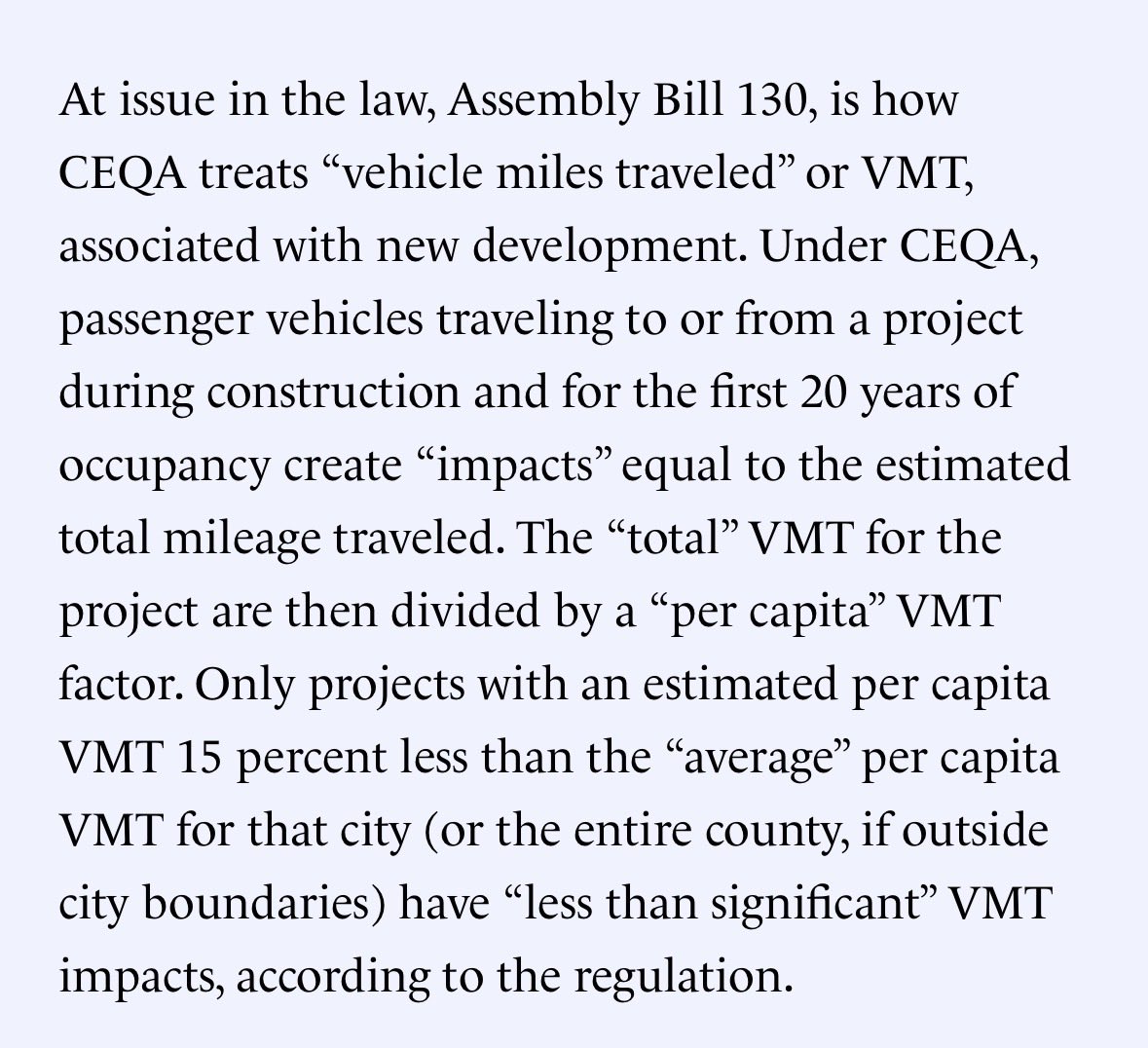
I’m a huge fan of Jennifer Hernandez, and her latest for @cityjournal exposes what I like to call immaculate-conception progressivism. Hernandez zeroes in on AB 130, a law that has attracted very little attention but that will have huge consequences. In short, the law creates a vehicle miles traveled (VMT) mitigation fee — potentially $1,350/month added to the cost of new homes outside transit corridors, falling hardest on exactly the market-rate suburban projects most likely to be affordable to ordinary families. Just to be clear, a mitigation fee this high is designed to kill affordable sprawl. California progressives understand that their state faces an acute housing shortage. That is good. But they seem to believe that California can meet housing demand while building only transit-adjacent urban infill that meets stringent affordability requirements — housing that is immaculately green, equitable, etc. As Hernandez observes, however, high-density urban infill is just about the most expensive housing you can build. Land costs, regulatory complexity, and construction costs in California's transit corridors routinely push rents above $3,000/month — before any new fees. I don't doubt that some number of working- and middle-class California families would love to live in these apartments, but they'll have a hard time affording them without large subsidies and, importantly, they'll have an even harder time commuting to service jobs or jobs in logistics, warehousing, light manufacturing, etc., outside of urban cores. The housing shortage is a mass-market problem. It requires mass-market solutions: homes that pencil out at prices ordinary families can afford, in the suburban and exurban areas where blue-collar jobs and land are (relatively) abundant. Unless I’m missing something, this is just unbelievably perverse. city-journal.org/article/califo…
English
@reoreiko I remember these: Ducati GTL 500 I believe, super over-square parallel Twin. If it had had a 270- degree crank, it might have set a trend. As it was, just another failed Ducati project from when the company was still government-owned and struggling.
English


Steve Anderson retweetledi

At 1.375 kg, Hyction™ sheds 450g per disc versus steel. Cutting nearly 1kg from the front wheel slashes inertia by 40%. For the rider, this translates to lightning-fast direction changes, surgical reactivity, and a level of steering precision that was previously unreachable.

English
Want! Particularly if it had something like Orbital direct injection and ran far more crisply and had better part-throttle behavior than an RG500 . . .
Stuart Shipman@shipman_stuart
What do you think ?
English
I have visited Japan perhaps a dozen times, and have traveled to locations not frequented by tourists via motorcycle with a local guide, met Japanese people that have become friends, and had wonderful food. As I've said on X before, every time I land in Japan, my body relaxes, I let out a breath, and I think: "civilization!"
English

No, this is almost a zero-downsides gain. Lighter-steered mass and inertia (everything that pivots about the steering axis) is almost all upside. Similarly less wheel gyroscopic effect is generally better — even Harley figured that out after they got serious about motorcycle dynamics simulations! Less unsprung mass makes your suspension more effective — if anything, you might need a little less high-speed compression and rebound damping. And on my 698 Mono, the wheel/brake package might save 6-7 kilos or so, maybe more— hard to find on a 150 kg motorcycle that already comes with a lithium battery. But pricey on a $/kg basis.
English

@Rashomon2 Ooooo lighter un-spring weight. But loss of some dampening????
English
I really need one of these for the front of my Ducati Hypermotard 698. That, and a set of carbon-fiber wheels, hmmm . . .
Brembo@BremboBrakes
Born from "Hyper" and "Action," Hyction™ features a carbon matrix reinforced with fibers and integrated with silicon carbide. Derived from hypercar CCM-R tech, this material offers thermal resistance and structural stability for consistent braking under extreme stress.
English
This brake will make a big difference in machine performance. Less inertia feels like power steering, and bump response will be noticeably better. We found this at EBR where our ZTL system (about 1.5kg lighter than brembo dual disk) was much preferred by our WSBK riders for handling — they just didn’t trust its heat capability.
Brembo@BremboBrakes
Brembo introduces Hyction™, the revolutionary carbon-ceramic disc debuting on the Ducati Superleggera V4 Centenario. This is the single biggest innovation in motorcycle braking since the legendary Brembo monobloc caliper changed the game back in 2006.
English
Unintended consequences . . . Or perhaps intended. Excess tenant rights legislation almost ensures social housing will be required.
Real Estate Lawyer@SinaiLawFirm
Since 1/1/25 about one-third of my evictions were for single family home properties Half of those properties were sold after the eviction concluded. Almost all of the clients swore to never lease to another tenant again
English
Steve Anderson retweetledi

In space, no one can hear NIMBYs scream
robyn@_robyn_smith
Why does it cost less to build a base on the moon than high speed rail from sf to la
English


How difficult is it to read the text in red?
(A) Can read at a glance, no effort
(B) Can read if I take a few seconds
(C) Can read, but very difficult
(D) Can't read at all

English
@matoxley @boxcardavid This thing also has quite the polar moment in roll. I expect Marquez can snap into a corner more quickly on his Ducati.
English
@matoxley @boxcardavid Doesn't appear to be. RAI was founded by one of the founders of Boston Dynamics. It has facilities in Cambridge, Massachusetts, and Zurich, both places you can find top schools and robotics researchers.
English
Someone else has mastered two-wheel dynamics . . . @boxcardavid
RAI Institute@rai_inst
It was great to see our name amongst the other “AI Native” companies during @Nvidia’s #GTC keynote. NVIDIA Isaac™ Lab helps us train reinforcement learning policies that enable the UMV to drive, jump, flip, and hop like a pro!
English