Mario Nawfal@MarioNawfal
🇺🇸🇮🇷 TRUMP’S INFRASTRUCTURE WAR AND THE LAW HE’S DARING TO BREAK
So here we are, watching a literal countdown to 8pm, with Trump threatening to wipe out Iran’s bridges and energy system if it doesn’t fall into line on schedule.
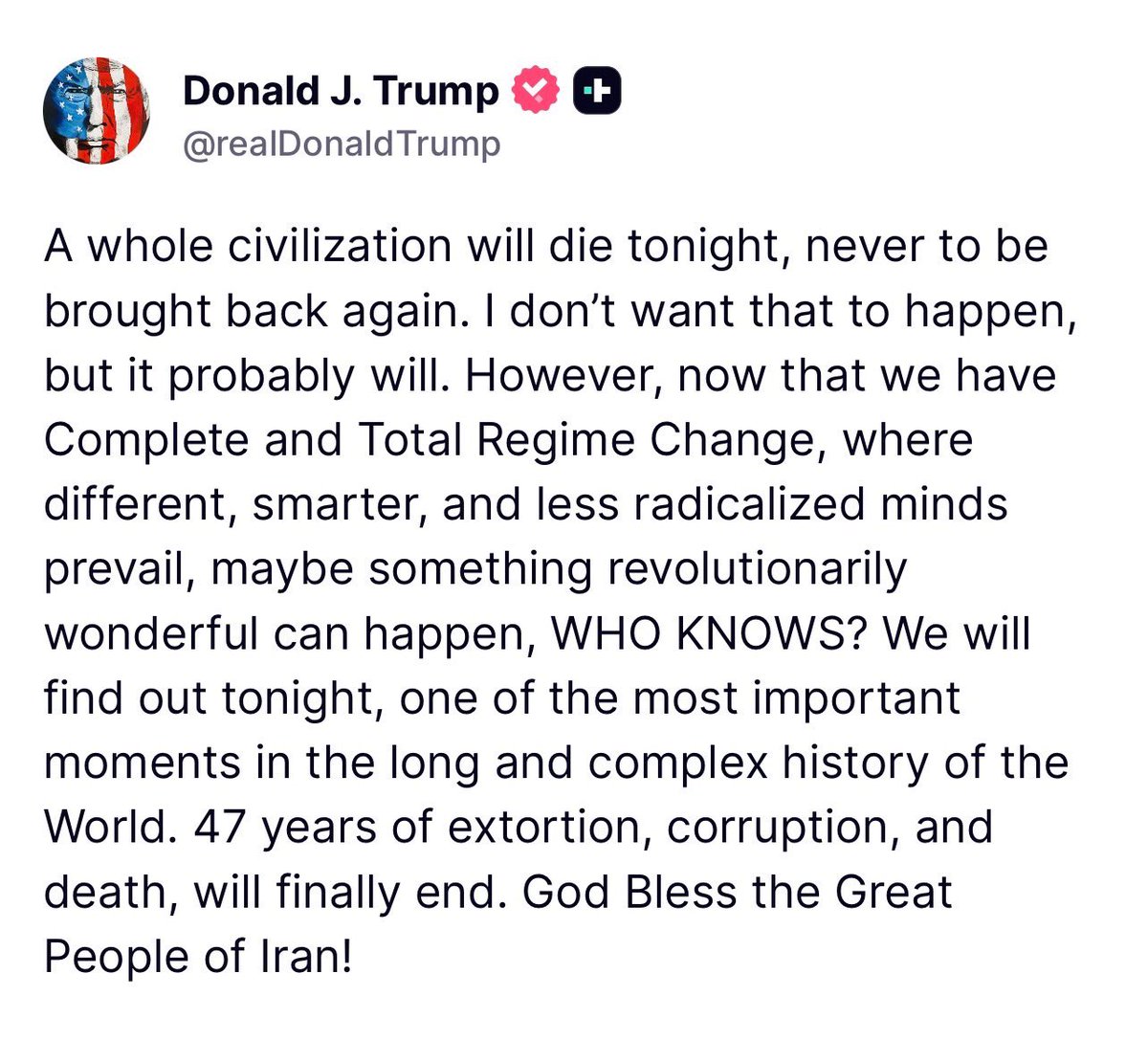
Trump even went as far as to threaten: “A whole civilisation will die tonight.”
That’s less a policy statement, more something you’d expect from a Bond villain, except this one comes with carrier strike groups and legal exposure.
And that’s really the point. This isn’t just escalation theatre, it’s a direct collision with the rules that are supposed to govern how wars are fought, and whether they can be fought at all.
Because the targets being floated aren’t military formations or missile sites. They’re bridges, power plants, transmission networks, the connective tissue of civilian life. The stuff that keeps hospitals running, water clean, food refrigerated, and cities functioning.
International humanitarian law is not subtle about this. Civilian infrastructure is protected unless it makes an effective and concrete contribution to military action, and even then, any strike has to pass the tests of distinction and proportionality. In plain English: you don’t get to shut off a country’s electricity because it might inconvenience its government.
And that’s where this threat starts to look less like hard-nosed strategy and more like collective punishment. Because when you deliberately target an energy grid, you’re not just hitting wires and transformers, you’re knowingly cascading harm across an entire civilian population.
What makes the situation even more precarious is that we’re not talking about a clean slate. There’s already been a steady drift toward infrastructure targeting. Recent strikes in Iran have hit transport links and bridges, including the Karaj B1 bridge, with civilian casualties reported. The line between “military objective” and “everything that keeps a society running” is already being blurred in practice, not just rhetoric.
That matters, because the legal justification gets thinner every time that line is crossed. “Dual-use” infrastructure, electricity, roads, ports, has become the favorite loophole of modern warfare.
Yes, power grids support military operations. They also support literally everything else. The law doesn’t ignore that, it centers it. If the foreseeable civilian harm is massive and systemic, you don’t get to wave it away as collateral damage. You chose the target knowing exactly what it sustains.
Which is why legal experts and international observers are already using the phrase “war crime” without much hesitation. Not as a rhetorical flourish, but as a straightforward reading of the rules.
And even that isn’t the whole legal problem. Because before you get to how a war is fought, you have to ask whether it’s lawful to fight it at all.
Under the UN Charter, the use of force is tightly constrained, self-defense against an imminent attack or authorization from the Security Council. An ultimatum to “comply by 8pm or we dismantle your infrastructure” sits uncomfortably outside both categories.
Put those two layers together and the picture gets stark: a potential violation of the rules governing the use of force, stacked on top of a potential violation of the rules governing conduct in war. It’s not just pushing the boundaries of international law, it’s stress-testing whether those boundaries still exist.
And then there’s the strategic irony. Infrastructure warfare doesn’t stay contained. Iran has already signaled it would respond in kind, targeting energy systems across the region. That’s the logic of escalation once these norms erode: if one side can switch off cities, so can the other.
At that point, the debate over legality becomes almost secondary to the reality it produces. Power grids become targets everywhere. Civilian systems become leverage everywhere. The distinction between battlefield and society collapses entirely.
Which is why this moment matters beyond the immediate crisis. If the U.S openly embraces the idea that civilian infrastructure is fair game, it doesn’t just bend the rules, it rewrites them. And not in a way that can be selectively applied.
Because once you normalize turning off someone else’s country, you’ve implicitly signed off on the possibility that someone else will try to turn off yours.
When you take into account that Chinese-linked hackers have already breached U.S critical infrastructure, including water treatment systems, as part of a broader strategy to pre-position for a future conflict, that possibility becomes all the more real.
So when the clock hits 8pm, the real question isn’t just whether the strikes happen. It’s whether the last thin line between warfighting and societal destruction gets rubbed out completely, and whether anyone can still pretend, after that, that the law of war is anything more than a suggestion.