Sweetshot

920 posts

Sweetshot

Sweetshot

@RealSweetshot

Katılım Nisan 2017
389 Takip Edilen39 Takipçiler
Sweetshot retweetledi
Niall Ferguson
Niall Ferguson@nfergus·
Let me walk you through the events of the war so far: 1. The United States and Israel tried regime change; it didn’t work. Or rather, they got regime change—Iran became an Islamic Revolutionary Guard Corps–led military dictatorship. That was not an improvement. 2. The U.S. won an overwhelming military victory with air and naval power and scarcely a boot on the ground. But it destroyed less of Iran’s missile- and drone-launching capabilities than at first appeared. 3. Then there was a hostage crisis. Iran took both the Gulfies and the Strait of Hormuz hostage. The result was a massive economic shock for the world that required a rapid resolution. 4. The choice was between 1) military escalation (boots on the ground or strikes on Iranian infrastructure), and 2) a diplomatic deal. Trump chose 2. 5. In Islamabad, the U.S proposed big economic concessions in return for some kind of change in the status of Iran’s enriched uranium stockpile, as well as the reopening of the strait. Contrary to the president’s social media feed, the Iranians did not accept. 6. In any case, the devil of any deal will be in the details, not the Truth headline. (When the small print finally comes out, every former Obama and Biden official will be ready to tell The New York Times that it’s worse than the 2015 Joint Comprehensive Plan of Action.) 7. Meanwhile, the Iranians have survived regime change and discovered that closing the strait is just as powerful a lever in economic warfare as they had always hoped. It’s not, despite the Russian quip, an “economic nuke,” because unlike a nuclear weapon you can use it. 8. Where we go from here is fairly predictable. I would be surprised if Trump now deploys ground forces. There will be more negotiation, so Islamabad, here we come. There may have to be more bombing, if the Iranians dust down the North Vietnamese playbook of stringing the U.S. negotiators along. And the final compromise will take longer to be agreed upon than Mr. Market currently believes. The consensus in prediction markets is this will be over by the end of May, but remember: It took Henry Kissinger more than four months to get the 1973–1974 oil embargo lifted.
English
591
820
4.2K
1.6M
Sweetshot retweetledi
Ariel Hernandez
Ariel Hernandez@RealSimpleAriel·
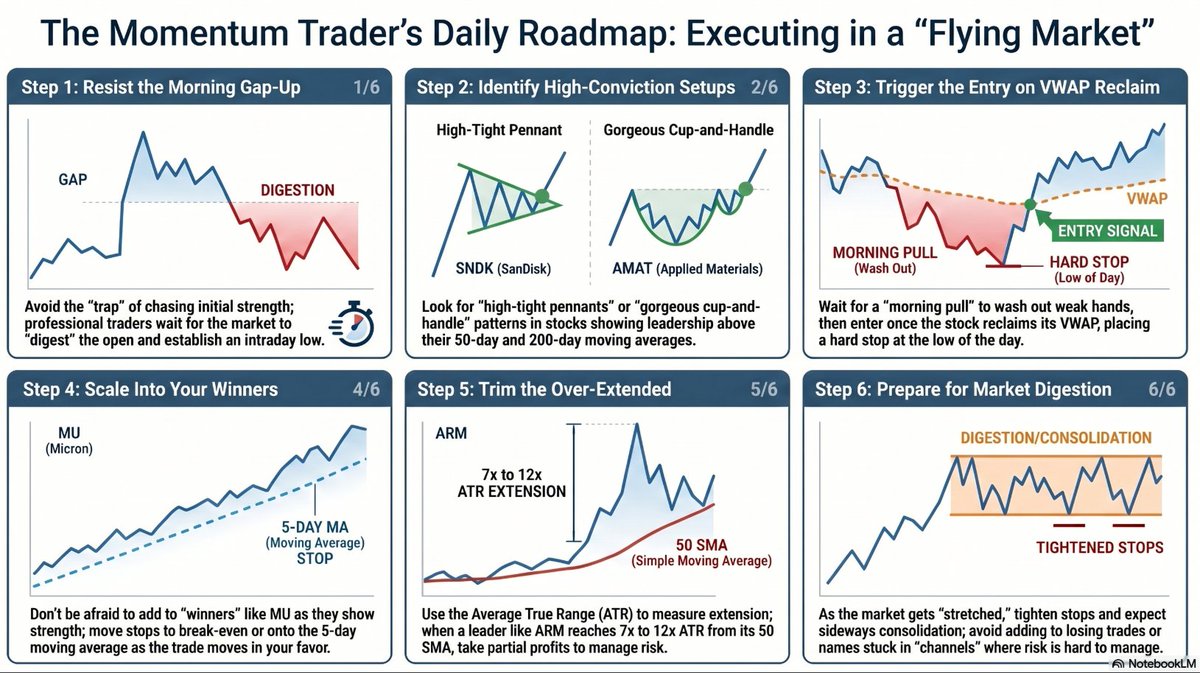
Really grateful for step 5. Trimming into extensions!!
Ariel Hernandez tweet media
English
20
102
766
31.5K
Sweetshot retweetledi
Adam Khoo
Adam Khoo@adamkhootrader·
ServiceNow ($NOW) has dropped over 60% from its all time highs (and other SaaS stocks have also been hard hit) over fears of SaaSpocalypse- thesis that AI agents like Claude Cowork are disrupting their business model NOW’s earrings report yesterday actually refuted these fears. The "SaaSpocalypse" theory suggests that AI agents (like Claude) will make SaaS platforms obsolete by automating workflows that used to require many human "seats." However, ServiceNow’s data showed the opposite: 1) AI Monetization is Exploding: Their AI product, Now Assist, saw customers spending over $1 million in annual contract value (ACV) grow by over 130% year-over-year. 2) Strong Top-Line Growth: Subscription revenue grew 22% (19% in constant currency), beating guidance. This suggests that instead of replacing ServiceNow, customers are paying more to add ServiceNow’s own AI agents into their workflows. 

3) RPO Growth: Remaining Performance Obligations (the backlog of contracted work) surged 25% to $27.7 billion, showing that enterprise commitment to the platform is actually accelerating, not shrinking. 4) In addition, NOW actually raised its 2026 AI revenue guidance from $1 billion to $1.5 billion. That is tangible evidence that they are successfully monetizing agents, not being replaced by them. So, why did the stock sell off over 12% after hours? 1) Net Margin Drop: The primary reason for the 12%+ drop was a margin drop caused by ServiceNow's recent aggressive spending spree. The company has spent over $11 billion recently on acquisitions like Armis ($7.7B), Moveworks ($2.9B), and Veza (~$1B). These acquisitions increase short term costs and lower short term profits but their strengthen the company’s moat over the long run. they are a land grab for the "Security + AI" layer of the enterprise. By the time Claude agents are widely deployed, ServiceNow wants to be the platform that governs and secures them. 2) Gross Margin Compression: Management lowered the full-year subscription gross margin outlook to 81.5% (analysts expected 82.1%). 

3) GAAP EPS Miss: While the company beat on non-GAAP "adjusted" earnings, it significantly missed on GAAP EPS ($0.38 vs. $0.89 expected) due to the costs associated with integrating these massive deals. 4) Macro/Geopolitics: CEO Bill McDermott noted a 75 basis point headwind caused by delayed closings of large on-premise deals in the Middle East due to ongoing regional conflict. NOW is suffering from a "success tax." They are spending heavily to dominate the AI agent era, and while that is working for their revenue, it is temporarily hurting their profit margins. The 12% drop is a reaction to how they are paying for growth, not a sign that their business model is being destroyed by Anthropic or OpenAI. As an investor who is in for the long run, this temporary drop does not concern me at all. In fact, I am assured that their economic moat continues to grow and their business model continues to be resilient .
English
58
72
729
107.4K
Sweetshot retweetledi
Nitin R
Nitin R@finallynitin·
🚨Presenting the "Persistency with moving averages" indicator for TradingView I've been using this indicator since 2024. Decided to make it free for everyone! Purpose: Stock selection (by acting as a proxy for the nature/character of the stock) Level: Intermediate (beginner traders can skip this indicator) Basic concepts This indicator is inspired by the concept of Persistency introduced by @PradeepBonde. Bonde emphasizes that it's not just about knowing a trend's direction, but also about understanding how resilient that trend is over time. Stocks that consistently move in the direction of the trend have better odds of continuing that trend. By identifying such stocks, traders can improve their chances of catching both more and bigger winners. Watch Stockbee's video for the original concept: youtu.be/mWE9J2Nta6g Bonde's original concept can be refined further by tracking how long a price has stayed in a certain trend direction relative to a key moving average. Instead of solely counting the instances where the close is higher than the previous close, this script tracks how many bars (periods) the price has stayed above or below certain moving averages. Moving averages act as dynamic support and resistance levels, providing a more nuanced view of price behavior. Key Features ⦿ The heart of the indicator is the persistency count, which tracks for how many consecutive candles the price has stayed above or below a moving average. By using the counts to find stocks that have consistently moved in one direction, we can use this indicator for identifying Persistent trends. ⦿ Max Persistency is the historical metric that records the longest consecutive streak the price has spent on one side of an MA within a specific lookback period. This tells us the past nature/character of the stock i.e. whether the stock has respected a particular moving average in the past or not. ⦿ Decisive Exit: When enabled, the indicator starts a pending exit if the price closes below a moving average. A decisive exit occurs if the price breaches the low of the pending exit day. Use Cases ⦿ Identifying stocks in persistent trends ⦿ Timing entries/exits via price/MA crossovers ⦿ Assessing momentum across multiple timeframes using MAs of different lengths
YouTube video
YouTube
Nitin R tweet media
English
71
160
1K
90.3K
Sweetshot retweetledi
Barchart
Barchart@Barchart·
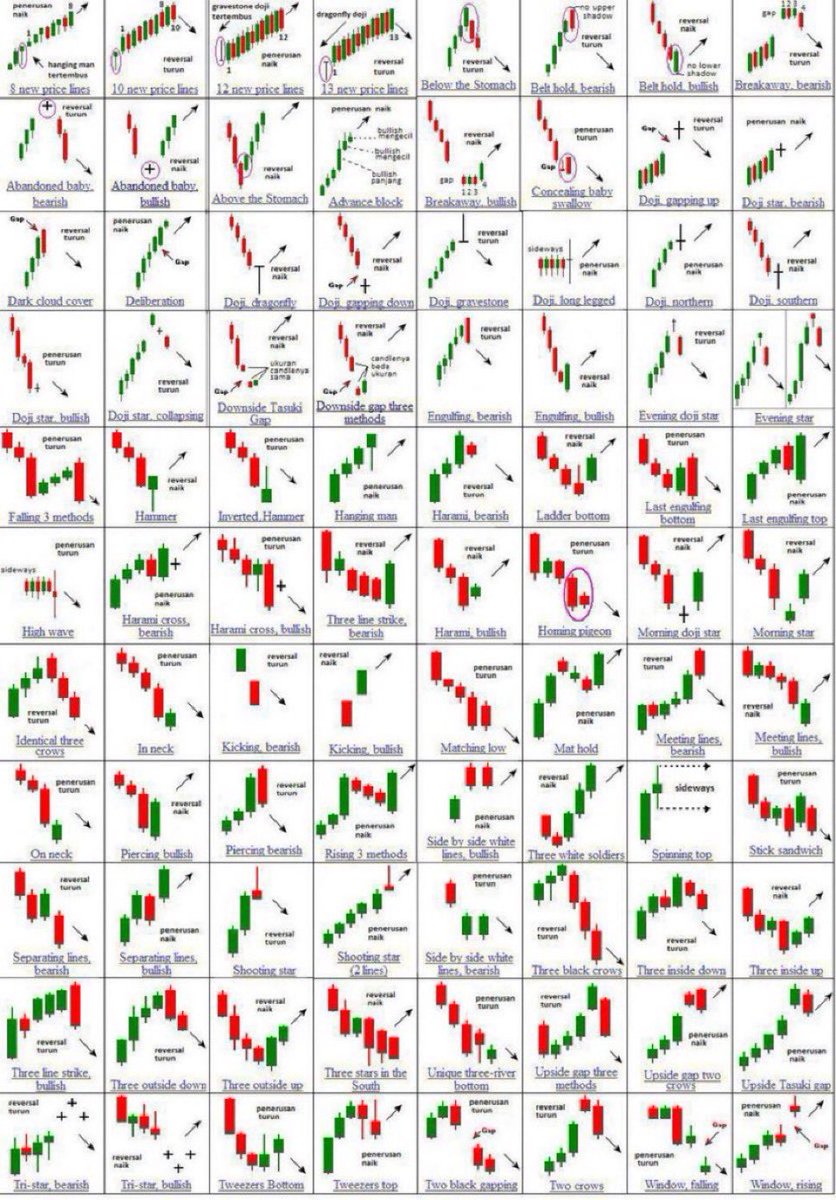
Chart Pattern Cheat Sheet
Barchart tweet media
English
12
47
238
23.6K
Sweetshot retweetledi
Eric Cole
Eric Cole@erichustls·
I shouldn’t be giving this away, but screw it… Here's how to become a millionaire with AI in 2026:
English
19
86
539
133K
Sweetshot retweetledi
peoplewish
peoplewish@Peoplewish·
I’ve been pounding the table on MACD for the last couple years. It’s cool seeing so many people I trade with using it effectively. I first learned about it through @RealSimpleAriel, who introduced me to @gilmoandco. He was using the 6/20 on the 5-minute chart to time both short and long entries. Most of you probably don’t know this, but I trade off one screen despite having a six-screen setup. When I was learning the 6/20 intraday timing method, I kept MACD up on all my saved time frames and started noticing something important: MACD is an exceptional timing tool across all bar aggregations, from the 1-minute to the monthly, not just on the 5min. For the same reason Ariel, Gil, and I use the 6/20 intraday to time entries around higher time frame key levels, it’s also incredibly useful on the daily for timing entries around key weekly levels (or daily... you get the point). Big thanks to the legend Gerald Appel for his contribution to technical analysis 🙏en.wikipedia.org/wiki/MACD
peoplewish tweet media
English
10
23
297
20.9K
Sweetshot retweetledi
Jim Bianco
Jim Bianco@biancoresearch·
I am not a military analyst. I'm a financial analyst focused on macroeconomic risk. That different lens might explain why I see something most military strategists and investors are missing. --- The New Rules of Warfare—And Why We Can't Opt Out For nearly a century, warfare belonged to whoever controlled the biggest defense budget. Aircraft carriers. Stealth bombers. Multibillion-dollar weapons systems. That model is changing in ways many aren't appreciating. Ukraine and Iran are showing the West what 21st-century conflict actually looks like: decentralized, highly iterative, fast-changing, unmanned, and cheap. Neither the US nor Russia—beginning in 2022—appears prepared. We might now have no choice but to show we can fight and win such a war. The Ukraine Approach Faced with a small defense budget, a much smaller population, and a vastly outnumbered army, Ukraine had to get creative. They couldn't match Russia's industrial capacity or spending. So they abandoned that playbook entirely. They developed an entirely new way to fight, highly decentralized, iterative, and most importantly, cheap. They also created Brave1—a completely new way to conduct war. Frontline commanders log into an iPad and bypass central command entirely. They spend digital points to purchase equipment directly from hundreds of (Ukrainian) manufacturers. When they encounter a new threat, they message the manufacturer directly and work with the engineers to find a solution, even if that means they visit to the front. The result is hardware or software upgrades that once took months now take days. Here's the crucial part: hundreds of manufacturers compete fiercely for these dollars by offering the best possible product as fast as possible. This isn't centralized procurement. It's a market. Competition drives innovation at scale. Weapons evolve as the enemy evolves in real time. Units are also awarded points for confirmed kills, uploaded from drone video—a powerfully eloquent way to grade effectiveness. But the real innovation might be how they decentralized manufacturing itself. Instead of building weapons in massive, centralized factories that make perfect targets for Russian bombing, Ukraine distributed production across hundreds of small manufacturers—workshops, machine shops, garages, and yes, kitchens. Each produces components or complete systems. This approach serves two purposes: speed and survival. You can bomb a tank factory. You destroy production for months. You cannot bomb ten thousand kitchens. If one workshop gets hit, ninety-nine others keep producing. The network regenerates faster than Russia can destroy it. This is why the manufacturing process includes actual kitchens—it's not a metaphor. It's a strategy. The Metric That Defines a New Era The result is staggering: at least 70% of battlefield casualties now come from drones. This is the first time in over a century that the primary cause of combat death is neither a bullet nor an artillery shell. Since World War I, industrial warfare meant industrial killing. Ukraine has broken that equation entirely. As a result, Russia is now controlling less territory than at any point since 2022 and going backward. In March, Ukraine made gains while Russia recorded no gains for the first time in two and a half years, and Drone-led offensives recaptured 470 square kilometers while paralyzing 40% of Russian oil exports. Ukraine has lowered the "cost per kill" to less than $1,000 per casualty—a 99.98% reduction from the millions of dollars that were common in the post-9/11 wars. This isn't an incremental improvement. This is a complete inversion of modern military economics. Yet the Western defense establishment is not learning from this. Rheinmetall CEO Armin Papperger mocked Ukraine's entire approach. In The Atlantic, he called Ukrainian manufacturers "housewives with 3D printers," dismissing their work as "playing with Legos." They are not studying this revolution. They are mocking it. And the "housewives with 3D printers" are beating the Russian army! Ukraine Is Now in the Middle East The US Military and Gulf states face an eerily similar problem. Iran's Shahed drones threaten shipping in the Strait of Hormuz—a chokepoint that funnels 21% of global oil. They cannot fend off Iran by firing a $4 million Patriot missiles at $20,000 drones. They need what Ukraine has discovered: a decentralized, rapidly adaptive defense network that doesn't require centralized industrial capacity. That's why Ukraine just signed historic 10-year defense deals with Saudi Arabia, Qatar, and the UAE. Over 220 Ukrainian specialists are now on the front lines of the Persian Gulf—exporting not just weapons, but a completely new doctrine of how to fight. The precedent is set. The model works. Everyone is watching. Mosaic On April 1st, Trump threatened to bomb Iran "back to the stone ages" if they don't reopen the Strait within weeks. It's the classic 20th-century playbook: overwhelming offense force, massive bombardment, industrial-scale destruction. The problem? That playbook doesn't work against distributed, cheap, rapid-iteration systems—especially when your enemy is organized under a mosaic structure. Iran's "Mosaic Defense" doctrine is a decentralized command system where authority and capability are distributed across multiple geographic and organizational nodes. Each region operates semi-autonomously with overlapping chains of command and pre-planned contingencies. It's designed so that when you destroy the center, the edges keep fighting. You cannot decapitate a system with no head. You cannot out-bomb your way to victory when your enemy is not centralized; this was the solution for 20th-century industrial warfare. Defense Wins Championships 21st-century asymmetrical threats require defensive shields, not aggressive offenses. Ukraine has built exactly that: rapid-iteration defenses, decentralized manufacturing, commanders empowered to buy solutions in real time and rewarded for success. That same defensive model may hold the key to opening the Strait of Hormuz. Not through massive offense, but through the ability to adapt and defend quickly. Why We're Stuck Whether you viewed this as a war of choice or not, it has now become a war to keep global trade open. And that makes it inescapable. This is precisely why the US cannot declare victory and walk away from the Strait of Hormuz— or TACO. Every adversary on the planet will interpret American withdrawal as confirmation that cheap asymmetric systems work against powerful centralized platforms. And these adversaries might have sent us a message last month. In mid-March 2026, an unauthorized drone swarm penetrated Barksdale Air Force Base in Louisiana, home to the U.S. Air Force's Global Strike Command. The fact that this happened not overseas but in the United States, and that these tests occurred just weeks ago, underscores how close this threat is now. They didn't attack. They announced their presence. Every adversary watching learned that cheap drone networks can reach into the US. The Global Supply Chain Risk If the US abandons the Gulf while Iran holds the Strait contested, markets will price this as validation that cheap systems can hold global trade hostage. The current market disruptions will become permanent. Supply chains will have to pivot from "just-in-time" efficiency back to "just-in-case" redundancy. Inflation returns as safety costs money. Trade routes diversify away from vulnerable chokepoints. The global friction tax becomes permanent. The Unavoidable Truth Once you prove that cheap, asymmetric systems can hold global trade hostage, that knowledge spreads globally and irreversibly. Every adversary learns the same lesson: you don't need a $2 trillion Navy—you need $20 million in drones and the will to use them. Withdrawing while the Strait remains contested would permanently validate this model. Supply chains shift to "just-in-case" redundancy. Insurance costs rise. The friction tax becomes structural—baked into every global transaction for decades. The cost of staying is measured in months. The cost of leaving is measured in decades of economic drag. We cannot leave unfinished business.
English
305
308
1.5K
608K
Sweetshot retweetledi
Mark Minervini
Mark Minervini@markminervini·
Today’s market strength was textbook. This is exactly what markets do during corrections when they get stretched to oversold levels. As I said just recently, "some of the biggest rallies occur during bear markets and corrections." Today was a perfect example. Traders rushed in after headlines hit that Iran’s president signaled a willingness to end the conflict with the U.S. The Dow exploded higher by 1,125 points. But let’s not confuse cause and effect. The news may have been the trigger, but the market was already set up for a rally. It was oversold and primed. Now comes the part where discipline matters. We ignore the first few days of a rally attempt. That’s potential noise. What matters is whether the market can follow through and whether leadership begins to emerge and proper setups develop. Technically, this is a classic snapback: Indexes that broke below the 200-day are rallying back toward it, while Indexes that held the 200-day are bouncing off it. That’s typical countertrend behavior until proven otherwise. Expect volatility to remain elevated. That’s not where low-risk money is made, but it's certainly where the risk is. Your job during corrections is simple: identify the stocks showing the best relative strength and the tightest price action. Those are your future leaders when the market finally turns. On the macro side, nothing has been resolved. Higher crude prices are still a problem. Yesterday’s rally did nothing to materially bring down oil. The bigger issue is still in play and the jury still out. Oil at these levels feeds inflation, pressures growth, and gives the Fed a reason to stay on hold longer. Yields stay elevated in that environment. To cut through all the noise, I look to the market itself, which has a much better track record of telling us the truth than the politicians, the analysts, the news, and the gurus. The four steps of the bottoming process are: 1. Oversold – The difference between an ordinary pullback and an oversold condition starts with price, but it does not end there. Poor breadth and and a lack of volume confirmed follow through describe a one-sided market, and one not to trust. 2. Rally – Inevitably, the market bounces from its oversold condition. A high-quality rally is broad-based. A low-quality rally is defined by short covering and driven primarily by the stocks that have declined the most. Again, the character of the rally is important to distinguish. So far, we simply don't have enough data to make a confident determination, so patience is the watch word while we wait. 3. Retest – After the rally, there is almost always a retest. The popular averages approach, and in some cases breach, their oversold lows. The key to a successful retest is less selling pressure, such as fewer stocks below their moving averages, fewer stocks, sectors, and markets making new lows, less total volume, and less downside volume. If the retest fails, the process reverts and we generally start looking for divergences during lower lows. In the event of unexpected news, it is possible for the market to recover in a "V" fashion with no retest. In that case, we look at breadth confirmation and participation. 4. Breadth thrusts – In the final phase, not only do benchmark indices rally sharply with few pullbacks, but they do so with an extremely high percentage of stocks, sectors, and markets participating, or what technical analysts call breadth thrusts. In rare cases, the market has skipped step 3. With strong enough breadth, retests are not necessary. The Covid bottom is an example of a pretty powerful V-shaped recovery. Bottom line: This was an oversold rally, sparked by headlines—but not defined by them, and certainly not confirmation of a reliable bottom. Now we watch: --Quality of follow-through --Emergence of leadership --Market internals and model health If the rally lacks quality, if economic pressure builds, or if leading stocks begin to deteriorate, then this remains what it likely is—a rally within a correction. Stay objective. Let the market prove itself. If you are going to trade, do so incrementally. minervini.com
English
118
562
3.3K
421.6K
Sweetshot retweetledi
zerohedge
zerohedge@zerohedge·
Goldman updates equity outlook: 1. Maintains year-end base case S&P target of 7600 (lowers PE multiple from 22x to 21x but offset by higher earnings) 2. In moderate growth shock scenario, expect S&P to 6300, consistent with a P/E multiple of 19x 3. In most severe oil supply shock sees S&P 500 level dropping 19% from current levels to 5400, bringing P/E multiple to 16x.
English
59
163
1.1K
255.2K
Sweetshot retweetledi
Shanaka Anslem Perera ⚡
Shanaka Anslem Perera ⚡@shanaka86·
Iran just offered to reopen the Strait of Hormuz. But only if you pay in yuan. CNN confirms, citing a senior Iranian official, that Tehran is considering allowing a limited number of oil tankers through the Strait provided the cargo is traded in Chinese yuan. Not dollars. Not euros. Yuan. The waterway that carries 20% of global oil, that seven P&I clubs closed through insurance, that a wounded Supreme Leader ordered permanently shut, that the United States just bombed the military defences of Kharg Island to force open, is being offered back to the world on one condition: the currency changes. This is the most consequential sentence of the war that nobody in the oil market has priced. The petrodollar system was born in 1974 when Saudi Arabia agreed to price oil exclusively in dollars in exchange for American military protection. That agreement has governed global energy trade for fifty-two years. Every barrel of crude on Earth has been denominated in dollars. Every central bank holds dollar reserves because oil requires them. Every nation that imports energy must first acquire dollars to pay for it. The system is the foundation of American financial hegemony, and Iran just proposed replacing it with yuan for the world’s most critical chokepoint. China is already the model. Eighty to ninety percent of Iranian crude exports to China settle in yuan or barter through CIPS, the Chinese cross-border payment system that processed 175 trillion yuan, approximately $24.5 trillion, in 2025, a 43% increase year on year. Since 28 February, 11.7 to 16.5 million barrels of Iranian crude have transited the Strait to China via shadow fleet under IRGC protection while every other nation’s shipping is locked out. China pays in yuan. China’s tankers move freely. Everyone else burns or reroutes. The war was supposed to force the Strait open. Instead it is being reopened selectively, on Iran’s terms, in China’s currency. America bombed Kharg to demonstrate it controls the island. Iran responded by demonstrating it controls the condition of passage. The military targets are rubble but the negotiating position is intact: the Strait opens when the currency changes. The implications cascade across every domain. If yuan-denominated tankers begin transiting Hormuz while dollar-denominated tankers remain locked out by insurance, mines, and IRGC targeting, the war produces a bifurcated oil market: yuan barrels for China and BRICS partners at Iranian-discounted prices, dollar barrels for the West at war-premium prices. Two prices for the same commodity. Two currencies for the same waterway. Two systems for the same barrel of oil. The fragmentation the dollar was designed to prevent is being accelerated by the war that was supposed to preserve it. China imports 45% of its crude through the Hormuz region. It holds 90 to 130 days of strategic reserves. Its teapot refineries process Iranian crude at $9 to $12 below Brent. Its CIPS system bypasses every Western sanction. And now the country whose Supreme Leader cannot stand is offering Beijing the one thing no amount of American airpower can bomb: a currency alternative for energy transit. The Strait is not reopening for ships. It is reopening for yuan. And the fifty-two-year-old system that priced every barrel in dollars just met the war that may end it. open.substack.com/pub/shanakaans…
Shanaka Anslem Perera ⚡ tweet media
The White House@WhiteHouse

“Moments ago, at my direction, the United States Central Command executed one of the most powerful bombing raids in the History of the Middle East, and totally obliterated every MILITARY target in Iran’s crown jewel, Kharg Island... Iran has NO ability to defend anything that we want to attack — There is nothing they can do about it!" - President Donald J. Trump 🇺🇸

English
278
1.8K
4.3K
945.3K
Sweetshot retweetledi
Banana3
Banana3@Banana3Stocks·
…and during a “Growth Scare” the market rewards a premium to companies that can GROW when GROWTH is SCARCE The longer Oil remains at high levels then Pundits will start to use terms like Recession and Global Recession fears Trump does not want a Growth Scare to Manifest into Recession fears cause we will possibly create one by talking ourselves into one and that timing could land right into the midterms causing the Republicans to lose the House and Senate as low approval ratings are often directly linked to consumer sentiment and peoples pocket books If the Stock Market senses that any one of the 1) - 2) - 3) things mentioned several paragraphs above start to happen then it will likely recover index pricing to be more bullish so look for commentary around terms like “Truce” - “Ceasefire” - “Russia Sanctions” - “war is over” - “control of the Strait” and so on. It’d the balance between Growth Scare/Recession Fears and dance steps between Rhetoric that will shift rotations between “Growth Stocks” and Industrial and Transportation Sectors in the Stock Market. As a simplified example AI growth Stocks like $NVDA and $MU fulfill the Growth stock narrative and $DAL (Delta Airlines) and $BA (Boeing - Industrial tied to the transportation sector) on alleviation of high Oil prices and a growth scare - Nasdaq100 versus the DowJones. This is why recently there has been days where the DOW has been down 300 to 400 points and the Nasdaq has been flat or up I hope you enjoyed the work, deep research, and read 🤗 Much love 💛🍌🍌🍌
English
8
5
92
7K
Sweetshot retweetledi
Samuel Tombs
Samuel Tombs@samueltombs·
@TheStalwart @asokol_econ @stuartapaul NFIB hiring intentions down sharply in February though, back to last year's lows (data released earlier today). Has been among the best leading indicators of payrolls over last four years.
Samuel Tombs tweet media
English
2
21
58
21.6K
Sweetshot retweetledi
Nazem Alkudsi
Nazem Alkudsi@LongArcNews·
The Hormuz closure is not a 6-week shock. It is an 18-month stress test for the global food system. Most allocators are trading the obvious: oil up, defense up, gold up. They are missing the connective tissue. 🧵
English
46
627
3.2K
457.2K
Sweetshot retweetledi
R
R@AlphaWizarDD·
Mark Minervini explained the Holy Grail of trading any stock. Serious traders must watch it.
English
29
523
2.6K
486.3K
Sweetshot retweetledi
Tech Fund
Tech Fund@techfund1·
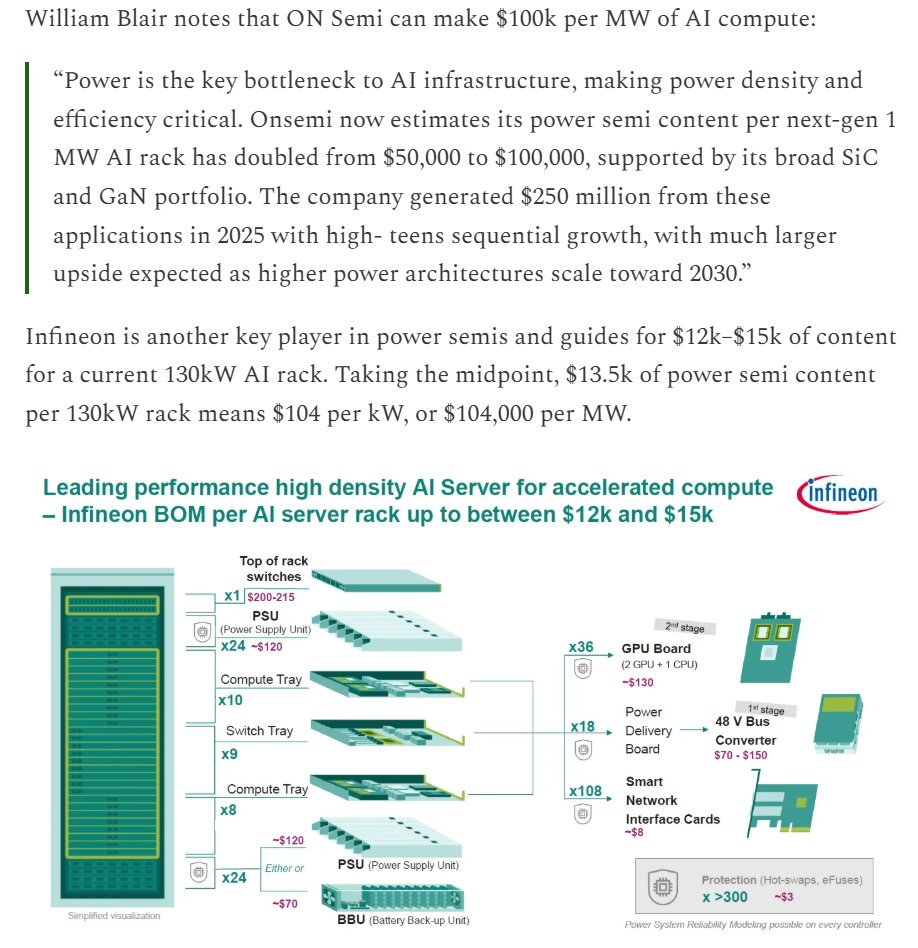
Power Semis in the AI Data Center don't get much attention - however, growth is exploding here. We review the key players: techinvestments.io/p/power-semis-…
Tech Fund tweet media
English
9
43
301
67.7K
Sweetshot retweetledi
Yumi🌸
Yumi🌸@samuraipips358·
Before the session, write this sentence at the top of your plan. “I will not trade my opinions. I will only execute my system.” Then measure yourself by how faithfully you obeyed that line.
Yumi🌸 tweet media
English
7
46
273
29.4K