

Rhys Goodall
301 posts

Rhys Goodall
@RhysGoodall
stuff @RadicalAI Born 362 ppm. https://t.co/eXRBdGWGwx
Katılım Mayıs 2011
116 Takip Edilen204 Takipçiler
@farazamiruddin How in the San Jose is putting all the commercial areas in one block on the edge going to create anything other than a city where everyone needs a car 5 days a week?
English

Loving urbanism is painful because you have to accept that what you want doesn't exist on the West Coast - a dense walkable city with middle housing and great public schools K-12.
I want to be able to walk everywhere in a state where the weather is great year round.
That's why the @CAForever is so exciting. It's everything I want in a place.
Jan Sramek 🇺🇲 🌁 ⛰️@jansramek
1/ 🇺🇸 Today, @CAForever submitted detailed plans for the next great American city, an hour north of Silicon Valley, including: Solano Foundry, America’s largest manufacturing park, Solano Shipyard, our largest shipyard, and walkable neighborhoods for 400,000 Californians.
English
@mmoderwell I am not hugely a fan of generative models but i think something like arvix.org/abs/2501.16051… could be good in this sort of funnel. Multi-step relaxation is good. Maybe just relaxing the unit cell parameters first could have prevented what I saw. Fixsym I don’t think would help.
English

@RhysGoodall do you think doing a two stage relaxation might help here for the random pyxtal initial structures?
first relax with space group constraints
#the-fixsymmetry-class" target="_blank" rel="nofollow noopener">ase-lib.org/ase/constraint…
and then do a second stage unconstrained to find true low energy if not already there.
English
Finally found a killer use-case for torch-sim. But first, a story on how I got there.
I've been developing a inorganic crystal generation package. Given the user input of stoichiometry and crystal system, the flow to generate goes something like this:
- Use Pyxtal to generate N candidates (cheap)
- Heuristic to choose best one (cheap)
- Geometry optimization on best candidate (expensive)
- Return the crystal
Basic, but effective for a lot of use cases given enough iterations.
Unfortunately, the heuristic was trash! I naively thought that lowest starting energy (using MLIP) would correlate with best final energy too. This was actually rarely the case! Extending the heuristic to read initial forces, stresses, and even after a mini-relaxation also gave no signal.
So within all these candidates I generated, the actual best could not be known unless you relax all of them and then compare final energies. With ASE, this would be a pain. You must sequentially relax each candidate, only to throw out most of the results when you find the best.
This is where torch-sim becomes incredibly valuable. Instead of sequentially relaxing each candidate, I can batch them on GPU and it takes the same amount of time.
Depending on what you choose N to be and the size of your GPU, you're able to explore N-times more of the search space in the same amount of time. Wow!
English
@mmoderwell I tried an enumerated campaign with SMACT -> anom prototype outer product -> Wren -> MLIP (sevennet-0) a few years back but saw lots of explosions from the MLIP. Wren cut ~10^9 to 25 * 10^6. The random symmetrical structures from pyxtal were often ill-conditioned to relax nicely
English
@RhysGoodall thanks for the suggestion! valence electron concentration from SMACT looks like it would be useful. going to test if there's correlation.
checking out your paper!
English
@notimenoway @ajassy If power shuts off the chips will stop producing heat and they’ll just cool slowly from the maximum safe temperature they were at under steady load with the cooling system?
There’s not a meltdown risk, these are gpus
English

Every cloud provider faces the same AI infrastructure challenge: chips need to be positioned close together to exchange data quickly, but they generate intense heat, creating unprecedented cooling demands.
We needed a strategic solution that allowed us to use our existing air-cooled data centers to do liquid cooling without waiting for new construction. And it needed to be rapidly deployed so we could bring customers these powerful AI capabilities while we transition towards facility-level liquid cooling.
Think of a home where only one sunny room needs AC, while the rest stays naturally cool – that’s what we wanted to achieve, allowing us to efficiently land both liquid and air-cooled racks in the same facilities with complete flexibility.
The available options weren't great. Either we could wait to build specialized liquid-cooled facilities or adopt off-the-shelf solutions that didn't scale or meet our unique needs. Neither worked for our customers, so we did what we often do at Amazon… we invented our own solution.
Our teams designed and delivered our In-Row Heat Exchanger (IRHX), which uses a direct-to-chip approach with a "cold plate" on the chips. The liquid runs through this sealed plate in a closed loop, continuously removing heat without increasing water use. This enables us to support traditional workloads and demanding AI applications in the same facilities. By 2026, our liquid-cooled capacity will grow to over 20% of our ML capacity, which is at multi-gigawatt scale today.
While liquid cooling technology itself isn't unique, our approach was. Creating something this effective that could be deployed across our 120 Availability Zones in 38 Regions was significant. Because this solution didn't exist in the market, we developed a system that enables greater liquid cooling capacity with a smaller physical footprint, while maintaining flexibility and efficiency.
Our IRHX can support a wide range of racks requiring liquid cooling, uses 9% less water than fully-air cooled sites, and offers a 20% improvement in power efficiency compared to off-the-shelf solutions. And because we invented it in-house, we can deploy it within months in any of our data centers, creating a flexible foundation to serve our customers for decades to come.
Reimagining and innovating at scale has been something Amazon has done for a long time and one of the reasons we’ve been the leader in technology infrastructure and data center invention, sustainability, and resilience. We're not done… there's still so much more to invent for customers.


English
@JacobAShell A biking trip would certainly have been a better plan. Local bus routes were not just bad but entirely absent. Maybe in a fairly near term future self driving taxis could have been the solution to my trailhead woes.
English

@RhysGoodall Yes. You'd have to bike the rail-trail from Poughkeepsie to New Paltz. IMO there should be a train to New Paltz even if it meant sacrificing a bike path to make the connection work
English
This is 100 minutes drive outside NYC, and 20 mins from a MetroNorth rail stop, but Brooklyn 20somethings only leave Brooklyn to go to JFK to fly to other countries' version of Brooklyn.


English
- Lobbying GDM to lift the NC license of GNOME data in MP as it undermines open source principles of MP (own opinion). If I were an academic I wouldn't try to make anything GNOME flagged because of this IP risk. Why limit materials more than proteins alphafold.ebi.ac.uk
English
- R2SCAN datasets for training foundation models like MatPES/MP-ALOE as MLIPs get more leverage approximating higher fidelity simulations at fixed inference cost. This also helps with unifying molecules and materials as R2SCAN + dispersion good for mols/mofs/mats
English
I have prematurely said that MBD was saturated more times than I should admit. Perhaps there is still more juice to squeeze but if I was still doing day to day research in this space I think there's more ripe fruit to pick elsewhere. I would like to see the following:
Simon Batzner@simonbatzner
Yet another NequIP in the top 10 with EquFlash, this time with some very clever accelerations! Bringing the total to ….? I’ll leave it to you how to count :) One question this raises is what a lot of folks have told me recently both on here and in private: they find it “disheartening” (to quote @SamMBlau) that we’ve had the same sota architecture since January 2021 now. My answer is always the same: we’re not building these models for the sake of building models. We’re building them because there are fundamental challenges that require the discovery of novel materials. These algorithms accelerate that. If the FF architecture isn’t the bottleneck, you should stop optimizing it and focus on more interesting problems (data, data, data, evals, scalability, and above all, actually finding and making materials). I can think of at least one other field that flourished when they stopped playing the architecture game. Take my words with a grain of salt though. I was told at APS 2019 by a very “senior” person in the field that the fitting problem of MLIPs was “solved”. That turned out it be horribly wrong. I’m rooting for every grad student to make a meaningful dent in this problem. And who knows, maybe there is more juice to be squeezed beyond a 1mev/atom MAE difference. (also if you’re building molecular FFs, different story, this is a materials benchmark)
English
@natolambert @tdietterich In the way Chemrxiv and Biorxiv exist, Airxiv would be welcome contribution to the landscape
English
@natolambert @tdietterich I have high trust in most physics and materials science papers in my domain on arxiv. The platform was adopted and dominated by the CS field but it remains important to other communities .
English

I feel strongly that, while I understand the challenges they're feeling to run this, that this is the wrong decision. What Arxiv is in practice versus what it is in reality is very different.
In practice there are already moderation rules, but they're so minimally enforced (due to being swamped) that they're effectively not there. See things like Schaeffer, Rylan. "Pretraining on the test set is all you need." arXiv preprint arXiv:2309.08632 (2023). Many more cases. Arxiv moderation is already a unpredictable black box that's hampers the dissemination of research and predictability of the research ecosystem.
It is important to note that Arxiv has policies in place that make this, student projects, maybe RLHF book, and other commonly posted things "not allowed."
In fact, Arxiv should be going in the other direction. Be the platform where everyone accepts ANY CS research is, and figure out if it's good later.
This feels like the early stages of a slow death of Arxiv. Where in 2-3 years they'll say the same for "technical" research, and then require peer review there. All of this is going to just delay research being published, because peer review takes time. Peer review at the same time is being completely rebuilt in the era of AI and it'll take even longer to fix.
Peer review is going to be reworked as AI first with human oversight. It's currently assumed to be all Human. It'll be a very different process in 20 years.
After Arxiv institutes a peer review requirement for technical work, it'll be the slow death of the platform. A competitor will come out. A slippery slope has started, and I'm happy to consult with the team on it as it seems like a lose-lose tradeoff.
For example, with this, I'd never be able to publish my RLHF book PDF on Arxiv, even though it was extremely requested and is likely a very well read PDF (more than much of my research work).
Keep arxiv as the default. We don't want this run by a for profit company. Hosting and open access to research is a fundamental win for humanity. Figuring out how to curate it is a new problem for the AI age, please don't leave it to our somewhat broken peer review institutions. Make it something new that is AI native. Lean into the future.
Update Arxiv's policies to reflect reality, not a slipping goal that is likely to be impossible to achieve.
Thomas G. Dietterich@tdietterich
The Computer Science section of @arxiv is now requiring prior peer review for Literature Surveys and Position Papers. Details in a new blog post
English
@rmcentush Wind is rotating power so it’s AC? The biggest mistake the US made on its grid was being early and going too low on the voltage.
English

Edison Was Right
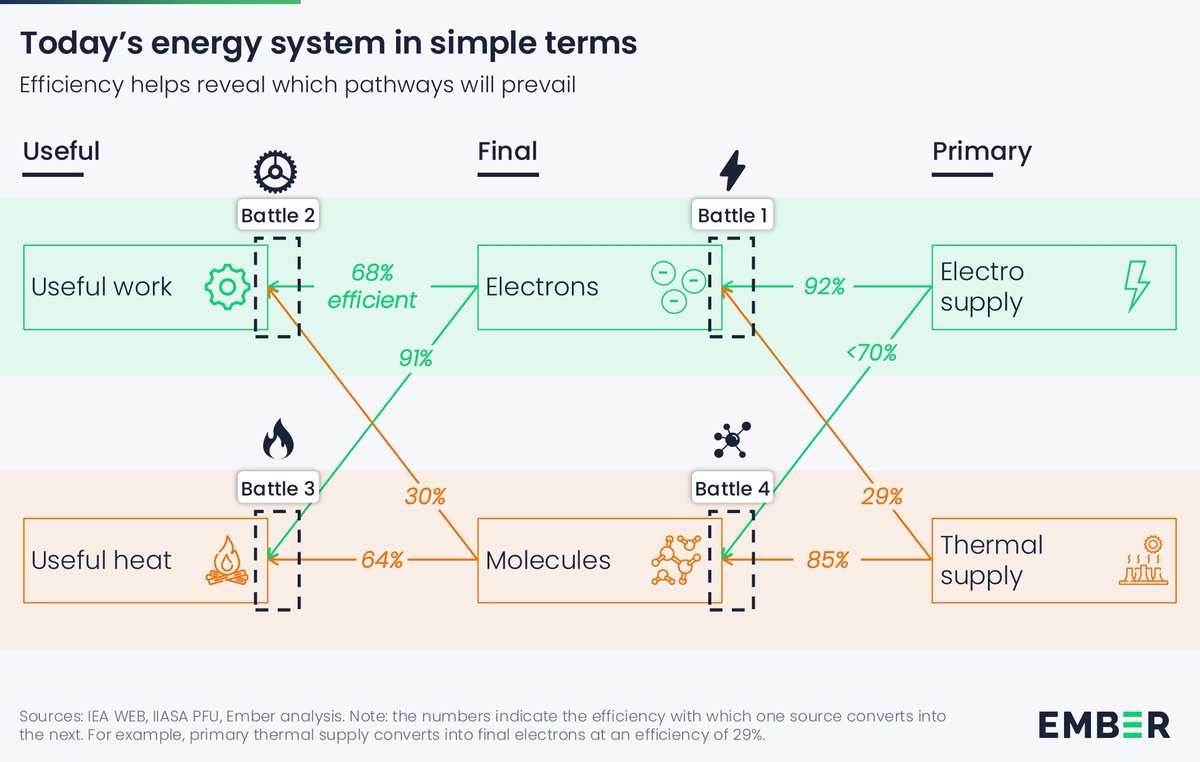
we took a century-long detour because nikola tesla figured out you could wiggle electrons up and down and move voltage around with coils of iron and copper. fair enough — in 1890, that was sorcery. transformers were the only way to change voltage, and the only trick we had was to shake the magnetic field at 60 hz and hope the iron didn’t saturate.
but that world’s gone. silicon rules now. wide-bandgap semiconductors — SiC, GaN, etc. — make voltage conversion solid-state. no moving parts, no humming oil tanks. we can step dc up, down, and sideways with converters that waste almost nothing.
every load worth caring about — batteries, EVs, LEDs, computers, servers, and modern motor drives — already runs on DC. new generation from solar and wind are also DC — we waste billions flipping it from DC → AC → DC again.
moreover, steel-coiled transformers are industrial fossils: 10,000-pound copper monuments with multi-year lead times. they hum because they’re ashamed. if we were building the modern grid from scratch, we’d run it DC from the rooftop to the rack — solid-state all the way down.
homes. cars. factories. data centers. ships. bases. no spinning rotors, no reactive power, no harmonic witchcraft. just clean, disciplined electrons flowing in one direction — like God, physics, and Edison intended.

English
@marvinvonhagen @letsbuildmore @TimSweeneyEpic @dhh Bad example google pays a huge amount to apple to access their distribution.
English

@letsbuildmore @TimSweeneyEpic @dhh would you be fine with apple only allowing apple search, no google usage on iphones? or no whatsapp, only imessage? or no google maps, just apple maps?
English
anyone got experience in suing tech giants for anticompetitive/monopolistic behavior?
we could really use some help 🙏🏼
@dhh @TimSweeneyEpic
TechCrunch@TechCrunch
WhatsApp is banning general purpose chatbots from using its Business API techcrunch.com/2025/10/18/wha…
English
@ruben_laplaza @curtischong5 Glad you're finding it helpful. Could you make an issue documenting what the issues are? I would guess loading from a ASE DB returns a list of Atoms and then we have IO functions to join those into a batched SimState. We want to remain decoupled from ASE but also be interoperable
English

@curtischong5 I am loving it so far, but ASE's database system HATES it. I guess too many things are in place in ASE. I'm doing my own fixes but it might be something to consider down the line, assuming ASE integration is a large percentage of use cases. Still, amazing piece of software 10/10!
English

I really really want TorchSim to be amazing to work with. It's such an important part of atomistic simulations and there's still so much work to do.
Please submit a PR/issue if there's a feature you want to see!
Ben Blaiszik@BenBlaiszik
🔥Today we're excited to announce a major milestone for the machine-learned interatomic potential (MLIP) ecosystem: TorchSim is moving to community ownership and governance through a partnership with Radical AI and the open-source community! MLIPs have become critical computational tools for materials discovery. These models predict atomic forces orders of magnitude faster than traditional methods with high accuracy - bridging the gap between DFT and MD. But, the MLIP ecosystem has been fragmented. Each new MLIP requires custom integration code, and the existing simulation engines aren't built for GPU-native workflows. As such, research teams are currently spending too much time on infrastructure instead of discovery. TorchSim changes this. It's an atomistic simulation engine built for the AI era, offering faster batched inference, full GPU utilization, and perhaps most importantly, a unified interface across model architectures enabling rapid prototyping and model swapping. Our team at @UChicago and @argonne, is proud to help facilitate TorchSim’s development and growth as an open source community. Special thanks to @radicalai, who invested in and built the software. The original development team, including Abhijeet Gangan, Orion Archer Cohen, @jrib_ , Rhys Goodall, Adeesh Kolluru, Stefano Falletta, and Curtis Chong, built something special, and we want to ensure their work not only continues to serve the community but grows. A special shoutout to Radical AI founders Joseph F. Krause (@josephfkrause) and Jorge Colindres (@colindresj_) for making this transition not only possible but continuing to build with the community. 🙌 But, for more success we now need your help! 🔷 MD practitioners: Build examples, tutorials, and benchmark your workflows 🔶 ML engineers: Integrate new MLIP architectures and optimize GPU utilization 🔷 Computational scientists: Implement integrators, optimizers, and simulation methods 🔶 Everyone: Help us document and build this ecosystem along with the Hugging Face AI for Science community (@cgeorgiaw). Thanks to the many community contributors already pushing this forward, including Thomas Loux, Ryan Liu, J Kian Pu, Filippo Bigi, Stefan Bringuier, Ph.D. , Myles Stapelberg, Yutack Park, John Gardner, Guillame Fraux, Chuin Wei Tan, and Timo Reents. This is just the beginning. With your help, we see a future where these models are as easy to use in your research as LLMs today and help drive materials discovery across the world.
English
Rhys Goodall retweetledi

Rhys Goodall retweetledi

We are excited to announce a $55M Series Seed+ led by RTX Ventures, joined by NVentures (@nvidia's VC arm), @noavctech, @infinitexyz, @eni, @alley_corp and many others.

English