
Sabitlenmiş Tweet
Richard Walls
461 posts

Richard Walls
@RichardWalls
I help professionals build successful careers doing what they love | Learn more at https://t.co/CC1JK1zywl
Austin, TX Katılım Ağustos 2009
124 Takip Edilen136 Takipçiler
Excited to share that my book, Decoding Tech Careers, is officially launched!
I wrote it because the tech job market has fundamentally changed. For the better part of the last 20 years, tech was growing. With it comes scaling headcount to meet demand and growth expectations.
Then the bubble popped.
Today, layoffs dominate the headlines for three main reasons:
1. Overhiring: A 20-year build-up that accelerated during the COVID spike.
2. Interest Rates: The jump from 0% to over 5% changed how companies spend.
3. AI: Automation is now mainstream, and it’s changing what companies actually need from employees.
The job market is more competitive than ever. But most professionals are still caught in a cycle of tactical execution—spending their days on manual, repeatable processes. In a world of AI, that is a career dead end.
The shift everyone needs to make to win in the market is to think like a "system architect". It's a way of operating. It means taking ownership of human judgment.
AI can execute a command, but it can’t decide what to build or why it matters to the business. As a system architect, you are the one who identifies the problem, decides on the solution, and builds the process from start to finish.
This is an inflection point for everyone to develop new skills as it will determine your future in the industry. I started as an entry-level analyst and worked my way up to leading global eCommerce teams at a Fortune 50 company. Over that time, I've learned what separates those to move their careers forward vs those who get stuck. Drawing from my experience and from those across the network I've built over 14 years, I've distilled those learnings into this blueprint that I'm now sharing with everyone.
In the book, I cover the following topics:
1. The State of the Job Market
2. How I Started in Tech
3. How AI is Reshaping Tech Careers
4. Your New Tech Career Roadmap
5. How to Build a Powerful Online Brand
6. Turning Your Network into Opportunities
What you'll come to find out is that despite the short term volatility AI is creating in the job market, there are still plenty of opportunities if you know where to look and how the skill demand is shifting. The important part is that you stay ahead of the curve. Understand what AI can do and how you can use it to your advantage.
If you want the roadmap that will move your career forward in the new AI world, this book is for you.
Check it out here: amzn.to/42y2dZb
English

Such a beautiful rocket
SpaceX@SpaceX
Starship and Super Heavy V3 together at the Starbase launch pad for the first time
English
Given my experience, I have a deep appreciation for supply chain complexity, which is why I'm excited about the prospect of AI improving both back end operations and front end customer service.
MIT's latest supply chain report drops a clear message: AI isn't optional anymore for handling omnichannel complexity.
The numbers back it up. E-commerce keeps growing for 81% of companies, but that means dealing with 40% return rates in fashion and exploding SKU counts. You can't scale that with headcount alone.
Companies are shifting investments to core operations. Last year was all about chatbots. Now it's warehouse management, where 61% use AI for picking and routing. Inventory allocation hits 60%, tracking stock across channels. And returns? 35% of organizations are seeing a meaningful decline with AI.
There's a catch, though. AI demands perfect data and faster restocking. Mess up the inputs, and the outputs fall apart.
Where's your supply chain hurting most—customer-facing ops or back-end logistics? Share below.
Full report: ctl.mit.edu/news/ai-not-op…
English

100% companies will get bigger and cut employees while growing rev/margin - look at @nvidia at $5T - I think entrepreneurship will explode for those willing to educate/work at it, look at @AlexFinn 👏
Richard Walls@RichardWalls
Meta is cutting 8,000 jobs on May 20. That's 10% of the company gone in a single day. Chief People Officer Janelle Gale sent an internal memo Thursday confirming the news. Beyond the 8,000 layoffs, Meta is also scrapping 6,000 open roles it planned to fill. This is the third wave of cuts in 2026, following smaller rounds in January and March. Here's the math behind this decision. Meta isn't struggling for cash. They're projecting massive revenue. This is a structural trade-off. The company plans to spend up to $135 billion on AI infrastructure this year, nearly double what they spent in 2025. They're building massive five-gigawatt superclusters and hiring elite AI talent with incredible comp packages. The strategy mirrors what most companies are either exploring or already doing: swap general headcount for specialized AI power. Zuckerberg has noted that projects once requiring large teams are now being handled by single individuals using AI. To accelerate this, Meta is reorganizing remaining staff into AI-focused "pods." Now and in the near future, as the cost of these technologies decrease while its capabilities improve are we seeing the end of the 'mass employment' era for Big Tech? Let me know if you think tech companies will eventually become trillion-dollar entities run by only a few hundred elite specialists. Or - with how capable these tools are, does the low barrier to entry introduce many new players to the market that are AI-native and can operate even faster? businessinsider.com/meta-plans-lay…
English
A welcome bit of news!
It is interesting to see the disconnect between the dire predictions and these stats. The drop in youth unemployment suggests that the entry-level "cliff" hasn't happened.
That said, we have to consider that many of these new hires are likely being brought in specifically because they are "AI-native" and can work faster than previous cohorts.
The quantity of jobs is holding steady, but the skill requirements for those roles have shifted significantly in twelve months
English

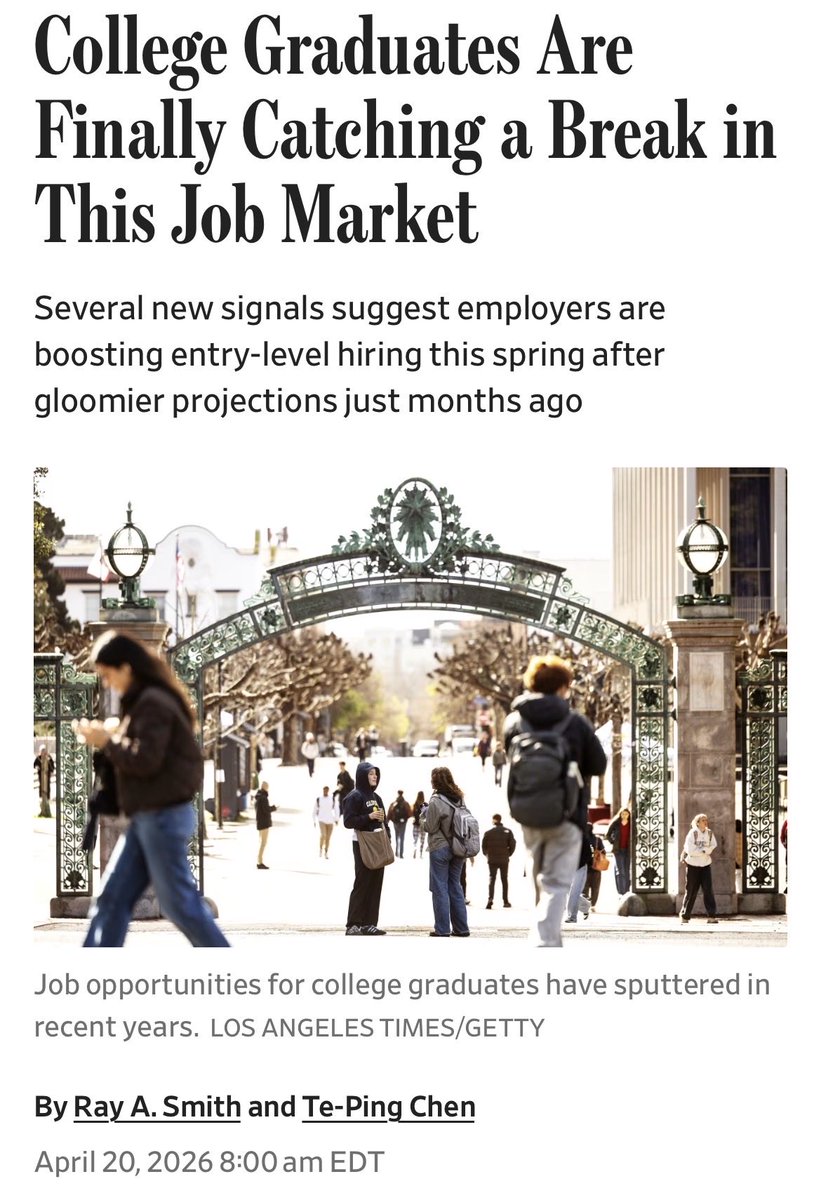
Narrative violation: Hiring of new college graduates is up 5.6% over last year. Youth unemployment for degreed 20–24‑year‑olds fell to 5.3% from 8.9%. Weren’t we told that 50% of entry-level jobs were going away?
English
If this doesn't get you excited about the future, I don't know what will.
I still remember like it was yesterday the first rocket booster landing they did back in 2014. To this day, still such an impressive sight with no other competitors able to accomplish the same feat (with the very recent exception of Blue Origin landing their booster for the first time).
Now with Starship on the horizon, our ability to reach the stars has never been greater.
On to the moon and Mars!
#spacex #starship
Elon Musk@elonmusk
Starship is the most powerful moving object ever made
English
Meta is cutting 8,000 jobs on May 20. That's 10% of the company gone in a single day.
Chief People Officer Janelle Gale sent an internal memo Thursday confirming the news. Beyond the 8,000 layoffs, Meta is also scrapping 6,000 open roles it planned to fill. This is the third wave of cuts in 2026, following smaller rounds in January and March.
Here's the math behind this decision. Meta isn't struggling for cash. They're projecting massive revenue. This is a structural trade-off. The company plans to spend up to $135 billion on AI infrastructure this year, nearly double what they spent in 2025. They're building massive five-gigawatt superclusters and hiring elite AI talent with incredible comp packages.
The strategy mirrors what most companies are either exploring or already doing: swap general headcount for specialized AI power. Zuckerberg has noted that projects once requiring large teams are now being handled by single individuals using AI. To accelerate this, Meta is reorganizing remaining staff into AI-focused "pods."
Now and in the near future, as the cost of these technologies decrease while its capabilities improve are we seeing the end of the 'mass employment' era for Big Tech?
Let me know if you think tech companies will eventually become trillion-dollar entities run by only a few hundred elite specialists.
Or - with how capable these tools are, does the low barrier to entry introduce many new players to the market that are AI-native and can operate even faster?
businessinsider.com/meta-plans-lay…
English
Most people expect LLMs to nail it on the first try. That's not how this works. But people are drawn into the narrative that LLMs can read your mind and give you exactly what you want without you investing more than a minute of your time.
Getting real value from AI means treating it like a conversation, not a vending machine. You throw in a prompt, review the output, refine your ask, and loop until the result actually matches what you need.
The professionals who see results break their requests into small, sequential steps. Think of it like writing code with if-then logic. Each step feeds the next. The more granular you get, the cleaner the output.
Yes, it takes effort upfront. But once you've built that muscle, the consistency and quality you get back are worth it.
What's one habit that's changed how you work with AI?
English
@ChrisWillx @DylanoA4 What's interesting is that "mindless entertainment" is often a legitimate biological recovery tool.
The problem isn't the entertainment itself, but the fact that the job makes it a necessity rather than a choice.
English

Capitalism’s one-two punch.
“There’s something about a soulless job that makes you crave mindless entertainment, and that’s the combination that slowly kills you.” — @DylanoA4
English
@BigBrainBizness Plenty of lessons here from one of the best.
As a leader, if you aren't clearing obstacles, you are one. A CEO's primary job is to be the ultimate friction-remover for the people actually building the product.
English

Steve Jobs on why the best CEOs work *for* their employees:
At a company full of world-class talent, Steve explains, the traditional org chart gets turned upside down.
"Where you've got incredibly talented people that are also rare and in demand, if you don't treat them right, they can go get another job in 10 minutes."
That reality changes everything about how leadership works:
"So, this strange thing happens, which is that the hierarchy of power inverts and the CEO is actually at the bottom. So, I sort of feel like I work for most of these people because they're the ones that are doing all the brilliant work."
In Steve's view, management isn't about directing the work. It's about enabling the people doing it:
"The best people are very hard to come by and so it's management's job to support them because they're on the front lines doing the work."
He explains how that support actually shows up day to day:
"We do that by creating the right environments and a very rich environment and removing obstacles out of their way and putting together the right teams of people together and getting the right projects, keeping the quality levels very high both in terms of people and strategy and projects."
The takeaway: when your people are the rarest resource in the company, your job as a leader is to clear the path in front of them.
English
@tasornp Absolutely. If you can’t trust your own word, you’ve already lost. Self-trust is the ultimate competitive advantage because it creates a level of consistency that talent alone can't touch.
English

Totally agree. Most people wait for a crisis to innovate, but by then, it is usually too late.
Proactive stress is a form of insurance. When you push yourself during the "good times," you are building the muscle memory and emotional resilience required for the inevitable downturns.
English

Totally agree. It's a prerequisite for success in this space. If they were strictly logical, they would look at the market data and quit immediately.
That "delusion" is actually a shield against the exhaustion of the early stages. But you have to know what you’re signing up for.
An intense founder should demand an intense team. If you want a 9-to-5 with clear boundaries, a startup isn't the right career move.
You’re betting on their vision, and that vision has to be big enough to justify the chaos.
English

Harsh truth: if you’re at a startup and the founder isn’t intense and even slightly delusional… you’re not going to win.
English
Totally agree. We’ve reached a weird point on social media where people act like seven figures is "small change" just because it won't buy a private island. 😄
$1 million is a huge achievement. That said, whether its "life-changing" depends on where you live. In a high-cost city, it’s a solid retirement foundation rather than "never work again" money. It's a goal worth hitting, even if it buys less than it used to.
English

Don’t let anyone fool you: $1,000,000 is life-changing money for 90% of the world’s population.
The “$1M is nothing” crowd is made up of under-achievers living in their parent’s basement who will never have anywhere near a mil.
English
Absolutely. Every hour you spend on a task you hate is an hour you can't buy back.
Most people treat their time like a renewable resource, but it's the only thing you're actually losing.
That said, "building someone else's dream" doesn't have to be a waste. Choosing the right company, role, etc, can be something you love.
At minimum, that baseline security can be helpful when building your own dreams.
English

The cost of not doing what you love?
You waste your most valuable asset: time.
Time spent building someone else's dream.
Time not spent building your own.
English
Applying for tech jobs with a generic identity makes it easy for recruiters to ignore you. Companies hire specific functions that fit their value chain, and they want to know exactly where you sit.
I like to think of roles in these four ways because they mirror how companies actually operate from an initial idea to a final sale.
- The Planner: These professionals handle the strategy and translation, defining what needs to built and why it matters to the business.
- The Builder: This is the technical heart of the company, where engineers and creators turn blueprints into stable, working products.
- The Operator: These folks run the internal engine, focusing on governance, logistics, and making sure the organization scales efficiently.
- The Driver: This role is the revenue engine, responsible for sales, marketing, and keeping customers happy to ensure the business stays profitable.
If you're looking to make a pivot in your career, look at your current resume and pick which of these four categories fits your experience best. Then use that to help you translate skills to specific roles that are peripheral to what you might already be doing.
Which of these four functional areas do you feel most comfortable in? Share your role in the comments.
#TechCareers #CareerStrategy #JobSearch #Leadership #DecodingTechCareers
English
Totally agree with this. We spend way too much energy seeking "gold stars" from people who don't even know our goals.
Success is a private metric. I’ve found that when I stop asking for permission to feel accomplished, my productivity actually shoots up. You have to be your own toughest judge and your own loudest fan.
That is the only way to stay sane in a loud world.
I liked @Markmanson's perspective on values if you want to stop caring about the wrong things.markmanson.net/personal-values
on values if you want to stop caring about the wrong things.
English
