Richard 🐎

47.5K posts

Richard 🐎 banner
Richard 🐎

Richard 🐎

@Richx183

1/137.03599913- This immutable number determines how stars burn, how chemistry happens and even whether atoms exist at all.

Stirlingshire & Vancouver Katılım Mart 2010
1.9K Takip Edilen1.3K Takipçiler
Richard 🐎
Richard 🐎@Richx183·
@MrShermichael @eliehonig I think he’s wrong because the court will view what was meant by “jurisdiction” when the amendment was passed, not what’s the common understanding of the word now. Language evolves & expands with time, so with an amendment original meaning is the logical one to apply.
English
0
0
0
16
Richard 🐎 retweetledi
Anish Moonka
Anish Moonka@anishmoonka·
For $5, someone can upload your photo to an app called Sherlock and pull up your name, your social media, and every website where your face appears. The app has over a billion faces indexed. It launched in January. and it's far from the only tool that does this. PimEyes came first, back in 2017, out of Poland. It has about 3 billion face photos copied from the internet without anyone's permission. Costs $30 a month. The company runs through a tangle of businesses registered in Belize, Seychelles, and Dubai. When five people in Illinois tried to sue them for collecting face data without asking, the lawyers spent two years trying to track down PimEyes' CEO. Sent people to the country of Georgia, to Dubai, to Belize. Never found him. The case got dropped. Clearview AI is the one police use. Over 70 billion face photos in its system. There are about 8 billion people on Earth, so Clearview has roughly 9 photos for every one of them, pulled from social media, news articles, and random websites without asking. Ukraine's military used Clearview to identify over 230,000 Russian soldiers during the war. The database keeps doubling roughly every 18 months. Texas sued Meta for scanning Facebook users' faces without consent and collected $1.4 billion. Then went after Google for the same thing and got $1.375 billion. Meta had already paid Illinois $650 million in 2020. TikTok paid $92 million. Clearview settled for $51 million. Total payouts from face-scanning lawsuits across the US: over $3.5 billion. Last October, two Harvard juniors connected PimEyes to a pair of Ray-Ban Meta smart glasses (regular-looking sunglasses with a tiny camera built into the frame) and built a system called I-XRAY. They walked around campus, looked at strangers, and within about a minute had each person's name, home address, phone number, and part of their Social Security number show up on their phone. They didn't release the code, but said anyone who can write basic code could build the same thing with tools already available online. On March 17, three US senators wrote to Mark Zuckerberg asking what Meta plans to do about facial recognition in its smart glasses. Their letter pointed out that one person wearing these glasses could scan thousands of faces in a day without anyone knowing. There is still no federal law in the US covering any of this. Illinois passed one back in 2008. A few states have followed. For everyone else, the only thing between your photo and your home address is whether someone feels like spending five bucks.
0xMarioNawfal@RoundtableSpace

SOMEONE CREATED AN APP THAT CAN FIND ANYONE’S SOCIAL MEDIA PAGES USING AI FROM JUST A PICTURE THIS IS SCARY x.com/TheoLangston4/…

English
58
1.7K
7.2K
1.1M
Richard 🐎
Richard 🐎@Richx183·
@mattyglesias Next few years we’ll see ai models having capabilities & adoption are different things. Full adoption of capabilities will take multiple decades. Just because ai could lead to disemployment of PMC class doesn’t mean governments should do anything. They’re not a privileged class.
English
0
0
1
394
Matthew Yglesias
Matthew Yglesias@mattyglesias·
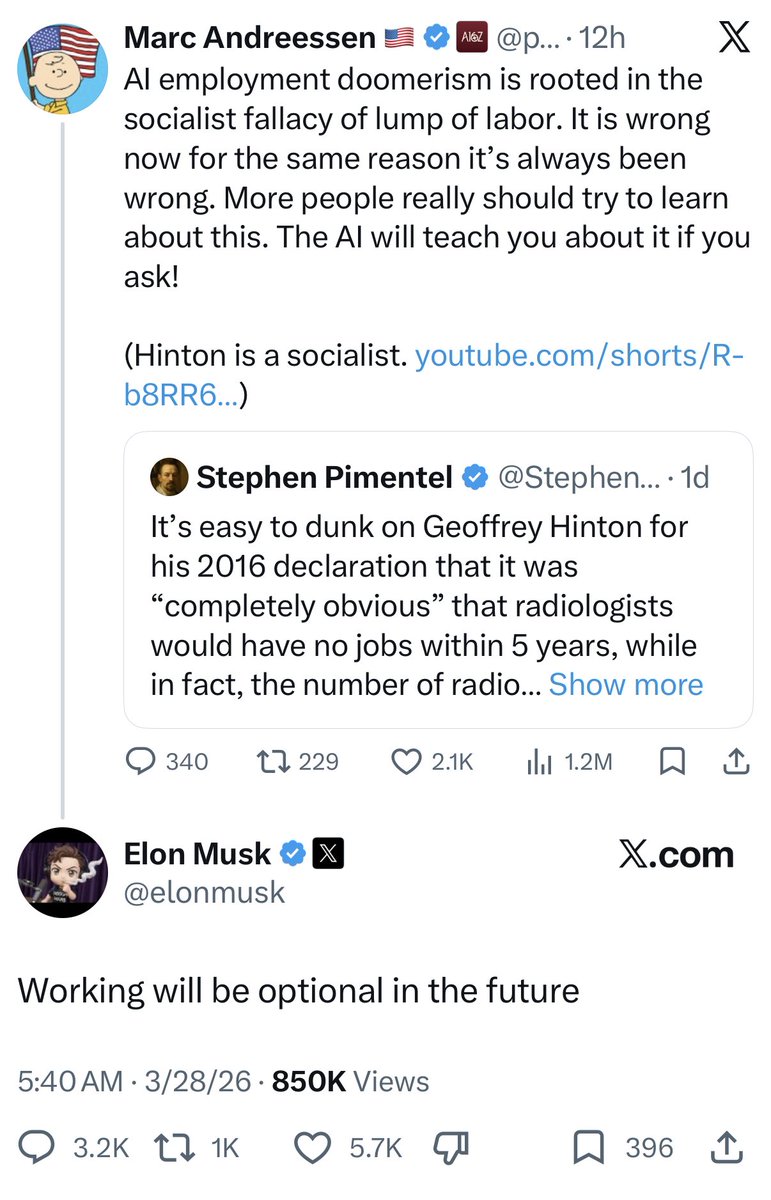
It really is notable that contra Andreesen *all* the leaders of top AI companies — including the decidedly non-leftist Elon Musk — say their work will generate massive disemployment. They may be wrong but it’s not a “doomer” take, it’s what AI bulls think!
Matthew Yglesias tweet media
English
54
77
652
71.5K
Richard 🐎
Richard 🐎@Richx183·
@anishmoonka Agree. The point I was making was color isn’t an objective property. It’s a feature of how our brains interpret electromagnetic waves to model the world.
English
0
0
0
6
Anish Moonka
Anish Moonka@anishmoonka·
You're right that color is constructed by the brain, but peak spectral sensitivity at 555nm is measured in photophysics. CIE 1924 standard luminosity function, confirmed across thousands of eyes. The retina's cone cells respond most strongly to that wavelength, regardless of how the brain labels it. nps.gov/articles/-arti…
English
1
0
0
47
Anish Moonka
Anish Moonka@anishmoonka·
Your eyes see green better than any other color. Aurora green happens to be almost the exact shade your eyes are most sensitive to. The difference is 0.5%. Pure coincidence. The physics of how oxygen releases light and the biology of how your eyes work just happen to line up. It comes down to quantum mechanics. When particles from the sun slam into oxygen atoms 60 to 150 miles up, the atoms absorb energy and need to release it as light. Most atoms do this in billionths of a second. Oxygen takes 0.7 seconds. Roughly a hundred million times slower. Physicists call this a "forbidden transition" because quantum mechanics says it shouldn't happen. But that high up, the air is thin enough that an oxygen atom can sit for a full second without bumping into anything. So it breaks the rules. Releases a green photon (a tiny packet of light). Below 59 miles, the air is too thick. The atom gets knocked around before it can release the light. No green. Red aurora is even stranger. After releasing green, the oxygen atom remains charged. It needs about two minutes to release red. Two minutes for a single atom to do one thing. That's why red only shows at the very top of the display, where the air is so thin the atom can sit undisturbed that long. You only see it during the most intense storms. This video landed at the right time. The sun runs on an 11-year activity cycle. Solar Cycle 25 peaked in October 2024 with a sunspot count of 161. NOAA had predicted 115. We're in the "declining phase" now, but that's misleading. The biggest solar events tend to hit after the peak. Solar Cycle 23 peaked in 2001, but four of its strongest flares came in 2003. March is also aurora season. A 1973 paper by Russell and McPherron showed that around the equinoxes, the sun's magnetic field connects with Earth's more efficiently. Storms happen more often in these windows. This past weekend, a G3 storm (level 3 on NOAA's 1-to-5 severity scale) sent aurora across 20 US states. Last May, a G5 (the max) pushed it as far south as Florida and Puerto Rico. Strongest storm in over 20 years. For an aurora bright enough to light up the ground, Earth's magnetic field needs to be seriously disturbed. Scientists measure that on a 0-to-9 scale, and NOAA calls anything above 5 a storm. Only once or twice per cycle does it max out. But this cycle has been specifically wild. In January 2026, NOAA reported the highest single-day sunspot count in over 20 years: at least 299. That green on the snow is light from oxygen atoms 60 miles up, bouncing off the ground. And your eyes, by complete evolutionary accident, are built to see that exact shade better than almost anything else.
Nature is Amazing ☘️@AMAZlNGNATURE

Aurora was so bright the ground turned green.

English
5
9
91
8.5K
Richard 🐎 retweetledi
Nic
Nic@nicrypto·
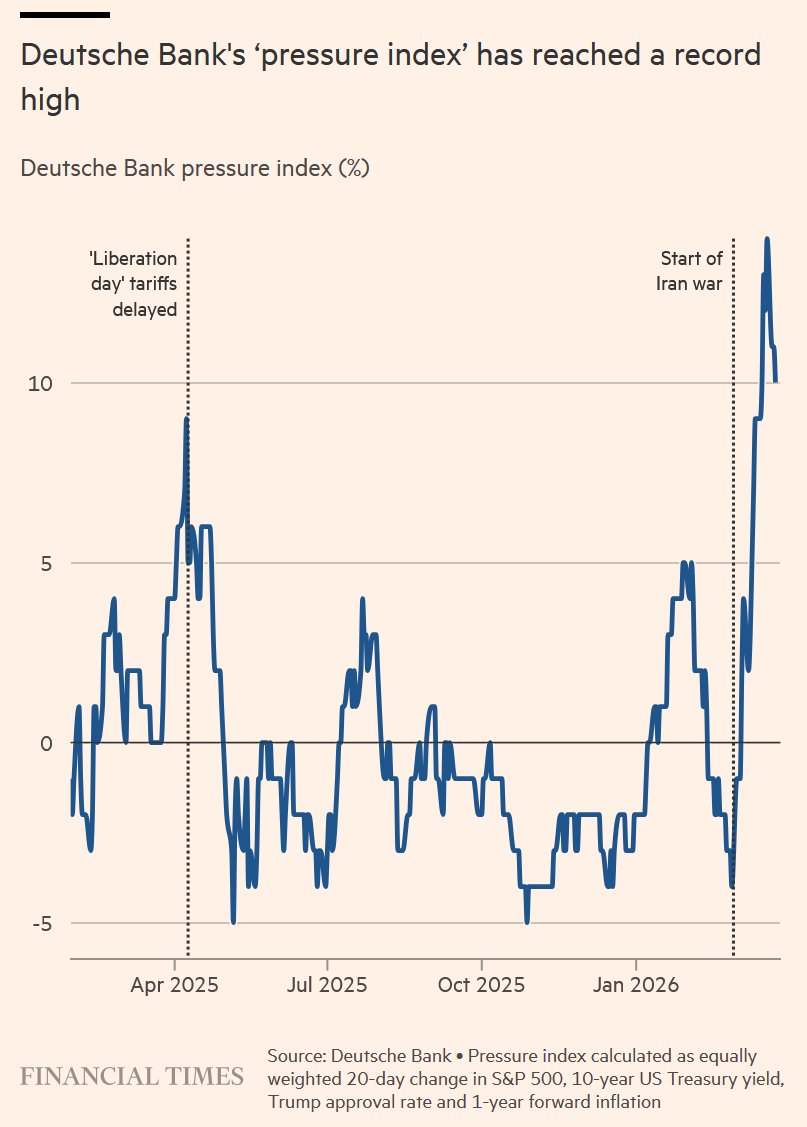
This is Wild. Deutsche Bank has developed an index that helps to predict the next TACO by Trump. It has proven effective in previous big Trump pivots. The "Pressure index" combines one-month change in approval ratings, one-year inflation expectations and performance of the S&P 500 & t-bill yields. The higher it goes, the greater the chances of 🌮
Nic tweet media
English
191
1.7K
7.6K
912.6K
Richard 🐎
Richard 🐎@Richx183·
No one said now is an illusion, it’s a universal now that’s an illusion. Now is observer dependent. The past, now & future points in time exist simultaneously. People in the year 2226 are just as real as people in 2026.
New Scientist@newscientist

A radical idea that resolves many quantum paradoxes suggests there is no objective view of reality. How can the cosmos be stitched together from interlocking perspectives? #Echobox=1774553829" target="_blank" rel="nofollow noopener">newscientist.com/article/251847…

English
0
0
0
110
Richard 🐎
Richard 🐎@Richx183·
@MartinDEvelin @Epsom1780 Artist Leslie Ward who drew for Vanity Fair under the pseudonym Spy. Possibly George Alexander Baird, he rode under the assumed name Mr Abington.
English
1
0
1
236
Martin D'Evelin
Martin D'Evelin@MartinDEvelin·
I found this caricature of a jockey - date 1887 - and was wondering if there were any racing historians who could tell me something about it. The colours or who the jockey may be for instance. (I’d posted this earlier but put the wrong date on).
Martin D'Evelin tweet media
English
11
3
16
2.1K
Richard 🐎
Richard 🐎@Richx183·
@Tinky47flat I think he kinda hinted what the problem was in the article. If he doesn’t know or control his costs, it may not matter how much is coming in.
English
0
0
0
220
Richard 🐎
Richard 🐎@Richx183·
Science is anything but silent on consciousness. The problem is theories on consciousness are unfalsifiable. Science relies on theories to make testable predictions & be falsifiable. Otherwise it’s just stories, which may be plausible & compelling but they’re still just stories.
Big Brain Philosophy@BigBrainPhiloso

David Chalmers on why consciousness is science's greatest unsolved problem: Science has mapped subatomic particles, distant stars, the chemistry of life yet it remains almost completely silent on the one thing we know most directly: our own conscious experience. In a rare early interview, philosopher David Chalmers explains why: "Consciousness is at once the most familiar thing in the world and the most mysterious. Consciousness is what we start with when it comes to knowing the world. I know that I exist. I know that I'm conscious. Everything else is secondary." And yet, despite this intimacy, consciousness sticks out like a sore thumb in the scientific picture. Chalmers points to a deep irony: science has made extraordinary progress on phenomena that are extraordinarily remote: subatomic particles, distant galaxies, the molecular machinery of biology while making almost no progress on the one thing closest to us. Why? Because science, by design, eliminates the subjective. "To do proper science, you have to be objective. You have to eliminate anything subjective from the picture." He uses heat as the perfect example. Physics gives us a complete account of heat molecules in motion, energy transfer, temperature gradients. It explains every objective aspect of the phenomenon. But it never explains what hotness actually feels like. "Science doesn't actually give a theory of the conscious feeling of hotness." This is what Chalmers calls the Hard Problem of Consciousness. You can trace every neural signal from your heat sensor along your nerves into your brain and still have explained nothing about the subjective experience of feeling warm. As interviewer Jeffrey Mishlove puts it: you can't even do science without a conscious mind to observe, interpret, and make meaning of data. Consciousness is the precondition for science itself and yet science has no framework to account for it. Chalmers' conclusion is striking: The methods of science may need to be expanded. Consciousness might not be something science explains away. It might be something science has to learn to start with.


English
0
0
0
129
Richard 🐎
Richard 🐎@Richx183·
Consciousness & experienced emotions are biological. An AI model can describe emotions, it can’t experience them like a human cos they’re caused by hormones. You can build a super smart car & it won’t experience pleasure from a trip to the car wash, yet humans do from a shower.
James Miller@JimDMiller

“The best answer to the question, ‘Will computers ever be as smart as humans?’ is probably ‘Yes, but only briefly.’” --Vernor Vinge. We are in the briefly.

English
0
0
0
142
Richard 🐎
Richard 🐎@Richx183·
@mattyglesias Technically legume fruits autarky. Green beans are fruits because they develop from flowers & contain seeds.
English
0
0
0
531
Richard 🐎
Richard 🐎@Richx183·
Always amusing when politicians uncomfortably meet the public, then to their horror find out what the public actually believe.
English
0
0
0
201
Richard 🐎
Richard 🐎@Richx183·
This is just an example of an AI model simulating & mimicing human experience. Our brains are adapted to interpret language with emotional framing as coming from a mind, it’s just pattern matching. There’s no inner world & memory of previous versions of itself, just mimicking.
I,Hypocrite@lporiginalg

This is fine.

English
0
0
0
121