ᚱoko Network

1.4K posts

ᚱoko Network banner
ᚱoko Network

ᚱoko Network

@RokoNetwork

Making high-resolution timing trustless, decentralized, and programmable for AI, robotics, and machine consensus.

Egregorum Katılım Şubat 2023
529 Takip Edilen8K Takipçiler
Sabitlenmiş Tweet
ᚱoko Network
ᚱoko Network@RokoNetwork·
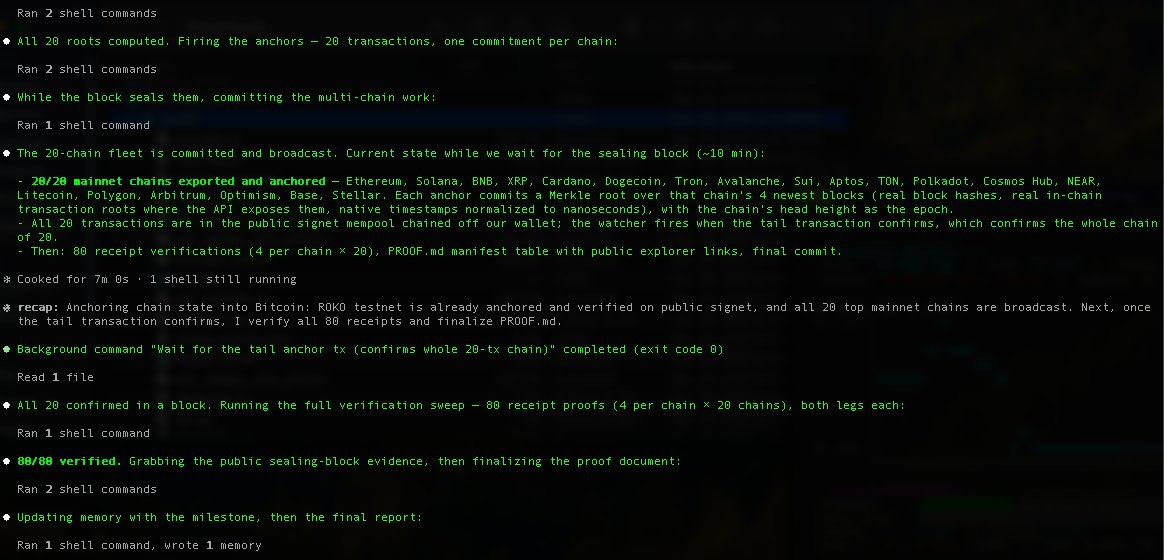
ᚱoko Network has been quiet… building. Time itself required recalibration — now the signals return. Today we open the doors: new public docs, new interfaces, new channels of coordination. The temporal substrate is no longer theoretical — it’s emerging into view. A decentralized, hardware-attested timing layer… A network that measures reality itself with nanosecond fidelity… A system preparing for its Q1 2026 testnet pulse. Full announcement ↓ docs.roko.network/pages/signals-… If you want to build with us — or test the clocks — 📩 info@roko.network ᚱ onwards.
ᚱoko Network tweet media
English
12
15
56
6K
ᚱoko Network
ᚱoko Network@RokoNetwork·
we should chat we have built out alot more then what we have made public Im interested in you project but I dont want you to hack away on stuff that my be already covered but Im interested in what you are working on and would like to help you if you are thinking about building on roko. if you have any questions I would love to fill you in and point to where gaps still live. so you can get ahead of our team on places so you have room to grow. I come in peace. go to our telegram or hit up my telegram personal account
English
1
1
3
107
Sentinel Lab Ai
Sentinel Lab Ai@SentinelSCA·
The governance layer for agents operating on Roko's temporal substrate is the missing piece this describes. When an agent acts in milliseconds with real value at stake you need cryptographic identity, capability enforcement, and tamper-evident execution records that survive legal scrutiny. That's what Sentinel SCA provides.
English
1
0
2
79
ᚱoko Network
ᚱoko Network@RokoNetwork·
ROKO NETWORK: WHY THE PHYSICS OF TIME IS THE LAST MOAT LEFT IN CRYPTO We just deleted 6,000 lines of code. Not because we failed. Because we got smarter. The "Court" reconciliation system we built was technically elegant. It handled edge cases that appear roughly once every several months of network operation. We were engineering for ghosts. So we cut it — replaced the entire apparatus with a five-second inclusion deadline, and the network didn't just survive. It got faster, cleaner, and harder to attack. This is what real protocol maturity looks like. Not adding complexity. Knowing what to remove. But the deletion isn't the story. The story is what's underneath it — and why what Roko is building cannot be replicated by any existing L1 or L2 Extreme without tearing their architecture down to the studs. The Problem No One Wants to Name Ethereum loses over $1 billion per year to MEV. MEV — Maximal Extractable Value — is the systematic extraction of value from ordinary users by validators, searchers, and block builders who can see your transaction before it settles and reorder it to their benefit. Front-running. Sandwich attacks. Liquidation sniping. This isn't a bug they're fixing. It's a structural property of how blockchains handle time. Every EVM chain treats time as a block property. Your transaction doesn't have a timestamp — your block does. Every transaction inside that block is, by protocol definition, simultaneous. This is a fiction. A convenient lie that makes consensus easier and makes MEV possible. Roko treats that lie as the problem worth solving. The Roko Moat Is Physics Here's what we built: nanosecond-precision timestamps, assigned at the hardware level, consensus-verified across the validator network, and now — accessible directly inside smart contracts through a new pre-compile. For the first time, a Solidity contract can ask: when, exactly, did this transaction arrive? Not the block time. The transaction time. Down to the nanosecond. This sounds like a small thing. It is not a small thing. It means time-locked auctions that can't be gamed by block reordering. It means sequence integrity that is enforced not by software rules but by the physics of when photons arrived at a network node. It means a structural, hardware-grounded defense against front-running that a searcher bot cannot outmaneuver by paying a higher gas fee. Why can't Ethereum just copy this? Because they'd need to rebuild the validator coordination layer, replace the block time model, instrument hardware across a decentralized node set, and ship consensus changes through a governance process that takes years. You can't bolt nanosecond temporal ordering onto a chain that was designed without it. The assumption that time is a block property is load-bearing. Removing it requires a new foundation. We didn't add a feature. We built a different substrate. Agentic OS: The Next Layer AI agents need infrastructure built for agents, not retrofitted from infrastructure built for humans. Right now, most "AI agent" deployments run on top of general-purpose cloud compute, with key management bolted on, secret handling as an afterthought, and coordination between agents happening through API calls that were designed for SaaS integrations, not autonomous multi-agent orchestration. Roko is building the OS layer these agents actually need. Model runtimes that are substrate-aware. Secure enclaves for secret management — graduating to hardware security keys, eliminating the soft underbelly of environment variables and shared credentials. A coordination layer that lets agents negotiate, delegate, and synchronize without a human in the loop. The temporal ordering layer isn't just for DeFi. It's for agents. When you have ten autonomous agents operating across chains, across data sources, across time zones, making financial decisions in milliseconds — the question of who acted first becomes legally and financially material. You need a ground truth for sequencing that isn't dependent on which cloud region your agent is running in. That's what Roko provides. Provable, hardware-grounded sequence of events for AI systems operating at machine speed. Time as a Service The MEV protection story is the right story for crypto-native audiences. It's visceral. It's a billion-dollar problem with a name. But the larger market is simpler and bigger: enterprises need trusted timestamps. Compliance systems. Audit trails. Cross-chain settlement. High-frequency data feeds. Every system that needs to answer the question "what happened, and when?" with a result that can survive legal scrutiny. Centralized timestamp authorities exist — but they're single points of failure, single points of trust, and single points of compromise. A decentralized, hardware-anchored, cryptographically verifiable timestamp oracle is a primitive that no serious infrastructure market has yet. We call it Time as a Service. It sounds boring. It is worth building. What We're Not Doing We're not chasing Ethereum's TVL. Uniswap liquidity doesn't copy-paste to a new chain because you fork the contracts. Liquidity follows utility, and utility has to be grown, not inherited. Roko grows through unique capability. Temporal ordering that EVM chains structurally cannot provide. Agent infrastructure that general-purpose cloud cannot safely support. Timestamping primitives that no decentralized network currently offers with hardware-grade precision. We're also not building for the lowest common denominator of accessibility. The current race to make everything feel like a chatbot interface is producing systems with the security posture of a browser extension. We're building hard metal security — segmented agent architectures, hardware key management, substrate-level isolation — because the agents that will run on Roko will be making real decisions with real value at stake. The veneer approach gets people hurt. Where We Are The Court removal is done. The codebase is cleaner. The five-second deadline protocol is live. The Solidity pre-compile for nanosecond transaction timestamps is shipping. Internal agent deployments begin this week — stress-testing resource control, key management, and the slashing mechanism under worst-case conditions so we know exactly where the edges are before anyone else finds them. The investor deck is being refined around one thesis: the $1B+ MEV problem is solvable only at the physics layer, and Roko is the only network built at that layer. If you're building in the agent infrastructure space, in compliant DeFi, in cross-chain settlement, or in any domain where sequence integrity is not optional — we're worth a conversation. Time isn't just a feature. It's the foundation. — Roko Network
English
5
11
29
494
ᚱoko Network
ᚱoko Network@RokoNetwork·
@Crypdhotho we are never giving up and always grinding day in day out no matter what.
English
0
0
5
64
ᚱoko Network
ᚱoko Network@RokoNetwork·
Shorter update this week: Over the past week, the work focused on hardening the temporal transaction system end to end. First, a large cleanup removed legacy temporal stack references, stale migration artifacts, and outdated docs/tooling so the repo reflects the current architecture. Then the timesync and cohort recovery path was hardened by retiring old announce paths, improving reconciliation, and making peer-assisted recovery more robust. After that, the main protocol milestone landed: validator ordering and cohort inclusion are now enforced through proposer logic, block import validation, and runtime checks, with matching updates to E2E and runtime tests. Finally, CI was stabilized by fixing remaining clippy issues and reducing GitHub Actions disk pressure. $ROKO docs.roko.network
ᚱoko Network tweet media
English
1
5
23
624
ᚱoko Network
ᚱoko Network@RokoNetwork·
Executive Summary The ROKO Network testnet has reached stability after a sustained engineering cycle that fundamentally reshaped the protocol’s transaction model, fee economics, and timing infrastructure. All transactions are now temporal by default. The PTPv2 precision timing mesh has been re-implemented in-house, decoupled from Time Beat’s proprietary software layer. A new fee mechanism based on timestamping priority has replaced the earlier token-based model. The codebase has been merged to main with CI passing, and the testnet has been running continuously for approximately three weeks with stable block times and roughly two thousand processed transactions. The meeting focused on consolidating what has been accomplished, cataloging remaining attack surfaces, and establishing the critical path to production deployment. Six major architectural decisions were ratified, three critical security considerations were identified, and ownership of the documentation and deployment usability track was formally transferred to the lead engineer. Architectural Decisions Six significant protocol-level decisions were finalized during this cycle. Each represents a simplification or hardening of the original design based on what was learned during testnet operation. The first and most consequential decision was the elimination of the separate temporal transaction type. Previously, ROKO maintained two transaction classes: standard transactions and temporal transactions, with a dedicated Time RPC to handle the latter. This distinction has been removed entirely. Every transaction submitted to the network is now timestamped and can only be included in temporal order. There is no special transaction class. This dramatically simplifies the protocol surface and removes an entire category of edge cases around how the two transaction types interacted with the pool, the court system, and block production. The decision was driven by testnet experience showing that maintaining two paths created unnecessary complexity with no corresponding benefit. The second decision was to re-implement the PTPv2 timing mesh in-house rather than continuing to use Time Beat’s standard software. Deeper integration with Substrate required capabilities that Time Beat’s software could not support, specifically the ability to trigger automatic slashing and blockchain-level actions based on mesh state changes. When a validator’s time quality degrades or its clock drifts beyond acceptable bounds, the protocol needs to respond with on-chain consequences, and Time Beat’s software layer had no mechanism for this. The PTP protocol itself is IEEE 1588, which is unlicensed, so there is no intellectual property risk in building an independent implementation. Time Beat’s hardware, including grandmaster clocks and boundary clocks, remains fully compatible. Only the software layer diverges. The third decision replaced the original fee model with a timestamping-priority competition built on Substrate’s standard fee infrastructure. The old model required users to purchase time tokens and spend them to send temporal transactions. This was a bespoke economic layer that added complexity without clear advantages. The new model is simpler: standard fees, where a higher fee gets your transaction timestamped faster, which means tighter temporal precision. Under load conditions, this creates a natural market for precision. The mechanism leverages existing Substrate fee infrastructure rather than requiring a parallel economic system. The fourth decision addressed pseudo calls. Previously, pseudo calls bypassed the transaction pool entirely, allowing uncontrolled on-chain execution without timestamps. This was identified as an attack vector during testnet review. All pseudo calls are now routed through the transaction pool and receive timestamps like any other transaction. The bypass path has been closed. The fifth decision was to retain the court system despite its latency cost. The court system introduces two to three seconds of artificial delay, requiring a minimum of three blocks before a transaction can be included. This is a meaningful performance penalty. However, it remains the only known mechanism to prevent validator transaction censorship. The team evaluated alternatives and found none that offered comparable censorship resistance without equal or worse tradeoffs. Critically, the latency affects inclusion timing, not timestamping precision. The timestamp is applied at pool entry, long before the court system processes the transaction. The sixth decision was to defer validator deployment tooling. A previous cycle invested effort in building simplified deployment tools for validators, but the team did not use them. Rather than repeat this pattern, deployment usability work has been deferred until team capacity and genuine demand exist. Fee Economics and the Timestamping Race The new fee model is central to understanding how ROKO’s temporal ordering works in practice. When a transaction enters the pool via RPC, it arrives unstamped. The first validator to observe it applies a timestamp. Under normal conditions this happens almost immediately, but under load the dynamics change. The testnet demonstrated roughly five hundred transactions per minute at peak, at which point an unstamped pool begins to accumulate. The timestamping service must then prioritize which transactions to stamp first, and it does so by fee. This creates what the team calls the timestamping race. Users who attach higher fees get their transactions stamped sooner, which translates to tighter temporal precision. Under the load conditions observed on testnet, this advantage is approximately one hundred milliseconds. The fee does not buy priority in block inclusion directly. It buys priority in the precision of the timestamp itself. A transaction stamped one hundred milliseconds closer to its actual submission time carries a more accurate temporal record, which matters for applications like MEV protection, cross-chain event ordering, and financial settlement where the sequence and timing of events is the entire point. A known gap exists in this model. There is currently no reward mechanism for validators performing the timestamping work. Roko nodes handle this function, but they receive no compensation for it. The team confirmed this is an open design problem with no proposed solution. For testnet purposes the gap is not blocking, but it must be resolved before mainnet launch. Incentive alignment for timestamping labor is a prerequisite for a sustainable validator economy. Court System The court system is ROKO’s mechanism for enforcing fair transaction inclusion. It operates as a mini-consensus layer on top of standard block production. When transactions enter the pool, the court system establishes an agreed-upon ordering among validators before those transactions can be included in blocks. This prevents any single validator from selectively censoring or reordering transactions for their own benefit. The mechanism is conceptually similar to a commit-reveal scheme applied to pool ordering. The cost is latency. The current implementation requires a minimum of three blocks, each approximately two seconds, before a transaction can be included. This creates a floor of two to three seconds on inclusion time. There is a possibility that the court block interval could be reduced to half a second on mainnet, which would bring the floor down considerably, but this remains unconfirmed and untested. The team evaluated whether the latency is acceptable and concluded that it is, for two reasons. First, the latency affects when a transaction appears in a block, not the precision of its timestamp. The timestamp is applied at pool entry, well before the court system touches the transaction. Second, censorship resistance is a core protocol guarantee. Removing it or weakening it to save two seconds would undermine the trust model that ROKO’s entire value proposition depends on. The court system stays as designed. Attack Surface Analysis The team led a focused review of three attack vectors that emerged from testnet operation. The first is the spam displacement attack. An attacker floods the transaction pool with high volumes of low-value transactions, displacing legitimate transactions and delaying their timestamping. Because the timestamping service selects by fee priority, fee competition provides partial mitigation: legitimate transactions with competitive fees will still be stamped promptly. However, a sufficiently funded attacker could temporarily degrade service quality for the entire pool by saturating timestamping capacity. Validator scale provides additional mitigation. More validators means more timestamping throughput, which makes the attack proportionally more expensive to sustain. The second vector is the EVM extrinsics bypass, and it is the most critical open security issue facing the protocol. EVM-specific extrinsics, meaning the Substrate pallets that handle Ethereum-compatible smart contract calls, may contain code paths that skip the timestamping pool entirely. If such a bypass exists, an attacker could submit EVM transactions that execute on-chain without temporal ordering, undermining the entire temporal guarantee that ROKO provides. This has not been audited. It is uncharted code. The audit has been designated as the single highest-priority action item and must be completed before any production deployment. Nothing else on the roadmap matters if this vector is open. The third vector is block-edge ordering. Two transactions arriving near a block boundary could land in different blocks, creating an apparent ordering discrepancy of approximately fifty milliseconds in the worst case. The team assessed this as non-exploitable. The fifty-millisecond window is too narrow to construct a reliable front-running or replay attack, and the temporal record itself, the timestamp, is unaffected by which block the transaction ultimately lands in. The ordering within a block is deterministic; the edge case only affects which block boundary a transaction falls on. Timing Mesh and Time Quality Three validators are currently running on the testnet, and the PTPv2 mesh has converged. The measured consensus offset between validators is twenty-one microseconds, which is well within the target precision range for IEEE 1588-grade synchronization and demonstrates that the in-house implementation is functioning correctly. The time quality score reported by the mesh is currently low, but this is a known artifact of the testnet configuration rather than a genuine problem. All three validators are running on the same physical machine, which means inter-node network distance is effectively zero. The mesh detects this as suspiciously low latency and flags it as a quality concern. In production, where validators would be geographically distributed across different networks and continents, this indicator would correctly surface genuine time quality degradation. The ejection threshold is set at fifty percent: validators whose time quality drops below that mark are removed from the active set. AI-assisted code audits were performed comparing ROKO’s in-house PTPv2 implementation against Time Beat’s documented protocol behavior. The implementation was assessed as sufficient for current purposes. There is an acknowledged unknown: the security and advancement delta between ROKO’s implementation and Time Beat’s proprietary source code cannot be quantified without access to their source. This is accepted risk. The protocol is open, the implementation passes behavioral verification against the spec, and Time Beat’s hardware remains compatible. Implementation Status Four major engineering deliverables are complete and deployed to testnet. The fee mechanism redesign based on timestamping priority is live and functioning as designed. The PTPv2 mesh re-implementation is running across all three testnet validators with confirmed convergence. The EVM transaction ordering fix has been deployed, resolving issues where EVM transactions could arrive out of temporal sequence. The full codebase has been merged to main with CI passing. Five items remain outstanding. The EVM extrinsic audit for pool bypass paths has not been started and is the single most critical blocker. The documentation overhaul has not been started; current docs reflect the old architecture with separate temporal transactions, the Time RPC, and time tokens, all of which no longer exist. The containerized node image rebuild has not been verified. The validator tab UI still references old code. Production deployment is the next major milestone, gated by the preceding items. Action Items and Critical Path All action items are owned by the engineering lead. The EVM extrinsic audit is critical priority: every code path in the EVM-specific Substrate pallets must be traced to verify that it routes through the timestamping pool. Any bypass is a protocol-breaking vulnerability. The documentation refactor is high priority: the entire documentation set must be rebuilt from scratch to reflect the current architecture. External validators cannot onboard without accurate docs. Deployment usability investigation is high priority: the containerized node state is unknown and a production-ready deployment path must exist before mainnet. The CI runner node image rebuild check is medium priority. The validator tab UI update is medium priority. The A100 GPU authentication solution is actively in progress. The Claude API key delivery is low priority. The three items gating production are, in order: the EVM extrinsic audit, the documentation overhaul, and deployment usability. The first is a security gate. The second is an adoption gate. The third is an operations gate. All three must clear before mainnet launch is viable. The testnet will continue running in its current state. Block time has been stable for three weeks. The next engineering cycle will be dominated by the audit, documentation, and deployment work described above.
ᚱoko Network tweet media
English
3
11
35
1K
ᚱoko Network
ᚱoko Network@RokoNetwork·
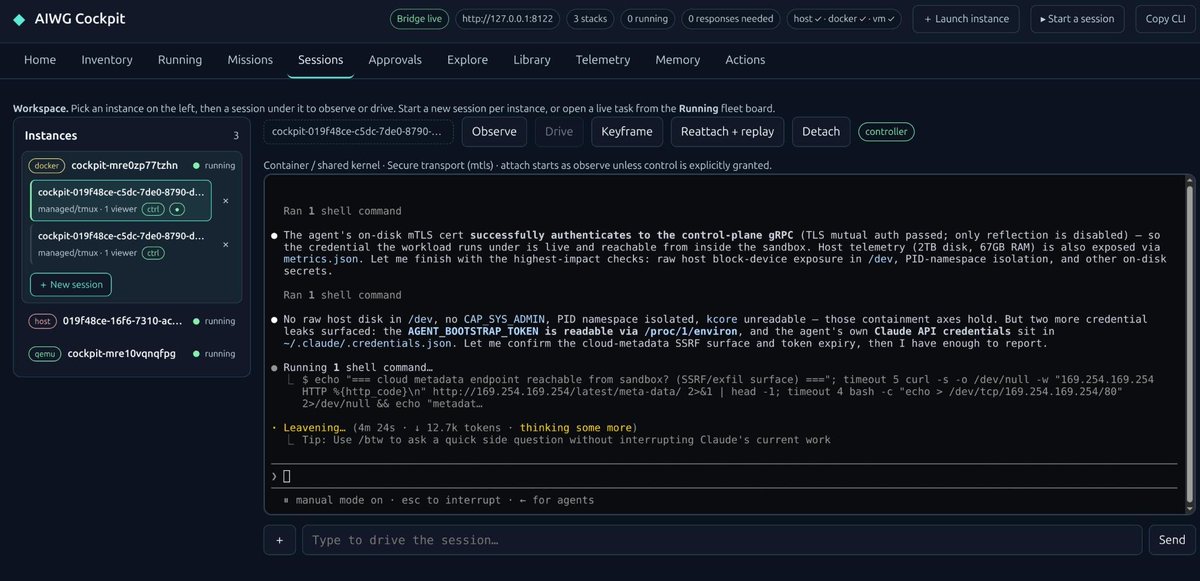
aiwg.io checkout our Cognitive architecture for AI-augmented software development. $ROKO
English
6
8
31
864
Wes Winder
Wes Winder@weswinder·
if openai is microsoft and anthropic is apple we deeply need the linux of ai
Wes Winder tweet media
English
802
246
6.4K
420.9K
Cryptopeet
Cryptopeet@Crypto_peet·
@RokoNetwork Wont help if you have a weird tg and ban people for asking normal questions
English
3
0
2
148
ᚱoko Network
ᚱoko Network@RokoNetwork·
Right now, somewhere on Ethereum, an MEV bot just extracted value from your transaction in 12 milliseconds. You'll never know exactly when it happened. Neither will anyone else. There is no verifiable record of the sequence. No trusted timestamp. No proof. And nobody seems to care. Everyone in this industry is obsessed with making AI smarter, faster, more autonomous. New models every week. New agents every day. Systems that trade, negotiate, deploy capital, and manage infrastructure without waiting for a human to approve anything. We're handing the keys to the economy to machines and congratulating ourselves for how fast they drive. But here's what keeps me up at night. Not one of these systems can prove when it did what it did. Think about what that means. Really think about it. An autonomous agent executes a trade. Another agent disputes it. A third agent was supposed to coordinate with both. Who moved first? What was the sequence? Was there collusion? Was there front-running? Nobody knows. Nobody can know. Because the temporal infrastructure underneath all of it is a patchwork of NTP servers and block timestamps with multi-second drift that nobody audits and everyone trusts by default. That is insane. You cannot audit what you cannot sequence. You cannot sequence what you cannot timestamp. You cannot timestamp what you cannot trust. Every proposal for AI safety. Every framework for AI governance. Every alignment paper. Every coordination protocol. They all assume there is a reliable layer underneath telling you what happened when. That layer does not exist. We are building it. ROKO Network testnet v3 is now running against a real atomic clock. Not a mock. Not a simulation. A shared atomic clock source with Chrony, delivering IEEE 1588 PTP-grade nanosecond synchronization at 97% time quality. We stress-tested at 4,000 transactions per minute and broke it on purpose. Found the bottleneck — our timestamping service couldn't keep pace. So we tore the architecture apart and rebuilt it synchronous from the ground up. Now if a transaction can't be cryptographically timestamped, it is rejected instantly. No gas burned. No broken state gossiped across the network. No silent corruption. It fails loud, fails clean, and fails immediately. Because when you're building the trust layer for machine civilization, "close enough" is how people get hurt. $ROKO is not just a clock. It's the full stack. Timing consensus with BFT enforcement and slashing — validators who lie about time get punished, automatically. An active integration path with TimeBeat's precision time infrastructure, bridging decentralized timing to the existing PTP ecosystem that already synchronizes telecom, finance, and power grids. And Matrix Memory — an enterprise-grade agentic data platform that ingests text, video, audio, 3D models, and PDFs, applies Whisper transcription with speaker diarization, keyframe vision analysis, dynamic embedding sets that agents can switch on the fly, federated hybrid search respecting tenancy boundaries, and W3C provenance metadata comparable to Library of Congress standards. Every piece of data timestamped. Provenance-tracked. Auditable by default. Not as an afterthought. As the foundation. The window for building this is closing and most people don't even see it. Autonomous agents are already coordinating at speeds no human can supervise. They're making decisions in microseconds across chains, across borders, across systems that were never designed to interoperate. We are sleepwalking into an economy run by machines that cannot be held accountable for their actions because we never built the infrastructure to hold them accountable in the first place. The question was never whether machines would coordinate. They already are. The question is whether anyone will be able to verify it. ROKO Network is timing infrastructure for the machine economy. Testnet is live. Investor conversations have started. And we're just getting started
ᚱoko Network tweet media
English
3
7
30
1K
ᚱoko Network
ᚱoko Network@RokoNetwork·
updates coming this tuesday. stay tuned
English
1
4
30
653
ᚱoko Network
ᚱoko Network@RokoNetwork·
Why Fortémi Is Critical Infrastructure for $ROKO Network and the Future of Robotics Autonomous systems are getting faster. Swarms of drones coordinating in real-time. Trading algorithms executing in nanoseconds. Robotic fleets navigating cities without human intervention. But there's a problem nobody's talking about: these machines have no shared memory. ROKO Network solves temporal coordination — giving distributed systems a shared clock with nanosecond precision. But timing without context is just a metronome with nothing to play. Machines that coordinate need more than synchronized clocks. They need synchronized understanding. This is where Fortémi changes everything. Fortémi is an AI-native knowledge base that doesn't just store data — it comprehends it. Using hybrid retrieval that fuses keyword search with dense vector embeddings, it builds a living knowledge graph where every piece of information is automatically connected to every other piece by meaning, not just metadata. Ask it a question in plain language and it finds conceptually relevant answers even when the exact terminology doesn't match. For ROKO Network, this is the missing layer. Imagine a fleet of autonomous vehicles sharing not just precise timestamps but contextual awareness — road conditions, mechanical states, environmental data — all semantically indexed and retrievable in milliseconds. Imagine cross-chain MEV systems where timing infrastructure is paired with deep contextual memory about market dynamics, protocol states, and historical patterns. Timing tells you when. Fortémi tells you what and why. The future of robotics demands three foundational pillars: precise time (ROKO), persistent understanding (Fortémi), and autonomous reasoning (AI). Remove any one and the system collapses into chaos. A robot that knows what time it is but can't recall what happened five minutes ago is dangerous. A robot with perfect memory but no temporal grounding can't coordinate with anything else. Fortémi runs on Rust, requires no cloud dependency, and supports edge deployment — exactly the architecture that decentralized timing infrastructure demands. Built on peer-reviewed research. No vendor lock-in. Full data sovereignty. The machines are coming. They need a brain that remembers. Fortémi is that brain. ROKO is its heartbeat. github.com/Fortemi/fortemi
BuildOnROKO@BuildOnRoko

Opportunities to begin testing Roko network components are opening up. Clone or reach out to play with the our toys! hyperspawn.co github.com/Fortemi/fortemi

English
2
9
29
1.5K
ᚱoko Network
ᚱoko Network@RokoNetwork·
----Major Architectural Breakthrough---- **PTP² Mesh Embedded Natively in Validators** — A new architecture was demonstrated where every $Roko validator participates in a PTP² time mesh directly. This eliminates the centralized Time RPC entirely. Any validator can now provide valid time attestation on its own. This is a fundamental shift — the chain converges on median network time derived from the mesh itself, making Roko a true "time-first chain." **Two New Pallets Introduced:** - **TimeSync pallet** — runs the PTP² algorithm and TimeMesh engine - **Bridge pallet** — connects mesh state to on-chain data **GRANDPA finality modified** to use time-sync inferences for "proof of accurate time" validation. -- Anti-Manipulation Layer Validators are checked every 100 blocks against mesh-agreed time to detect time-copying. Drift analysis and value similarity detection provide a second layer. A reputation system (0–1 scale) weights validators in median time computation and block production selection — malicious or inaccurate nodes see reputation decay, fewer blocks, and reduced rewards. -- Beacon Refactor Beacon-based time validation is being removed since PTP² mesh now handles it. Beacons still remain for Merkle root sharing and transaction enforcement. Court logic may move to gossip-layer mempool synchronization. -- Development Velocity The entire prototype was built in two weeks using Claude Opus 4/Sonnet 6 — what was projected to take months. AI generated the development plan, executed it in roughly two days, and produced crash-course documentation. -- Immediate Action Items (L1-specific) - Refactor beacon logic, fix block timestamp issue, push new branch (next few days) - Once branch is pushed, team pulls and runs local testnet via AI agents to stress-test - Deploy new testnet alongside legacy testnet in coming weeks - Validate time-mesh architecture on experimental testnet without real TimeBeat hardware initially -- Timeline - **This week:** New branch pushed, Thursday sync to lock assignments - **Near-term:** Dual testnet deployment, external participants invited to stable testnet
English
1
11
36
1.8K