

Roy
6K posts
Roy
@RoyGoorman
Just trying to serve my King. κύριος Ἰησοῦς χριστός Postmill with a special love for the jewish people. 3 forms of unity 💯
Katılım Ocak 2023
49 Takip Edilen83 Takipçiler

@RoyGoorman The 2nd half of this song was a subtle rebuke to the dank reformed right. But I hope to do more down the road.
English
This latest rap song was inspired by Paul Washer's
"Shocking Sermon".... but slightly updated for the problems within the Church today.
English


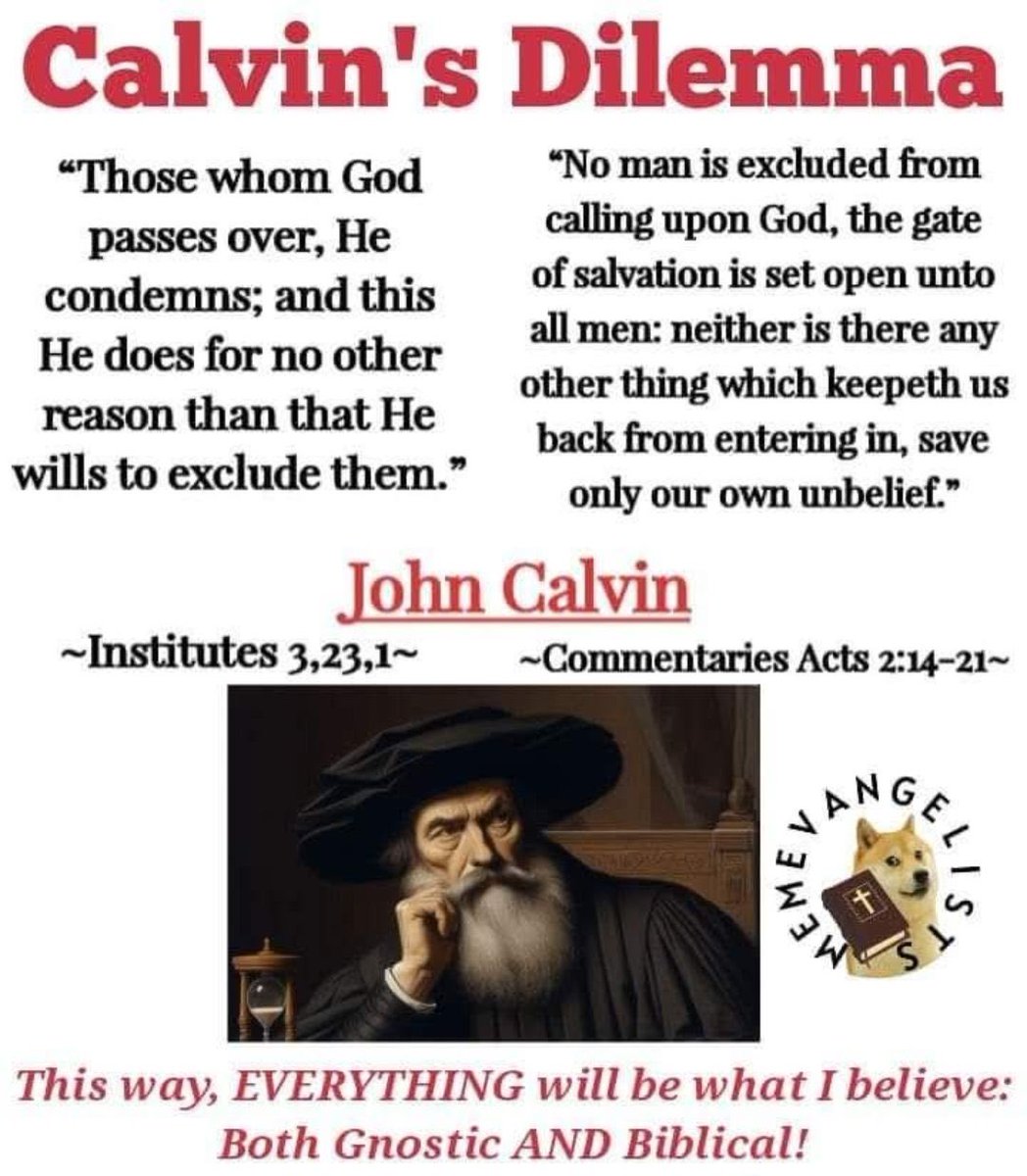
There is no dilemma. Calvin on the left is referring to God’s decree while on the right, he is referring to the prescriptive will of God which calls and invites all men to repent and believe. Both things that Calvin says here are true.
English
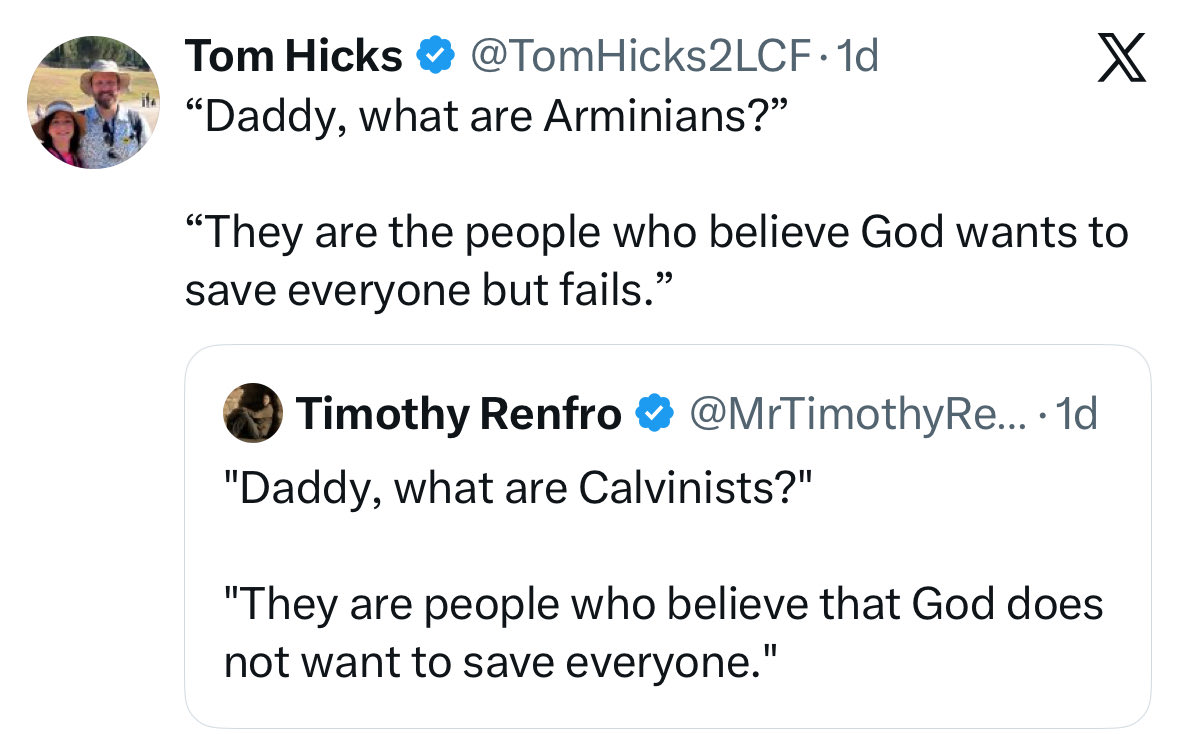
@ReformedCaio Man i always expected antisemitism to rise back up in my lifetime, but never had i dreamed of 'christians' being the ones pushing it.
We're witnissing the fall of the west and Gods judgement on her in real time
English

@RoyGoorman @_jonbowlin The made up ones? How many are up to?
English
@ReformedCaio Well its kinda unclear and can mean 2 things. In the broader context of rom9-11 it can refer to true israel, but in the direct context of Rom 11 he constantly talks about ethnic Israel which reads more naturally.
It he meant true Israel it would'nt make sense to not specify it
English

What does Paul mean when he says, “and so all Israel will be saved” (Romans 11:26)?
For those who insist that “all means all,” as in “every single individual without exception,” how do you read this passage?
English
This is the absolute brain rot of the christless conservative movement.
Cold hearted loveless men pretending to know Christ
Michael Spangler@spanglermt
One of the most subversive books around: The Hiding Place, by Corrie Ten Boom It celebrates shielding Christ’s enemies from the political consequences of their evil. Promotes lying to do so. Glorifies resistance to just government and cobelligerence with Communists. Paints the just consequences for these actions as persecution. And does so all in the name of White Protestant Christianity. Two dozen copies are available at your local Christian homeschool bookstore. Ministers cite it in the pulpit as something well known and beloved. The rot is very deep.
English
@HwsEleutheroi What vile/disgusting persom that is. Pretends to know Christ while having a cold stone heart
English

So the Nazis are out and about today. Certainly one of the most absurd, vile posts I have seen in a long time. Sorry, must lead with this on the DL today. Mark, warn, avoid. The wolves are dressed as sheep these days, but they barely bother to zip up their costumes.
Michael Spangler@spanglermt
One of the most subversive books around: The Hiding Place, by Corrie Ten Boom It celebrates shielding Christ’s enemies from the political consequences of their evil. Promotes lying to do so. Glorifies resistance to just government and cobelligerence with Communists. Paints the just consequences for these actions as persecution. And does so all in the name of White Protestant Christianity. Two dozen copies are available at your local Christian homeschool bookstore. Ministers cite it in the pulpit as something well known and beloved. The rot is very deep.
English
@TheMuppetPastor Dinosaurs arent related to birds. Thats an evolutionary lie. Dinosaurs are dinosaurs and birds are birds.
English

I got geology books for my oldest and they talked about a 4.5 billion year old earth with fossils and geological eras.
And she asked “But God created the world in seven days?”
I sat down with her and said “Yes, he did. Whether that’s seven days that we know or seven days to God, He did.”
And then I said “Look at the order of fossils you see. What animal comes first?”
“They think Bacteria.”
“Right. Before we even needed light, and after. What’s next?”
“Plants.”
Day 3 after he made heavens and earth. And next came the sun day four.
Next.
“A lot of clams and fish.”
“Fifth day. Also remember dinosaurs are related to birds, and birds are day five.”
“Wow I see dinosaurs and birds now!!”
What’s next?
“Day 6, animals.”
“And what’s next after dinosaurs?”
“Mammals!!”
Day 6!!
“Now what comes last?!”
“People!!!”
“End of day six.”
“Wow, so the geologists are saying that life was created the exact same order God said?”
“Yes. Did God lie to us?”
“No way!! It’s the same order!”
“So if it’s a human week, great. If it’s a week to God, who is outside of time and space, also great. Where some people look and see the Bible disproven, I look and see the creation order of Genesis one. And that is the takeaway. God made the universe and science agrees with the build order!”
I respect young earth creationists and old earth creationists. Whether God intimately crafted every atom, or if He designed a universe where nature itself would do that for Him, He is still almighty and loving. God doesn’t need to meet my 2026 scientific standards for me to believe. I have seen the Grand Canyon and Mammoth Caves. God not only exists, He chooses to love even me.
And the Bible isn’t “disproven” nor is it “errant” if earth is 4.5 billion years old. God designed the universe no matter what and expecting human authors born 4000 years before then scientific method to satisfy my modern curiosity is the height of arrogance.
The Bible was written for us, but not TO us. We should endeavor to understand the culture it can from. Our pride demands it to fit our preconceived notions, but that is folly and sin. We are to understand the bible, not force it to become something it isn’t.
God took us exactly what He wanted us to hear and know at a level He wishes us to understand. It’s like speaking to children, which we are. He made clear to Job that He doesn’t owe us an explanation of exactly how he designed the universe! Rather we are to trust and obey Him no matter what. And none of that somehow makes the Bible errant. No, it is exactly what God meant to say to humanity.
Sure, it fascinates me that dinosaurs are now considered close relatives of birds, and that they were created before most mammals and humans, which explains day 5 and 6. But knowing that isn’t what made me want to love and obey God, either.
Christians shouldn’t live in “fear” that science will disprove God. Remember, God created science, and the universe it studies. He will be just fine. He is just as real now as He was at the dawn of time, and nothing will ever disprove Him. Our pride does that, and you know what they say about that particular sin.
English
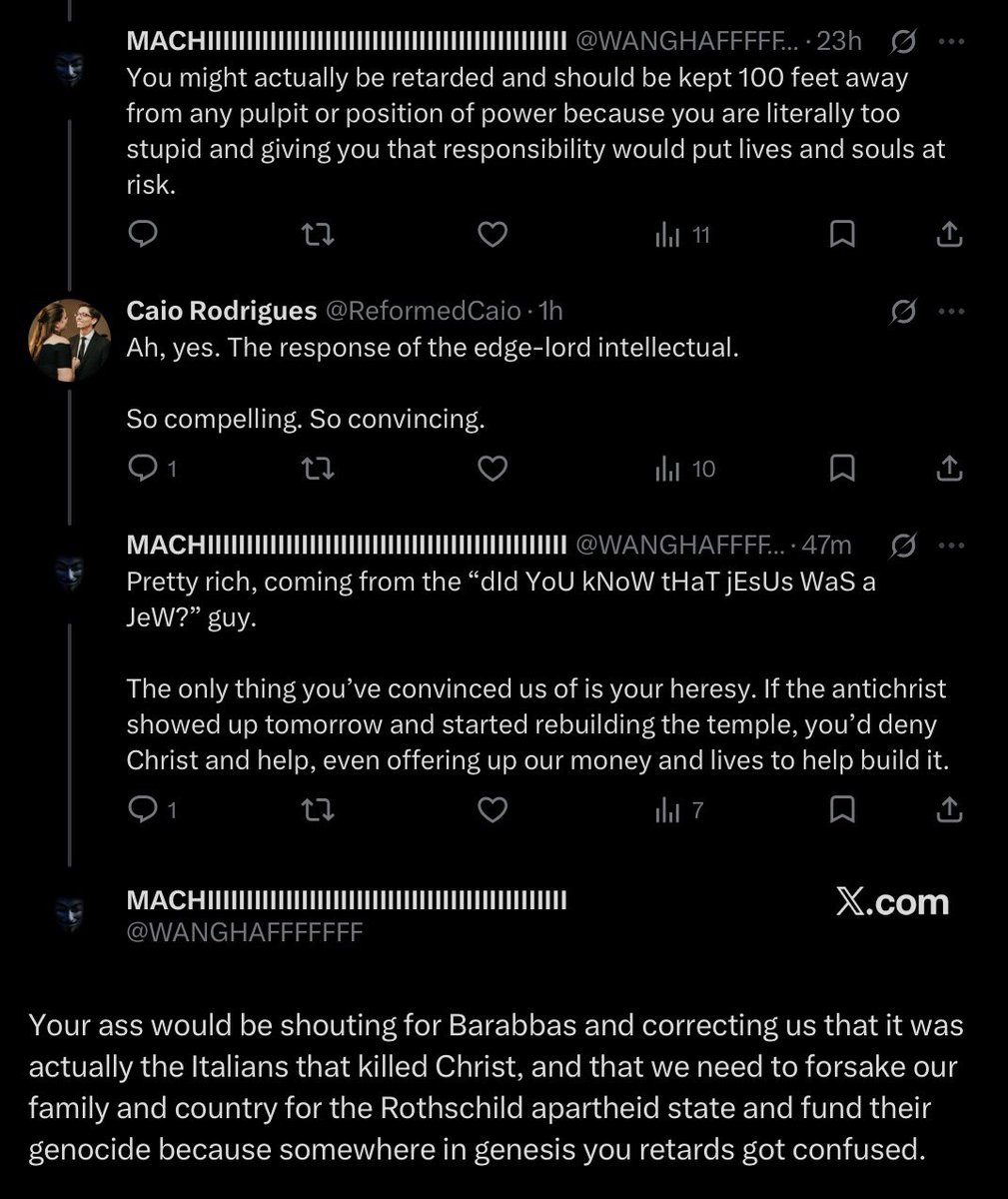
Imagine the mental derangement it takes to respond this way because someone believes what the Bible says, that Jesus was a Jew.
Guys like this need serious help. I’m thankful that not every CN is as rabid as this. And I’m especially thankful that every single CN I know in real life are absolutely normal and love filled brothers.
This level of derangement only exists online behind anonymous accounts.
English
@ostrachan @ReformedRap has awesome christen rap/rock songs. You should check out his reformers resistance album and hear Huss, Luther, zwingly, Calvin & Knox rap it out in style
English

I love rap music so much, and interestingly Christian rap led me to much deeper worship of the Messiah, Jesus Christ, who lived all his days on earth with Jewish blood pumping through his veins.
Mikale Olson@realmikolson
Joel Webbon and Calvin Robinson say rap music is evil and—you guessed it—Jewish 🫠🫠🫠🫠
English


@ReformedRap @Brian_Sauve Dont lets these guys talk your work down.
You bring the king of music no one makes, but that we need!
English
@Brian_Sauve My channel is only AI generated songs, but it's mostly for educational purposes and entertainment value. No artist is making high quality rap songs about John Calvin or Tyndale... so why not me?
English

Your immediate response to discovering that a piece of "music" was AI-generated should be visceral disgust.
English
@ReformedRap @Brian_Sauve I really dont mind that your songs are made with AI. Because i know there is a person behind it that checks it, makes sure its theologically sound and controls the outcome to get it the way he envisioned it.
You are doing a magnificent job. Keep going strong
English
@Brian_Sauve If there was a REAL band that made a Rock Battle between Augustine and Pelagius... then I wouldn't have to use AI.
I think we need discernment with AI, not fear-mongering.
x.com/ReformedRap/st…
ReformedAndDangerous@ReformedRap
Augustine vs. Pelagius as a Rock Battle!
English
Just so you are aware, the way that streaming royalties work is that every stream of an AI-generated song means a real musician makes less on every one of their streams.
Most platforms already only pay out about $.003 per stream, or three-tenths of one penny per stream.
That number will plummet As AI-generated music takes over, particularly music generated by the streaming platforms themselves.
English
@ReformedRap Brother i need to get your attention to this.
I notice a small mistake in the song 'faith that burns' (awesome song btw).
At the 3:27-3:32 mark the voice of the chorus fades out so that the 'better fire than apathy' part is not hearable anymore.
Just thought i'd let you know
English
In my devotions this morning I was struck by this line from Thomas Brooks in Precious Remedies Against Satan’s Devices:
“God is most angry when he shows no anger. God keep me from this mercy; this kind of mercy is worse than all other kind of misery.”
The Lord disciplines those He loves. And we should thank Him for it.
If God never corrects us, that’s not mercy—it’s abandonment.
It’s a frightening prayer, but one we should pray: Lord, love me enough to discipline me if I stray into grave sin.
Brooks also warns:
“When Satan tells you of other men’s sins to draw you to sin, think of their sufferings to keep you from sin… If you sin with David, you must suffer with David.”
The worst judgment is not immediate punishment.
It’s being left to our own devices.
We’re seeing that in many ways in our nation today.
May we turn from sin and cling to Christ—
individually, as a church, and as a nation.
English