Rushi Chavan

579 posts

Rushi Chavan banner
Rushi Chavan

Rushi Chavan

@RushiChavan_

I track capital flows before they become consensus.

Katılım Mayıs 2024
792 Takip Edilen123 Takipçiler
Sabitlenmiş Tweet
Rushi Chavan
Rushi Chavan@RushiChavan_·
The “tokenization roadmap” isn’t: start with safe assets → move to exotic ones. That’s a narrative. Reality: Assets move onchain only where there is clear economic advantage. Most “obvious” assets aren’t transformed. They’re just better distributed. And most “illiquid” assets aren’t broken rails. They’re weak demand + poor price discovery. Tokenization doesn’t fix fundamentals.
English

0
0
2
26
Rushi Chavan
Rushi Chavan@RushiChavan_·
For Bitcoin to compound at 30% forever, it would need continuous exponential capital inflows or systemic fiat failure. Both are unlikely at that scale. Scarcity alone doesn’t create returns. Returns come from marginal buyers with capital. Bitcoin can outperform. But perpetual 30% CAGR is mathematically and structurally unrealistic.
English
0
0
1
24
Rajat Soni, CFA
Rajat Soni, CFA@Rajatsoni·
So many people truly believe that Bitcoin can't return 30% a year in perpetuity in terms of US dollars I disagree The belief that Bitcoin's returns must fall over time makes no sense because the dollar has no real value, just like every other government issued currency It can be printed out of thin air, and there is no supply cap The dollar can lose 99%, then another 99%, and then another 99%, because the supply can rise 10-15% per year forever The dollar is literally DESIGNED to trend to 0 forever... the more dollars that exist, the lower the value of each individual dollar In terms of Bitcoin, there is no cap on how much value the US dollar can lose each year The dollar is purely backed by belief and trust, which can literally disappear overnight So yes, Bitcoin could have 30%+ returns per year for a very long time It all depends on how long it takes for people to lose trust in the dollar and fiat currencies in general Every fiat currency eventually goes to 0 because the market decides its value, not elected individuals in offices This is why I think Bitcoin's returns will accelerate over time As more people want it and fewer coins are available, the price will have to go up faster and faster Bitcoin will be extremely volatile in terms of every fiat currency, but eventually, 1 BTC will be worth $10M, $100M, and $1B It's just a matter of time
English
18
10
120
6K
Rushi Chavan
Rushi Chavan@RushiChavan_·
@binji_x Ethereum isn’t the base layer of everything yet. Usage is still finance heavy and fragmented. Upgrades help, but don’t solve UX or distribution. The bet is valid. But only if it outcompetes closed systems.
English
0
0
0
40
binji
binji@binji_x·
WTF is Ethereum (Glamsterdam edition): more of your life is going to run through software your money your identity your messages your work your reputation your agents your access to institutions your ability to prove who you are and what you own the next internet will not just show you information, it will act for you it will move value and it will coordinate people, markets, apps, governments, even machines. in this world the question becomes: where does this internet run? inside closed platforms? inside private databases? inside systems you cannot inspect, cannot leave, and cannot meaningfully challenge? or on neutral infrastructure that anyone can verify, anyone can build on, and anyone can exit from? the latter is the ethereum bet the world needs powerful shared infrastructure but power without neutrality becomes capture power without privacy becomes surveillance power without security becomes fragility power without open source becomes dependence ethereum is trying to build the other path glamsterdam is an upgrade to ethereum that makes that path more credible ePBS changes how ethereum builds blocks today, part of block building depends on off protocol infrastructure and a very tight timing window glamsterdam brings more of that process into the protocol and gives execution more breathing room that matters because bigger blocks need time to move safely across the network block level access lists give ethereum a map of what a block will touch before the work begins right now, much of ethereum execution is like a kitchen where every chef has to wait in one line because nobody knows who needs which ingredient BALs give clients the shopping list up front that opens the door to parallel reads, better throughput, faster syncing, and eventually much more parallel execution gas repricing makes sure higher capacity does not poison the network blockchains have a memory problem when you create new accounts, contracts, or storage, that data can live in the network’s state for a very long time if ethereum raises the gas limit without pricing that properly, the network gets faster in the short term and heavier forever EIP 8037 is about making state growth pay its real cost ethereum can grow without making it impossible for normal people to run the network crypto people talk about gas limits, blobs, builders, validators, access lists, and state growth normal people care about something simpler can i own what is mine? can i leave if the platform turns against me? can i prove something without exposing everything? can i use digital money without asking permission from a private company? can the systems I depend on keep working when politics, markets, or institutions break? ethereum exists because those questions need serious answers Ethereum stands for PEOPLE has final say over their assets, identity, actions, and agents read that again in the age of AI agents will act for us wallets will become smarter software will negotiate, sign, pay, filter, recommend, and remember the internet is becoming more alive that makes the base layer more important, not less because when machines act for people, people need stronger guarantees about what those machines are allowed to do they need credible exits they need privacy they need open rules that is what ethereum is for it is the open rail underneath a more digital world the world is moving toward programmable money, AI agents, tokenized assets, digital identity, and institutions that operate onchain that future needs a base layer ethereum is fighting for that base layer to stay open the open path has to scale glamsterdam is ethereum scaling the open path and is doing it so that everything is still neutral still open still yours
English
8
22
143
7.1K
Rushi Chavan
Rushi Chavan@RushiChavan_·
@aswren Dawkins being smart doesn’t validate the argument. Capability doesn't mean consciousness
English
0
0
2
89
Adam Wren
Adam Wren@aswren·
Dawkins is more intelligent than 99% of the people making fun of him and ‘if AI can be just as capable as us without being conscious, why did we develop consciousness in the first place?’ is a great question
English
920
192
2.5K
224.5K
Rushi Chavan
Rushi Chavan@RushiChavan_·
@renaissancing_ @ethereum That’s the ideal, not reality. Ethereum is strong as settlement and coordination, but usage is still fragmented and finance heavy. World computer only holds if it delivers scale and low friction. Not there yet.
English
0
0
0
27
renaissancing
renaissancing@renaissancing_·
The World Computer (@ethereum) is decentralized infrastructure for permissionless compute, communication, and association, and it naturally connects to builders who uphold those freedoms: open source projects, privacy and cryptography researchers, civil liberties defenders, educators and public-interest technologists, builders of resilient local communities, and the quiet maintainers of civilization who keep essential systems and traditions running.
English
3
3
52
4.5K
Rushi Chavan
Rushi Chavan@RushiChavan_·
@colludingnode Not nuance, category confusion is the real problem. Everyone mixes permissionless claims with centralized realities
English
0
0
0
43
勾结节点
勾结节点@colludingnode·
As a nuance hater, it sucks when issues are genuinely too nuanced for public discourse - Tornado Cash: - devs can be guilty of some charges, but the important thing is that gov should be constitutionally-prevented from sanctioning autonomous smart contracts - Arbitrum Multisig: - reclaiming hacked funds is good, but the backdoor should require the same compliance burden as custodial offerings (or not exist) - Stablecoins: - It's not that they're "not cypherpunk" or whatever, but all the legislation that exempts stablecoin products from the same regulations as money transmitters and brokers incorrectly presumes that the issuers "don't control the ledger", when the entire industry quietly admits that they do; and thus they facilitate every transaction in the provenance of the tokens for which they process redemptions.
English
4
7
54
2K
Rushi Chavan
Rushi Chavan@RushiChavan_·
@Web3Kristel Yes, If users need to understand gas, they'll never adapt. Until it feels like PayPal or Google Pay, it stays niche
English
0
0
0
28
Kristel
Kristel@Web3Kristel·
When your beta testers have had MetaMask installed for three years and understand gas fees intuitively, you never experience the friction that kills adoption for someone who does not.
English
3
0
9
265
Rushi Chavan
Rushi Chavan@RushiChavan_·
@rand_longevity Dose, cooking method, and overall diet matter far more than demonizing one category of fats
English
0
0
2
39
Rand
Rand@rand_longevity·
what seed oils do to your body: inflame cell membranes oxidize at cooking temperature disrupt hormones drive metabolic dysfunction accelerate biological aging
English
5
3
24
1K
Rushi Chavan
Rushi Chavan@RushiChavan_·
@r0ktech I know, but still better than doing nothing till your limit resets, testing deepseek V4 with difficult tasks made me realise how good open-source LLM has become
English
1
0
3
73
𝐑.𝐎.𝐊 👑
Claude Code: "You've hit your limit, Limit resets 7pm". Me from 5 - 6:59pm . 💀
English
79
795
12.2K
588K
Rushi Chavan
Rushi Chavan@RushiChavan_·
The stablecoin debate is being misframed as innovation vs regulation. That’s not the real conflict. This is about who gets to issue money-like liabilities and under what constraints. Stablecoins replicate key bank functions: they take in capital, promise redeemability, and rely on trust in reserves. But they operate outside the full stack of bank regulation: capital buffers, lender of last resort, deposit insurance, and supervision. Regulators are reacting to that gap. Not just to control crypto, but to prevent shadow banking risks scaling on new rails. At the same time, overreach is real. When agencies stretch mandates or reinterpret narrowly written laws, they risk slowing competition and entrenching incumbents. The core tension is not ideological. It’s structural: Crypto optimizes for: speed, global access, capital efficiency Regulators optimize for: stability, consumer protection, systemic containment You cannot maximize both. The real question is: who absorbs losses in a stress scenario and who has authority over that system. Everything else in this debate is downstream of that.
Rushi Chavan tweet media
English
0
0
0
23
Rushi Chavan
Rushi Chavan@RushiChavan_·
Overreach risk is real, but this isn’t just capture. Stablecoins mimic bank liabilities without full bank rules. Yield and rewards directly affect run risk. One to one reserves alone do not guarantee safety. What matters is asset quality and redemption under stress. This is about who holds the risk, not just who writes the rules.
English
0
0
0
112
Jeff Park
Jeff Park@dgt10011·
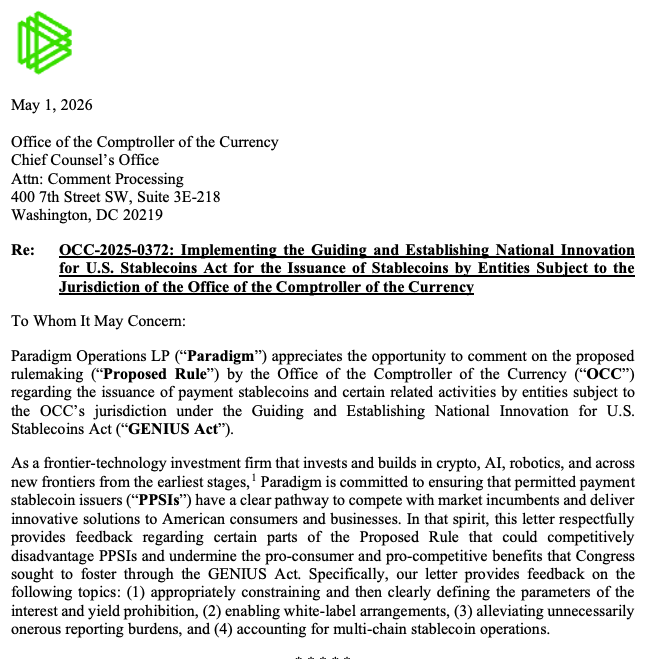
this response is worth a full read, and you don't really have to understand or care about crypto to diagnose the political issue at stake. it's a story about regulatory capture the kind of institutional rot that gave rise to crypto in the first place congress knows how to legislate broadly if it wanted to prohibit certain things, so the fact that it didnt means that it was intentionally narrow. for the OCC to then interpret its own goals more broadly, further made worse by rebuttable presumption ("guilty until proven innoncent") goes against the spirit of the sandbox that other agencies are striving to achieve; the OCC is the clear outlier. paradigm's citing of loper bright case knocking down the Chevron deference is worth a read the core issue is that OCC is imposing a reg standard that is materially stricter than what it otherwise imposes on the functionally equivalent bank products. banks routinely run reward arrangements at incredible scale. consider for example BOFA (a deposit institution) holding your deposits where Merill (a broker dealer affiliate) pools its investment balances with BOFA for which based on those combined balance, members receive elevated credit card rewards bonuses, interest rate boosts etc. the OCC has never suggested BOFA needs to prove this isnt disguised interest. this is before we even contemplate a third party/affiliate classification all arguments for the OCC eventually lead to some kind of deposit flight concerns and stablecoin lacking FDIC insurance. but again, this grievance (as illegitimate as it may be) is an argument for Congress to address, not an agency. and they did - with a supermajority bipartisan vote. the yield topic was exhaustively debated leading up to GENIUS passage last year, and the banking lobby lost. attempting to relitigate that decision through the OCC is the kind of institutional behavior that made americans distrust banks in the first place. this will age very badly for them and here is the greatest irony of it all- stablecoins are safer than bank deposits! they are required to hold 1:1 reserves which is safer than fractional reserve leverage with FDIC insurance with a cap! the OCC should consider that maybe deposit flight is a feature, not a bug
Stefan Schropp@SPSchropp

In case you missed it, on Friday, @Paradigm responded to OCC’s proposed GENIUS Act rule. This a major lift on a very important rulemaking, and the @OCC got a lot right; but there’s a lot that needs work too.

English
3
13
100
22.2K
Rushi Chavan retweetledi
Joel Valenzuela
Joel Valenzuela@TheDesertLynx·
The feed is full of insecure crypto bagholders trying to twist charts into bullish setups, hyping their sad tokens as the next big opportunity, and viciously bashing other coins. It's absolutely pathetic. Build cool stuff and get it used. Collaborate with others on your same mission, even competitors. The rest of you are going to lose all your money. And you'll deserve it.
English
15
7
70
2.2K
Rushi Chavan
Rushi Chavan@RushiChavan_·
@stijnnoorman Simplicity isn’t intelligence Some things are simple Some are irreducibly complex
English
0
0
3
198
Stijn Noorman
Stijn Noorman@stijnnoorman·
Dumb people are impressed by complexity. Smart people are impressed by simplicity.
English
240
1.6K
11.8K
180.2K
Rushi Chavan
Rushi Chavan@RushiChavan_·
@RWAFoundation_ Legal enforceability Redemption and cash flow rails Real liquidity, not just venues Accounting Tax and jurisdiction Governance
English
0
0
1
50
RWA Foundation
RWA Foundation@RWAFoundation_·
Real-World Assets Need Lots of layers to click into place in order to become complete: Asset origination Legal structuring Custody & asset verification Tokenization layer Onchain issuance Compliance / KYC & AML Oracles & data feeds Liquidity venues (DEXs/CEXs) Settlement & clearing Risk management / ratings Investor access layer Servicing & reporting What layers are we forgetting?
English
27
11
70
2.7K
Rushi Chavan
Rushi Chavan@RushiChavan_·
@anndylian What matters is real users paying for real utility without that, it’s just reflexive liquidity cycling not value creation
English
0
0
0
7
Anndy Lian
Anndy Lian@anndylian·
#加密货币 需要可持续的收入,而不是自我陶醉. #Crypto needs sustainable revenue. Not circle-jerking.
中文
15
3
56
2.7K
Rushi Chavan
Rushi Chavan@RushiChavan_·
Crypto doesn’t capture financial services. It competes in specific layers where it’s structurally better like settlement, collateral mobility, cross border payments Most of that thirty six trillion is regulated balance sheets, credit intermediation, and trust based services Adoption is not linear, real upside exists, but only where crypto delivers
English
0
0
1
60
Richard Teng
Richard Teng@_RichardTeng·
People often ask: how big can crypto really get? Consider the total addressable market: → Financial services: ~$36T → Payments: ~$788B → Social: ~$208B → Crypto exchanges today: ~$55B The opportunity is expanding rapidly. Even marginal adoption across these sectors could drive transformational growth for crypto.
Richard Teng tweet media
English
126
59
310
23.7K
Rushi Chavan
Rushi Chavan@RushiChavan_·
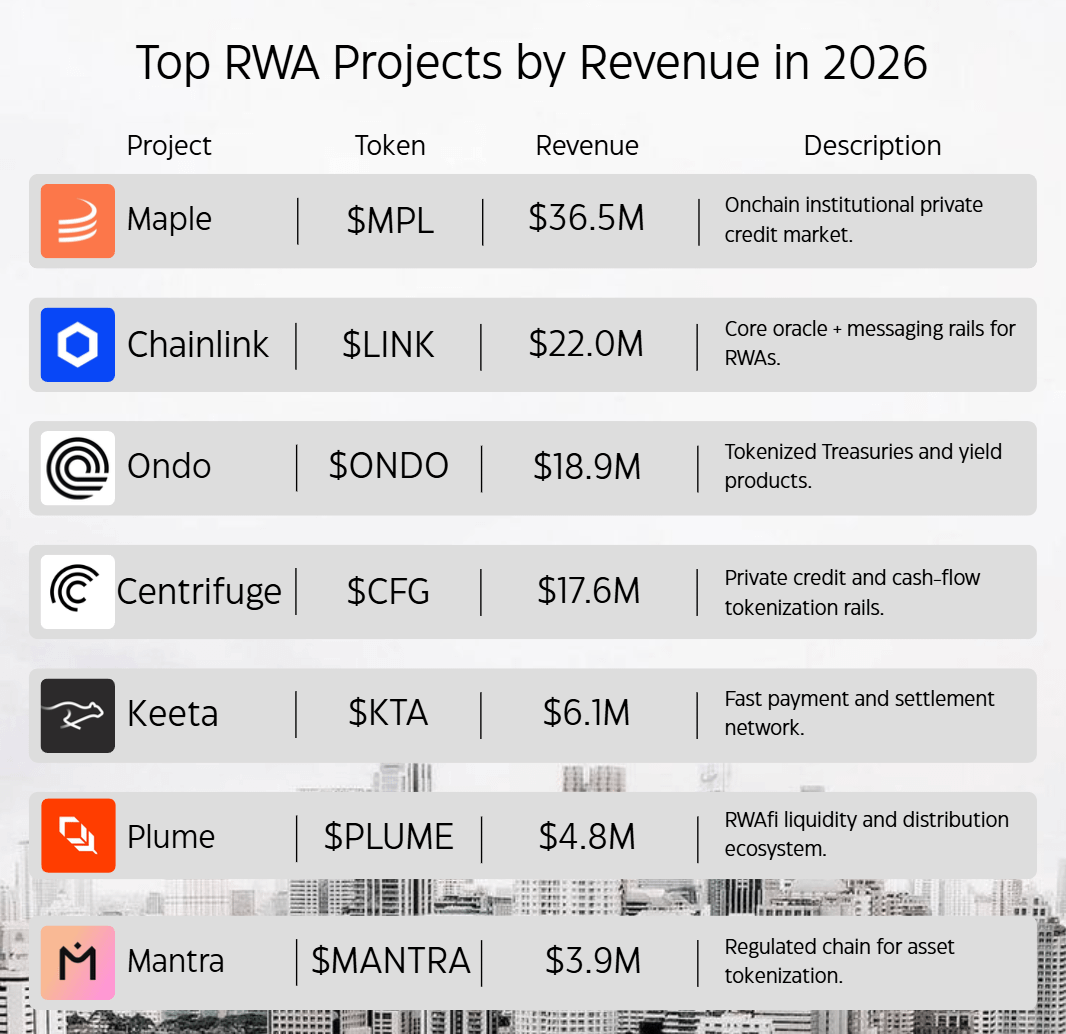
Most of this revenue is rate driven yield capture, not durable protocol economics These aren’t pure crypto businesses, they are wrappers around offchain assets with fees on distribution and structuring Bull case exists but this is still early infrastructure, not proven cash flow durability
English
1
0
2
254
AlΞx Wacy 🌐
AlΞx Wacy 🌐@wacy_time1·
RWA exploded to $30B onchain in record time. TVL tells story. Revenue tells future. RWAs printing cash in bear = positioned for 5-15x when bull phase hits. Fundamentals now. Multiple expansion tomorrow. Top RWA earners in 2026: $MPL @maplefinance - Onchain credit market for institutional borrowers and lenders. Maple is showing that private credit can work onchain when underwriting, yield, and capital demand are real. $LINK @chainlink - Core oracle and cross-chain infrastructure for RWAs. Institutions need reliable pricing, proof-of-reserves, NAV data, and settlement rails, and Chainlink sits directly in that flow. $ONDO @OndoFinance - Tokenized Treasuries and institutional yield products. Ondo is one of the clearest examples of compliant RWA demand moving onchain. $CFG @centrifuge - RWA credit infrastructure focused on private credit, invoices, and structured assets. Centrifuge connects real-world cash flows with DeFi liquidity. $KTA @KeetaNetwork - High-speed payment and settlement network focused on real-world financial transfers and tokenized asset movement. Built for scalable financial rails. $PLUME @plumenetwork - RWAfi network built to bring tokenized assets into crypto-native markets. Plume focuses on distribution, liquidity, and making RWAs usable inside DeFi. $MANTRA @MANTRA_Chain - RWA-focused chain built around compliant asset tokenization. MANTRA is targeting institutions that need regulated rails for issuing and managing real-world assets. RWA isn’t just about putting assets onchain anymore. The next filter is simple: who actually makes money from it?
AlΞx Wacy 🌐 tweet media
English
49
48
220
18.8K
Rushi Chavan
Rushi Chavan@RushiChavan_·
@ZeusRWA They are very different layers Stablecoins are onchain money Represented assets are offchain exposure Distributed RWAs are actual tokenized claims. If you want the real number, look at distributed RWAs only. That is the closest to true onchain ownership
English
1
0
1
35
Zeus 🇬🇧
Zeus 🇬🇧@ZeusRWA·
When we talk about “total RWAs onchain,” what should actually get counted? Do we include stablecoins + tokenized/represented assets + distributed exposures? If yes, you’re looking at roughly: $300B + $440B + $31B = $770B+ onchain Or do we jusy go with distributed assets which ranges from 27-31 billion depending on what data site you use…
English
22
1
49
1.4K