SA_vaninvestor

5.9K posts

SA_vaninvestor

SA_vaninvestor

@SA_VanInvestor

Retail investor. Not investment advice.

Katılım Kasım 2021
129 Takip Edilen529 Takipçiler
SA_vaninvestor
SA_vaninvestor@SA_VanInvestor·
@WSB_redditor @Sportellosprea1 In my opinion, Cooper wants $mpct.un to eventually succeed for his legacy so I figure it will. That said, the condo market is awful in TO so I can see bad news from that front in the near term.
English
1
0
1
64
WSB Redditor
WSB Redditor@WSB_redditor·
@SA_VanInvestor @Sportellosprea1 No worries. It makes sense. In the grand scheme of things, Iran war aside and having no personal stake in MPCT, what do you think about the Q1 earnings & trajectory ? General meeting next month on june 3rd. Cheers 🍻
English
1
0
0
40
Sportello_spreadsheets
Sportello_spreadsheets@Sportellosprea1·
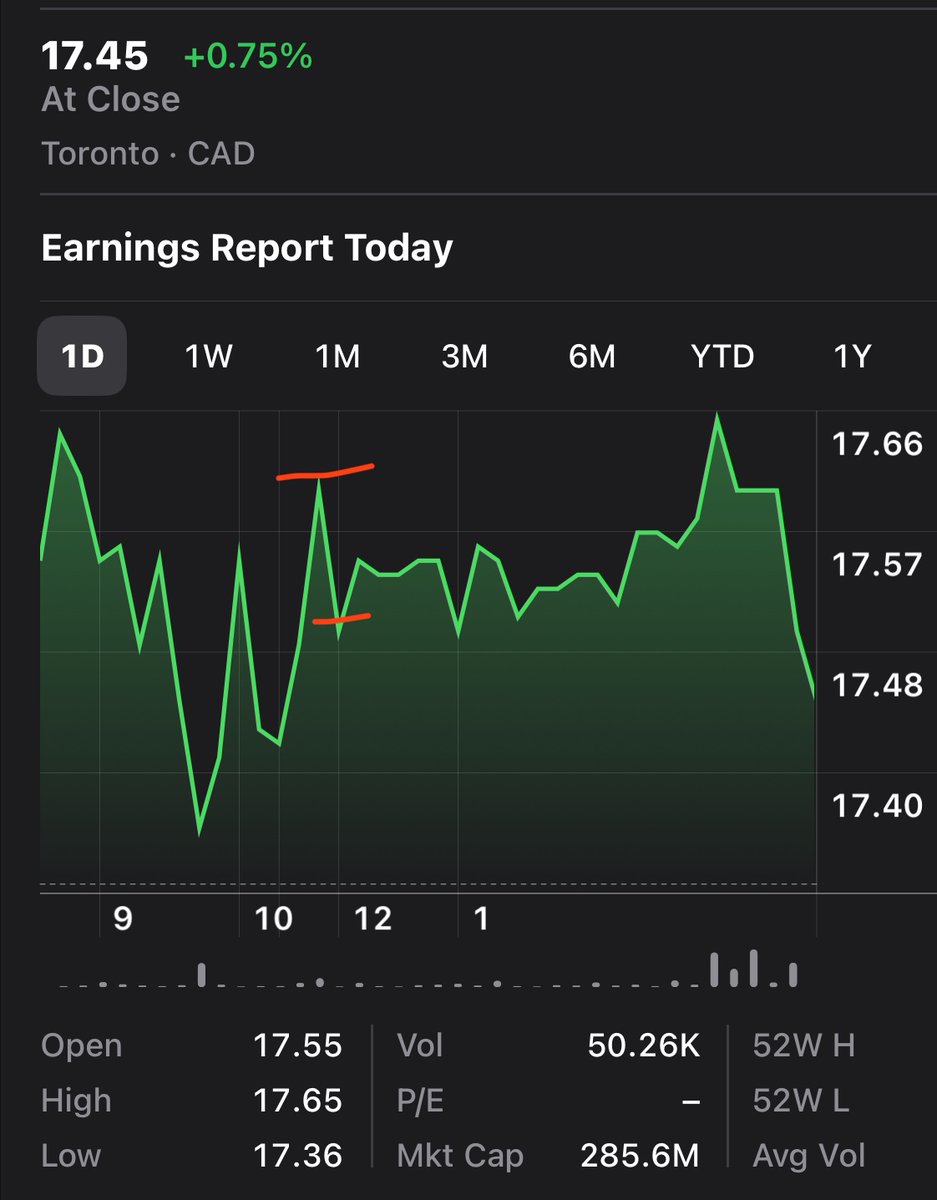
Put a 100 share limit order in at the midpoint of bid/ask and caused the red mark 😂. I want to see through the upside to Toronto financial sector RTO. I see higher likelihood of take private after $ddr.un SR. May not happen in 2026 but like the r/r at $17.50. 2027 AFFO est 🥵
Sportello_spreadsheets tweet media
English
2
1
7
755
SA_vaninvestor
SA_vaninvestor@SA_VanInvestor·
@tsxman Chris are you still long $acx.to going into earnings? I have been adding to my position since the dip in April.
English
1
0
2
123
Chris in Canada 🍁
OFS multiple charts from #CIBC's underwhelming coverage. $ESI.TO $PTEN $PD.TO $HP $NBR $TOT.TO
Chris in Canada 🍁 tweet media
English
1
0
3
874
SA_vaninvestor
SA_vaninvestor@SA_VanInvestor·
@deepvalueco I actually did same except aold out of $mda.to and eqb.to completely. Neither were core positions and after they went up I didn’t have much conviction on either.
English
1
0
0
94
IRResistible CAGRs🍁
IRResistible CAGRs🍁@deepvalueco·
International Growth Portfolio hasn't put up much in terms of returns over the last 12-18 months Feels much cheaper and could see a number of ways for notable catchup over the next 18 months. Very interested in seeing how a few things play out.
English
2
0
1
1.1K
SA_vaninvestor retweetledi
TechStockFundamentals
TechStockFundamentals@TechFundies·
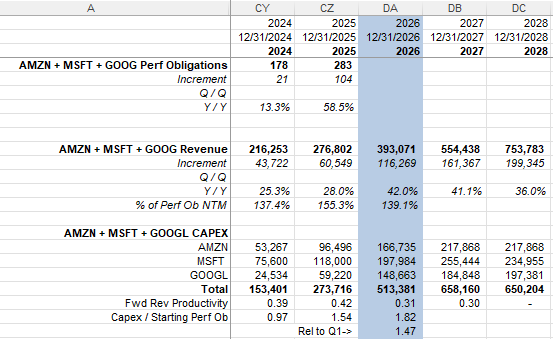
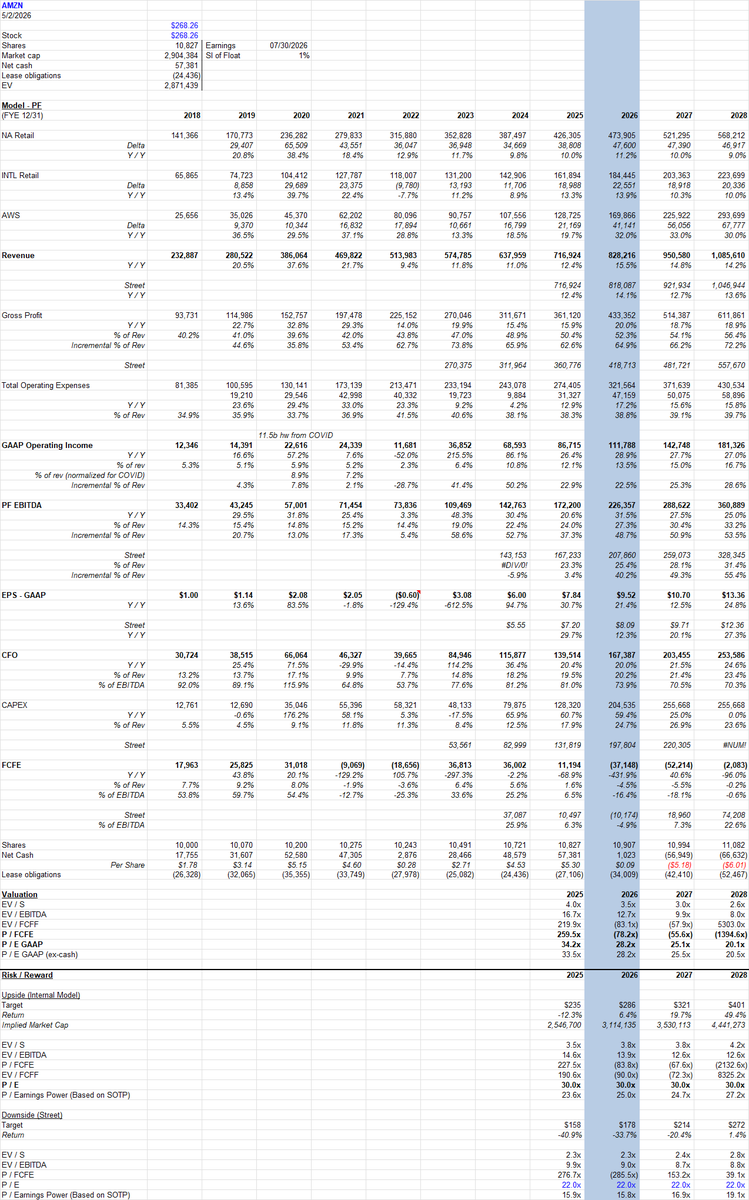
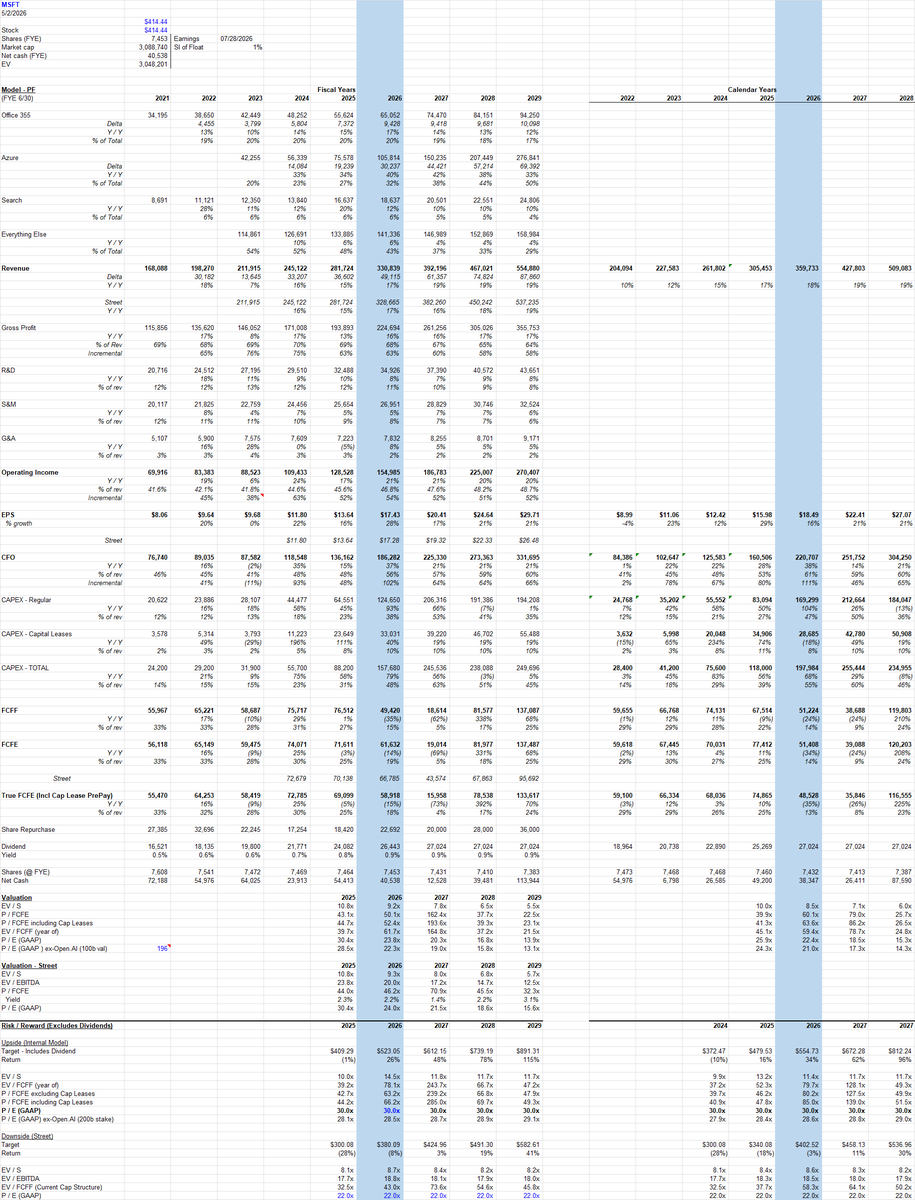
Since all the hyperscalers are going to report on the same day, maybe they can just hold a joint conference call to make it easier on us? Would make Q&A a lot more interesting. Ok – so the numbers were so wild that I think we have to start by looking at them together : $AMZN AWS + $MSFT Azure + $GOOGL GCP = HYPE. HYPE cloud rev of 84.4b grew 6.8% qq / 39.1% yy with net add of 5.4b. Just to provide some context for how outrageous this is, the 5.4b in net add compares to 0.7b last Q1 and 1.4b the Q1 prior to that. (FX was a tailwind of a few points but inconsequential as far as the bigger picture). I attempt to normalize backlog for duration (ie rough exercise to normalize for companies signing longer-term deals) which results in “current” backlog of 350b up 77% yy. Net add add of 68b in Q1 up from 19b last Q1 and 5b the Q1 prior to that. Outrageous. GAAP margins were healthy across the board which validates capex spend to date. Digesting this AI infra cycle is really mind-bending so let’s just try to invert it all and start with facts. I try to normalize all CAPEX for HYPE infrastructure only (and strip out capex for AMZN retail, GOOGL search, etc.). Here is HYPE CAPEX by year relative to beginning current backlog -2024: CAPEX of 153b was 97% of starting current backlog -2025: CAPEX of 274b was 154% of starting current backlog -2026: CAPEX plan of 513b is 182% of starting current backlog. And is 147% of current backlog at end of Q1 (might be more fair given massive Q1 bump). 2025 / 2026 CAPEX are clearly elevated versus starting backlog compared to 2024, but also include more longer-dated investments as a percent of total. Also demand is exploding so leaning in makes sense. So if 2025 CAPEX was rational based on the revenue ramp / healthy margins we are seeing thus far, 2026 also seems defensible relative to starting backlog. In other words, the 2025 CAPEX bet is playing out nicely and 2026 seems inline with 2025 based on backlog. Here is capex revenue productivity (incremental cloud revenue in forward year / current year CAPEX) -2024 productivity of 0.39 (2025 incremental revenue / 2024 capex) -2025 productivity of 0.42 (2026 estimated incremental revenue / 2025 capex). This is based on my estimate that HYPE does 393b in rev this year which is up 42% yy. So what will revenue productivity be in 2026 (ie how much incremental revenue in 2027 from capex this year?). I am assuming a meaningful stepdown in productivity (competition for ROIC, more long-dated investments, etc.) to 0.31 down from 0.42 in 2025. This implies HYPE will do 554b of rev in 2027 up 41% yy w/ net add of 161b up from 116b this year. So, we are now crossing over from facts to implication. 2026 is probably going to be great. (Or maybe this massive Q1 / Q2 spending ramp results in CFO panic / scrutiny and we see an equally epic sequential slowdown in Q3 / Q4. Don’t know.) Anthropic / Open.AI have added 50-60b in incremental ARR thus far this year (!). Let's say they add >100b. An overly conservative estimate would be that they spend 100% of this ARR on HYPE (+ORCL / NEO) - think of it as 50% of the spend is for inference and 50% for forward model training (we know model training is way higher). Anyways, 2025 capex seems like a solid investment w/ cooked 2026 revenue growth. So the trillion dollar question is will the model companies (Open.AI, Anthropic, Gemini, ...) see scorching revenue momentum in 2027 to justify 2026 CAPEX and justify meaningfully higher CAPEX in 2027 and maybe 2028? These feel like the tip of the spear questions to me: -Can the HYPE capex of 513b this year generate 161b in incremental rev in 2027 (up from 116b incremental in 2026)? Going to need continued, MASSIVE growth out of the model companies... -If this year goes according to plan, will HYPE capex for 2027 reach 658b (28% growth)? On the back of that, can HYPE 2028 revenue grow 36% growth at 0.30 productivity - this implies 199b in additional revenue dollars?! I don't really know how to put odds on that. That's a lot of incremental revenue dollars. I’m not even including ORCL and neoclouds in this capex / revenue capacity / productivity exercise which would make hand-wringing even sweatier (tons of capacity coming from them which makes the revenue bogey to preserve ROI even higher, or completely whacks industry ROI). I can’t really answer these questions with confidence. That raises unanswerable follow-on questions – does the law of large numbers dictate capex has to peak in or by 2028? And does that imply second derivative turns negative by 2027? (if so, semis probably peak later this year)? Is HYPE cheap here ahead of great growth / ROIC? Business this year seems locked in given model momentum and the stocks are cheap on this year. So arguably even if model momentum slows meaningfully in 2027, we are already pricing in lower ROIC on 2026 capex. Maybe the simplest view ends up being the correct one: while the model companies are scorching, the stocks will do well. And whenever / however that party ends, the whole ecosystem goes down. Thoughts welcome but only if superior to AI thoughts below which are pretty strong. If AGI is measured relative to average comment on X or qualitative feedback from the average investment team, we're already there. Seriously.
TechStockFundamentals tweet mediaTechStockFundamentals tweet mediaTechStockFundamentals tweet mediaTechStockFundamentals tweet media
English
3
6
86
12.8K
SA_vaninvestor
SA_vaninvestor@SA_VanInvestor·
I am watching SI results. If their results don’t accelerate soon due to wider spread AI adoption then IMO AI has a serious real world demand problem.
English
0
0
0
55
SA_vaninvestor
SA_vaninvestor@SA_VanInvestor·
Demand from SaaS vendors. They have been adding AI capabilities like crazy to avoid obsolescence but at some point this will slow down. Circular demand from internal and partner foundation models. This demand seems risky. Any wobbles in the AI story and it gets whacked.
English
1
0
0
61
SA_vaninvestor
SA_vaninvestor@SA_VanInvestor·
AI air pocket coming? I am a corporate IT professional. From what I am see, read and results from SIs, AI is not YET being adopted quickly. For most orgs, still are in a “we need to figure this out before we invest significantly.” So how are hyperscalers growing crazy?
English
1
0
0
119
SA_vaninvestor
SA_vaninvestor@SA_VanInvestor·
@BobEUnlimited What I find interesting is the huge difference in business growth of the hyperscalers and the SIs ($acn, $cap.pa, $ibm consulting). The SI consulting arms are growing at oow single digits. How can this be possible in an AI adoption boom? Is there really a boom?
English
0
0
0
96
SA_vaninvestor
SA_vaninvestor@SA_VanInvestor·
@Mr_Neutral_Man As well, as constantly enhancing security, changes to APIs, continual testing, and you lose access to functional enhancements that come every month. It just doesn’t make sense for most organizations to do it.
English
0
0
0
26
SA_vaninvestor
SA_vaninvestor@SA_VanInvestor·
@Mr_Neutral_Man Why not go further? He may but IMO it doesn’t make sense to replicate/replace SaaS unless a custom solution creates a bunch if business value for you. Building your own accounting and payroll means you now have to constantly keep it updated to state and federal changes
English
1
0
0
31
Mr Neutral Man aka "Howard Marks of REITs”
If you invest in SaaS, you need to read this This is probably the most real world example of AI eating software that I have seen We've tried a bunch of AI efforts and it was extremely painful 18 months ago. I need to revisit and get more involved.
Barrett Linburg@DallasAptGP

Two people in our office are finishing custom software that will be the backbone our entire company. Two years ago this would have cost $1M+ and a year of dealing with outside software developers. We are building it in a few months with VSCode and AI. Operating apartments is not hard. What is hard is making a hundred people share the same data and do the right thing at the right time. That coordination is the whole game in vertical integration. We invest, develop, build, and manage Texas apartments. Four functions under one roof. Most operators outsource three of the four. The advantage of doing all four shows up only when the four sides share data in real time. Without that, vertical integration is just four separate companies under the same name. So we needed software that tied the four sides together. No SaaS product exists for it. Every SaaS tool we run is a silo. ResMan tracks leases. Procore tracks construction. Sage Intacct tracks the books. LoanBoss tracks the debt. Juniper Square holds investor relationships. ADP holds the people. None of them talk to each other. None of them know about the investment memo or the business plan. So we built the system that fixes it. APIs pull data from every SaaS tool above. The data lands in a blob. The blob fills the operating system. Every employee gets a unique login, a custom dashboard, and a task list pulled from live property data. The MVP ships with eleven modules. Phase two adds eight more. It tracks every vendor, contract, and renewal date. Every loan with rate, term, prepayment penalty, and DSCR test. Every entity with EIN, FinCEN filings, and CPA deadlines. Every insurance policy with coverage, deductibles, and claims. The original investment memo on every deal with every deviation logged. Portfolio rollups from the property level. Investor reports generated in one click. The maintenance supervisor in Houston sees his open work orders next to vendor performance scores and the punch list on his renovation. The CFO sees cash position next to debt maturities and every lender covenant. The partnerships team sees commitments, distributions, and K-1 status across every fund and entity. Same data. Different views. Permissions scoped to the role. There is also an AI assistant inside the system. Every employee can ask it questions in plain English. It answers only from data the employee is allowed to see. A loan covenant gets close. The system flags it before the bank does. A vendor underperforms. The renewal alert says do not renew. An investor asks for last quarter's distribution. The answer takes ten seconds. The business plan slips by five percent. The variance report writes itself. Two years ago I emailed a buddy with this dream and we realized it wasn't anywhere near in budget. So I sat on it. A few months ago I handed the vision to my business partner. He taught himself how to build it with AI. He is almost done. We did not build this to show off the technology. We built it because you cannot be the best at investment, development, construction, and property management at the same time without a system that ties them together. The dream every small business operator has is buildable now. For us, it is what turns four functions into one company.

English
5
1
45
22.7K
SA_vaninvestor
SA_vaninvestor@SA_VanInvestor·
@zeroxpectation I think you are right. During Covid, stock price fell briefly to low 70s and around $5 eps. So it was 14 P/E. Now 10 P/E.
English
0
0
1
51
L
L@zeroxpectation·
@SA_VanInvestor $GIB.A has never been this cheap if my memory serves me right.
English
1
0
0
116
SA_vaninvestor
SA_vaninvestor@SA_VanInvestor·
$gib.a (CGI inc) destroyed today, and I added to my position. At one point -15%. Currently at: <10 P/E >13% fcf Mkt clearly is worried that CGI’s biz is in terminal decline. My whole career has been in corporate IT and this makes no sense to me.
English
4
0
5
859
SA_vaninvestor
SA_vaninvestor@SA_VanInvestor·
@Peter_JMarshall CGI is part of the AI revolution. They are the installers of AI solutions into corporates and govt. Their book to bill ratio was 104%, margins, revenue, and EPS all increased this quarter. They just didn’t grow as fast as expected and they aren’t AI infrastructure.
English
1
0
0
59
Peter Marshall
Peter Marshall@Peter_JMarshall·
@SA_VanInvestor If you added to your position, you’re now even deeper underwater. With the AI revolution underway, you’re not just swimming against the current with names like CGI Inc., you’re also waiting for proof they can adapt and survive. Two clear headwinds.
English
1
0
0
60
SA_vaninvestor
SA_vaninvestor@SA_VanInvestor·
CGI is a steady eddy IT service provider that grows slowly. Not sexy but they manage costs well, and deploy capital decently: share buybacks and good returns on acquisitions. IMO, this is a an excellent MOS entry point.
English
0
0
1
129
SA_vaninvestor
SA_vaninvestor@SA_VanInvestor·
Govts & corporates will always outsource non core operations and hire IT service providers to do projects. Tools will change (as they always have). Contracts will continue to be more outcome based (as already happening) And rev growth will be cyclical as it always has been
English
1
0
1
139