SS

10.6K posts

SS

SS

@SSS210800

California, USA Katılım Ocak 2022
354 Takip Edilen150 Takipçiler
SS retweetledi
Diva Jain
Diva Jain@DivaJain2·
Ignore white noise from "financial services economists" who want to make money from flows and read this thread where Dr Panagariya gives us a masterclass in proper, rigorous economic thinking/policy making.
Arvind Panagariya@APanagariya

Dear @RBI: Do not let the psychology of Rs 100 per dollar determine your policy response. 100 is just a number, like 99 and 101. Whether the oil shortage is short-lived or long-lived, the right response at this moment is to let the rupee depreciate. 1/6

English
20
85
475
44.6K
SS retweetledi
Arsen Ostrovsky
Arsen Ostrovsky@Ostrov_A·
"The question we must now confront is an uncomfortable reality: what if the resurgence of antisemitism is not merely a failure of liberal democracies, but ­evidence of deeper moral and intellectual decay within them?" ✍️ 🗞️ My article in today's @australian.
Arsen Ostrovsky tweet media
English
64
115
352
18.9K
SS retweetledi
Minhaz Merchant
Minhaz Merchant@MinhazMerchant·
220 million Muslims. 30 million Christians.1 billion Hindus. Plus Sikhs, Jains, Buddhists & Parsis, many with their own personal laws. Religious freedom is built into India’s DNA unlike the West where minorities face discrimination. My @TOIPlus column timesofindia.indiatimes.com/toi-plus/inter…
English
2
23
37
1.1K
SS retweetledi
Erik Solheim
Erik Solheim@ErikSolheim·
In defense of Indian 🇮🇳 democracy! During Prime Minister Narendra Modi most successful visit to Norway a minor incident happened. A Norwegian journalist demanded that the prime minister starts holding press conferences. She claimed that Indian democracy is in bad shape. May be its time to pause? May be its time to be a bit curious to the world’s largest democracy? Two weeks ago five Indian states and territories held elections. The turn out in the battlefield state of West Bengal was 94%. In the last local election in Norway it was 62%, in many European local elections turn out is below 50%. Can voting in massive numbers be a signal Indians trust their democratic process? In the same election BJP won big in Assam and West Bengal. It lost even bigger in Kerala and Tamil Nadu. Can this diversity be a signal that Indian democracy is reflecting the will of the people? The journalist referred to a democracy ranking putting India at 157 in the world, behind many dictatorships and deeply troubled states. When a ranking is so obviously contrary to common sense, why not ask critical questions to those making the ranking rather than demand that leaders shall comment on nonsense? I recommend Salvatore Babones book “Dharma democracy”. The book debunks convincingly the flawed methodology of these rankings. It was referred to a ranking claiming it’s very dangerous to be a journalist in India. Reality is that it is more dangerous to be journalist in the US and far more dangerous in the vast majority of other nations in the world. Let’s be real. India is not perfect. Of course there are incidents. India has a population the size of North America, South America and Europe combined. But India is much more peaceful than Europe or the Americas. That’s remarkable - given the ethnic, language and religious diversity of India and the many development challenges. Unless we consider democracy a form of government only suited for some very small, peaceful and homogeneous Western European nations, may be we should commend Indian democracy? India is the only major former UK colony which became and has remained a democracy. Its sometimes claimed that the Brits taught India democracy. If that was the case why isn’t Myanmar or Pakistan or the Gulf kingdoms democracies??? Reality is that Indian democracy is both homegrown and extraordinary successful.
Erik Solheim tweet media
English
788
5.5K
16.6K
496.7K
SS retweetledi
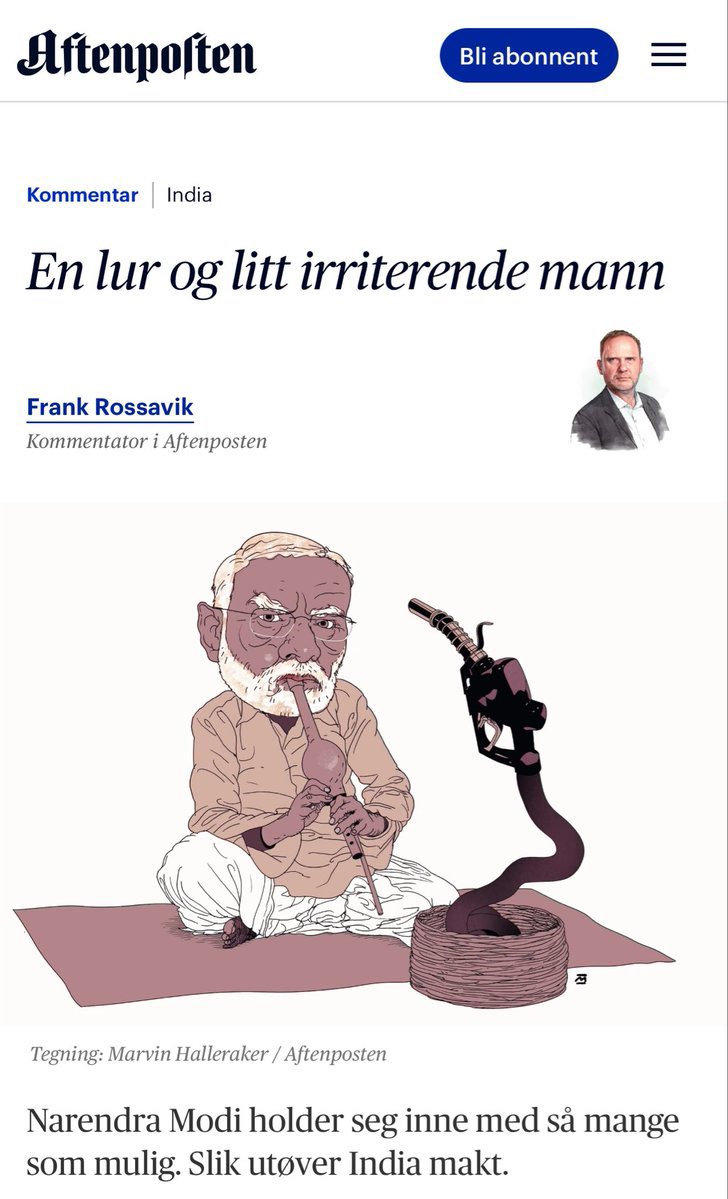
Nandini
Nandini@NBDwrites·
Yesterday’s image and caption however in a Norwegian newspaper, was different. That one felt personal with its blunt racism. It said far more about #Norway than it did about India. So we must thank them for the unintended honesty. It showed us exactly who they are.
Nandini tweet media
English
11
73
185
2.7K
SS retweetledi
Somnath Mukherjee
Somnath Mukherjee@somnath1978·
Bunk👇. Bulk of outward FDI comprise of PEs repatriating exits frm investments made in the last 10 yrs + MNCs repatriating royalties/dividends/capital, some post an India-listing. Outward FDI by Indian corp sector is v small. Politically resonating rationale <> wht is accurate..
Zafar Shaikh@InvesysCapital

“No one in his right mind wants to do business with a system where anyone can be raided or jailed because a business has to be bought/acquired.” We wonder why corporates are not investing in India. Why net FDI is zero. Foreign corporates as well as domestic companies are moving money outside India. These are serious issues.

English
7
25
141
11.9K
SS retweetledi
Gaurie Dwivedi
Gaurie Dwivedi@GaurieD·
Norway's journalist invoked the 'freest press in the world' at PM Modi in Oslo. Before Oslo lectures New Delhi on accountability, take a look at their own record. -In 2016, Norway signed a normalization pact with China that included a formal government pledge that it "attaches high importance to China's core interests and major concerns" and "will not support actions that undermine them." Norway's youth parties called it what it was — a formal renunciation of the right to criticize Chinese authorities. This was the price of resumed trade talks with Beijing after a 6-year pause. What triggered that 6-year freeze? Norway's Nobel Committee gave the Peace Prize to Chinese dissident Liu Xiaobo in 2010. So China punished Oslo diplomatically and economically — stopped buying Norwegian salmon. And Oslo eventually capitulated. -In 2018, Norway's King and Queen visited China and claimed they were unaware of Xinjiang's internment camps — in 2018, when international documentation of mass detention was extensive. So you see, all this talk of 'human rights', 'press freedom' and other such fancy phrases are hollow and hypocritical. -Norway's own Helsinki Committee urged its government in 2022 to increase pressure on China over Xinjiang. The government did not comply. -In September 2024, PM Støre flew to Beijing, met Xi Jinping, and returned with 15-day visa-free access for Norwegian citizens. The official Chinese readout quoted Støre saying China's "development is full of vitality and has significant successful experience." Norway pledged again to respect China's "core interests." Human rights got a one-line mention vague enough to mean nothing. -Aftenposten — Norway's newspaper of record — has itself acknowledged that every time it published something critical of Beijing or positive about Taiwan, its website was blocked in China for two weeks. Did this issue ever get raised diplomatically? A journalist from a country whose government formally pledged not to challenge Beijing's core interests, whose royal family pleaded 'ignorance' about Xinjiang in 2018, whose PM flew to Beijing and praised Xi's 'vitality' in 2024, and whose flagship newspaper self-censored under Chinese pressure — invoking press freedom as a unilateral moral standard against a democratically elected leader of 1.4 billion people — is HYPOCRISY 101. Press freedom is a principle. Oslo needs to prove it actually deserves it's number 1 ranking before lecturing others.
English
127
1.2K
3.4K
417.2K
SS retweetledi
Harsh Gupta Madhusudan
Harsh Gupta Madhusudan@harshmadhusudan·
One can only pity such naivete. China has literally given Pakistan nukes and missiles (while America looked the other way.) Why? Because it is some great admirer of Pakjabi Islamic Republics? No, because it knows in the long run its true competitor is India. It has refused to share many key technologies with Indian corporates, even as it wants to make us dependent on them for various intermediates and capital goods. Many attacks on Indian manufacturing facilities and power grids... well, let us let be what can by nature not be proven in the public domain. The Chinese know how dirt poor they were, and how quickly they rose. They know the power of scale and its agglomeration effects for capital and labour. They are afraid of the open polity/society/economy example that India will set as it rises. They know that literally there is a near 3-to-1 lead in children being born in India today compared to China. Quantity has its own quality, and even quality is available aplenty here. The more the Chinese try to ignore - they more they are obsessed. See how they tried not to cover the Trump visit in their press just now. They think its too smart. Actually, it is too clever by half. They have shown their hand once again.
Shankar Sharma@1shankarsharma

In that case you should meet a lot of Chinese people ( I do know a few). Their opinion of India my surprise you. For them the only competition is America. India does not even matter. Not even the 112 billion dollars surplus that they enjoy. ( However, your point on their investment in Vietnam is valid: it's a tiny, absolutely zero threat country to China. India is relatively bigger. But don't have delusions about what China actually thinks of India)

English
23
74
372
40.8K
SS retweetledi
Anang Mittal अनंग मित्तल
This framing is common among Indian commentators who lost patronage when Modi became Prime Minister. Demand stronger allegiance to Gandhian principles while denying Modi any agency as a Gujarati leader and three-time PM. Thus, the embellishment that Modi looked surprised.
Rohit Sharma 🇺🇸🇮🇳@DcWalaDesi

.@RoKhanna — “I told PM Modi, you are the 5th largest economy, but the World respects Gandhi more. They have not named things after your name like they have for Nehru..”

English
3
8
86
1.9K
SS retweetledi
HindolSengupta
HindolSengupta@HindolSengupta·
Indians - if they want to build comprehensive national strength - must blinker themselves from such things. The only things that are true are: GDP, per capita GDP, technological advancement, indigenous military capability, and popularity of cultural products. All else is noise.
English
4
18
90
1.8K
SS retweetledi
HindolSengupta
HindolSengupta@HindolSengupta·
There is a simple thing that Indians must understand. If you are a strong proponent of the geopolitical success and rise of your own country, you will not be liked by many other countries who do not wish to see this rise. So being berated, even heckled, is part of that journey.
English
54
215
948
22.4K
SS
SS@SSS210800·
@npunwani @RoKhanna If more things were named after Modi at this stage, then they would use that as proof that he is a megalomaniac. Heads I win, tails you lose specious argument.
English
0
0
2
198
Nathan Punwani
Nathan Punwani@npunwani·
Dumbest thing to ever come out of @RoKhanna's mouth Nehru & Gandhi have been household names in India since the 1930s. Modi, meanwhile, has been Prime Minister since 2014. Naturally the former two will have more things named after them since they've been around longer by a margin of at least 80 years This is the most bizarre apples and oranges comparison that I ever heard. It truly makes me question Ro Khanna's intelligence
Rohit Sharma 🇺🇸🇮🇳@DcWalaDesi

.@RoKhanna — “I told PM Modi, you are the 5th largest economy, but the World respects Gandhi more. They have not named things after your name like they have for Nehru..”

English
13
32
219
12.9K
SS retweetledi
Happymon Jacob
Happymon Jacob@HappymonJacob·
You ask uncomfortable questions to a diplomat: That is journalism. The diplomat answers the questions in a manner he can: That is diplomacy. You heckle the diplomat repeatedly & stage a walkout: That’s activism, not journalism.
English
156
2.1K
10.4K
248.5K
SS retweetledi
Harsh Gupta Madhusudan
Harsh Gupta Madhusudan@harshmadhusudan·
The Chinese, who cannot even talk to their own folks on this platform, are lecturing Indians about why Vietnam etc got China+1 investments as Indians are too argumentative and defensive, not willing to learn etc. It is all typical gaslighting nonsense. The Chinese, despite their hostility towards the Vietnamese, are happy to invest there because a relatively small Vietnam can never become a true economic rival the way India can and will. It is as simple as that. Beijing has actively put in poison pills. DC is also openly saying it cannot let India become another China. The Indian elite is actually more invested in India than the Chinese elite in China. Entrepreneurs, army officers and administrators do not overnight vanish in India the way they do in China. This is not a Stalinist-Maoist state. Make no mistake, Beijing is very scared about India's latent and developing potential. And America is also a bit more than nervous as its own officials have confessed on Indian soil itself. India has made significant improvements in its manufacturing, defense and deep tech ecosystems starting from a very low base even as late as a decade ago. Delhi has simultaneously accepted more trade and more industrial policy. Much more needs to be done of course, and is being done. Manufacturing will be one of India's key strengths over and above its unique services one. Do not let the frustrations of others bamboozle you into doubting your own country. India is a generation behind China and two behind America. It will cover the gap in decades, not generations. Yes, we should rise even faster but we are rising starting with universal adult franchise in a continental-sized civilisation and a millennium of heroic resistance to colonialism behind us. Please learn to differentiate between well-wishers and those pretending to be so.
English
63
153
667
47.9K
SS retweetledi
Nathan Punwani
Nathan Punwani@npunwani·
Gujarat's Asiatic lion has boomed (a 172% increase since the turn of the century) thanks to the unswerving conservation efforts of @PMOIndia @narendramodi ji, which date back to even when he was Chief Minister of Gujarat in 2001
National Geographic@NatGeo

All of the world’s Asiatic lions live in Gujarat, a western Indian state along the Arabian Sea. Over the last century, this species has been brought back from the brink of extinction through careful conservation efforts—but the future of these lions remains uncertain. 🔗 on.natgeo.com/MqnFfH

English
0
3
22
1.1K
Evan A. Feigenbaum
Evan A. Feigenbaum@EvanFeigenbaum·
Hard disagree with this piece. The more likely outcome, at least in Asia, is fragmentation not unipolarity one way or the other. Putting China to the side, Asia includes sizable, capable, self-interested powers that are not going to simply accept Chinese "hegemony" (whatever that means). If we think in terms of function, not form, it is more likely that we will see shifting coalitions, portfolio politics, and diversity rather than unipolarity or Cold War like bipolarity. I've written a lot on this, including here in 2020 for example: carnegieendowment.org/posts/2020/09/…
Foreign Policy@ForeignPolicy

Chinese hegemony once looked impossible. But weakened U.S. alliances may no longer prevent Beijing’s dominance. foreignpolicy.com/2026/05/12/chi…

English
18
67
274
45.6K
SS retweetledi
Erik Solheim
Erik Solheim@ErikSolheim·
The worlds most popular politician. India 🇮🇳 Prime Minister Narendra Modi is visiting Norway 18-19 May. While European leaders struggle to achieve 30% popularity in their own countries, Modi has an approval rating in India around 70. He is loved by most Indians. I believe this is due to his own life story coming from the most modest background in Gujarat, the strength and ideology of his party and that he is leading India at a time of rapid economic development. Western leaders should stop lecturing India and start being curious. They can learn a lot from Modi’s constant message about green growth. India is now the worlds third renewable nation. I have written welcoming Modiji for Norwegian business daily Dagens Næringsliv. Here is the piece - in English. lnkd.in/eRnFgBQq
Erik Solheim tweet media
English
547
2.2K
11.5K
211.4K
SS retweetledi
Evan A. Feigenbaum
Evan A. Feigenbaum@EvanFeigenbaum·
There are a lot of Great Game fantasists about, Mackinder wannabes, and folks who apparently read one too many Harry Flashman novels. Sorry to say it but Central Asian states are not going to conform to these pipe dreams, swing from “bloc” to bloc, or be the willing object of think tank fantasies. As part of our initiative on #ContinentalAsia, my #CarnegieAsia teammate @jmurtazashvili takes on some of this wishful thinking. “Central Asia” as an analytical category is a Soviet administrative inheritance, drawn along lines that served the convenience of Moscow. But the Central Asian states that Russia named no longer see themselves through this category alone and are not aligning across political blocs but instead building external partnerships sector by sector, assigning different partners to different functions. This makes them the subject of their own stories, not the object of foreigners’ fantasies of competition. Jen’s essay is a good and timely read. carnegieendowment.org/research/2026/…
English
1
26
68
10K