Joe Frankenfield

2.3K posts

Joe Frankenfield

Joe Frankenfield

@SagaPartners

Portfolio Manager at Saga Partners. Long-term, fundamental, value investing.

Cleveland, OH Katılım Mart 2019
468 Takip Edilen14.9K Takipçiler
Joe Frankenfield
Joe Frankenfield@SagaPartners·
Yes, his comp has been generous and is fair to scrutinize. It is also worth keeping in perspective that $TTD would not exist without Jeff Green, and he remains important to the company’s long-term success. His 2025 reported comp was ~$27M, mostly equity. At ~$21/share, the 235K restricted shares are worth about ~$5M, while the 450K options have a $49 strike and no intrinsic value today, though they still have time value. Including salary/bonus, the current intrinsic value of his 2025 comp is closer to ~$9M. The 2021 performance options also have no intrinsic value at today’s price. The comp is fair to question, but if Jeff succeeds in growing TTD’s value per share over time, it will likely be small relative to the value created for shareholders.
English
1
0
0
193
SwingTraderCO
SwingTraderCO@SwingTraderCO·
@SagaPartners @siyul With a near billion dollar incentive package Jeff should not also be compensated nearly 30M a year, far above other industry execs. Treating the company like his own personal slush fund.
English
1
0
0
108
Siyu Li
Siyu Li@siyul·
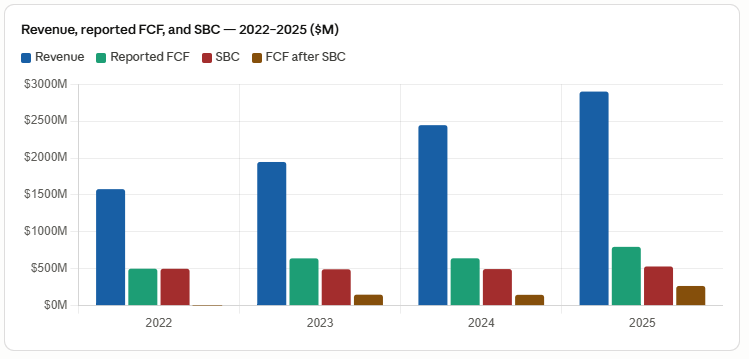
Saga's 1Q26 Letter on $TTD "With ~$10Bn Mkt Cap, ~$1.3Bn of net cash, and ~$1Bn in FCF in 2026, the market prices in a level of pessimism that I find hard to reconcile with the company’s long runway to grow earnings power." It shows 10%+ FCF yield, compelling, isn't it? 2 issues stand out: > true earnings (FCF minus SBC) are ~$260Mn in 2025. 30x price to true earnings. > TTD is ~1/5 Amazon's ads size, and half the growth rate (2025). It has an "Amazon problem".
Siyu Li tweet media
English
2
0
22
4.2K
Joe Frankenfield
Joe Frankenfield@SagaPartners·
That’s fair. Any investment write-up is a conjecture about why a stock may be mispriced. If the writer owns the stock, they are naturally going to explain why they think it is attractive. The useful next step is not to accept those reasons at face value, but to criticize them. That was my point with $TTD. The 10x FCF line should not be taken by itself. It points to a valuation relative to cash generation that looks unusually pessimistic, but it still has to be tested against SBC, dilution, working capital, normalized earnings power, and most importantly, the long-term competitive dynamics. If the explanation survives criticism and still looks attractive relative to alternative opportunities, then it is worth taking seriously.
English
1
0
1
113
Siyu Li
Siyu Li@siyul·
@SagaPartners That said, my primary point was whenever we see a headline bull case that oversimplifies the underlying facts (esp. when the facts are known to a reasonably sophisticated owner), it signals a possible ownership bias, or a need for defense.
English
1
0
1
224
Joe Frankenfield
Joe Frankenfield@SagaPartners·
Thoughts on $TTD SBC
Joe Frankenfield@SagaPartners

Appreciate the pushback, Siyu. I agree SBC is a real cost and should not be ignored. My comment in the Saga letter on $TTD selling around 10x FCF was too simplistic and could have been more precise. FCF is also probably not the best single metric for underlying earnings power given TTD’s working capital, since AR and AP can move around meaningfully. With TTD’s SBC, I think you have to look a little deeper to get the full picture. I’d separate ongoing employee SBC from the CEO performance award, which has inflated reported SBC since 2022. Reported SBC included ~$262M in 2022, ~$198M in 2023, ~$128M in 2024, and ~$67M in 2025 from the special CEO award. This was a performance option award that only becomes valuable if TTD reaches certain stock price targets by 2031. If TTD’s shares reach $340/share by 2031, the full dilution would be in the low-single-digit percentage range. That is a real cost, but it would also come alongside a very strong outcome for shareholders. Excluding that award, SBC was ~$237M, ~$294M, ~$367M, and ~$424M from 2022 to 2025. Still meaningful, but less punitive than the headline number. For 2025, GAAP net income was ~$443M. Adjusting only for the after-tax CEO award gets you to roughly ~$488M of adjusted GAAP net income, or about ~20x earnings on a ~$10B market cap. The CEO award is now fully expensed as of Q1 2026 and only starts becoming economically dilutive if the stock clears the $68.29 strike and relevant performance hurdles. So I agree the key question is normalized owner earnings after ongoing SBC and dilution. The question is whether true earnings power, after accounting for all expenses including ongoing SBC, is attractive at the current price.

English
0
0
1
3.2K
Joe Frankenfield
Joe Frankenfield@SagaPartners·
@yossijlevi Currently have 3 under 5 also. It's fun but also a lot of work. Bedtime/sleeping is also our biggest challenge right now. And by right now, I mean since our second was born 2+ years ago. 🤪😴
English
0
0
1
772
Yossi J Levi
Yossi J Levi@yossijlevi·
Parents with multiple young kids close in age (3 kids under 5 if we’re being exact) — how did you do it? Asking for a friend 😅
English
83
1
44
30K
Joe Frankenfield
Joe Frankenfield@SagaPartners·
Last week I sent out Saga Partners 2025 Annual Letter. The core idea is simple: because the future depends on knowledge that does not yet exist, it cannot be forecast reliably. Investing therefore has to begin with explanations. The letter also includes reflections on nine years managing the Saga Portfolio and updates on $CVNA, $ROKU, $TTD, $TRUP, and $WIZEY Link below.
English
3
2
29
4.8K
Joe Frankenfield retweetledi
Ryan Verklin
Ryan Verklin@verklin·
Lots of discussion about OpenPath. I am pro OP. My thoughts below. Someone tell me where I’m wrong. OpenPath has value to both the buy and sell side. It has value to the buyer because TTD claims (and I’ll take their word for it) they run OP at cost. They claim their ~5% take rate is just to run it at break even. TTD is making all their money on DSP fees (different discussion) where the other SSPs have higher yields and dynamic pricing so they can make a profit which OP doesn’t need to. The pubs don’t have the same margin rate across all SSPs (it’s dynamic and essentially the SSPs is trying to take the highest margin while also trying to win the auction in the Pub’s adserver/header). Hypothetically OP would have the lowest margin (because they are running it at break even) but the bid would still have to be the highest to win the auction in the pub’s adserver. The one benefit for pubs using OP should be that they get more volume from TTD they wouldn’t otherwise get if they didn’t use OP. If TTD isn’t outright lying about OP and they are running it at breakeven and aren’t favoring it beyond it being the most efficient path to supply then I only see a benefit for buyers to use them. The inherent problem is, Google poisoned the well on this, when a company is on the buy and sell side they have a conflict of interest. Makes them an easy target for all of AdTech to bash them. OP doesn’t do rebates so holdcos who’s SSP rebates go right to their bottom line have every incentive (besides their clients media performance) to use SSPs who give them the biggest rebates. Has any advertiser ever talked about turning off Amazon Publisher Services? Amazing to me they have been able to fly under the radar for scrutiny when unlike TTD I don’t believe they have ever claimed to run it at cost or not to favor their own pipes.
Trishla Ostwal@trishlaostwal

Scoop: Dentsu and WPP have pulled back from The Trade Desk’s most closely-watched initiative, OpenPath, citing concerns over transparency, control and undisclosed costs. The shift signals mounting pressure on the adtech darling’s key supply-chain bets. adweek.com/media/exclusiv…

English
3
4
23
4.1K
Joe Frankenfield
Joe Frankenfield@SagaPartners·
Definitely, but a true “meta DSP” only works if it can actually optimize across everything. Walled gardens don’t expose enough data or control for that. You can allocate budgets across them, but you can’t really decision across them the same way. So the hardest part of the problem still sits in the open internet, where fragmentation is highest. If $TTD succeeds in improving transparency and efficiency there, it should attract more dollars away from walled gardens. Over time, as those closed platforms mature and growth slows, they may be incentivized to open up more to prove performance on a more comparable basis. That would be a very favorable outcome for whoever controls allocation across the open internet.
English
0
0
0
139
Rohit Dube
Rohit Dube@crookb0nd·
@SagaPartners Corollary - a meta DSP that allocates among all, managing spend among all could be the right strategy, even if margins on walled gardens are lower?
English
1
0
0
156
Joe Frankenfield
Joe Frankenfield@SagaPartners·
Most people think The Trade Desk $TTD's problem is slowing growth. That is part of the story, but it misses the bigger picture. Advertising has shifted from an inventory access problem to a capital allocation problem. The challenge is deciding where to deploy budgets across a fragmented and constantly evolving set of opportunities. In that world, the most valuable position is not owning media, but controlling the decisioning layer of the open internet. The real question is whether The Trade Desk’s role in that system is weakening or becoming more important. Full write-up below:
English
2
2
16
7.7K
Joe Frankenfield
Joe Frankenfield@SagaPartners·
In 2018, I wrote about $TTD in Barrons. barrons.com/articles/ad-te… Since then, the company has become significantly larger, more scaled, and more central to the advertising ecosystem. Notably, its share price is not too far off from where it was back then. That disconnect is interesting to reconcile. The core problem in digital advertising is larger than ever. Which is why the current debate around The Trade Desk may be missing the bigger picture.
Joe Frankenfield@SagaPartners

Most people think The Trade Desk $TTD's problem is slowing growth. That is part of the story, but it misses the bigger picture. Advertising has shifted from an inventory access problem to a capital allocation problem. The challenge is deciding where to deploy budgets across a fragmented and constantly evolving set of opportunities. In that world, the most valuable position is not owning media, but controlling the decisioning layer of the open internet. The real question is whether The Trade Desk’s role in that system is weakening or becoming more important. Full write-up below:

English
1
0
8
3.9K
Joe Frankenfield
Joe Frankenfield@SagaPartners·
AI may reduce direct site visits, but it doesn’t remove the core problem, it concentrates it. If more consumption moves through AI interfaces, the key question becomes, who decides which ads get shown and where budgets get allocated within them? The real question is whether that decisioning stays independent or gets controlled by the LLM platforms themselves. If anything, multiple AI agents could fragment control making it look more like CTV vs search.
English
0
0
4
302
jx
jx@Setsaiselcce3·
@SagaPartners Curious - what if eyeballs and time spent on open internet is being eroded by AI. E.g. instead of visiting 10 websites to read the news or research a topic, it is done via ChatGPT? Can TTD score a contract with these LLMs?
English
1
0
0
340
Joe Frankenfield retweetledi
Dan Gill
Dan Gill@DanGill·
There has always been speculation about how @Carvana creates such differentiated results. The truth is simpler than many people realize - it's a vertically integrated business model built to create better customer experiences end to end. I appreciate @peterahigh digging into the details of our integrated systems and the tailwinds to come from AI. Apple: podcasts.apple.com/us/podcast/how… Spotify: open.spotify.com/episode/5CFJgu… YouTube: youtu.be/GMduzqMqRQA?si…
YouTube video
YouTube
English
21
13
80
31K
Lucy Biggers
Lucy Biggers@LLBiggers·
I spent half of my 20s as a brainwashed climate activist. This is the story of how I changed my mind and became a climate realist.
English
700
3.3K
13.9K
631.1K