
Sabitlenmiş Tweet
Sam Mendel
126 posts

Sam Mendel
@SamMendel00
CEO, Co-founder @Network_Ocean_ building ocean data centers + energy ⬡ 🌊 (YC S24) @zfellows
Katılım Ağustos 2020
1K Takip Edilen1.5K Takipçiler
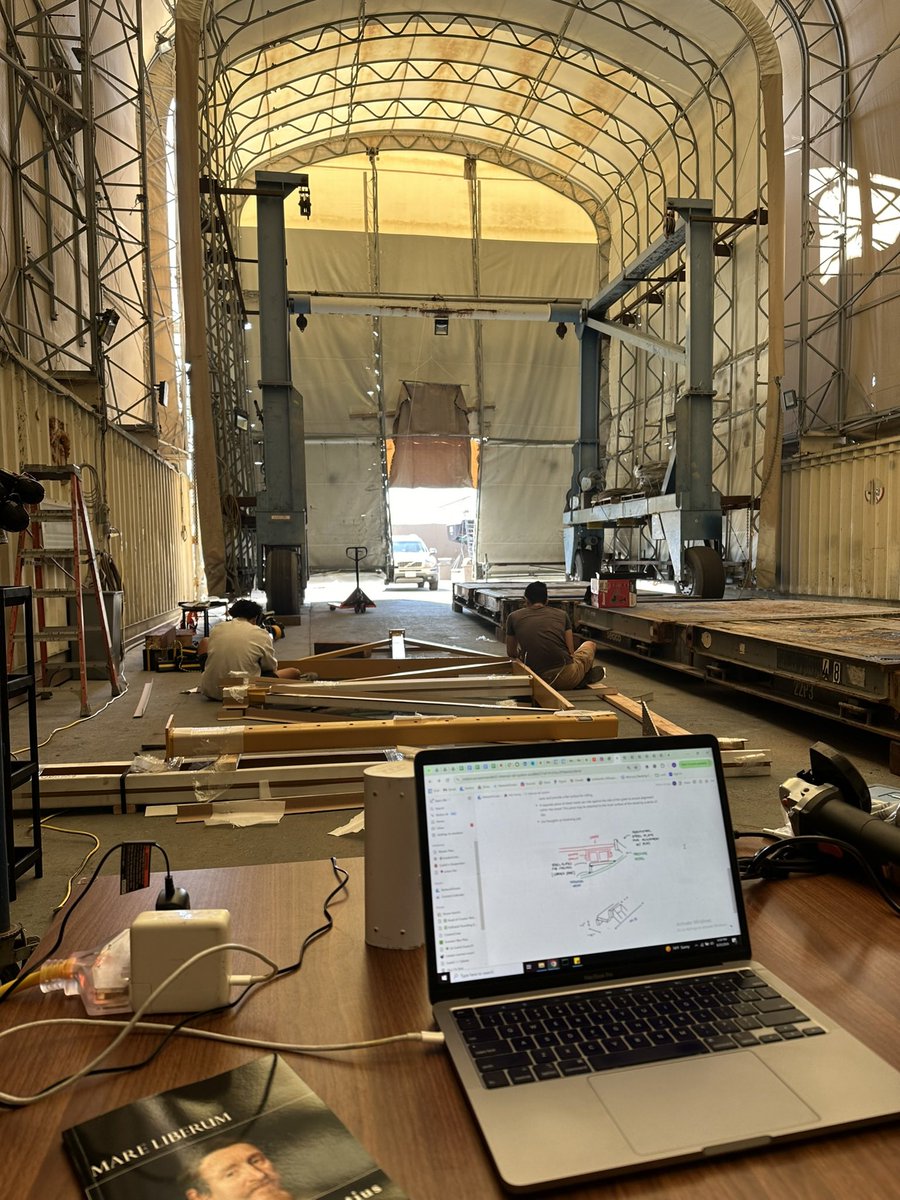

@Willob Maritime Data Centers with power from @reflectorbital will be beautiful
English

The tech industry is not ready for the backlash coming from AI-related job losses, data centres, energy costs etc.
It’s going to be ugly, loud and likely violent.
This is going to drive more and more economic development & technology deployment to the less regulated frontiers - space and maritime.
English



Today @IsembardGroup announces our $50m Series A. More factories, more engineers, more countries. If not now, when...
🇬🇧🇺🇸🇩🇪🇫🇷🇺🇦

English
$100k grant
an inflection point for the kind of builder that will have an outsized impact for humanity
the downstream effects of this will be wild
so sick @thewildstevenp
Steven Pang@thewildstevenp
A 10-minute application for $100,000. A free, no-strings-attached prize for builders, scientists, operators. Introducing the Eigenprize. ↓ run by @menemazarakis, @markkhrapko, & yours truly :)
English
Deutsch

A 10-minute application for $100,000.
A free, no-strings-attached prize for builders, scientists, operators.
Introducing the Eigenprize. ↓
run by @menemazarakis, @markkhrapko, & yours truly :)
English
@AndronOcean need to account for amortization.
land based lifespan conservatively 15yrs vs 5yr space
x.com/SamMendel00/st…
Sam Mendel@SamMendel00
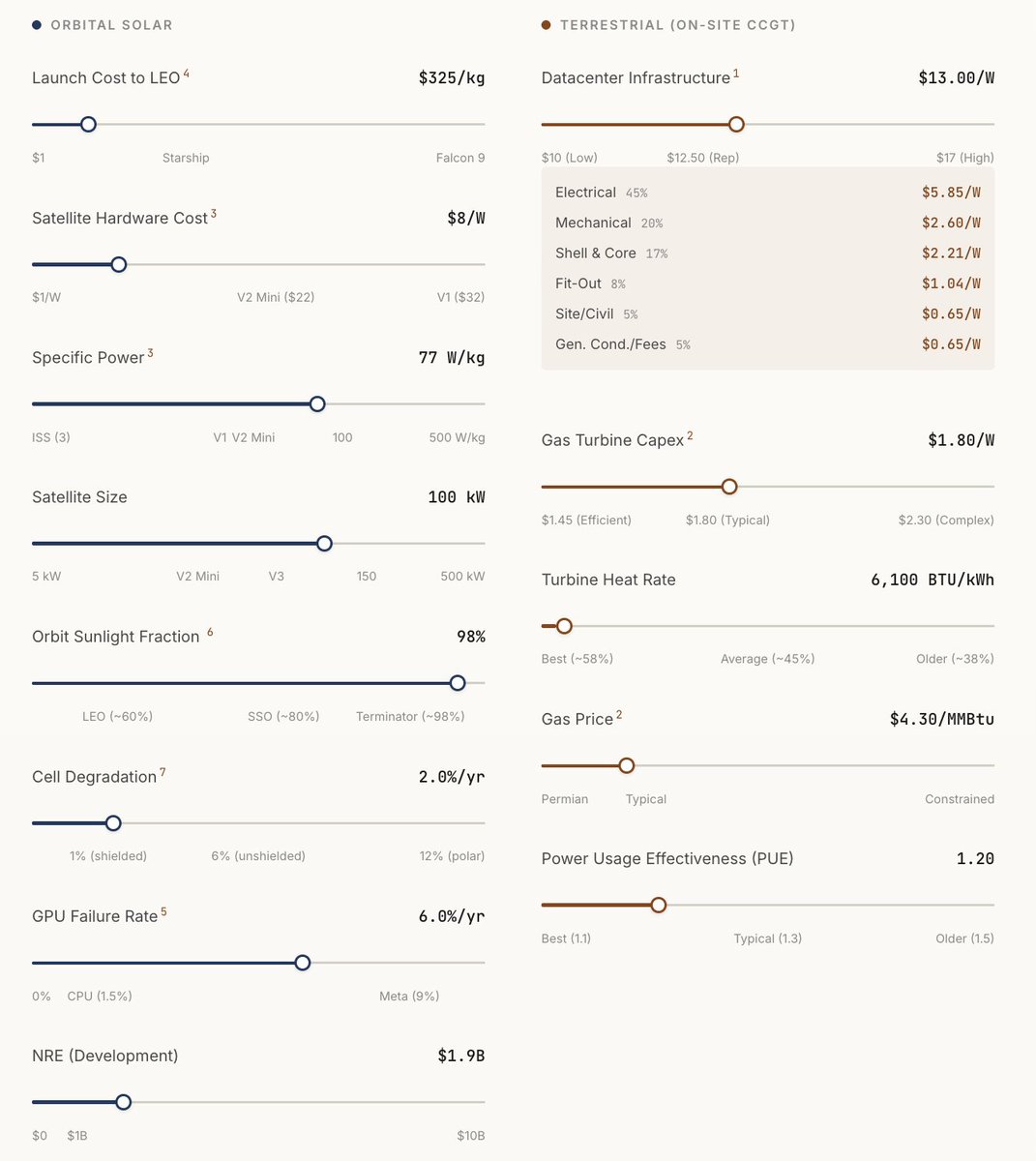
ok time to chime in. @andrewmccalip this model is miles better than anything else I’ve seen on here. kudos for the transparency. That being said, in the pursuit of a more accurate analysis, there are a few fundamental oversights in the model. After fixes (default case) -> Space DCs are 10x more expensive than on-land and still 62% more expensive in the most space-optimistic future case. Here are the fixes:
English

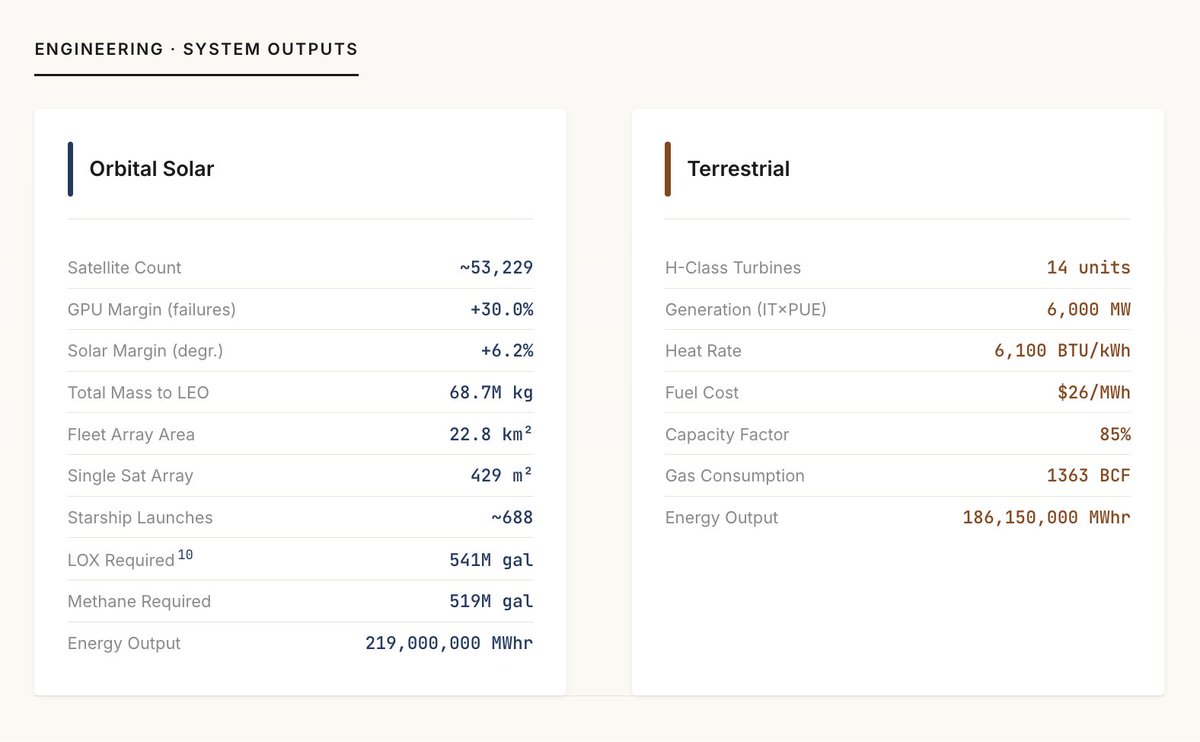
I came up with a data-centers-in-space scenario that seems plausible (or at least sub-ridiculous) to me (layperson who spends too much time on this stuff).
It's not TOO hard to make the costs match.
This gets interesting because Andrew's tool is missing a time-to-market dimension. Data centers are productive assets for their operators(^1). It's advantageous to bring one online as soon as possible.
The terrestrial pipeline for new datacenters is clogged with regulation, environmentalists, NIMBYs, political volatility, contractor hell, and simple resource competition, which makes it slower and slower to bring them up. One can hypothesize deregulation/mandating that cuts through much of this, but the effectiveness of such scales linearly with political unpopularity (the masses aren't clamoring for more data centers), and politicians are nervous creatures when they are made to vote on things.
But data centers in space would be manufactured.
Starlink has demonstrated that mass satellite manufacture works impressively well.
An operator may find it easier (faster) to manufacture 10,000 - 50,000 satellites and launch them on Starship 688 times, than to bring online equivalent new terrestrial capacity. The satellite option can be brute-forced with capital, while the terrestrial way is much messier.
Put another way, from a *risk* perspective, there is a threshold where putting compute in orbit is preferable, even if slightly more expensive.
When does that path become viable? No idea. There is a first-mover advantage to solving the technical challenges, however, so "sooner than expected" might be a good answer.
---
Footnote 1: Data centers are productive assets assuming that AI's bottomless money pit economics find some sustainable RoR, which is a necessary postulate for all of this talk.

Andrew McCalip@andrewmccalip
Data centers in space. It might not be economically rational. But it might be physically possible. I’m trying to bring some quantitative structure to a conversation that’s been mostly big-number vibes. andrewmccalip.com/space-datacent…
English
Sam Mendel@SamMendel00
ok time to chime in. @andrewmccalip this model is miles better than anything else I’ve seen on here. kudos for the transparency. That being said, in the pursuit of a more accurate analysis, there are a few fundamental oversights in the model. After fixes (default case) -> Space DCs are 10x more expensive than on-land and still 62% more expensive in the most space-optimistic future case. Here are the fixes:
QME

The breakeven point vs terrestrial datacenters using these assumptions is like $350/kg to LEO. Very doable, but you’ll have to be fully reusable.
Robotbeat🗽 ➐@Robotbeat
Target capacity 22GW, AP 5yr, LCtLEO $20/kg, SHC $5/W, SP 50W/kg, SS 130kW, OSF 98%, Cell Deg 8%/yr, GPU FR 2.5%, NRE $10B. Terrestrial with defaults. I got $175.3B for orbital, $348.7B for terrestrial.
English

@Object_Zero_ Seasteaded AI data centers in international waters? Connected via high bandwidth lasers to dedicated Starlink-style satellites?
English

Building Datacenters…
Terrestrial sites have 3.5GW heat sink ceilings, and so many NIMBYs that permit authorities are starting to block them.
Space is 100 miles from NIMBYs but your heat sink is behind a vacuum, and you need to lift everything out of a gravity well.
I wonder if there is a third place? Maybe one with zero NIMBYs and unlimited immersion cooling? Maybe where megastructures can effortlessly float into position?
Andrew McCalip@andrewmccalip
Data centers in space. It might not be economically rational. But it might be physically possible. I’m trying to bring some quantitative structure to a conversation that’s been mostly big-number vibes. andrewmccalip.com/space-datacent…
English
Sam Mendel@SamMendel00
ok time to chime in. @andrewmccalip this model is miles better than anything else I’ve seen on here. kudos for the transparency. That being said, in the pursuit of a more accurate analysis, there are a few fundamental oversights in the model. After fixes (default case) -> Space DCs are 10x more expensive than on-land and still 62% more expensive in the most space-optimistic future case. Here are the fixes:
QME

@SamMendel00 @network_ocean_ *glances at my coast guard regulatory meeting on the calendar*
Whomst amongst us hasn't run afoul of a regulation or two?
English
ok time to chime in.
@andrewmccalip this model is miles better than anything else I’ve seen on here. kudos for the transparency.
That being said, in the pursuit of a more accurate analysis, there are a few fundamental oversights in the model.
After fixes (default case) ->
Space DCs are 10x more expensive than on-land
and still 62% more expensive in the most space-optimistic future case.
Here are the fixes:
Andrew McCalip@andrewmccalip
Data centers in space. It might not be economically rational. But it might be physically possible. I’m trying to bring some quantitative structure to a conversation that’s been mostly big-number vibes. andrewmccalip.com/space-datacent…
English


Sam Mendel@SamMendel00
ok time to chime in. @andrewmccalip this model is miles better than anything else I’ve seen on here. kudos for the transparency. That being said, in the pursuit of a more accurate analysis, there are a few fundamental oversights in the model. After fixes (default case) -> Space DCs are 10x more expensive than on-land and still 62% more expensive in the most space-optimistic future case. Here are the fixes:
QME
Great model @andrewmccalip, however there’s a few big oversights.
Accounted for, the default case is Space DCs are 10x more expensive than on-land currently
and still ~60% more expensive in the most space-optimist’s future case ($20/kg launch, $5/W satellite, 75.0 W/kg specific power)
For space data centers to be economically competitive, there needs to be an outsized increase in cost on-land due to delays (permitting, public opposition).
hmm I could think of one place with even fewer regulatory bodies than in space… 🤔@network_ocean_
x.com/SamMendel00/st…
English
Data centers in space.
It might not be economically rational. But it might be physically possible.
I’m trying to bring some quantitative structure to a conversation that’s been mostly big-number vibes.
andrewmccalip.com/space-datacent…
GIF
English
The core question is “can you make space-based, commodity compute cost-competitive with the cheapest terrestrial alternative?”
The answer seems like a clear no.
The alluring potential of space DCs in the short term is absolutely space-based edge compute, and in the long term, the incredible scale of power (however this only becomes important at the 100TW+ scale, we will get there eventually…)
English
- Amortization: Currently, terrestrial DC lifespan = satellite lifespan. No. Conservatively, DC infra lasts 15yrs on-land vs 5yr in space. Decouple DC amortization, analysis period, and satellite lifespan. Observe -62% for terrestrial costs @15 years.
For such different tech lifespans, a more useful metric for comparison would be $B/GW/yr.
- GPU Failure rate: Currently, the model takes X% failed GPUs to mean we need to spend X% more on satellite bodies. ??? Is this implying you replace the entire satellite (without launching)? More likely, you have multiple GPUs per satellite, and in each satellite X% of GPUs are not working. Also, GPU availability cannot be decoupled with DC financials. 1GW corresponds to ~$20B of IT hardware. 9%/yr failure rate over 5yrs = average of 80% availability, or ~$4B to space cost or +8% to space cost. You need autonomous maintenance to decrease this added cost.
- On-land generation: The only available model is natural gas turbines. The go-to plan has been turbines until grid connection, then use turbines mostly as backup/load following. Opex of turbines dominates capex, so switching over leads to -8% for terrestrial costs @8¢/kWh. Solar/BESS and nuclear are both trends that will likely further decrease $B/GW.
- Nits: A) Current space degradation model is set to produce an average of the nameplate capacity. Nameplate capacity should be the maximum power guarantee over the lifespan of the satellite, representing +5% to space cost. B) Add launch cost to GPU margin (assuming current maintenance model of replacing X% of GPUs/satellites). +13% for space cost.
Conclusion:
English

Let me tell you about this place…
Energy Resources: Oil, Gas, Wind, Waves, Uranium
Cooling: Infinity (for all practical purposes)
NIMBY Population: 0
… ever been offshore?
I’ve visited (I think) 15 different North Sea installations, a couple of MODU drilling rigs, two different SSCVs and dived on a couple of submarines (one of which I designed)… what did I learn?
It’s a very different environment. A lot of things are much harder to do, but a few things can ONLY be done here. You want to build something big? Over 100,000 tonnes? You do it here, where you can float one million tonnes or more if you need to.
You can lift 5 - 10,000 tonnes with a crane, and move any object of any size; up, down, left, right, forwards, backwards and roll.
Everything can be bigger, some offshore platforms export 200,000 barrels a day, that’s 13 GW of power.
Ever seen a 25,000 bopd flare test from up close? (I actually would not advise).
I get it, you live in a city, you carry a laptop, you work at a desk, riding a Waymo to work is exciting. Industrial stuff is weird, confusing and therefore boring to you. But it’s OK, you don’t have to live like that forever.
There’s still time to do interesting things, or be involved in doing interesting things.
It can be very hard to imagine what is possible if you don’t know about some stuff. You wouldn’t expect a fish to invent fire.
But you can do some stuff that will make you say “Wow”, and even after 20 years you still feel wowed sometimes when you go to bed.
Especially when it’s so esoteric, that barely anyone would understands what happened even if you explained it to them. There best things to work on are things so complicated that NIMBYs don’t understand how to complain about it.
So yes, I am here selling fire to fish.
You will like it. It is fire. Watch this space.
There’s a lot of deep heavy industry, where the capital intensity is ridiculous. There are many industrial assets producing $10-40m revenue per employee. Where every problem is a $10m problem, and the company doesn’t dare let anyone anywhere near the thing unless they are great.
In the bigger picture, for 130 years before 2015, the only companies bigger than the big banks were the supermajor energy companies. For the past 10 years tech companies have been bigger by far, but the tech companies themselves are now begging Daddy to return.
I don’t need to be more explicit about what happens next. Great things are happening.
Stuff is afoot. But you won’t see it in the news.
English