Sam Passey

128 posts

Sam Passey

Sam Passey

@SamPassey3

Incoming predoc @StanfordGSB; Math & Econ @BYU. Interested in macro and growth.

Katılım Temmuz 2022
248 Takip Edilen74 Takipçiler
Sam Passey
Sam Passey@SamPassey3·
@nihilists4jesus “This pleasant conversation? 🥱 boring and unstructured. Let’s move pieces of cardboard and plastic around a table for 2 hours instead”
English
1
0
4
26
Sam Passey
Sam Passey@SamPassey3·
@cosmosadderall Strangely, I have the exact same opinion. Inglorious was by far my favorite and I didn’t really enjoy the rest 🤝
English
0
0
1
12
John S
John S@cosmosadderall·
I really like movies. Which is why it gives me no pleasure to admit that I haven’t seen one Quentin Tarantino film that was exceptional to me. Hateful Eight, Reservoir Dogs, Django Unchained, Pulp Fiction, were all meh. Inglourious Basterds was good. But that was ALL Waltz
English
17
0
15
1.7K
Sam Passey
Sam Passey@SamPassey3·
@DonVianna Um actually☝️🤓 she’s using a taylor approximation i.e. 1-(1-p)^n ≈ np for small p
English
0
0
1
110
Sam Passey
Sam Passey@SamPassey3·
@ATabarrok Well, using a taylor approximation, 1-(1-p)^n ≈ np 😉
English
0
0
2
1.2K
Sam Passey retweetledi
Pol Schiaffino
Pol Schiaffino@pabloschiaffino·
“De la hiperinflación a la estabilización: la anatomía real de los precios bajo Milei (nuevo paper)”. Link a presentación: drive.google.com/file/d/1UysbXJ… RESUMEN CORTO AQUI: Usamos datos diarios y ultra-granulares (precios UPC por cadena y provincia) para mostrar cómo ajustaron realmente los supermercados antes y después de enero 2024, justo cuando Milei empezó el ajuste fiscal, déficit cero y control de emisión. Durante la estabilización: → Los aumentos se volvieron menos frecuentes pero más grandes (las empresas ya no ajustan todo el tiempo porque la inflación dejó de ser impredecible). → Las bajadas se volvieron más frecuentes y más chicas, con un spike inicial → correcciones de precios que habían quedado “inflados”. Curiosidad clave: A misma tasa de inflación, la dispersión de precios (el mismo producto cuesta distinto según cadena o provincia) es más alta después del pico. La estabilización no es simétrica: hay más “ruido” y la normalización es gradual. Un guess concreto: Este estudio da evidencia de que la fuerte desinflación iniciada a partir de enero 2024 modificó el comportamiento de los precios en las góndolas. Pero también marca que la tarea aún no está terminada: la dispersión sigue alta y explica por qué algunos precios se sienten desalineados aunque la inflación general baje. Además de que aún exista inflación "termita": baja pero persistente. Un guess a titulo personal por analizar: Un shock de regimen monetario (dolarización, convertibilidad, etc): ¿es un "masazo" que liquida la inflación rumiante, la dispersión y cualquier salto especulativo sobre el tipo de cambio? (Ampliaremos...)
Pol Schiaffino tweet media
Español
2
27
153
20.4K
Sam Passey
Sam Passey@SamPassey3·
The best part about reading econ papers from the 1960s is they’re <20 pages longs
English
0
0
1
35
Sam Passey
Sam Passey@SamPassey3·
@mean_field_zane When you win the John Bates Clark medal I’m sure you’ll feel fine about your undergrad
English
0
0
8
2.8K
𝔐𝔽𝓩
𝔐𝔽𝓩@mean_field_zane·
I’ve basically spent the last two years of my undergraduate as a PhD student, and my second year was spent only with a tiny group of people in a very difficult class, so I only really got one year of being a real college student. Feeling very melancholic and like I missed out right now.
English
16
0
116
11.6K
Sam Passey retweetledi
Ludwig Straub
Ludwig Straub@ludwigstraub·
We measure spending flows between thousands of small groups of consumers and thousands of small groups of producers to study how exactly shocks propagate through an economy. It matters for understanding policy. Check it out!👇
Ludwig Straub tweet media
QJE@QJEHarvard

#QJE May 2026, #3, “Disaggregated Economic Accounts,” by Andersen, Huber, Johannesen, Straub, and Vestergaard: doi.org/10.1093/qje/qj…

English
4
95
472
66.7K
Sam Passey
Sam Passey@SamPassey3·
@quant_____ My prior is that average macro person is to the right of the average applied micro person. Elon acquires X, more applied micro people leave econ twitter than macro people.
English
0
0
3
33
quant (is rebranding soon)
Macro seems to be pretty over represented on econ twitter. It honestly might just be selection on smarts. (Not a macro guy in the slightest btw)
English
4
0
9
573
Sam Passey
Sam Passey@SamPassey3·
Models first, data later is the new punk rock.
𝔐𝔽𝓩@mean_field_zane

This might be unacceptable to say to a lot of modern applied economists, but I don’t really care about model misspecification too much. In my view, all models are misspecified, but some mechanisms are useful. I think economic theory is useful because it disciplines mechanisms, and structural models are useful because they provide clear illustrations about stories concerning mechanisms and their relative sizes. I do not believe for a second the size of an estimate in a structural econometric model as being true. I just care about if it helps to discipline and illustrate and validate the economic foundation & narrative. I write a microfounded model because it gives an economic story about the assumptions needed to estimate and identify credibly using it instead of having to just rely on statistical assumptions. I think many actually seek to get effective sizes using structural models, which I view as nothing but a nice secondary effect at best. I care about validating stories so one can construct more future work whether it be using bigger data & more model-free methods, richer structural models, or more complicated theories. This is why I like a lot of Acemoglu’s macroeconomic work. He writes a rich theoretical model then independently tests the mechanisms using the best reduced form methods, using economics to justify the assumptions. I think that is one of the best ways to do empirical economics.

English
0
0
4
184
Sam Passey
Sam Passey@SamPassey3·
@mean_field_zane There needs to be a Gen-Z counter reformation against the millennial credibility revolutionaries. You are the man to lead it 🫡
English
0
0
8
387
𝔐𝔽𝓩
𝔐𝔽𝓩@mean_field_zane·
I think this also goes deeper into why it’s so hard to shake Friedman’s methodology on identification: realism requires unreality to actually work econometrically and is itself prone to ambiguity about what is realistic, pure explanational valence or parsimony of the features will either over-complicate a model, making it hard to judge as identified, or completely deny it usefulness as a general theory, so leveraging explanation-relative-to-simplicity is the right framework. One gains economic illustration alongside tractability, but does not bury the assumptions nor deny understanding of the important features of the problem at hand.
𝔐𝔽𝓩@mean_field_zane

This might be unacceptable to say to a lot of modern applied economists, but I don’t really care about model misspecification too much. In my view, all models are misspecified, but some mechanisms are useful. I think economic theory is useful because it disciplines mechanisms, and structural models are useful because they provide clear illustrations about stories concerning mechanisms and their relative sizes. I do not believe for a second the size of an estimate in a structural econometric model as being true. I just care about if it helps to discipline and illustrate and validate the economic foundation & narrative. I write a microfounded model because it gives an economic story about the assumptions needed to estimate and identify credibly using it instead of having to just rely on statistical assumptions. I think many actually seek to get effective sizes using structural models, which I view as nothing but a nice secondary effect at best. I care about validating stories so one can construct more future work whether it be using bigger data & more model-free methods, richer structural models, or more complicated theories. This is why I like a lot of Acemoglu’s macroeconomic work. He writes a rich theoretical model then independently tests the mechanisms using the best reduced form methods, using economics to justify the assumptions. I think that is one of the best ways to do empirical economics.

English
2
1
20
8.9K
Aziz Sunderji
Aziz Sunderji@AzizSunderji·
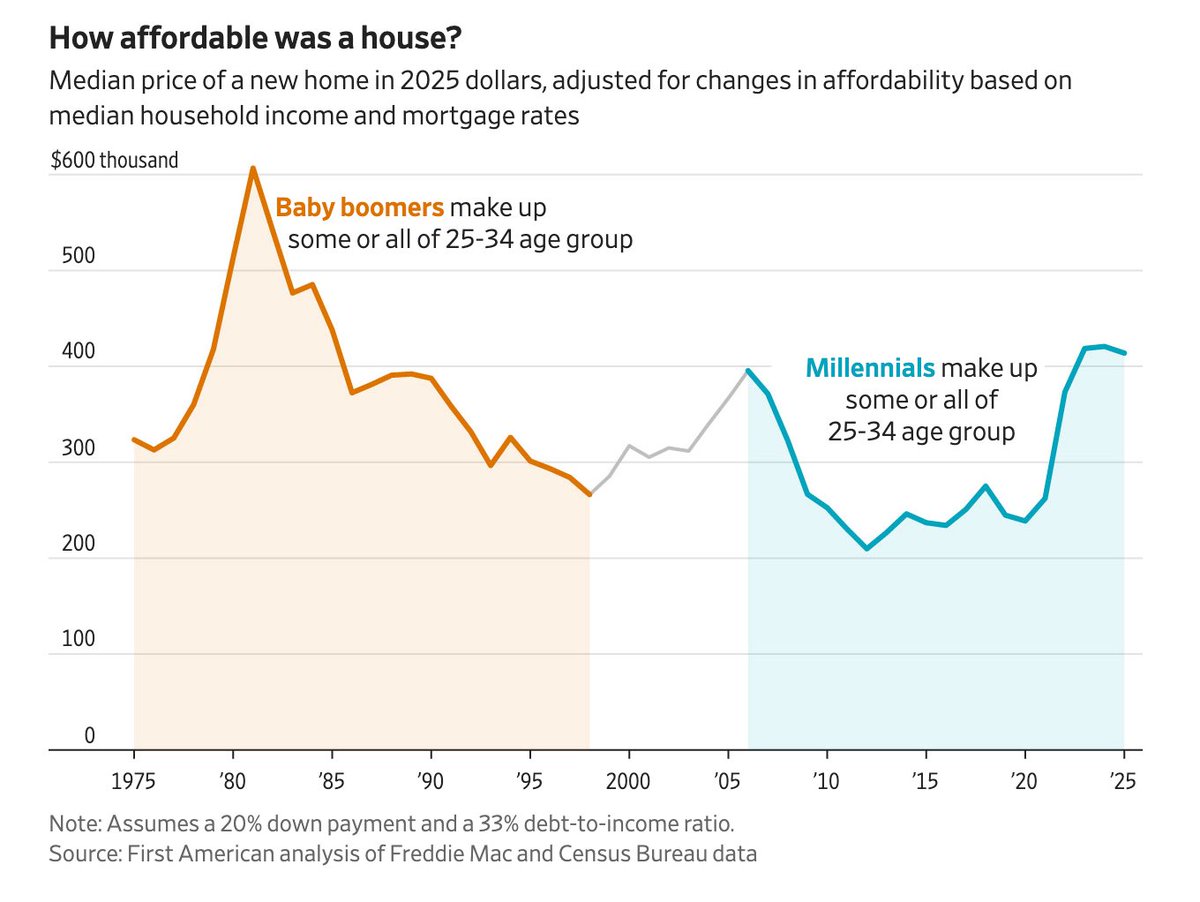
This is...confusing @WSJ. It's the price of a new home? Adjusted for income? How?
Aziz Sunderji tweet media
English
6
0
21
2.5K
Sam Passey
Sam Passey@SamPassey3·
@nominalthoughts liberalism is/has always been the globally stable steady state for American politics
English
0
1
7
344
Renki
Renki@HikaruiTen·
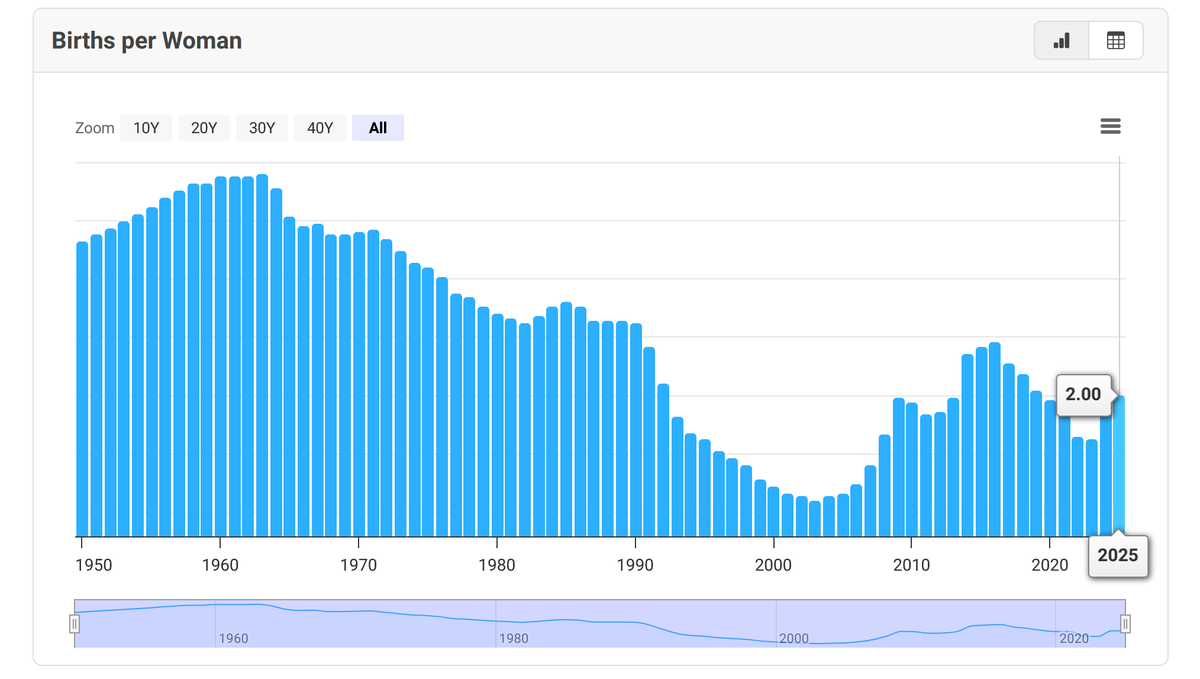
@JesusFerna7026 While not at the same level as Israel, I've noticed Georgia's TFR is not that terrible and hasn't declined that much compared to others.
Renki tweet media
English
1
0
5
533
Jesús Fernández-Villaverde
Jesús Fernández-Villaverde@JesusFerna7026·
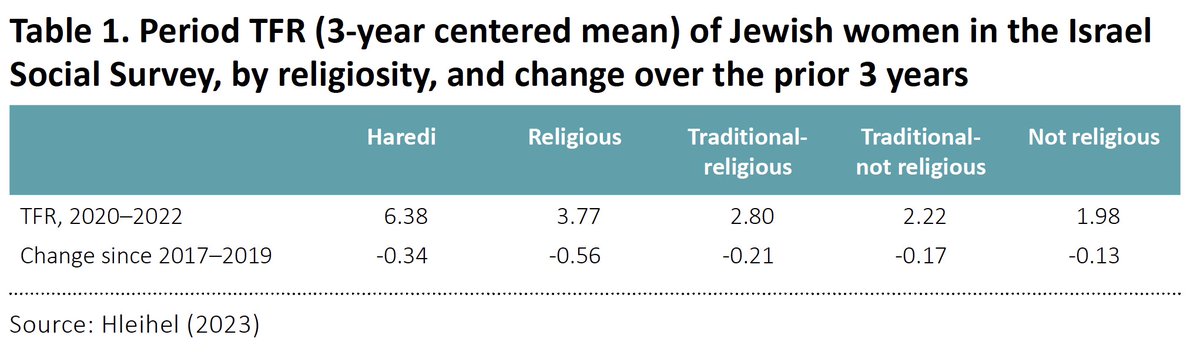
Are there examples of countries that have avoided the recent sharp decline in fertility? A few exist, but the most interesting case is Israel. In 2024, Israel’s total fertility rate (TFR) stood at 2.83. In 1991, it was 2.91, and it has remained roughly constant for the last 35 years. This stability is remarkable in itself, but the evolution of fertility within population subgroups in Israel is even more striking. The graph I include, copied from: taubcenter.org.il/wp-content/upl… plots the overall TFR (blue), the TFR of Jews (light blue), Muslims (yellow), Christians (brown), Druze (orange), and others (green). While in 2000 the TFR for Jewish women was 2.66 and for Muslim women 4.74, by 2024, these rates had shifted to 3.00 and 2.80, respectively. The decline in the TFR of Muslims in Israel mirrors patterns seen in countries such as Egypt and Jordan, perhaps with a lag, but it broadly follows the same trend. By contrast, the TFR trajectory among Jewish women in Israel is quite unusual in the global context. As a result, since 2020, and for the first time since the founding of the State of Israel in 1948, the TFR of Muslims has fallen below that of Jews. Additionally, the share of births to Jewish mothers continues to rise and now exceeds the Jewish share of the total female population. Combined with ongoing positive net Jewish immigration, this implies that the Jewish share of Israel’s total population is likely to increase in the coming years. How is fertility evolving across different levels of religiosity within the Jewish population? As seen in the table I am copying, all groups are experiencing modest declines. For instance, the TFR among Haredi Jews has fallen by approximately 0.34 children per woman, and among non-religious Jews by about 0.13. However, because the Haredi represent a growing share of the Jewish population, the overall Jewish TFR has remained stable, an interesting example of counterintuitive aggregation effects at work. A particularly noteworthy point is that the TFR of non-religious Jewish women still stands at 1.98. This is surprisingly high when compared to secular populations in other high-income countries. Nevertheless, unless there are significant shifts in religiosity (such as Haredi individuals becoming secular), the share of births from non-religious Jews within the total population is expected to decline over time. In parallel, as the TFR of Muslim women continues to decline, we can anticipate a gradual decrease in Israel’s overall TFR over the next decade. A final note: throughout this post, I have used the population definitions employed by the Israel Central Bureau of Statistics. These include the territory within the 1948 Green Line, the Golan Heights, East Jerusalem, and Jewish residents throughout the West Bank. I am not taking a position on the political questions this may raise; I am simply working with the data as officially provided.
Jesús Fernández-Villaverde tweet mediaJesús Fernández-Villaverde tweet media
English
15
37
230
60.6K
Sam Passey retweetledi
Jesús Fernández-Villaverde
Jesús Fernández-Villaverde@JesusFerna7026·
In a few months, we will celebrate the 250th anniversary of the Declaration of Independence. To mark the occasion, I thought it would be fun to periodically post updated slides from my course “The Political Economy of Early America,” accompanied by brief commentary. Although I am not teaching this course this semester, it has always been one of my favorites. I cover the evolution of the political economy of what is now the U.S., from pre-Columbian times to roughly the Age of Jackson. The goal is to go beyond a standard economic history course by incorporating more analytical content on institutional development. I like that perspective because it helps me avoid some of the shortcomings of more conventional U.S. history courses (not enough analytical content, too much presentism, and, sorry to say, too much political activism) and of U.S. economic history courses (too dry, not enough context). Today, I start by posting the first slide deck: sas.upenn.edu/~jesusfv/PEEA_… “Introduction to the Political Economy of Early America,” which corresponds to the first two lectures. If you have seen the slides before, this new version is much longer, with substantial new material and expanded discussions. The new slides reflect my reading over the last few years and, in many cases, relevant new research that has emerged. In this deck, I set up the course’s basic question: Why did the U.S. become the richest economy of the Americas by 1900 when it was not around 1700? The “usual suspects” do not work. The U.S. does not have a better natural endowment than other countries. If you think slavery was the answer, why not Brazil, which had many more enslaved people and did not abolish it until 1888? In fact, my strong prior is that the U.S. would have been much richer in 1900 if it had abolished slavery in 1787, when the Constitution was approved. Then, I lay out an analytic framework based on the modern tools of political economy for the birth and growth of the U.S. I finish with a quote from James Baldwin, one of my favorite writers: “American history is longer, larger, more various, more beautiful, and more terrible than anything anyone has ever said about it.”
Jesús Fernández-Villaverde tweet media
English
10
44
271
21.1K