

Kurt Thorn
1.6K posts
Kurt Thorn
@ScopeKurt
Mastodon: [email protected]. Microscopy and DS/ML. Chief Technology Officer @ArrePath. Tweets are my personal opinion. Pronouns: he/him/his.
San Francisco, CA Katılım Kasım 2016
1.2K Takip Edilen1.8K Takipçiler

@dr_alphalyrae Worth noting that the molecule in question is a fairly straightforward medchem derivative of ISRIB, which was discovered at UCSF. I doubt Calico’s tech had much to do with it.
English

Genuinely believe that big tech companies wanting to play in the biotech/pharma space need to do what they do well to win - build tech. Trying to be a therapeutics company feels like a misstep.
Jason Mast@Jasonmmast
Google’s secretive anti-aging company Calico finally released data. Its drug failed statnews.com/2025/01/06/cal…
English
Kurt Thorn retweetledi

Very good post about the economics of and investor dynamics in drug discovery/biotech/techbio startups, where the hard problems are, and the fundamental challenges in assessing outcomes and quality.
Ankit Gupta@agupta
With the start of my first batch as a visiting partner at @ycombinator, this felt like a good time to write my founder story about our journey at @reverielabs. It's a bit of a long one. ankitg.me/blog/2025/01/0…
English
Kurt Thorn retweetledi

And yes, school board elections matter!
Vote for parents’ #1: SUPRYIA RAY @RayforBOE, and rising education leaders like @jaimenina and @ParagGuptaSF
English
Kurt Thorn retweetledi

Thermal expansion -> a typical problem in time-lapse microscopy at high resolution. Here I measure the axial shift of the focal plane of a Nikon 40x0.95 air objective at ~1.6um/K, or about ~1.5x the depth of field per degree C:
github.com/amsikking/Niko…

English
Kurt Thorn retweetledi

I believe James Earl Jones was the last surviving cast member from DR. STRANGELOVE (his first movie). What a career. RIP.

English
@manorlaboratory I think a jacket, no tie is probably fine. I’ve only been at a few east coast biotechs but they’re not much more formal than CA. Honestly I suspect a jacket will have you better dressed than many.
English
Kurt Thorn retweetledi

Are you new to Cursor and looking for some tutorial videos?
Here is a list of the good ones.
First place to start for sure is @hive_echo list of Cursor videos:
@echohive/search?query=cursor" target="_blank" rel="nofollow noopener">youtube.com/@echohive/sear…
More below
English
Kurt Thorn retweetledi

He failed at the two problems, cache invalidation and naming things.
Roshan Patel@roshanpateI
my friend works in fashion. i set her up with one of my tech homies. this is how it went.
English
Kurt Thorn retweetledi

My blue green boundary is at hue 174
Patrick Mineault@patrickmineault
Do we all see the same colours? Over the weekend, I made a little app to test this. ismy.blue 1/
English
Kurt Thorn retweetledi

Kurt Thorn retweetledi

I gave the “map of every European City” by itchy feet to Claude and asked it to do one for the US. Given its drawing skills, this was pretty solid, even a couple funny bits. (yes, of course similar things exist, this didn’t seem to be pulling from them)


English

This last talk on CO2 fixation has me thinking maybe we could improve functioning of something like Rubisco with RFDiffusion and LigandMPNN. 🧐
#RosettaCon
English
Kurt Thorn retweetledi
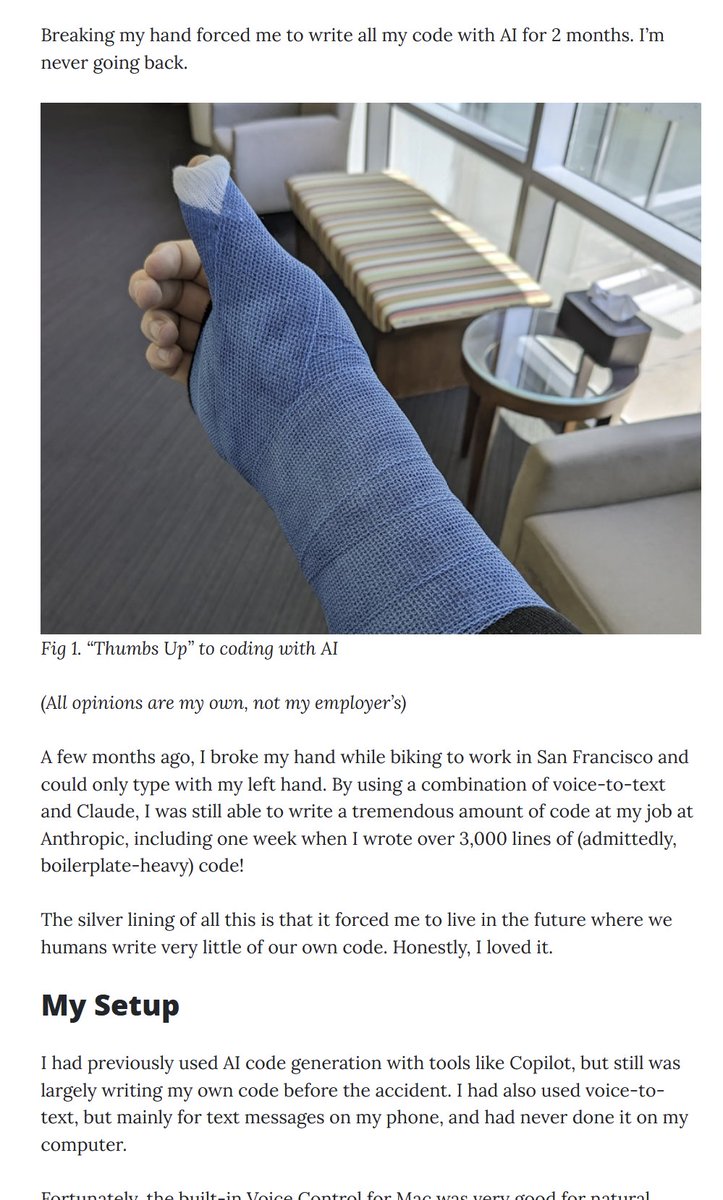
Right now the advantages from AI accrue to workers, not firms. As a result, they can be hard to notice (especially if you don't try to seriously use AI yourself, which is illuminating)
These two accounts by coders are instructive:
nicholas.carlini.com/writing/2024/h…
erikschluntz.com/software/2024/…

English
Kurt Thorn retweetledi

ePhective (San Francisco) is a newly founded #phagetherapy company started by @joeBondyDenomy (@UCSF) & Zemer Gitai (@Princeton). They are currently looking for:
2 #Phage Scientists to lead projects in phage discovery, characterization, & engineering
English
Kurt Thorn retweetledi
PCA is surprisingly hard to beat

English
It’s funny how moving from academia to industry changes your perspective. Looking for my second industry job I spent a lot of time asking questions about business strategy, to find a company that I thought would be successful. That never would have occurred to me in academia.
Keith Hornberger@KRHornberger
@ScopeKurt 💯 when I joined my current company when it was private and much smaller, the first thing I looked for was who they’d hired already - the concept was cool, but they’d also brought in many pharma veterans who knew how to get out the hammer and tongs and get sh*t done
English
Agreed. There’s a reason VCs prefer an A team with a B idea over a B team with an A idea. Execution matters more than you think.
Keith Hornberger@KRHornberger
Second this. Pharma prioritizes action and decision-making. Scientific excellence is important, but execution is equally important. The work is iterative. Turn the crank, fail fast, learn from the failure, improve design, repeat. You can be scientifically excellent to a fault.
English
Kurt Thorn retweetledi

Second this. Pharma prioritizes action and decision-making. Scientific excellence is important, but execution is equally important. The work is iterative. Turn the crank, fail fast, learn from the failure, improve design, repeat. You can be scientifically excellent to a fault.
Vega Shah@dr_alphalyrae
An observation from the industry side, a lot of companies prefer not to hire academic scientists because they are prone to spending too much time in ideation as opposed to building+experimentation. I struggled in my job search early on due to this belief about phds in industry
English