Scott Hadaway retweetledi
Scott Hadaway
443 posts

Scott Hadaway
@ScottHadaway
No one special, just an Unapologetic Libertarian.
Makaha Hawai'i Katılım Ekim 2021
1.1K Takip Edilen128 Takipçiler

@spacebrandonb Thank you so much for posting this. I was driving when I heard it. There are no words.
English

This is what I mean re: @AstroVicGlover
x.com/i/status/20397…
Eric Daugherty@EricLDaugh
🚨 WOW! Artemis II pilot Victor Glover gives the PERFECT response to a leftist reporter asking about skin color "I hope we push that one day...it's about human history, humanity, NOT 'black history,' not 'women's history,' but that it becomes human history!" RIGHT ON! Victories for Americans and victory for humanity 🇺🇸🚀
English

🚨 WOW! Artemis II pilot Victor Glover gives the PERFECT response to a leftist reporter asking about skin color
"I hope we push that one day...it's about human history, humanity, NOT 'black history,' not 'women's history,' but that it becomes human history!"
RIGHT ON!
Victories for Americans and victory for humanity 🇺🇸🚀
English

Huge fan @AstroVicGlover, your words during the interview should be shared on every device on the planet. Hoping someone releases a transcript so I can share. Bravo and Godspeed!
English
Scott Hadaway retweetledi

Ode to Apple’s Liquid Glass
O Liquid Glass, thou shimmering pretender,
How do I scorn thee? Let me count the ways:
I love thee as a mirror in midlife crisis,
Reflecting everything yet revealing naught,
A kaleidoscope of glare where focus dies.
I love thee for the game of Where’s Waldo apps,
Icons drowned in refraction’s smug embrace,
Each tap a treasure hunt through frosted haze.
I love that productivity bowed to “vibes,”
Where once I worked, now I admire the sheen,
A meditation on translucency, not tasks.
I love that everything shines, yet nothing works,
Buttons dissolve in light’s capricious dance,
Text retreats behind thy glassy smirk.
I love the squinting I’ve perfected as craft,
A new core competency: eyes half-closed,
To pierce the glamour for the ghost of function.
I love thy accessibility as afterthought,
A WCAG whisper lost in iridescent fog,
Thou art the emperor’s new wardrobe, digitized.
O Liquid Glass, thou meta-material divine,
Fluid as Apple’s excuses, deep as marketing spin,
Thou art the triumph of form over every fucking thing else.
Truly, a masterpiece for the ages.
Shiny bullshit.
English

@Sean_in_Boston @DocStrangelove2 You are correct but let's be honest, if he gave us a 3 second headshart he's still be done before we were :)
English

I notice he didn't show the timer or announce the time. The length of the beep is about .33 seconds. His first shot is at least .2 seconds after the end of the beep. Not a chanced in hell that he got 6 shots off in less than half a second with a revolver. My best guess would be a time in the 1.5 second range. Not shabby at all with that ammo but not anywhere near 1 second.
English

Everything you said about the current state of the Navy's mine countermeasures capability is wrong. Not a little wrong. Completely, embarrassingly, dangerously wrong....
"The four ships we had dedicated to doing this we just decommissioned." The Avengers in Bahrain... Devastator, Dextrous, Gladiator, Sentry. Wooden-hulled ships from the 1980s. Ships that were pushing 40 years old. You know what replaced them? Three Independence-class Littoral Combat Ships... Canberra, Santa Barbara, and Tulsa… all three already deployed to U.S. 5th Fleet, all three operating in the Persian Gulf and Arabian Gulf right now, today, as you wrote this little rant. Not in San Diego. Not in drydock. In theater. Carrying the most advanced mine countermeasures mission package the Navy has ever fielded.
USS Canberra arrived in Bahrain in May 2025 as the first LCS with a full MCM mission package. USS Santa Barbara is in the Arabian Gulf conducting mine countermeasures operations with unmanned surface vehicles… and, by the way, just made naval history by executing the first-ever at-sea launch of a LUCAS one-way attack drone from a littoral combat ship under Task Force 59. USS Tulsa is right there alongside them. Three ships. In the Gulf. Doing the mission. While you say the Navy "is absolutely not ready for this."
These are fundamentally different platforms. Autonomous mine-hunting sonar… the AN/AQS-20C… towed by unmanned surface vehicles so sailors stay outside the minefield. Airborne laser mine detection systems on MH-60 helicopters. Unmanned influence sweep systems for acoustic and magnetic minesweeping. The old Avengers sent sailors INTO the minefield on wooden boats. The new systems keep them OUT of the minefield using robots... something you call a "downgrade"
And while Santa Barbara hunts mines, she's operating under armed overwatch from A-10C Warthogs out of Jordan… loaded with JDAMs, laser-guided APKWS rockets, and enough firepower to shred any fast boat or drone swarm the Islamic Regime throws at them. The Avengers never had anything like that.
"We lost all of our corporate knowledge." Really? The Navy spent a decade building, testing, qualifying, and deploying an entirely new mine warfare architecture specifically to preserve and advance that knowledge. They trained new crews. They ran operational tests on Cincinnati. They deployed the first operational package on Canberra. The Navy's mine countermeasures technical division ran this transition for years with deliberate overlap between old and new platforms. You lose corporate knowledge when you do nothing. The Navy did the opposite of nothing.
"Now we're running an experiment and it's gonna cost people their lives." Three combat ships, forward deployed in the most contested waters on earth, running mine countermeasures with unmanned systems, protected by close air support, integrated with Task Force 59's autonomous warfare network. That's the most capable mine warfare force the United States has put in the Persian Gulf since 1991.
Yelling "amateur hour" at people while getting the basic facts of the Navy's current force posture completely, demonstrably wrong… while three ships are literally in the water doing the job he says nobody can do… that IS amateur hour.

English

@HealthyNestzz There is a big difference in something containing useful compounds and something being good for you. Do not eat avocado pits. The Tannins and Trypsin Inhibitors alone cause problems. Add the fact that too much will nuke your liver, and this a very bad idea.
English
Scott Hadaway retweetledi

1866: Cotton seeds are agricultural waste. After extracting cotton fiber, farmers are left with millions of tons of seeds containing oil that's toxic to humans. Gossypol, a natural pesticide in cotton, makes the oil inedible. The seeds are fed to cattle in small amounts or simply discarded.
1900: Procter & Gamble is making candles and soap. They need cheap fats. Animal fats work but they're expensive. Cotton seed oil is abundant and nearly worthless. If they could somehow make it edible, they'd have unlimited cheap raw material.
The process they develop is brutal. Extract the oil using chemical solvents. Heat to extreme temperatures to neutralise gossypol. Hydrogenate with pressurised hydrogen gas to make it solid at room temperature. Deodorise chemically to remove the rancid smell. Bleach to remove the grey color.
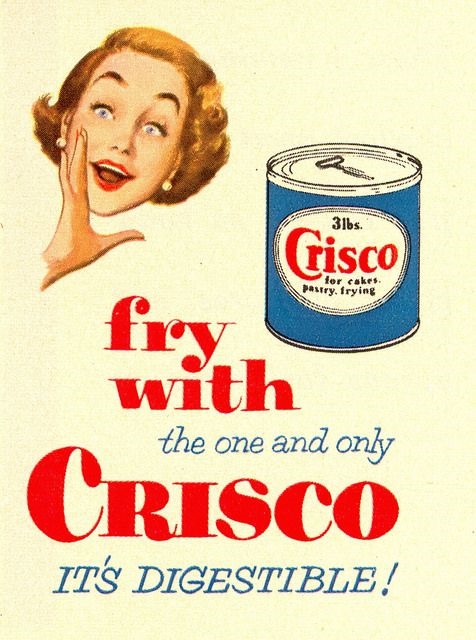
The result: Crisco. Crystallised cottonseed oil. Industrial textile waste transformed through chemical processing into something white and solid that looks like lard. They patent it in 1907, launch commercially in 1911.
Now they have a problem. Nobody wants to eat industrial waste that's been chemically treated. Your grandmother cooks with lard and butter like humans have for thousands of years. Crisco needs to convince her that her traditional fats are deadly and this hydrogenated cotton-seed paste is better.
The marketing campaign is genius. They distribute free cookbooks with recipes specifically designed for Crisco. They sponsor cooking demonstrations. They target Jewish communities advertising Crisco as kosher: neither meat nor dairy. They run magazine adverts suggesting that modern, scientific families use Crisco while backwards rural people use lard.
But the real coup happens in 1948. The American Heart Association has $1,700 in their budget. They're a tiny organisation. Procter & Gamble donates $1.7 million. Suddenly the AHA has funding, influence, and a major corporate sponsor who manufactures vegetable oil.
1961: The AHA issues their first dietary guidelines. Avoid saturated fat from animals. Replace it with vegetable oils. Recommended oils: Crisco, Wesson, and other seed oils. The conflict is blatant. The organization issuing health advice is funded by the company that profits when people follow that advice.
Nobody seems troubled by this. Newspapers report the guidelines as objective science. Doctors repeat them to patients. Government agencies adopt them into policy. Industrial cotton-seed oil, chemically extracted and hydrogenated, becomes "heart-healthy" while butter becomes "artery-clogging poison."
1980s: Researchers discover that trans fats, created by hydrogenation, directly cause heart disease. They raise LDL, lower HDL, promote inflammation, and increase heart attack risk more than any other dietary fat. Crisco, as originally formulated, is catastrophically unhealthy. This takes 70 years to officially acknowledge.
Procter & Gamble's response: Quietly reformulate without admission of error. Remove hydrogenation, keep selling seed oils, never acknowledge that their "heart-healthy" product spent seven decades actively causing the disease it claimed to prevent.
Modern seed oils remain. Soybean, canola, corn, safflower oils everywhere. Same chemical extraction process. Same high-temperature refining. Same oxidation problems. Just without hydrogenation so trans fats stay below regulatory thresholds.
These oils oxidise rapidly when heated. They integrate into cell membranes where they create inflammatory signalling for months or years. They're rich in omega-6 fatty acids that promote inflammation. They've never existed in human diets at current consumption levels.
But they're cheap. Profitable. And the food industry has spent a century convincing everyone they're healthy. The alternative, admitting that industrial textile waste shouldn't have been turned into food, would require acknowledging the last 110 years of dietary advice was fundamentally corrupted from the start.
Your great-grandmother cooked with lard because that's what humans used for millennia. Then Procter & Gamble needed to sell soap alternatives and accidentally created the largest dietary change in human history.
We traded animal fats that built civilisations for factory waste that causes disease.
The soap company won. Your health lost.

English
Scott Hadaway retweetledi

I’m realizing on my health journey that the problem isn’t lack of willpower, discipline, or knowledge. It’s the system itself. People genuinely try to eat better and still get tripped up by the options available to them. Even when you have some time, some money, access to information, and you’re cooking real food at home, it’s still incredibly hard to consistently eat a diet that’s lower in sodium and sugar, minimally processed, affordable, and high enough in protein, healthy fats, and decent carbs. A lot of those goals are working against each other.
This hits families with kids especially hard, and single parent households even harder. It’s not just about the cost. Think about the constant drain on time and energy. Beck is growing vegetables in our tower garden, buying produce at the farmers market, and spending huge amounts of time cooking real meals from scratch. Despite all of that effort, it’s still hard to get all the numbers to line up.
People also end up making choices they’re told are better for them, but those choices come with a cost and can sometimes be worse. Take diet soda. No sugar, no calories, marketed as the responsible option. But it keeps the sweet habit alive, trains taste buds to expect intensity, and comes with tradeoffs most people never think about. Artificial sweeteners may not spike blood sugar like sugar does, but there’s growing evidence they can still affect appetite, cravings, and metabolic signals in ways that make healthy eating even harder over time.
Convenient food always comes with a cost. If it’s quick and easy, it’s usually over salted, ultra processed, or engineered to keep you coming back for more. If it’s clean and protein dense, it’s often expensive, time consuming, or just not realistic for everyday family life. Over time, that creates a closed loop. The more people rely on processed, salty, and sweet foods, the more their tastes adapt to them, and the harder it becomes to change course.
This isn’t a personal failure, or a failure of strength or willpower. It’s a predictable outcome of a food system optimized for shelf life, profit, and palatability, not long term human health.
I’m no doctor or nutritionist, and I know none of this changes overnight. But maybe the answer isn’t fixing everything at once. Maybe it’s starting with a couple of small, realistic changes. For a lot of people, that might just mean prioritizing protein earlier in the day. Do that for a month and then, I don’t know, maybe replace a sweet treat with a bowl of fruit once a week. It can’t hurt.
Drink water.
Go for a walk.
English
Scott Hadaway retweetledi

@howie_hua Divide 12 by 4 and then multiply the result by 100. Zero idea why I do it this way.
English