Seaplane Ventures

113 posts

Seaplane Ventures banner
Seaplane Ventures

Seaplane Ventures

@SeaplaneVC

Seaplane Ventures is an early stage venture firm in Austin, TX. Focused on pre-seed and seed-stage US startups. Led by @Magyer.

Austin, TX Katılım Nisan 2023
148 Takip Edilen223 Takipçiler
Seaplane Ventures retweetledi
Better Auth
Better Auth@better_auth·
Today we're announcing Agent Auth Protocol An open standard for agent authentication, capability based authorization and service discovery ⇃read more ⇂
Better Auth tweet media
English
39
78
986
88.4K
Seaplane Ventures retweetledi
Joe Magyer
Joe Magyer@Magyer·
🎉 50 episodes of @InvestNStartups! We’re marking the milestone with a special episode packed with the biggest insights and hardest lessons I’ve learned from hosting the show. We dive into the game-changing impact of AI on founders and investors, the fiercest debates shaking up venture, what I’ve completely reversed my thinking on, and my most contrarian take on VC. Here's the longer breakdown of my conversation with good friend and guest host @ChrisHillALX, host of @MoneyUnpluggedP: AI has been the defining force in venture since the show started in 2024. AI has changed how startups get funded, how fast they grow, and how lean they can be, helping revive venture after the post-2021 downturn. The rebound has been real, but highly concentrated to the biggest winners. AI is also driving growth and efficiency at once. Startups can scale revenue much faster without scaling headcount the same way, pushing more value toward companies that pair strong demand with small teams. One of venture’s biggest debates is around portfolio construction. I talked about the tension between ultra-diversified investing, which improves the odds of catching a unicorn at the expense of diluting its impacts to returns, and concentrated investing, which can raise the quality bar and leave more time to support founders. Another major split is hot deals versus non-consensus deals. Some investors want the most in-demand founders regardless of price, while others hunt for overlooked opportunities in less fashionable markets and sectors. Several guest conversations changed my thinking. One example was @MacConwell on reserves: instead of setting aside large amounts for future rounds that may never materialize, I now favor a “fast follow” approach when conviction rises. Another lesson, from @nikiscevak, was the importance of finding your tribe with fundraising. Rather than trying to change minds, it is more effective to build a clear identity and attract founders and LPs who already share your worldview. My most contrarian take is that ownership targets are overrated. What really matters to LPs and fund performance is not what percentage of a winner a fund owns, but what percentage of the fund’s capital is invested in the winner. We also talked about emerging managers and the insights from guests on why they're able to outperform. Namely, that smaller, newer funds are hungrier, more focused, and more flexible. Lastly, we talked about AI's role in VC. AI will increasingly help investors analyze startups, move faster, and operate with fewer people, even if judgment remains difficult to automate. AI will also narrow the gap between small and large venture firms by giving smaller managers better tools without requiring a large internal team. Thanks to Chris for guest hosting this one, to all our listeners, and to the 50 amazing guests who have come on the show!
Joe Magyer tweet media
English
1
4
12
4.1K
Seaplane Ventures retweetledi
Ali Ansari
Ali Ansari@aliansarinik·
Excited to introduce micro1 Cortex, a contextual evaluation, visibility, and improvement platform for enterprise AI agents. Foundational models are trained for general intelligence, but enterprises need agents that perform reliably inside their unique context: workflows, policies, data environments, and edge cases. Cortex brings trust to enterprise AI by leveraging domain experts and real-world scenarios for any use case to test, diagnose, and improve how agents behave in production.
English
52
60
322
115.5K
Seaplane Ventures retweetledi
Beka
Beka@bekacru·
Excited to announce Better Auth Infrastructure Get started: better-auth.com
Beka tweet media
English
66
62
1.2K
268.5K
Seaplane Ventures retweetledi
Ti Morse
Ti Morse@ti_morse·
My first interview with @aliansarinik, Founder & CEO of @micro1_ai. 1:10 Continuous model improvement 2:42 Starting with an AI recruiting tool 5:42 Moving into the human data space 7:19 The Human Happiness Index 13:32 Creating a real world robotics dataset 17:03 Hiring hundreds of doctors & lawyers in a week 20:15 Providing a world class white glove service 22:15 Hiring for agency & risk taking 26:03 High velocity on two way decisions 27:35 Going all-in on data 28:52 Structuring incentives 38:18 Leadership & staying in the details 40:10 Losing their biggest customer right before an investor pitch 43:24 Becoming risk averse after an existential crisis 50:45 Taking action as fast as possible when you feel the urge to act 56:12 What it felt like growing revenue 30x in a year 1:00:48 Staying focused & limiting new projects 1:02:30 Predicting what the big AI labs will want 1:06:50 Creating a model to predict timelines 1:12:23 Hiring as a last resort 1:18:25 Taking big bold bets 1:28:49 Long-horizon tasks
English
23
39
233
145.7K
Seaplane Ventures retweetledi
stuxf
stuxf@stuxfdev·
We spun out of the #1 hacking team in the US and built AI that finds what even the best hackers miss. During one engagement, it found 6 different ways to take over any user's account on a popular webapp. Completely autonomously. Then suggested fixes for every single one. Today we're announcing @verialabs' $3.2M seed, backed by @ycombinator, @gokulr, @paulg, and @woloski (co-founder of Auth0), and many other great investors. DM me if you want to know what we'd find in your app.
stuxf tweet media
English
24
19
235
52.3K
Seaplane Ventures retweetledi
Ali Ansari
Ali Ansari@aliansarinik·
The U.S. MUST win the AI race We’ve implemented a clear policy at micro1: we will only work with U.S. AI labs and its allies. We made this decision because the AI race is not just about better products. It is about who controls the intelligence layer of the global economy, and whether frontier capability is used to strengthen the free world or to empower adversarial states. AI will be the most important technology of our lifetime. In the fullness of time, it will automate most functions across the economy. Not just software tasks, but coordination, production, logistics, judgment, and execution. As those functions are automated, human time is freed up to invent new ones. Those new functions then become candidates for automation themselves. This loop compounds. As this trajectory continues, output per worker increases dramatically. Entire categories of work become cheaper and faster to perform. Manufacturing reshoring becomes economically viable not because of policy intervention, but because intelligent systems operated domestically outperform global labor arbitrage. Goods and services trend toward lower marginal cost, while distribution improves through better coordination of supply and demand. That is the upside. However, this is impossible without deep integration of intelligent systems. For AI to meaningfully automate real-world functions inside enterprises or governments, it needs full context of any given enterprise. That means read and write access to its core databases. There is no credible path to automating high-impact functions without granting frontier systems that level of access. If the United States does not win the AI race, enterprises eventually face a constrained choice. Either grant that access to Chinese models controlled by an adversarial government, or rely on sub-optimal intelligence to automate functions that still must be automated. Both outcomes are not acceptable. And ultimately, this becomes the greatest national security risk the United States has ever faced. AI models are trained by humans. The judgment embedded in pre-training data and especially in expert post-training data largely determines how a model behaves. While emergent behavior exists, a useful approximation is that a model reflects the weighted aggregate of the human judgment distilled into it. Assisting foreign actors—who will naturally prioritize expert tasks aligned with their own interests—to dominate data creation embeds those interests directly into the intelligence layer itself. Once encoded at scale, these interests propagate through every downstream applications that relies on that intelligence. Here’s how we win. First, leverage is in software. China is ahead in hardware for physically intelligent systems. Catching up there is a long and difficult battle. Software, both large language models and robotics models, remains the bottleneck. Advancing the brain (AI models) is the fastest way to increase the usefulness of existing hardware and deployed systems. Second, the U.S. must 100x its investment in structured human judgment. Continued investment in compute and algorithmic efficiency is critical. But that investment is ultimately a bet on very high future inference demand. For that bet to pay off, models must unlock many new capabilities, and in practice the only way to unlock those capabilities is through expert human data. Historically, experts like doctors and lawyers were never incentivized to produce high-quality reasoning data in a machine-verifiable format. There was no reason for a doctor to generate precise, structured simulations of patient interactions, diagnostic reasoning, or treatment tradeoffs. There was no reason for a lawyer to document complex legal reasoning paths in a way that could be programmatically evaluated. AI systems now require exactly this kind of data. The incentive finally exists because this data directly improves systems that operate at massive scale, and experts can be paid well to produce it. Once expert judgment is encoded into models in a structured, verifiable way, it compounds. Those who delay do not just lose time. They lose the ability to catch up. Third, distillation from Chinese labs must be stopped. AI labs must do everything they can to prevent Chinese labs and models from distilling frontier models. Simply calling frontier APIs, or even interacting through UIs, lets Chinese model companies rapidly generate high-quality supervised fine-tuning datasets and close the gap at a fraction of the cost. This method does not put you at the frontier, but it does let you catch up quickly, which is what we saw with DeepSeek. The West significantly overreacted to DeepSeek’s headline capabilities, but underreacted to the underlying dynamic: frontier access itself becomes a training set at a fraction of the cost. Human data platforms also have a duty to help prevent this distillation. Lastly, the U.S.government should set the standard for AI Evaluation that leads to real production usage. AI agents are under-deployed relative to what the technology allows because they are probabilistic systems that require a fundamentally different QA approach than deterministic software. Generic QA is insufficient; safely shipping agents requires explicit evaluation frameworks that assess their full action space. Organizations must clearly define which functions an agent is allowed to perform, how quality is measured for each function, and which domain experts are qualified to judge outcomes. With these frameworks in place, agents can be rigorously tested using structured human data, deployed to production with confidence, and continuously improved over time. The U.S. government should be the first large enterprise to implement rigorous evaluation systems across every function. If the government leads on evaluation-driven deployment, adoption across the private sector accelerates naturally. This is how American workers become more powerful. Each worker operates digital or physical agents that expand their effective output. Recruiting, manufacturing, logistics, and other domains shift toward human judgment overseeing autonomous execution. Reshoring occurs because it becomes economically rational. Work becomes more meaningful. This is a race to determine who controls the intelligence layer of the global economy. And that must be us. 🇺🇸
English
58
101
517
392.9K
Seaplane Ventures retweetledi
Joe Magyer
Joe Magyer@Magyer·
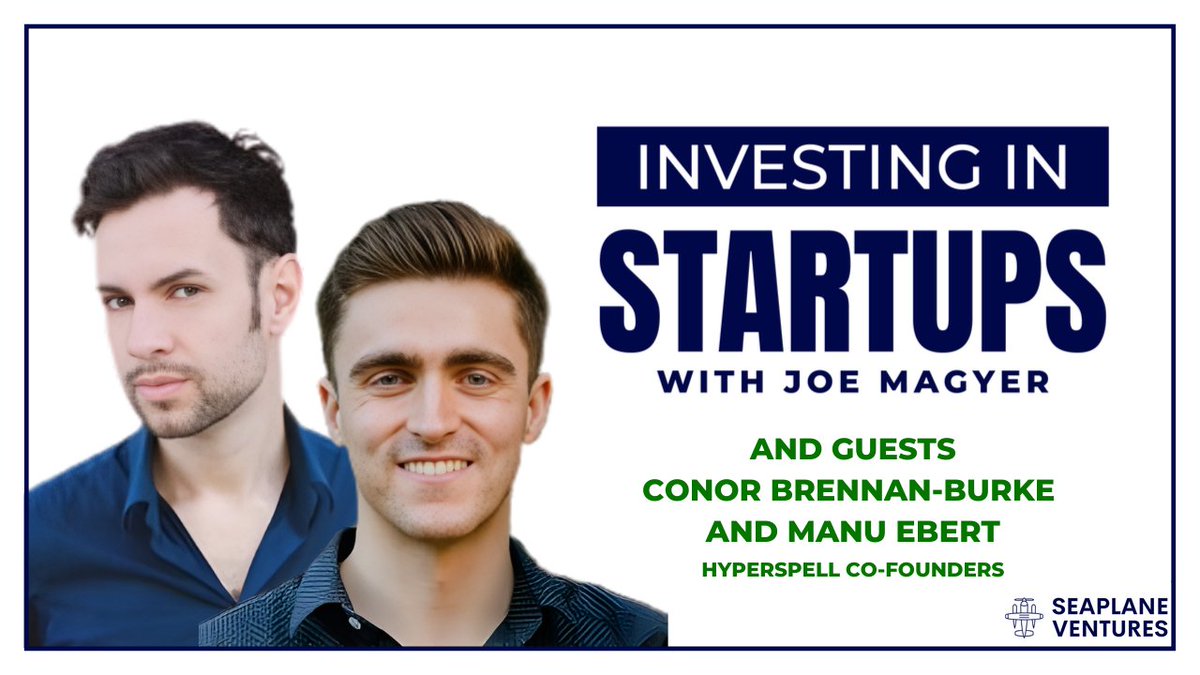
Tech stocks puked this week because of the rise of AI agents. Perfect timing for a conversation with the cofounders of @hyperspell, one of whom is such an AI OG that he once bought a .ai domain name via fax. @conor_ai and @maebert discussed AI agents, the evolution of context, @ycombinator , and more: From chatbots to true agents – Conor breaks down where tools like ChatGPT stop and AI agents begin, and why the key shift is agents taking actions autonomously across your tools, not just answering questions. Why context is the real bottleneck – Manu and Conor share how building their own “chief of staff” agent led them to Hyperspell, a memory and context layer that plugs into tools like Slack, Gmail, and Notion so agents can actually understand your customers, org chart, and tech stack. The three bottlenecks to agent adoption – Manu explains why verification, capability, and context each limit what agents can do today, and why decoupling these layers (rather than relying on a single big lab) gives companies more flexibility and avoids platform lock-in. Why workers aren’t using AI (yet) – Conor reacts to studies showing most desk workers rarely touch AI, and argues that fear, bad framing (“AI will replace you”), and lack of personalized context are holding back adoption despite models already outperforming humans on many benchmarks. AI as global leapfrog, not just US office automation – Manu highlights under-discussed upside: primary care in Africa, McKinsey-grade advice for small businesses, tailored guidance for farmers, and always-on tutors that could reshape opportunity in developing markets. Let machines be the cogs, not people – The pair paint a future where AI agents handle status updates, follow-ups, and information shuffling inside big orgs, freeing humans to do creative, high-leverage work instead of feeling like dehumanized “TPS report” machines. YC, rejection, and founder stubbornness – Conor and Manu talk about finally getting into Y Combinator after nine applications between them, why persistence is a superpower for founders, and how YC has shaped Hyperspell’s trajectory. Thanks to Conor and Manu for joining on this conversation. And, yes, we are proud investors in Hyperspell at @SeaplaneVC.
Joe Magyer tweet media
English
4
6
15
970
Seaplane Ventures retweetledi
Veria Labs
Veria Labs@verialabs·
We hacked a Times Square billboard! jk! @brexHQ put us up there for YC F25. Back to actually finding security vulnerabilities.
English
2
3
20
2.4K
Seaplane Ventures retweetledi
Beka
Beka@bekacru·
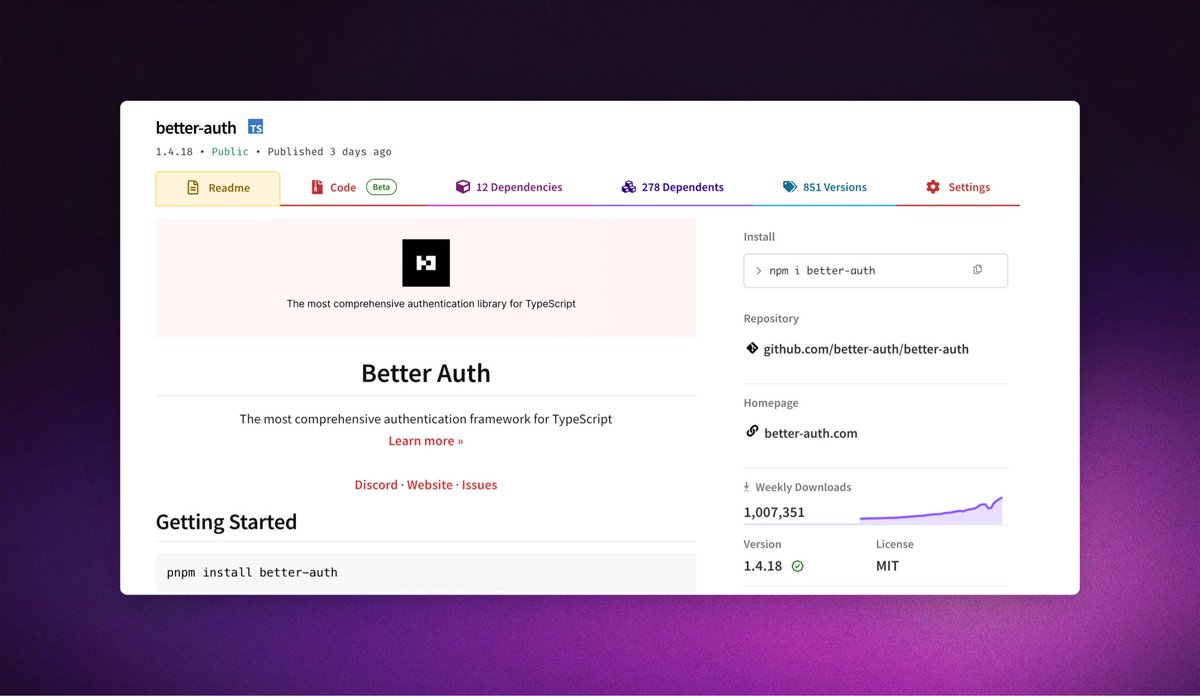
Better Auth just hit 1,000,000+ weekly downloads on npm 🫡
Beka tweet media
English
47
20
654
24K
Seaplane Ventures retweetledi
Joe Magyer
Joe Magyer@Magyer·
Proud investor in @micro1_ai and 100% support this policy. Thanks, @aliniikk.
Ali Ansari@aliansarinik

The U.S. MUST win the AI race We’ve implemented a clear policy at micro1: we will only work with U.S. AI labs and its allies. We made this decision because the AI race is not just about better products. It is about who controls the intelligence layer of the global economy, and whether frontier capability is used to strengthen the free world or to empower adversarial states. AI will be the most important technology of our lifetime. In the fullness of time, it will automate most functions across the economy. Not just software tasks, but coordination, production, logistics, judgment, and execution. As those functions are automated, human time is freed up to invent new ones. Those new functions then become candidates for automation themselves. This loop compounds. As this trajectory continues, output per worker increases dramatically. Entire categories of work become cheaper and faster to perform. Manufacturing reshoring becomes economically viable not because of policy intervention, but because intelligent systems operated domestically outperform global labor arbitrage. Goods and services trend toward lower marginal cost, while distribution improves through better coordination of supply and demand. That is the upside. However, this is impossible without deep integration of intelligent systems. For AI to meaningfully automate real-world functions inside enterprises or governments, it needs full context of any given enterprise. That means read and write access to its core databases. There is no credible path to automating high-impact functions without granting frontier systems that level of access. If the United States does not win the AI race, enterprises eventually face a constrained choice. Either grant that access to Chinese models controlled by an adversarial government, or rely on sub-optimal intelligence to automate functions that still must be automated. Both outcomes are not acceptable. And ultimately, this becomes the greatest national security risk the United States has ever faced. AI models are trained by humans. The judgment embedded in pre-training data and especially in expert post-training data largely determines how a model behaves. While emergent behavior exists, a useful approximation is that a model reflects the weighted aggregate of the human judgment distilled into it. Assisting foreign actors—who will naturally prioritize expert tasks aligned with their own interests—to dominate data creation embeds those interests directly into the intelligence layer itself. Once encoded at scale, these interests propagate through every downstream applications that relies on that intelligence. Here’s how we win. First, leverage is in software. China is ahead in hardware for physically intelligent systems. Catching up there is a long and difficult battle. Software, both large language models and robotics models, remains the bottleneck. Advancing the brain (AI models) is the fastest way to increase the usefulness of existing hardware and deployed systems. Second, the U.S. must 100x its investment in structured human judgment. Continued investment in compute and algorithmic efficiency is critical. But that investment is ultimately a bet on very high future inference demand. For that bet to pay off, models must unlock many new capabilities, and in practice the only way to unlock those capabilities is through expert human data. Historically, experts like doctors and lawyers were never incentivized to produce high-quality reasoning data in a machine-verifiable format. There was no reason for a doctor to generate precise, structured simulations of patient interactions, diagnostic reasoning, or treatment tradeoffs. There was no reason for a lawyer to document complex legal reasoning paths in a way that could be programmatically evaluated. AI systems now require exactly this kind of data. The incentive finally exists because this data directly improves systems that operate at massive scale, and experts can be paid well to produce it. Once expert judgment is encoded into models in a structured, verifiable way, it compounds. Those who delay do not just lose time. They lose the ability to catch up. Third, distillation from Chinese labs must be stopped. AI labs must do everything they can to prevent Chinese labs and models from distilling frontier models. Simply calling frontier APIs, or even interacting through UIs, lets Chinese model companies rapidly generate high-quality supervised fine-tuning datasets and close the gap at a fraction of the cost. This method does not put you at the frontier, but it does let you catch up quickly, which is what we saw with DeepSeek. The West significantly overreacted to DeepSeek’s headline capabilities, but underreacted to the underlying dynamic: frontier access itself becomes a training set at a fraction of the cost. Human data platforms also have a duty to help prevent this distillation. Lastly, the U.S.government should set the standard for AI Evaluation that leads to real production usage. AI agents are under-deployed relative to what the technology allows because they are probabilistic systems that require a fundamentally different QA approach than deterministic software. Generic QA is insufficient; safely shipping agents requires explicit evaluation frameworks that assess their full action space. Organizations must clearly define which functions an agent is allowed to perform, how quality is measured for each function, and which domain experts are qualified to judge outcomes. With these frameworks in place, agents can be rigorously tested using structured human data, deployed to production with confidence, and continuously improved over time. The U.S. government should be the first large enterprise to implement rigorous evaluation systems across every function. If the government leads on evaluation-driven deployment, adoption across the private sector accelerates naturally. This is how American workers become more powerful. Each worker operates digital or physical agents that expand their effective output. Recruiting, manufacturing, logistics, and other domains shift toward human judgment overseeing autonomous execution. Reshoring occurs because it becomes economically rational. Work becomes more meaningful. This is a race to determine who controls the intelligence layer of the global economy. And that must be us. 🇺🇸

English
0
1
8
965
Seaplane Ventures retweetledi
Joe Magyer
Joe Magyer@Magyer·
People sweating AI destroying jobs forget something important: Most people don't enjoy their jobs today! @conor_ai of @hyperspell makes this point and talks about unleashing human potential in an upcoming episode of @InvestNStartups.
English
1
3
9
1.1K
Seaplane Ventures retweetledi
Beka
Beka@bekacru·
Introducing Better Hack At Better Auth, our goal is to democratize access to high quality software that enables others to build category defining products and companies. We’re finding software is often weighed down by legacy decisions, bloated features, and workflows that no longer make sense. Time to strip it down, figure out what’s broken, and make it better. We're kicking this off with a hackathon at YC to push this effort forward and invite builders to come and prototype the next generation of better tools. The winner gets a Y Combinator interview, $10K cash and credits, swags and other prizes from our partners. We have amazing judges lined up for the event. Sponsored by: @vercel @neondatabase @sentry @coderabbitai @mintlify @AnthropicAI @autumnpricing Registration link below. See you there!
English
32
36
465
64.5K
Seaplane Ventures retweetledi
Better Auth
Better Auth@better_auth·
thank you :)
Better Auth tweet media
English
14
19
465
14.3K
Seaplane Ventures retweetledi
Joe Magyer
Joe Magyer@Magyer·
.@better_auth crossed the 25k ⭐ barrier on Github yesterday. Amazing work by @bekacru and the community of 700+ contributors!
Joe Magyer tweet media
English
3
5
50
4.2K