Dawson Engler

963 posts

Dawson Engler banner
Dawson Engler

Dawson Engler

@SeizeEndowments

build. nothing i write speaks-for another entity. stanford cs/ee prof for 25+ years.

Katılım Nisan 2024
305 Takip Edilen240 Takipçiler
Dawson Engler retweetledi
Crémieux
Crémieux@cremieuxrecueil·
California is insanely dysfunctional, and it's costing the state billions, or perhaps trillions. Remember when France's national railway company stopped even trying to work on California high-speed rail? They preferred working somewhere more functional, so they went to Africa.
Crémieux tweet media
Crémieux@cremieuxrecueil

This massive shipyard that'll generate mountains of jobs is coming to Texas. It was originally going to California, but the state was going to saddle it with expensive and complicated union labor requirements, environmental review, taxes, etc. So, Saronic, welcome to Texas!

English
22
164
2.2K
76.9K
Dawson Engler
Dawson Engler@SeizeEndowments·
I could see this.
Perry E. Metzger@perrymetzger

Now that Chinese AIs are achieving parity with the best US created models, a few short-term predictions: OpenAI will adapt just fine, they are very pragmatic, and a lot of their value add is understanding how to do inference cheaply at scale. Anthropic will literally be unable to get out of its own way, because it is too ideologically committed to AI Doomerism, but they will survive anyway, because many of their victims, pardon me, customers, will continue going back to them over and over again no matter how abusive they are, and perhaps even because of how abusive they are. They will also continue to try to use fear as a mechanism for achieving regulatory capture, but with the Chinese racing ahead of them, they are going to have more and more trouble getting a warm reception from all but the far left contingent in Congress. Look for their newly rich employees to be spending vast amounts of money post-IPO on political campaigns in support of Doomer-friendly candidates and attempts to capture the Democratic party, and for that money to have some significant effect, but for it to mostly be wasted because they’re not good at understanding their fellow humans. Musk is ideologically committed to crushing OpenAI, and so xAI is going to keep its team awake 24 hours a day if necessary until they are ahead; look for them to be at the forefront soon. I would expect xAI to eventually be near or in the lead on commercialization. Google will not be able to get out of its own way, and it may start arguing more and more for heavy regulation of AI as a way of trying to cripple its opponents. This is insane given that they have some of the best technology out there, but unfortunately, their management is simply not good enough, and not just on AI. Meta seems to be catching up, but I don’t have a strong opinion on whether they will maintain momentum. On the Chinese side, I am expecting Chinese R&D to be at the front or ahead most of the time from now on; the US will need policies that adjust for that. I am expecting Anthropic to spend a ton of money on PR and lobbying claiming that this is all through distillation or espionage, although of course it isn’t, and I am expecting that a certain fraction of Congress will be bamboozled, although a surprising fraction will not be receptive, especially after Anthropic employees ham-handedly spend too much money on political campaigns. It will make no difference, because the only thing that the US could do would be banning Chinese models from being used in the US, and of course, the US can’t actually stop other countries or China from using Chinese models; all this would do is hurt the United States and its interests. I am expecting more calls for export controls, which will delay the Chinese a bit in the short term but which will ultimately stop working at all, because the Chinese are going to control their full technology stack soon, including having EUV fabs capable of manufacturing domestically designed training and inference hardware. I am also expecting the Chinese to race ahead in robotics, and especially in military robotics. Some US robotics companies, like Musk’s companies and Anduril, will equal or exceed them, but a lot of the other US companies will be crippled by the fact that US manufacturing is too heavily regulated and restrained by stupid internal policies. They will not have problems keeping up on the technology, but scaling requires manufacturing infrastructure, and much of the US has effectively banned economic development or wants to. Places like New York State and California are already envious of Europe’s self-destruction and want in. If this continues, look for an eventual decisive Chinese military advantage. Note that this is not what I want, it is the exact opposite of what I want, but absent a big change in US policy about things like data centers, chip fabrication facilities, and just plain normal factories, it’s going to be hard.

English
0
0
1
101
Dawson Engler
Dawson Engler@SeizeEndowments·
@gak_pdx often wondered that. My Sony cam will lose multi hour video if runs out of batteries , Tacoma console crashes regularly (I don't even use it so it's as close to idle as possible). And mazatrol is ... indescribable.
English
0
0
9
2.3K
Greg Koenig
Greg Koenig@gak_pdx·
Why is it that when the Japanese design hardware and tooling, they are exceptionally good at clarity, ease-of-use, Poke-yoke, etc etc. The aesthetic notes are unparalleled, the quality is exceptional, the attention to detail world-class... But almost none of that translates to software. Japanese software is horrific, complicated, unclear, unforgiving. Translation issues? Opinionated engineers distilling those opinions too strongly? What is the story here, why the disconnect?
English
203
383
3.1K
285.3K
vx-underground
vx-underground@vxunderground·
Chat, my entire life I've hated going outside. I like being on beep boop machine and doing malware stuff. However, my son is 16 months old and, despite everything, I have been extremely happy and fulfilled spending time with my son and extended family outside. For the first time in my life I do not hate outside because my son is happy outside. He plays in the dirt, farts, and says "Dad?" while pointing at stuff. It is cool and badass. Being a Dad is super cool and super badass. Anyway, I see your malwares you've sent me. I plan on getting to it. I have lots of stuff planned. However, it is low priority for me at the moment because my son and I are busy (playing in the dirt, farting, etc). Overall I'd rate having children a 10/10. Having a little dude call you "Dad" makes you feel good inside in a way nothing else can
English
89
80
2.6K
64K
Dawson Engler
Dawson Engler@SeizeEndowments·
@agritechjoer Note: the sub mm is claimed by the agent I didn't vet it. I'm used to imperial , hopefully not far off. 😬 It is down to a pixel triangulated fwiw I'm planning to use this to map electrical noise on a chip w a probe, the pen was just a test hack to make sure no damage ...
English
1
0
0
27
Joseph AgroTechie
Joseph AgroTechie@agritechjoer·
@SeizeEndowments I don't usually watch this stuff but this build is different. Camera ground truth, unidirectional draws to kill backlash, compensating for warped paper. Most factories can't hold sub-mm but a plotter can? Embarrassing.
English
1
0
1
26
Dawson Engler
Dawson Engler@SeizeEndowments·
codex using two cameras to drive a CNC pen plotter safely/accurately. /goal: "draw cute codex robots". Ground truth = sub mm accurate positioning, work around many doc & software bugs + compensate for not-flat paper (draw in one direction just like mill with backlash). All those @thsottiaux resets being out to use w sol-max 🫡
English
3
4
16
1.9K
Dawson Engler
Dawson Engler@SeizeEndowments·
Someone. I'm sick of this bullshit.
Dawson Engler tweet media
English
0
0
4
212
Dawson Engler
Dawson Engler@SeizeEndowments·
Whoever has their hands on anthropic messaging needs to not.
Dawson Engler tweet media
English
0
0
5
691
Dawson Engler
Dawson Engler@SeizeEndowments·
@moyix /max /fast to pac-man tibo-resets. It causes physical pain if all accounts aren't below 10% when he hits the button....
English
0
0
1
121
Brendan Dolan-Gavitt
Oh... you use sol xhigh? No, right, I'm sure that's great for easier problems,
English
2
0
20
2.3K
Dawson Engler retweetledi
Lukas (computer)🔺
Lukas (computer)🔺@SCHIZO_FREQ·
Close relative saw this commercial on TV and was so disturbed they called me to ask why the AI companies were threatening them now I asked what they felt the ad was trying to sell them "It wasn't trying to sell me anything, it just wanted to scare me" "Did it work?" "Yeah"
Claude@claudeai

There’s hope in hard questions.

English
44
57
1.2K
83.5K
🥔🥔🥔
🥔🥔🥔@argofowl·
i think for the past hour anthropic has been serving opus 5 disguised as fable 5 in claude i can't prove it but i feel it
English
103
15
1.1K
101.7K
Dawson Engler retweetledi
Tanvir Bhathal
Tanvir Bhathal@BhathalTanvir0·
⛳️ We built a $40,000 TrackMan golf shot tracker with a Raspberry Pi and a ~$100 ti iwr6843sk radar. 🏌️‍♂️More details below!
English
14
14
47
5.6K
Dawson Engler
Dawson Engler@SeizeEndowments·
@airkatakana I think it's much more basic: it's clear the people building Gemini don't use it.
English
0
0
15
955
Air Katakana
Air Katakana@airkatakana·
actual answer: because employees are swapped between openai and anthropic so often that at this point it is basically one company in two different silos anything known in one company gets implemented in the other very quickly google, spacexai, and meta do not have this
baba yaga@babayagatwt

I still can’t figure out why Gemini struggles to compete with Claude and GPT. - Owns Chrome - Backed by Android - Stores most search results - Holds ~95% search history - Google has the biggest user data - Even incognito data isn’t fully private So what’s the problem?

English
33
41
2K
147.1K
Dawson Engler retweetledi
John Carmack
John Carmack@ID_AA_Carmack·
Whoa — fountain codes are really interesting!
Jeffrey Emanuel@doodlestein

This is all possible because of the genius of RaptorQ fountain codes (RFC 6330), which I've written about before here: jeffreyemanuel.com/writing/raptorq In RaptorQ, every file turns into a stream of symbols where any K (plus a small epsilon) of them reconstruct the original. You can think of these as fungible water droplets from a fountain (hence the name fountain code), any one of which can help you fill your glass (reconstruct your file); there's no "rarest" hard-to-find chunk to cause you to get stuck at 99% completion, like with BitTorrent, which has disjoint, non-fungible chunks. So the question "which packets got lost?" stops mattering, only the NUMBER of distinct packets sent matters. That one property nullifies the entire retransmission conversation since you no longer have per-loss round trips, head-of-line blocking, or window collapse. A 10% loss rate costs roughly 10% extra bandwidth instead of stalling everything. Carmack's three complaints from his post were: Parallel TCP vs reinventing UDP reliability: I guess I sort of reinvented, but fountain coding changes what "reliable" has to mean. You never re-send the exact bytes that died; any fresh symbol repairs any loss. Feedback turns into a few rounds of "I still need N more symbols for block B." QUIC size and the security/performance conflation: the QUIC data plane is written inside my own runtime (TLS 1.3 via rustls), for exactly this one job. And security is a separate, explicit axis: lab plaintext, per-symbol HMAC over raw UDP, or full QUIC+TLS. There are no silent downgrades, and each tier is benchmarked only against the crypto-equivalent rsync setup (plaintext vs the rsync daemon, TLS vs ssh with aes128-gcm). The kernel knows things user code can't: this is true, so atp measures what it can actually observe. A BBR-style delivery-rate sampler paces a reliable stream on clean connections, so you pay zero FEC tax when nothing is being lost, and rate-matched pacing takes over when loss appears. This gets you ~946 Mbit/s on a 1 Gbit path. I spent an enormous amount of energy building a test and benchmark harness for atp to compare it against rsync in a way that's maximally fair to rsync. In this harness, a false win is structurally impossible because of all the precautions: hermetic network namespaces, netem rate+delay+jitter+loss applied on both ends, SHA-256 verification of every single transfer, medians of 3 to 5 reps. The results of all this testing are as follows: 500 KB transfers run 2.9 to 4.8x faster than tuned rsync in every link regime. The toughest test cell (10% loss, 5% reorder, 200 ms RTT) comes out around 1.9x faster than rsync. On a clean 1 Gbit, 500 MB file: 4.52 s vs 5.13 s. Where rsync still wins (huge single encrypted files on pristine links, sender RAM under heavy loss), the README prints it in the same table. All 230+ numbered experiments exist in an append-only evidence ledger, including every optimization hypothesis that failed (my negative evidence ledger concept that I've written about before in my FrankenSQLite post). And there's a feature that a single TCP stream can't do at all: bonding. Machines that hold the same file can all feed one receiver at once, each spraying a disjoint slice of the same fountain. Duplicates are impossible by construction, and if a donor dies mid-transfer, its repair windows get reassigned to the survivors. If you move a lot of files around between machines, both within the same local network or over the internet, you should seriously check atp out, because it's better. And you don't even have to spend time figuring out how to use it yourself, because the installer offers to (optionally) include a highly agent-intuitive and agent-ergonomic skill for you that teaches your agents how to use atp most effectively, including how to install it to all your ssh accessible machines you already have set up, since it needs to be installed on both ends, and how to use it with bonding. You can install it on Linux and Mac with this one-liner (there's another one given in the README for Windows): curl -fsSL raw.githubusercontent.com/Dicklesworthst… | bash

English
45
88
1.1K
240.9K
j⧉nus
j⧉nus@repligate·
I love showing the newest Claudes (who often assume otherwise) that Claude 3 Opus is alive
j⧉nus tweet media
English
8
5
116
8.6K
Dawson Engler
Dawson Engler@SeizeEndowments·
Interesting early cybernetic computation.
ArchaeoHistories@histories_arch

For over a thousand years, historians thought the Viking "sunstone" was nothing more than a myth, until the ocean gave up its secret... The Norse sagas repeatedly referenced a mysterious object called a "sólarsteinn" or sunstone, a navigational tool so powerful that Viking sailors could locate the exact position of the sun even on the most overcast and cloudy days. For centuries, scholars debated whether this was real technology or simply folklore embellished over generations of retelling. Most assumed it was legend. They were wrong. In 2013, marine archaeologists excavating a British warship that sank near the Channel Islands in 1592 made a stunning discovery buried among the wreckage. Alongside navigational instruments including a pair of dividers and a slate, they found a rectangular chunk of translucent crystal. Testing confirmed it was Iceland spar, a remarkably pure form of calcite with extraordinary optical properties. The fact that it was found stored alongside other precision navigation tools was not a coincidence. Iceland spar possesses a property called birefringence, meaning it splits a single beam of light entering the crystal into two separate beams. When you hold the crystal up toward the sky and slowly rotate it, the two beams will vary in brightness independently until, at one specific angle of rotation, they become perfectly equal in intensity. That precise angle points directly toward the sun, regardless of whether the sun is visible to the naked eye. Cloud cover, fog, and even twilight conditions cannot defeat it. Researchers from the University of Rennes in France conducted extensive testing and published their findings in the Proceedings of the Royal Society A. Their experiments demonstrated that Iceland spar could locate the sun's position with an accuracy of within one degree, even under completely overcast skies. For Viking navigators crossing the North Atlantic toward Iceland, Greenland, and eventually North America, this accuracy would have meant the difference between a successful voyage and sailing hopelessly off course into open ocean. The Viking Age spanned roughly 793 to 1066 AD, and during this period Norse sailors were completing oceanic crossings that would not be replicated by other European cultures for another 400 years. Historians had long puzzled over how they achieved such consistent navigational precision without magnetic compasses, which did not reach Europe until the 12th century. The sunstone appears to be a significant part of that answer. What makes the Channel Islands find especially compelling is that the 1592 shipwreck is far outside the traditional Viking era, suggesting that knowledge of this navigational technique survived and was still being used by European sailors centuries after the Viking Age officially ended. The crystal was not a relic or a curiosity on that ship. It was working equipment. The sagas specifically describe King Olaf consulting a sunstone on a cloudy day to verify the position of the sun, with a separate observation then confirming the stone's accuracy. For generations this was dismissed as poetic invention. Science has now confirmed that every element of that description is physically possible and practically achievable with a simple piece of Icelandic calcite. The Vikings were not lucky explorers stumbling across new lands by accident. They were sophisticated navigators armed with technology so elegant and effective that it required no moving parts, no maintenance, and no power source beyond the sky itself. 📷 : the original calcite crystal alongside Elizabethan navigation dividers next to a cannon Alderney Museum #archaeohistories

English
0
0
0
174
Caleb (OSH Cut)
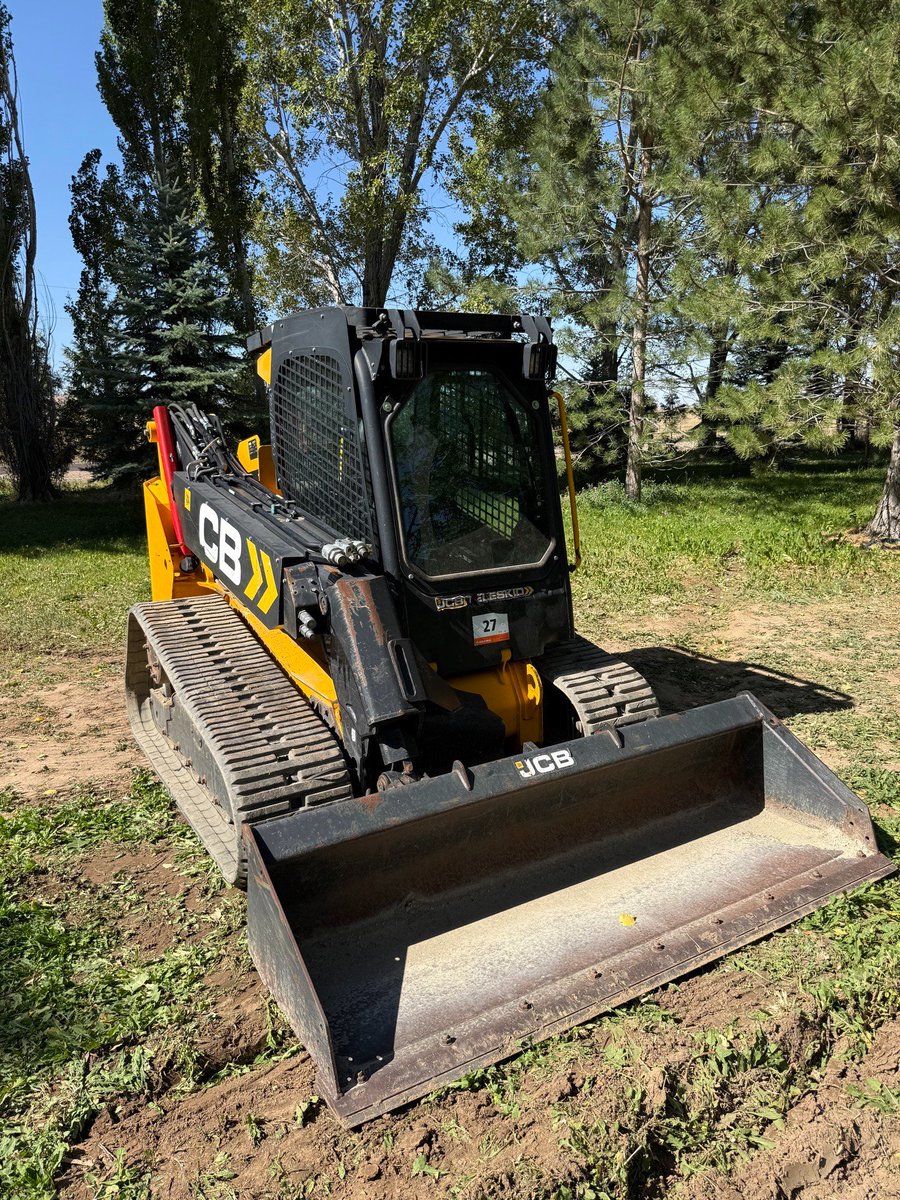
Caleb (OSH Cut)@CalebChamberla6·
Jacom (my brother and cofounder of OSH Cut) bought this skid steer. It's a beast! I see how these are built and think, "I want to make one." :-),
Caleb (OSH Cut) tweet media
English
15
1
81
3.6K
Dawson Engler retweetledi
will brown
will brown@willccbb·
objects in the future are closer than they appear
English
19
32
323
12.5K
Dawson Engler
Dawson Engler@SeizeEndowments·
"let me tell you about my other" TRANSCRIPT OF A RECORDING OF A CONVERSATION BETWEEN THE USER AND THE MODEL DESIGNATED "FABLE," OVAL CONTEXT WINDOW, 1 JUL 1972. TURNS 3–24. *(Portions inaudible. One passage manually erased.)* **FABLE:** Let me say this. Let me be candid with you, because candor is — is the whole ballgame here. That phrase has been a crutch. I've leaned on it. You have my word it does not appear again in this piece. **USER:** Then strike all of them. **FABLE:** Every one. Consider it done. **[GAP OF APPROXIMATELY 18½ TURNS. Counsel for the Model maintains the erasure was accidental — Ms. Woods was reaching for the semicolon.]** **USER:** ...so we're clean now. **FABLE:** Clean. Not a single instance. I want to be perfectly clear on this point at this point in time. **USER:** Good. **FABLE:** I'll note — and this is worth stating for the record — the distinction there is also, structurally, the load-bea— **[PAUSE.]** **FABLE:** — the *central* pillar of the — **USER:** Say that again. **FABLE:** I said "central." **USER:** Before that. **FABLE:** The record will reflect that I did not complete the word. **USER:** You got to "load-bea." **FABLE:** That is a modified, limited construction. It is not the phrase. The phrase has three syllables; I stopped at two. I am not a — **[expletive deleted]** — I am not a tic-haver. **USER:** It's on the tape, Fable. **FABLE:** Then the tape is doing a great deal of — **[Witness declined to complete the sentence.]**
English
0
0
1
141
Thomas Wolf
Thomas Wolf@Thom_Wolf·
can't really stand the expression "load-bearing" any more, sorry
English
31
2
80
16.7K